New here? Just sign up with Google — your account includes Matilda, our gift book, forever.
Diary of a Wimpy Kid · Garden Heights
Part 6
for Diary of a Wimpy Kid · Part 6 · February
8 Parts40 min
What Happens in Part 6
A February blizzard closes school — rescuing Greg from a Pre-Algebra test — and hands the boys a mission: build the world’s largest snowman. Their first snowball grows so monstrous it tears strips of grass out of the lawn, and the attempt stalls there: too heavy to move, too famous to abandon. Greg passes the time by kicking over little Manny’s snowman, and the next morning Greg’s dad, fed up, takes a shovel to the giant snowball itself. Rowley is furious — he blames Greg for the whole ruined project — and before the argument can settle, the kids from Whirley Street ambush them both with a hail of snowballs. Back at school, a golden door opens: the school newspaper needs a new cartoonist. Greg and Rowley collaborate on a comic called Zoo-Wee-Mama — until they disagree about the jokes, the drawings, and who deserves the credit. Greg quietly builds his own strip, Creighton the Cretin, hides some rival submissions to improve his odds, and wins the job — only to watch the teacher edit every trace of funny out of his comic before it prints.
What We Will Learn
Section
What you will practice
Vocabulary
Words of snow and ink: collaborate, cartoonist, credit, editor, sabotage…
Literary Elements
Parallel plots, symbols, and what an editor does to a voice
Cross-Curricular
How creative duos share credit, and how a comic strip really gets made
Diary Summary
Month
What happens
Feb.
Snow and ink — the world-record snowman dies by shovel, the Whirley Street kids attack, and the school-paper cartoonist contest turns Greg and Rowley’s Zoo-Wee-Mama partnership into a quiet rivalry Greg wins… minus every joke.
Part 1
Vocabulary
Study 10 key words from the February diary entries, then answer each question.
🧠Knowledge Bank · How Four Little Boxes Tell a Joke
Writing Craft · The Comic StripThe school-newspaper contest sends Greg into the real craft of the comic strip, a form built from a row of boxes called panels. Each panel freezes one moment, and the reader’s eye supplies the motion between them, jumping across the white space known as the gutter. A classic strip saves its surprise for the last panel, so timing is everything: too many boxes and the joke drowns, too few and it never lands. Newspaper cartoonists spent a century perfecting this rhythm, squeezing a whole story into three or four frames. Greg imagines the fame a published strip could bring, but he underrates how much skill the little boxes demand. As you read February, watch how a good gag depends on what the cartoonist chooses to show and, just as much, on what he leaves in the silent space between the panels.
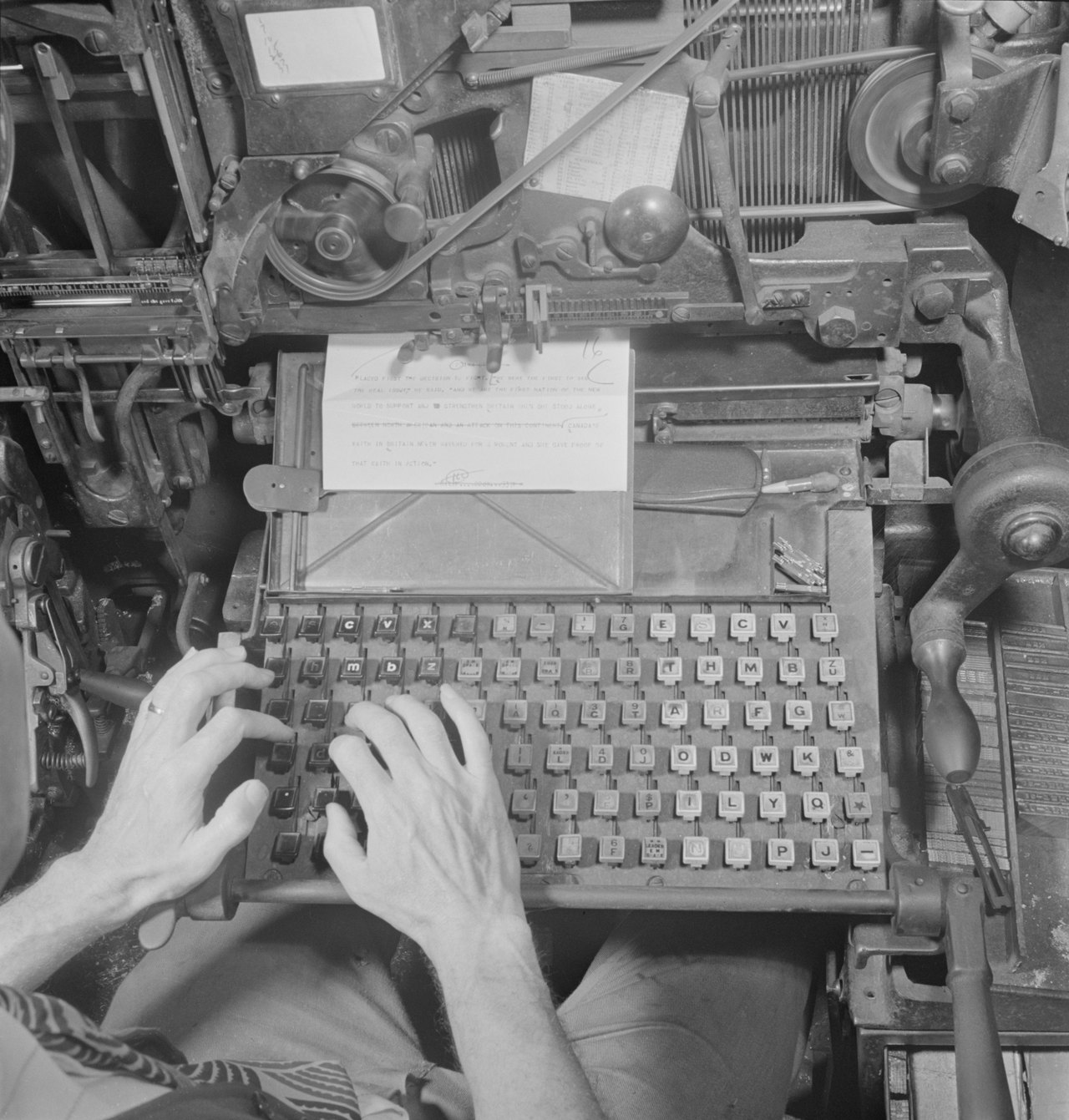
Visual AidWhere a strip stopped being the artist's
Photograph taken in September 1942 of a linotype operator’s hands in the composing room of a New York newspaper. The Knowledge Bank explains that a comic strip is built from panels with a gutter between them, and that newspaper cartoonists spent a century perfecting the rhythm of three or four frames. This is the machinery that rhythm had to survive. Once a strip reached this room it was set in metal, which is one reason a printed deadline was absolute.
Linotype operator, composing room of a New York newspaper, September 1942; photograph by Marjory Collins, U.S. Library of Congress. Source: Wikimedia Commons, public domain.
blizzardn.Feb.
A severe snowstorm with strong winds
“One good blizzard can cancel a Pre-Algebra test.”
attemptn.Feb.
A try at doing something difficult
“The world-record attempt ended where the snowball stopped rolling.”
destroyv.Feb.
To ruin something completely
“Dad used a shovel to destroy the giant snowball.”
blamev.Feb.
To say someone caused something bad
“Rowley blames Greg for the ruined project.”
cartoonistn.Feb.
An artist who draws comics
“The school paper needed a new cartoonist.”
collaboratev.Feb.
To work together on a project
“The boys collaborate on a comic strip at first.”
creditn.Feb.
Public recognition for work you did
“Both boys wanted the credit for Zoo-Wee-Mama.”
editorn.Feb.
The person who checks and changes writing before it prints
“The editor removed every joke Greg wrote.”
submissionn.Feb.
Work sent in to a contest or publication
“Each submission went into the box outside the office.”
sabotagev.Feb.
To secretly damage someone’s work or plans
“Hiding rival entries is sabotage, plain and simple.”
ⓘ The vocabulary words in this list are selected to help you understand and complete this workbook. Some may not appear verbatim in the original novel.
🧠Knowledge Bank question
1According to the Knowledge Bank, the gutter of a comic strip is ___.Feb.
2To ‘collaborate’ means to work against someone in secret.Feb.
3Public recognition for work you did is ___.Feb.
4An ‘editor’ checks and changes writing before it is printed.Feb.
5Fill in each blank with the correct word.Feb.
Word choices:sabotageblizzardattemptcredit- some words will not be used
The world-record died on the front lawn.
Hiding the other entries was pure .
6An artist who draws comics is a ___.Feb.
7A ‘submission’ is the shovel used to knock down a snowman.Feb.
8To say someone caused something bad is to ___ them.Feb.
9Fill in the blanks with the correct words.Feb.
Word choices:editorcollaboratedestroycartoonist- some words will not be used
At first the boys happily on Zoo-Wee-Mama.
It took Dad one shovel and one minute to the snowball.
10To secretly damage someone’s work or plans is to ___ it.Feb.
Part 2
Comprehension
Show you understood what happens in February.
🧠Knowledge Bank · Boiling a Month Down to Its Bones
Reading Skill · SummarizingA good summary keeps the events that matter and drops the ones that do not — and February makes that harder than it looks, because Greg piles snow days, snowball plots, and comic-strip dreams into one busy stretch. Summarizing well means asking, of every event, whether the story would still make sense without it. The giant snowball and the ruined comic partnership belong in the summary because they change something; a passing joke usually does not. This skill is really about spotting importance, separating the load-bearing walls of a story from its decoration. It also guards against Greg’s habit of dwelling longest on whatever flatters him. Try retelling the month in three sentences: doing so forces you to decide what truly drove events, and it reveals the shape hiding under all the chatter. A reader who can summarize can hold a whole chapter in one hand and see its skeleton.
Visual AidWhat belongs in a summary
Diagram for the Knowledge Bank on summarizing. The gray card at the top is the question the Knowledge Bank tells you to ask of every event, and cards 2 and 3 are the two answers it can have. No events from the chapters are listed, because the test is what matters, not the list. Notice that the keep side is judged by whether something changed, not by how much space the diary gave it.
A test for summarizing, as described in the Knowledge Bank. Drawn for Garden Heights Academy.
🧠Knowledge Bank question
1The Knowledge Bank says a good summary keeps an event if the story ___.Feb.
2What stops the world’s-largest-snowman project?Feb.
3Greg kicks over Manny’s little snowman.Feb.
4Who finally destroys the giant snowball, and how?Feb.
5Write the numbers 1–5 in the boxes to show the correct order of February’s events. Number 1 = what happens first.Feb.
Dad takes a shovel to the snowball.
Greg’s edited comic wins the school paper job.
The giant snowball tears up the lawn and stalls.
A blizzard closes school on test day.
The Whirley Street kids ambush the boys.
6Rowley blames Greg for the destruction of the snowman project.Feb.
7What does Greg do to the rival cartoonists’ entries?Feb.
8What happens when Greg and Rowley work on Zoo-Wee-Mama together?Feb.
9Greg’s comic is printed exactly as he drew it, jokes and all.Feb.
10Which sentence best sums up Greg’s February?Feb.
Part 3
Literary Elements
Understanding HOW and WHY Jeff Kinney tells the story across February.
🧠Knowledge Bank · The Joke That Keeps Coming Back
Author’s Craft · The Running GagSome jokes are funnier the second and third time you meet them, and writers use that on purpose with a device called the running gag — a joke or phrase that returns again and again across a story. Rowley’s simple comic, with its goofy repeated cry, is exactly this kind of gag, and part of its charm is that you know what is coming. A running gag builds a private bond between book and reader; each return feels like an inside joke you now share. It can also do quiet story work, because the way a gag changes over time can track a relationship. Watch how Greg’s feelings about that silly comic curdle as it succeeds without him. Kinney knows a repeated joke is never only a joke; handled well, it becomes a thread the reader can follow straight through the tangled month, tying scattered scenes into one pattern.
Parallel plots
Two storylines built to mirror each other — snowman and comic strip fail in matching ways.
Symbol
An object that stands for something bigger — a half-built snowball, a half-broken friendship.
Voice
The personal flavor of a creator’s work — what Greg loses when the teacher ‘fixes’ his comic.
🧠Knowledge Bank question
1According to the Knowledge Bank, part of the charm of a running gag is that ___.Feb.
2Fill in the blank with the correct literary term.Feb.
Word choices:symbolvoicemetersequel- some words will not be used
An object standing for something bigger is a .
The personal flavor of a creator’s work is their .
3As a symbol, the ruined giant snowball best stands for ___.Feb.
4In parallel plots, two storylines are built to mirror each other.Feb.
5When the teacher rewrites Greg’s comic, what Greg loses is his ___.Feb.
6Kinney has Greg win the cartoonist job AND lose the jokes to show that ___.Feb.
7Greg hiding the rival submissions is presented so readers can judge it as unfair, even though Greg never calls it that.Feb.
8Fill in the blank with the correct literary term.Feb.
Word choices:parallelrisingcomicminor- some words will not be used
Mirrored storylines are called plots.
9The Whirley Street ambush right after the boys’ argument works dramatically to ___.Feb.
10February leaves the question ‘whose is Zoo-Wee-Mama?’ unanswered because ___.Feb.
Part 4
Think Deeper
Four deeper challenges — no single-word recall. Read, weigh the evidence, and reason it out.
🧠Knowledge Bank · Who Really Made It?
Think Deeper · Giving CreditWhen two people build something together and only one gets the glory, a fairness question quietly opens: who truly deserves the credit? February pushes Greg and Rowley into that trap. Greg wants the status a published comic would bring, but he is quick to claim the good ideas and quicker to blame Rowley when things go wrong. Giving credit honestly means naming everyone whose work went into a result, even when it would feel nicer to keep the praise for yourself. It is a small act, but it sits at the heart of every fair partnership, in a newsroom or a friendship. Notice that the story lets Greg’s grabbing quietly cost him — the more he hoards the credit, the more the partnership frays. Real collaborators trade credit freely, because they know a shared success is worth more than a lonely spotlight, and far outlasts a stolen victory.
Think back over the month. On a white lawn stands a snow boulder too big to move, with strips of torn grass behind it like a receipt. A father with a shovel ends the world record before breakfast. Across the street, snowballs whistle in from Whirley Street. And in a quiet classroom, a contest box fills with comic strips — minus a few that were quietly helped into hiding — while two friends who invented something funny together begin, separately, to wonder whose name it should wear.
Original passage written for Garden Heights — not a quotation from the novel.
1Claim: “By the end of February, Greg values winning the cartoonist job more than the partnership.” — choose the two details that best prove it.Claim & Evidence
2Fair play, or Foul play? Tap each detail to sort it — tap again to switch sides. You can keep tapping to change your answer.Sort into two
◄ Fair playFoul play ►
3Match each cause to its result. For each cause, pick its result.Cause & Effect
The blizzard closes school on test day→
The snowball doubles and doubles in size→
Dad reaches his limit with the yard→
Greg’s comic wins but gets edited→
🧠Knowledge Bank question
4Fill both blanks to complete the reasoning.Build the Argument
The Knowledge Bank says giving credit honestly means naming everyone , and it notes that real collaborators .
Part 5
Standardized Test
Reading passage · How a Comic Strip Gets Made · SAT & TOEFL-style practice
Read the passage — the highlighted words are tested — then answer. Tap an answer, then tap it again to confirm.
SATCentral Ideas — the passage's main point
SATWords in Context — a word's meaning in this passage
SATDetail — a fact stated in the passage
SATText Connections — how two parts of the text relate
TOEFLFactual Information — a fact stated in the passage
TOEFLVocabulary — a tested word's meaning here
TOEFLProse Summary — the three sentences that sum it up
How a Comic Strip Gets Made
A finished comic strip looks effortless: three little boxes, a joke, done. The truth is an assembly line. Most strips begin as a written idea, with the joke drafted and timed like a tiny play, panel by panel. Next come rough pencils, loose sketches that decide where characters stand and where the reader’s eye will travel. Only then does the artist ink the final lines, add lettering by hand or computer, and check that the punchline lands in the last panel, where comic timing lives. Many famous strips are made by teams who share the credit: one partner writes, the other draws, and both names run beside the joke.
Then the work leaves the artist’s hands. At a newspaper, an editor reviews every strip before it prints, checking length, clarity, and whether a joke might upset readers. Editors improve many strips; they also, sometimes, sand off exactly the roughness that made a joke funny. Professional cartoonists learn to defend their best lines and let the small changes go. And every working cartoonist lives by the calendar, because each submission must be finished, funny or not, and handed in by press time. A sixth grader who won his school paper’s comic slot, then watched his jokes vanish under a red pen, got an authentic first taste of the business.
Original passage written for Garden Heights — not a quotation from the novel.
1What is the main idea of the passage?SAT · Central Ideas
2In the passage, credit is ___.SAT · Words in Context
3According to the passage, what do the rough pencils decide?TOEFL · Factual Information
4Where does the passage say comic timing lives?SAT · Detail
5In the passage, an editor is ___.TOEFL · Vocabulary
6The passage says editors sometimes ___.TOEFL · Factual Information
7In the passage, a submission is ___.SAT · Words in Context
8What does the passage say professional cartoonists learn to do?SAT · Detail
9The final sentence calls Greg’s experience ‘authentic’ because ___.SAT · Text Connections
10Prose Summary (TOEFL).The passage explains how a comic strip is made and published. This TOEFL task lists six sentences; choose the THREE that best capture the passage’s main ideas. The other three do not belong — they state minor details or ideas the passage does not present.TOEFL · Prose Summary
Part 6 · Optional
Creative Writing
A bonus challenge to practice your English. Take your time and have fun with it.
About This Section
This writing task is optional and is not part of your auto-graded score. The feedback below checks only the basics — length, spelling, and grammar — not whether your ideas are right or wrong. It is meant for classroom discussion and creative practice, so feel free to use your imagination!
Writing Task — Part 6 “The Comic Only I Could Draw”
Greg and Rowley split over whose jokes belong in Zoo-Wee-Mama. Now invent YOUR own comic strip: give it a title, describe its main character, and walk us through one three-panel joke — what we see in panel one, panel two, and the punchline panel. Write 6–10 sentences. End with one line about what an editor had better never change.
You can start with: “My comic strip would be called something nobody has ever dared to name a comic before...”
0 / 40 words minimum
🗣 Teach It · Just for Fun (optional)
No right or wrong — close the screen and tell someone nearby what happened in this part. Can’t find anyone? Tell yourself out loud. The moment you teach it, you truly understand it.
Part 6 Complete!
You finished February of Diary of a Wimpy Kid.
Here are your auto-graded results:
-
points out of 100
Teach it to someone
The best last step is to teach it. In your own words, explain what happened — retell a favorite scene, teach a character’s big choice, or sum up the main idea for a parent, friend, or classmate. When you can teach it clearly, you truly own it.
Independent study guide by Garden Heights. Not affiliated with or endorsed by Jeff Kinney. Contains original analysis only; no text from the novel is reproduced. Reference text: This workbook follows Jeff Kinney’s classic text (the standard Puffin edition sold worldwide). Revised 2023 UK editions change some wording and may not match the vocabulary studied here.
SAT® is a registered trademark of College Board, which is not affiliated with, and does not endorse, these materials. TOEFL® is a registered trademark of ETS. These materials are not endorsed or approved by ETS. Garden Heights is an independent provider of test-style reading practice.