New here? Just sign up with Google — your account includes Matilda, our gift book, forever.
Diary of a Wimpy Kid · Garden Heights
Part 7
for Diary of a Wimpy Kid · Part 7 · March – April
8 Parts40 min
What Happens in Part 7
In March, Rowley is called to the principal’s office, accused of ‘terrorizing’ the kindergartners he walks home on Safety Patrol duty. The reader knows what the school does not: the culprit was Greg, who covered that shift wearing Rowley’s borrowed coat and chased the little kids with worms — and a neighborhood woman who saw it reported the boy in Rowley’s coat. Greg weighs confessing, thinks hard about his free hot chocolate, and decides silence is golden. His advice to the accused: be more careful about lending out your coat. An anonymous tip soon names the real culprit; Greg is thrown off the patrol while Rowley — cleared and vindicated — gets promoted. The friendship goes into deep freeze. Through April, Rowley hangs out with Collin Lee — Greg’s so-called backup friend — and Greg, desperate for company, invites himself to a sleepover at Fregley’s. It goes exactly as badly as you imagine: jellybeans vanish, a booger is brandished, and Greg flees into the night. By late April, Greg gives up on repairing anything and aims instead at the yearbook’s Class Favorites page: one great prank, he calculates, and the title of Class Clown is his.
What We Will Learn
Section
What you will practice
Vocabulary
Words of the falling-out: accuse, confess, anonymous, loyal, prank…
Literary Elements
Dramatic irony, the turning point, and the narrator’s excuses
Cross-Curricular
How trust breaks, and what science says makes an apology work
Diary Summary
Month
What happens
Mar.
The accusation — Rowley takes the blame for Greg’s worm-chasing in the borrowed coat; Greg stays silent, an anonymous tip outs him, and Rowley is promoted while Greg is expelled from the patrol.
Apr.
The freeze — Rowley upgrades to Collin Lee; Greg endures the Fregley sleepover, escapes by night, and pivots to winning Class Clown in the yearbook.
Part 1
Vocabulary
Study 10 key words from the March – April diary entries, then answer each question.
🧠Knowledge Bank · Why Betrayal Cuts So Deep
Social Science · The Science of TrustFriendship runs on an invisible fuel called trust — the quiet belief that a friend will look out for you when it counts. Scientists who study relationships find that trust is built slowly, through many small kept promises, and shattered quickly, through a single broken one. That imbalance explains why betrayal stings far more than an insult from a stranger; the pain is measured against how much you relied on the person. In these chapters, the safety-patrol trouble forces the issue: when blame lands, does Greg shield Rowley, or let his friend carry it alone? A stranger owes you little, but a friend owes you loyalty, so the fall feels steeper. Repairing broken trust is slow and uncertain work, which is why wise people guard it carefully. The story is quietly teaching that trust is a friendship’s most valuable and most fragile possession.
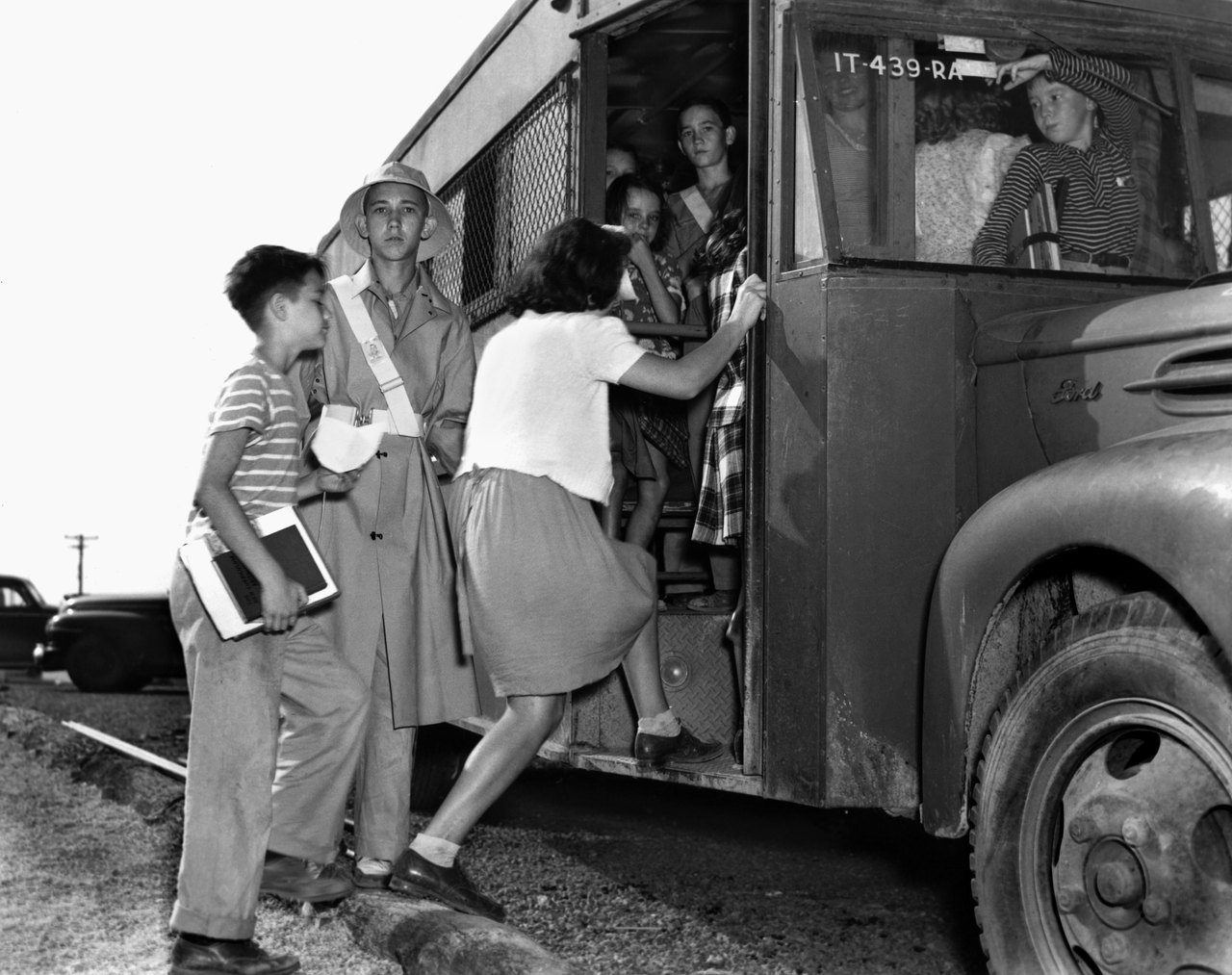
Visual AidChildren trusted with other children
Photograph taken in September 1944 of a school safety patrol at Highland View School in Oak Ridge, Tennessee. The Knowledge Bank explains that trust is built slowly through many small kept promises and shattered quickly by a single broken one, and that a friend owes you loyalty where a stranger owes you little. The white belt is the whole idea in one object: an ordinary pupil, given a job that only works if everyone believes he will do it.
School safety patrol at Highland View School, Oak Ridge, Tennessee, September 1944; photograph by Ed Westcott for the U.S. Department of Energy. Source: Wikimedia Commons, public domain.
accusev.Mar.
To say someone did something wrong
“The school accuses Rowley of scaring the kindergartners.”
culpritn.Mar.
The person who actually did the wrong thing
“The real culprit was wearing a borrowed coat.”
confessv.Mar.
To admit you did something wrong
“Greg considers whether to confess — briefly.”
anonymousadj.Mar.
From a person whose name is not known
“An anonymous tip finally names the real culprit.”
promotev.Mar.
To move someone up to a higher position
“The patrol promotes Rowley once his name is cleared.”
loyaladj.Apr.
Faithfully standing by someone
“A loyal friend would have spoken up at once.”
avoidv.Apr.
To stay away from someone or something
“Rowley goes out of his way to avoid Greg.”
desperateadj.Apr.
Willing to try anything because nothing is left
“Only a desperate boy sleeps over at Fregley’s.”
apologizev.Apr.
To say you are sorry for something you did
“Greg never quite manages to apologize.”
prankn.Apr.
A playful trick played on someone
“One legendary prank should clinch Class Clown.”
ⓘ The vocabulary words in this list are selected to help you understand and complete this workbook. Some may not appear verbatim in the original novel.
🧠Knowledge Bank question
1According to the Knowledge Bank, trust is built ___.Mar.
2The ‘culprit’ is the person who actually did the wrong thing.Mar.
3A tip ‘from a person whose name is not known’ is ___.Mar.
4To ‘confess’ means to blame someone else for your mistake.Mar.
5Fill in each blank with the correct word.Mar.–Apr.
Word choices:loyalprankpromoteavoid- some words will not be used
A friend speaks up when you are wrongly accused.
After the truth comes out, Rowley starts to Greg completely.
6Willing to try anything because nothing else is left is ___.Apr.
7To ‘promote’ someone is to move them down to a lower position.Mar.
8A playful trick played on someone is a ___.Apr.
9Fill in the blanks with the correct words.Mar.–Apr.
Word choices:anonymousculpritdesperateapologize- some words will not be used
An source finally tells the school the truth.
The real loses his spot on the Safety Patrol.
10To say you are sorry for something you did is to ___.Apr.
Part 2
Comprehension
Show you understood what happens in March – April.
🧠Knowledge Bank · Reading the Road Ahead
Reading Skill · Making PredictionsA prediction is a reader’s forecast of what will happen next, built from patterns the story has already shown. By March, Greg has given you plenty of pattern to work with: again and again he protects himself first, so when the safety-patrol blame starts falling, an alert reader can guess which way he will lean. Good predicting is not wild guessing; it draws on evidence from earlier chapters plus what you know about how people behave. When your prediction comes true, you understand the character more deeply; when it is wrong, the surprise teaches you something you had missed. Either way, predicting keeps you leaning into the page, testing your read of Greg against what he actually does. Try pausing before each turning point to ask what a boy this careful with his own reputation is most likely to choose.
🧠Knowledge Bank question
1The Knowledge Bank says good predicting draws on evidence from earlier chapters plus ___.Mar.
2Who actually chased the kindergartners — and with what?Mar.
3The neighborhood woman who reported the incident believed she was reporting Rowley.Mar.
4Why does Greg decide not to confess?Mar.
5Write the numbers 1–5 in the boxes to show the correct order of events in March–April. Number 1 = what happens first.Mar.–Apr.
Rowley is called to the office and accused.
Greg survives half a sleepover at Fregley’s.
Rowley is promoted; Greg is off the patrol.
Greg chases the kindergartners wearing Rowley’s coat.
An anonymous tip names the real culprit.
6When the truth comes out, Greg and Rowley are both removed from the Safety Patrol.Mar.
7Who does Rowley spend his time with in April?Apr.
8How does the Fregley sleepover end?Apr.
9By late April, Greg focuses on winning Class Clown on the yearbook’s Class Favorites page.Apr.
10What finally pushes Rowley to end the friendship?Mar.
Part 3
Literary Elements
Understanding HOW and WHY Jeff Kinney tells the story across March – April.
🧠Knowledge Bank · Knowing More Than the Characters
Author’s Craft · Dramatic Irony Because Greg confides everything to his diary, the reader often knows a secret the other characters do not — and that gap is the engine of dramatic irony, which happens when the audience sees what a character on the page cannot. During the safety-patrol mess, we know the real story of who did what, while the adults and classmates know only part. That knowledge changes how we read every scene; we watch Rowley trust Greg and we wince, because we can see the letdown coming. Dramatic irony pulls a reader emotionally into a story, turning us into helpless witnesses who long to shout a warning through the page. Watch for the moments when you understand a scene better than the people living it, because that is where Kinney makes you feel the true cost of Greg’s silence.
Visual AidWho knows what, and when
Diagram for the Knowledge Bank on dramatic irony. Card 1 is the reader, who has read the diary, card 2 is everyone else in the story, and card 3 is what the difference does to us. The short dotted line is the gap the Knowledge Bank describes. Notice the arrows point down into the reader’s discomfort rather than into the plot, because dramatic irony changes how a scene feels, not what happens.
Dramatic irony as described in the Knowledge Bank. Drawn for Garden Heights Academy.
Dramatic irony
Readers know a truth the characters don’t — we saw who wore the coat.
Turning point
The moment after which nothing goes back to normal — Greg’s silence in March.
Rationalization
The excuses a narrator builds to make a wrong choice sound reasonable — Greg’s specialty.
🧠Knowledge Bank question
1According to the Knowledge Bank, dramatic irony happens when the audience ___.Mar.
2Fill in the blank with the correct literary term.Mar.
Word choices:ironyrationalizationsimilechorus- some words will not be used
When readers know what characters don’t, that is dramatic .
An excuse dressed up as good sense is a .
3Greg framing his silence as ‘protecting his privileges’ is an example of ___.Mar.
4The office scene works as a turning point because the friendship never returns to normal afterward.Mar.
5Greg advising Rowley to ‘be more careful with your coat’ instead of confessing is ___.Mar.
6Kinney sends Greg to Fregley’s sleepover right after losing Rowley to show ___.Apr.
7Dramatic irony means the characters know more than the readers do.Mar.
8Fill in the blank with the correct literary term.Mar.
Word choices:turningfallingopeningclosing- some words will not be used
The moment after which nothing returns to normal is the point.
9After the friendship freezes, Greg’s pivot to the Class Favorites page shows that he ___.Apr.
10Kinney tells the whole coat incident only through Greg’s self-serving entries, so readers must ___.Mar.
Part 4
Think Deeper
Four deeper challenges — no single-word recall. Read, weigh the evidence, and reason it out.
🧠Knowledge Bank · When Saying Nothing Is a Choice
Think Deeper · Honesty There is a kind of dishonesty that never speaks a single false word: staying silent while someone else takes the blame you have earned. When Rowley is punished for something Greg had a hand in, Greg’s quiet is not innocent — a choice to say nothing is still a choice. Honesty, it turns out, is not only about avoiding lies; it is about owning the truth even when no one demands it of you. Greg comforts himself that he did not technically lie, but the story lets us feel the gap between that thin excuse and real integrity, which means letting your actions and your words match. As you read, weigh what Greg gains against what he lets his friend lose, because silence that saves you and sinks a friend is not neutral at all — it is a quiet betrayal.
Think back over these months. A woman at a window watches a boy in a familiar coat chase shrieking kindergartners with a fistful of worms — and reports the coat’s owner. In an office, the wrong boy sits red-faced under a poster about honesty. Somewhere nearby, the right boy weighs the truth against a cup of hot chocolate, and chooses quietly, and says nothing. Spring arrives. One boy walks home with a new friend. The other spends a long night at Fregley’s house, backed against a door, negotiating with a booger.
Original passage written for Garden Heights — not a quotation from the novel.
1Claim: “It was the cover-up, not the prank, that ended the friendship.” — choose the two details that best prove it.Claim & Evidence
2What a loyal friend does, or What Greg does? Tap each detail to sort it — tap again to switch sides. You can keep tapping to change your answer.Sort into two
◄ What a loyal friend doesWhat Greg does ►
3Match each cause to its result. For each cause, pick its result.Cause & Effect
Greg covers the shift in Rowley’s coat→
Greg protects his perks with silence→
An anonymous tip reaches the school→
Rowley’s name is finally cleared→
🧠Knowledge Bank question
4Fill both blanks to complete the reasoning.Build the Argument
The Knowledge Bank says there is a dishonesty that never speaks a false word: , because honesty means .
Part 5
Standardized Test
Reading passage · Why Apologies Work · SAT & TOEFL-style practice
Read the passage — the highlighted words are tested — then answer. Tap an answer, then tap it again to confirm.
SATCentral Ideas — the passage's main point
SATWords in Context — a word's meaning in this passage
SATDetail — a fact stated in the passage
SATText Connections — how two parts of the text relate
TOEFLFactual Information — a fact stated in the passage
TOEFLVocabulary — a tested word's meaning here
TOEFLRhetorical Purpose — why the author included a detail
The Anatomy of a Real Apology
Scientists who study forgiveness have taken apologies apart the way mechanics take apart engines, and they find the same three parts in every one that works. First, name the harm plainly: say what you did, without hiding it in soft words. Second, confess your own part: the cause was your choice, not the weather, not bad luck, not the other person. Third, offer repair: show what you will do to make it right. Apologies missing a part tend to fail, and one famous type fails hardest. The non-apology, which says sorry you were upset or mistakes were made, quietly hands the blame back to the injured person, and studies show it often leaves people angrier than no apology at all.
Why does the real thing work? Researchers describe the trust between loyal friends as an account that wrongdoing overdraws. A true apology, one that costs the apologizer something, whether pride, comfort, or a confession in a principal’s office, makes a deposit big enough to restore the balance, because the cost is the proof. Cheap words prove nothing. That is worth remembering when a certain sixth grader, watching his best friend take the blame for the worm incident, offers the injured party his very best advice: be more careful about lending out your coat.
Original passage written for Garden Heights — not a quotation from the novel.
1What is the main idea of the passage?SAT · Central Ideas
2In the passage, to confess your part is to ___.SAT · Words in Context
3According to the passage, which of these is a ‘non-apology’?TOEFL · Factual Information
4The passage says non-apologies often leave people ___.SAT · Detail
5In the passage, loyal friends are ___.SAT · Words in Context
6According to paragraph 2, what makes an apology’s deposit ‘big enough’?TOEFL · Factual Information
7In the passage, restore most nearly means ___.TOEFL · Vocabulary
8The passage compares trust between friends to ___.SAT · Detail
9The final sentence calls Greg’s coat advice ‘his very best’ as a form of ___.TOEFL · Rhetorical Purpose
10Based on the passage, what would a WORKING apology from Greg have required?SAT · Text Connections
Part 6 · Optional
Creative Writing
A bonus challenge to practice your English. Take your time and have fun with it.
About This Section
This writing task is optional and is not part of your auto-graded score. The feedback below checks only the basics — length, spelling, and grammar — not whether your ideas are right or wrong. It is meant for classroom discussion and creative practice, so feel free to use your imagination!
Writing Task — Part 7 “The Apology I Should Have Given”
Greg never apologizes to Rowley — he offers coat advice instead. Think of a time you owed someone an apology (big or small, real or imagined). Now write the FULL apology the passage describes: name what you did, take responsibility without excuses, and offer a repair. Then add two or three sentences about why saying it would have been hard. 6–10 sentences total.
You can start with: “This is the apology I should have said out loud, and here it is, complete...”
0 / 40 words minimum
🗣 Teach It · Just for Fun (optional)
No right or wrong — tell someone nearby what happened in this part. Can’t find anyone? Tell yourself out loud. The moment you teach it, you truly understand it.
Part 7 Complete!
You finished March – April of Diary of a Wimpy Kid.
Here are your auto-graded results:
-
points out of 100
Teach it to someone
The best last step is to teach it. In your own words, explain what happened — retell a favorite scene, teach a character’s big choice, or sum up the main idea for a parent, friend, or classmate. When you can teach it clearly, you truly own it.
Independent study guide by Garden Heights. Not affiliated with or endorsed by Jeff Kinney. Contains original analysis only; no text from the novel is reproduced. Reference text: This workbook follows Jeff Kinney’s classic text (the standard Puffin edition sold worldwide). Revised 2023 UK editions change some wording and may not match the vocabulary studied here.
SAT® is a registered trademark of College Board, which is not affiliated with, and does not endorse, these materials. TOEFL® is a registered trademark of ETS. These materials are not endorsed or approved by ETS. Garden Heights is an independent provider of test-style reading practice.