New here? Just sign up with Google — your account includes Matilda, our gift book, forever.
The Miraculous Journey of Edward Tulane · Garden Heights
Part 6
for The Miraculous Journey of Edward Tulane · Part 6 · Chapters 20–22
8 Parts40 min
What Happens in Part 6
Sarah Ruth gives the rabbit his fifth name — Jangles — and gives him something greater: he becomes the most precious thing in her small world. Her days are hard; a deep cough shakes her little body, and the children’s father is a harsh, mostly absent man. But the cabin has its own medicine. Bryce tends his sister like a parent, plays his harmonica in the evenings, and rigs strings to the rabbit’s arms so that Jangles dances for her in the firelight — and Sarah Ruth laughs, and rocks him, and holds him through every night. Edward, held so hard and needed so much, learns the deepest lesson yet: being loved is work, and worth everything. Then comes the night the coughing wins. Sarah Ruth dies with the rabbit in her arms, and a great hush falls over the cabin. When the grief and the shouting are done, Bryce packs a small bundle, takes Jangles, and walks away from home for good — toward Memphis.
What We Will Learn
Section
What you will practice
Vocabulary
Words of the cabin’s music and sorrow: cough, harmonica, tend, precious, grief, hush…
Literary Elements
Tragedy told gently, the motif of music, and tone
Cross-Curricular
Why comfort objects truly help, and what a harmonica is
Chapter Summary
Ch.
What happens
20
Jangles — a fifth name, a dance on strings, and a place in Sarah Ruth’s arms.
21
The Cabin’s Music — harmonica evenings and firelight dances against a deepening cough.
22
The Hush — Sarah Ruth dies holding the rabbit; Bryce packs a bundle and walks toward Memphis with Jangles.
Part 1
Vocabulary
Study 10 key words from Chapters 20–22, then answer each question.
🧠Knowledge Bank · When Medicine Was Out of Reach
History · Sickness in the Hard YearsBryce carries Edward home to his little sister Sarah Ruth, who is gravely ill with a deep, rattling cough. In the 1930s, sicknesses of the lungs like this were common and often deadly, especially for poor families. There was no easy cure, and a visit from a doctor cost money that families like Bryce’s simply did not have. Children sometimes grew sicker in cold, crowded homes with too little food or warmth. Knowing this helps you understand why Sarah Ruth is so frail, and why Bryce is so desperate to bring her one small piece of joy. Against such hardship, a toy rabbit who can be made to dance becomes a gift more precious than any medicine.
Visual AidA cabin kitchen in the hard years
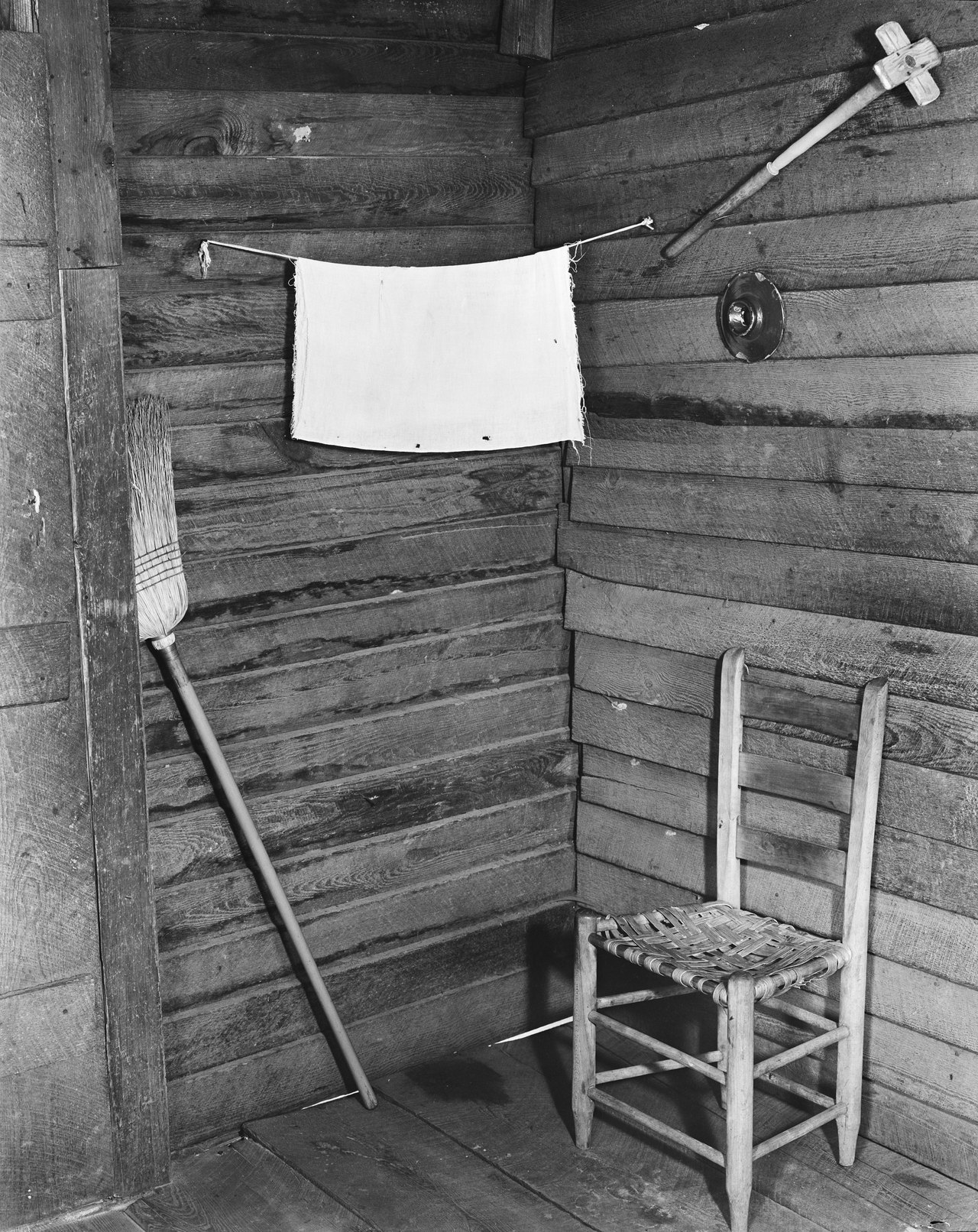
Photograph of the corner of a kitchen in a sharecropper’s cabin in Hale County, Alabama, taken by Walker Evans in 1936. Bare plank walls, one chair, a broom, a towel on a line: that is the whole room. The Knowledge Bank explains that in the 1930s a doctor’s visit cost money that families like Bryce’s did not have, and that children sometimes grew sicker in cold, crowded homes with too little food or warmth. This cabin belonged to a real Alabama family, not to Bryce and Sarah Ruth, and no one in it is sick. Notice the gaps between the boards — the cold the Knowledge Bank means came straight through walls like these.
Corner of the kitchen in Floyd Burroughs' cabin, Hale County, Alabama, 1936; photograph by Walker Evans, Farm Security Administration, Library of Congress. Source: Wikimedia Commons, public domain.
coughn.Ch.20–21
A harsh burst of air from sick lungs
“A deep cough shook her small body.”
harmonican.Ch.20
A small mouth organ played by breathing
“Bryce played his harmonica in the evenings.”
rockv.Ch.20
To sway gently back and forth
“She rocked the rabbit like a baby.”
harshadj.Ch.20–21
Rough, stern, and unkind
“The father was a harsh, absent man.”
tendv.Ch.21
To care for someone or something
“Bryce tended his sister like a parent.”
dancev.Ch.20
To move in rhythm, as to music
“On strings, Jangles danced in the firelight.”
preciousadj.Ch.20
Loved and valued above all
“Jangles was her most precious thing.”
griefn.Ch.22
Deep sorrow after a loss
“Grief filled every corner of the cabin.”
bundlen.Ch.22
Things wrapped together for carrying
“Bryce packed a small bundle and left.”
hushn.Ch.22
A sudden deep quiet
“A great hush fell over the cabin.”
ⓘ The vocabulary words in this list are selected to help you understand and complete this workbook. Some may not appear verbatim in the original novel.
🧠Knowledge Bank question
1According to the Knowledge Bank, a doctor's visit in the 1930s ___.Ch.20
2To ‘rock’ someone is to sway them gently back and forth.Ch.20
3Deep sorrow after a loss is called ___.Ch.22
4A ‘harsh’ person is warm, soft-spoken, and kind.Ch.20–21
5Fill in each blank with the correct word.Ch.20–21
Word choices:tendcoughharmonicarock- some words will not be used
A deep shook her small body.
Bryce would his sister like a parent.
6Loved and valued above everything else means ___.Ch.20
7A ‘hush’ is a sudden burst of loud noise.Ch.22
8Things wrapped together for carrying make a ___.Ch.22
9Fill in the blanks with the correct words.Ch.20–22
Word choices:precioushushgriefdance- some words will not be used
On his strings, Jangles would in the firelight.
A great fell over the cabin.
10To care for someone with attention is to ___ them.Ch.21
Part 2
Comprehension
Show you understood what happens in Chapters 20–22.
🧠Knowledge Bank · Love Shown, Not Spoken
Narrative Logic · Love Shown, Not SpokenOnce again the book asks us to infer — to read the love that hides beneath simple actions. Bryce does not make speeches about how much he cares for his sister; instead, he steals out at night to bring her Edward and works string after string to make the rabbit dance for her. Sarah Ruth, too weak for many words, shows her love by holding Edward close and naming him Jangles. Gather these small clues and add them up, and you will feel a fierce, tender devotion between a brother and sister who have almost nothing else. This is the reader’s real work: to notice that the biggest feelings often arrive in the smallest, quietest acts.
🧠Knowledge Bank question
1The Knowledge Bank says Bryce shows his love by ___.Ch.20
2How does Bryce make Jangles dance?Ch.20
3Sarah Ruth’s illness shows itself as a deep, shaking cough.Ch.20–21
4What is the children’s father like?Ch.20–21
5Write the numbers 1–5 in the boxes to show the correct order of events in Chapters 20–22. Number 1 = what happens first.Ch.20–22
Sarah Ruth dies with the rabbit in her arms.
Sarah Ruth names the rabbit Jangles and claims him.
The cough deepens despite all the cabin’s care.
Bryce packs a bundle and walks toward Memphis with Jangles.
Evenings of harmonica music and firelight dances.
6Edward resents being squeezed and clutched by the sick girl.Ch.20–21
7Who cares for Sarah Ruth day to day?Ch.21
8How does Sarah Ruth’s story end?Ch.22
9After her death, Bryce stays on at the cabin with his father.Ch.22
10Where do Bryce and the rabbit head at the part’s end?Ch.22
Part 3
Literary Elements
Understanding HOW and WHY Kate DiCamillo tells the story across Chapters 20–22.
🧠Knowledge Bank · The Feeling in the Room
Literary Craft · Tone & MoodTone is the feeling an author builds into a scene, and mood is how that feeling settles over the reader. In these chapters DiCamillo weaves two moods together at once: the sweet warmth of a sister’s love and the heavy shadow of her sickness. When Sarah Ruth laughs at Edward’s dancing, the room seems to glow; when she coughs, a cold worry creeps back in. This mixture of joy and sorrow is exactly what makes the writing so moving. Authors control tone through small details — a whisper, a shiver, a fading light. As you read, notice how your own heart lifts and tightens by turns, because that gentle rise and fall is the mood doing its quiet, powerful work.
Visual AidTwo moods in one room
Diagram for the Knowledge Bank on tone and mood. The two boxes are the two moods the Knowledge Bank says the author weaves together, the warmth of a sister’s laughter and the shadow of her cough; the red wave beneath is the rise and fall the Knowledge Bank says you feel in your own heart. It does not describe how the chapters end. Notice that the wave never stays high or low for long — that is the weaving.
Moods and their rise and fall as described in the Knowledge Bank. Drawn for Garden Heights Academy.
Tragedy
A loss no effort can prevent — told plainly and gently, without looking away.
Motif of Music
Handmade joy recurring against sorrow — harmonica evenings and a rabbit dancing on strings.
Tone
The telling’s quiet steadiness — no preaching, no wailing; the hush is allowed to speak.
🧠Knowledge Bank question
1According to the Knowledge Bank, these chapters weave together ___.Ch.22
2Fill in the blank with the correct literary term.Ch.20–22
Word choices:tonemotifsettingirony- some words will not be used
Music recurring against sorrow — harmonica, dancing strings — is a .
The telling’s quiet, steady voice is its .
3Why does DiCamillo let the firelight dances and the deepening cough share the same evenings?Ch.20–21
4The story’s tone turns loud and preachy at Sarah Ruth’s death.Ch.22
5Edward being present — held — at the death gives his journey ___.Ch.22
6The dancing rabbit — a toy made to move by a brother’s hands — works as a symbol of ___.Ch.20
7A gentle tone can make a tragedy hit harder than dramatic wailing.Ch.22
8Fill in the blank with the correct literary term.Ch.22
Word choices:tragedytoneflashbackdialogue- some words will not be used
A loss that no effort in the story could prevent is a .
9The father’s harshness beside Bryce’s devotion creates a contrast showing that ___.Ch.20–22
10DiCamillo includes a death in a children’s book — gently but truly — because ___.Ch.22
Part 4
Think Deeper
Four deeper challenges — no single-word recall. Read, weigh the evidence, and reason it out.
🧠Knowledge Bank · Loving What You May Lose
Social-Emotional · Love & GriefWith Sarah Ruth, Edward learns to love once more, even though part of him must sense how fragile she is. When she dies, the grief is real and deep — for Bryce, and for the rabbit who held her close. This is the tenderest lesson in the whole book: to love someone is to risk the pain of losing them, and yet the love is still worth it. A heart that stays open through sorrow is stronger, not weaker, than one that never dared to care at all. As you sit with this sad chapter, remember that Edward’s sorrow is itself proof of how far he has come. Grief is simply the shape that love takes when someone we cherish is gone.
Think back over the cabin evenings. A boy who works all day comes home to play doctor, cook, and puppeteer; a tin harmonica fills the room while a rabbit dances on strings and a little girl laughs between coughs. Every night she holds Jangles tighter. Then one night the music stops, and a hush comes down like snow — and a boy walks out of his childhood with a bundle, a harmonica, and the most precious thing his sister ever held.
Original passage written for Garden Heights — not a quotation from the novel.
1Claim: “Jangles gives Sarah Ruth something medicine could not.” — choose the two details that best prove it.Claim & Evidence
2What Bryce gives, or What the father gives? Tap each detail to sort it — tap again to switch sides. You can keep tapping to change your answer.Sort into two
◄ What Bryce givesWhat the father gives ►
3Match each cause to its result. For each cause, pick its result.Cause & Effect
Sarah Ruth’s days are pain and fever→
The rabbit is squeezed, rocked, and needed→
No doctor or medicine reaches the cabin→
The cabin holds nothing more for Bryce→
🧠Knowledge Bank question
4Fill both blanks to complete the reasoning.Build the Argument
The Knowledge Bank says to love someone is to , and grief is .
Part 5
Standardized Test
Why a Doll Helps · SAT & TOEFL-style practice
Read the passage — the highlighted words are tested — then answer. Tap an answer, then tap it again to confirm.
SATWords in Context — a word's meaning in this passage
SATDetail — a fact stated in the passage
SATText Connections — how two parts of the text relate
TOEFLFactual Information — a fact stated in the passage
TOEFLVocabulary — a tested word's meaning here
TOEFLProse Summary — the three sentences that sum it up
Why Comfort Objects Soothe Children
Doctors and nurses have long noticed something parents already knew: a sick or frightened child does better with a beloved object in her arms. Psychologists call these comfort objects — the worn teddy bear, the ragged blanket, the doll that must ride to the hospital too. The attachment a child forms to such an object is real and useful: the familiar softness stands in for the people who love her, so that even alone in the dark, some part of home is holding her hand. Science backs the old wisdom. Holding a precious object can slow a racing heart, quiet the body's alarm systems, and soothe a child through pain that cannot otherwise be helped — which is why hospitals welcome the bears and blankets, and why the objects most loved are the ones most held: smudged, mended, and shapeless with use. A comfort object cannot cure. What it can do — steadily, all night, without tiring — is exactly what it is: stay.
Original passage written for Garden Heights — not a quotation from the novel.
1What have doctors and nurses long noticed?TOEFL · Factual Information
2In the passage, “comfort objects” are ___.TOEFL · Vocabulary
3In the passage, a precious object is one that is ___.SAT · Words in Context
4How does the familiar object help a child who is alone?SAT · Detail
5In the passage, to “soothe” means to ___.TOEFL · Vocabulary
6What can holding a treasured object do, according to the passage?TOEFL · Factual Information
7Why do hospitals welcome the bears and blankets?TOEFL · Factual Information
8What marks the objects that are most loved?SAT · Detail
9How does the passage connect to Chapters 20–22?SAT · Text Connections
10Prose Summary (TOEFL).The passage explains what comfort objects are and what they can honestly do. This TOEFL task lists six sentences; choose the THREE that best capture the passage’s main ideas. The other three do not belong — they state minor details or ideas the passage does not present.TOEFL · Prose Summary
Part 6 · Optional
Creative Writing
A bonus challenge to practice your English. Take your time and have fun with it.
About This Section
This writing task is optional and is not part of your auto-graded score. The feedback below checks only the basics — length, spelling, and grammar — not whether your ideas are right or wrong. It is meant for classroom discussion and creative practice, so feel free to use your imagination!
Writing Task — Part 6 “The One That Stays”
Sarah Ruth held Jangles through every night. Write about a comfort object — yours, or an imagined child’s: how it came to be the chosen one, what it has been through, and what it does that people cannot. Write at least 40 words.
You can start with: “It isn’t much to look at anymore, and that is exactly the point…”
0 / 40 words minimum
🗣 Teach It · Just for Fun (optional)
No right or wrong — close the screen and tell someone nearby what happened in this part. Can’t find anyone? Tell yourself out loud. The moment you teach it, you truly understand it.
Part 6 Complete!
You finished Chapters 20–22 of The Miraculous Journey of Edward Tulane.
Here are your auto-graded results:
-
points out of 100
Teach it to someone
The best last step is to teach it. In your own words, explain what happened — retell a favorite scene, teach a character’s big choice, or sum up the main idea for a parent, friend, or classmate. When you can teach it clearly, you truly own it.
Independent study guide by Garden Heights. Not affiliated with or endorsed by Kate DiCamillo. Contains original analysis only; no text from the novel is reproduced. Reference text: This workbook follows Kate DiCamillo’s classic text (the standard Puffin edition sold worldwide). Revised 2023 UK editions change some wording and may not match the vocabulary studied here.
SAT® is a registered trademark of College Board, which is not affiliated with, and does not endorse, these materials. TOEFL® is a registered trademark of ETS. These materials are not endorsed or approved by ETS. Garden Heights is an independent provider of test-style reading practice.