New here? Just sign up with Google — your account includes Matilda, our gift book, forever.
Esperanza Rising · Garden Heights
Part 1
for Esperanza Rising · Part 1 · Aguascalientes & Las Uvas
8 Parts40 min
What Happens in Part 1
The story opens in 1924 on El Rancho de las Rosas, a great vineyard estate in Aguascalientes, Mexico. Papa — Sixto Ortega — kneels with his daughter Esperanza and presses her ear to the ground so she can feel the land’s heartbeat, teaching her that the earth breathes and provides for those who love it. Esperanza is about to turn thirteen; she lives like a princess, waited on by servants, wrapped in fine dresses, certain the world is arranged for her comfort. On the night before her birthday, Papa rides out to check the cattle and does not come home. The family waits through a terrible night until a wagon returns with his body: bandits have murdered him for his land and his defiance. The house fills with grief, and the whole valley mourns a landowner known for treating his workers with rare kindness. Papa’s stepbrothers arrive for the funeral — Tio Luis, the cold banker, and Tio Marco, the mayor — and Esperanza senses at once that their sympathy hides ambition. Abuelita, Esperanza’s grandmother, keeps working on a crochet blanket of zigzag stripes and tells her that the mountains and valleys of the pattern are like life: you climb up, you fall down, but you never stop.
The land’s heartbeat, the zigzag blanket, and a birthday turned to grief
Cross-Curricular
Mexico after its Revolution: land, landowners, and unrest
Chapter Summary
Ch.
What happens
Aguascalientes 1924
The Land’s Heartbeat — Papa teaches Esperanza to feel the earth breathe; she is the treasured daughter of a rich vineyard family on the eve of turning thirteen.
Las Uvas
The Grapes — the harvest should crown Esperanza’s birthday, but Papa is murdered by bandits for his land; grief fills the house, and his scheming stepbrothers arrive with the mourners.
Part 1
Vocabulary
Study 10 key words from Aguascalientes & Las Uvas, then answer each question.
🧠Knowledge Bank · Words of Land and Loss
Lexical Semantics · Words of Land and Loss
Four words, and the last one destroys the first three. A vineyard is a field where grapes are grown, and El Rancho de las Rosas has rows of them running to the foot of the mountains. An estate is a large piece of land with a grand house, held in Papa’s family for generations. A harvest is the gathering of a ripe crop, and the grape harvest is the busiest and happiest week of Esperanza’s year. A bandit is an armed robber who attacks travelers, and after dark the lonely roads belong entirely to them. Ryan spends the whole opening chapter on the first three words so that the fourth can take them away in a single night. The vineyard itself does not change. What changes overnight is the family’s claim.
vineyardn.Aguascalientes
A field where grapes are grown
“Rows of the vineyard ran to the foot of the mountains.”
estaten.Aguascalientes
A large piece of land with a grand house
“The estate had been in Papa’s family for generations.”
harvestn.Las Uvas
The gathering of a ripe crop
“The grape harvest was the busiest week of the year.”
banditn.Las Uvas
An armed robber who attacks travelers
“Bandits ruled the lonely roads after dark.”
mournv.Las Uvas
To feel and show deep sorrow for a death
“The whole valley came to mourn a fair master.”
patiencen.Aguascalientes
Calm waiting without giving up
“Abuelita’s stitches taught a lesson in patience.”
heartbeatn.Aguascalientes
The steady thump of a living thing
“Papa said the land had a heartbeat of its own.”
defiancen.Las Uvas
Bold refusal to obey or give in
“Papa’s quiet defiance had made him enemies.”
ambitionn.Las Uvas
A strong desire for power or success
“Greed and ambition hid behind the uncles’ sympathy.”
tenderlyadv.Aguascalientes
In a gentle, loving way
“She held the roses tenderly, the way Papa had shown her.”
ⓘ The vocabulary words in this list are selected to help you understand and complete this workbook. Some may not appear verbatim in the original novel.
🧠Knowledge Bank question
1According to the Knowledge Bank, what does the fourth word do to the first three?Aguascalientes
2To ‘mourn’ means to celebrate happily.Las Uvas
3An armed robber who attacks travelers is a ___.Las Uvas
4‘Patience’ means giving up quickly.Aguascalientes
5Fill in each blank with the correct word.Aguascalientes
Word choices:heartbeatestatedefiancesneer- some words will not be used
Papa pressed her ear down to feel the land’s .
The had belonged to his family for generations.
6‘Defiance’ most nearly means ___.Las Uvas
7An ‘estate’ is a small rented room.Aguascalientes
8A strong desire for power or success is ___.Las Uvas
9Fill in each blank with the correct word.Las Uvas
Word choices:harvestmourntenderlyvineyard- some words will not be used
The grape should have crowned her birthday.
The whole valley came to a fair master.
10To do something ‘tenderly’ is to do it ___.Aguascalientes
Part 2
Comprehension
Show you understood what happens in Aguascalientes & Las Uvas.
🧠Knowledge Bank · Following the Fall
Narrative Causality · Following the Fall
In Aguascalientes & Las Uvas, plot comprehension depends on locating the trigger, tracing mounting pressure, and recognizing the decisive turn. The story opens in 1924 on El Rancho de las Rosas, a great vineyard estate in Aguascalientes, Mexico. Papa — Sixto Ortega — kneels with his daughter Esperanza and presses her ear to the ground so she can feel the land’s heartbeat, teaching her that the earth breathes and provides for those who love it. Esperanza is about to turn thirteen; she lives like a princess, waited on by servants, wrapped in fine dresses, certain the world is arranged for her comfort. On the night before her birthday, Papa rides out to check the cattle and does not come home. The family waits through a terrible night until a wagon returns with his body: bandits have murdered him for his land and his defiance. Seen as cause and effect, “Following the Fall” becomes the opening catalyst.
🧠Knowledge Bank question
1The Knowledge Bank explains that Papa presses Esperanza's ear to the ground so she can ___.Aguascalientes
2At the opening of the novel, Esperanza lives ___.Aguascalientes
3Papa dies of an illness in his sleep.Las Uvas
4The family first fears something is wrong when ___.Las Uvas
5Write the numbers 1–5 in the boxes to show the correct order of events. Number 1 = what happens first.Aguascalientes & Las Uvas
Papa rides out to the cattle and does not come home.
Tio Luis and Tio Marco arrive among the mourners.
The family prepares for Esperanza’s thirteenth birthday.
A wagon returns with Papa’s body.
Papa teaches Esperanza to feel the land’s heartbeat.
6The valley’s workers respected Papa because he treated them cruelly.Las Uvas
7Abuelita’s zigzag blanket is meant to teach that life ___.Aguascalientes
8Esperanza senses that Tio Luis’s sympathy really ___.Las Uvas
9Papa’s death changes nothing about the family’s future.Las Uvas
10By the end of Part 1, the family is best described as ___.Las Uvas
Part 3
Literary Elements
Understanding HOW and WHY Pam Muñoz Ryan tells the story across Aguascalientes & Las Uvas.
🧠Knowledge Bank · The Blanket That Teaches
Narrative Technique · The Blanket That Teaches
In Aguascalientes & Las Uvas, Pam Muñoz Ryan coordinates symbol, motif, and foreshadowing to establish the novel’s opening design. Watch Abuelita’s crochet blanket — it is the novel’s master symbol, introduced in the very first chapters. Its stripes run in mountains and valleys, up and down, and Abuelita says life follows the same zigzag: when you are at the bottom of a valley, you must have patience, because the mountain always comes again. Ryan plants this lesson early, before Esperanza will need it, so that every later fall — the fire, the poverty, Mama’s illness — can be read against the pattern. Keep the blanket in mind; the book will hand it back to us, unfinished, at the moments Esperanza most needs its promise. That authorial design makes “The Blanket That Teaches” a lesson in deliberate atmosphere.
Visual AidThe pattern Abuelita crochets
Diagram for the Knowledge Bank on the blanket. Cards 1 and 2 are the two halves of the zigzag — the good year and the bad one — and card 3 is the part that matters: the stitching never stops at either end. Card 4 is Abuelita’s whole lesson in one line. Notice that the pattern is given to us before anything goes wrong, which is how a reader can feel the shape of Part 7 while it is still happening.
The zigzag of Abuelita's blanket, as described in the Knowledge Bank. Drawn for Garden Heights Academy.
Symbol
Abuelita’s zigzag blanket — a real object that also stands for the rise and fall of a life.
Motif
The land’s heartbeat — a repeated image that ties Esperanza to the earth from first page to last.
Foreshadowing
Hints of trouble — the uncles’ cold eyes, Abuelita’s warning — that prepare us for the fall to come.
🧠Knowledge Bank question
1According to the Knowledge Bank, Abuelita's blanket teaches that ___.Aguascalientes
2Fill in each blank with the correct literary term.Aguascalientes
Word choices:motifsymbolforeshadowingrhyme- some words will not be used
The land’s heartbeat, repeated across the book, is a .
A hint of trouble to come, like the uncles’ cold eyes, is .
3Foreshadowing means telling the reader plainly how the book ends.Las Uvas
4The uncles’ cold, measuring sympathy is a hint that they ___.Las Uvas
5Ryan opens on a fairy-tale ranch mainly to make the reader feel ___.Aguascalientes
6The name ‘Esperanza’ is chosen at random and means nothing.Aguascalientes
7Planting the blanket’s lesson BEFORE the fall is an example of ___.Aguascalientes
8Fill in each blank with the correct literary term.Aguascalientes
Word choices:motifsymbolsettingantagonist- some words will not be used
Treating the earth as a living, loving thing turns the land into a .
Because the heartbeat returns again and again, it also works as a .
9A motif appears only once in a story.Aguascalientes
10The strongest clue that Esperanza’s easy life is ending is ___.Las Uvas
Part 4
Think Deeper
Four deeper challenges — no single-word recall. Read, weigh the evidence, and reason it out.
🧠Knowledge Bank · A Country Still Shaking
Mexico After the Revolution · A Country Still Shaking
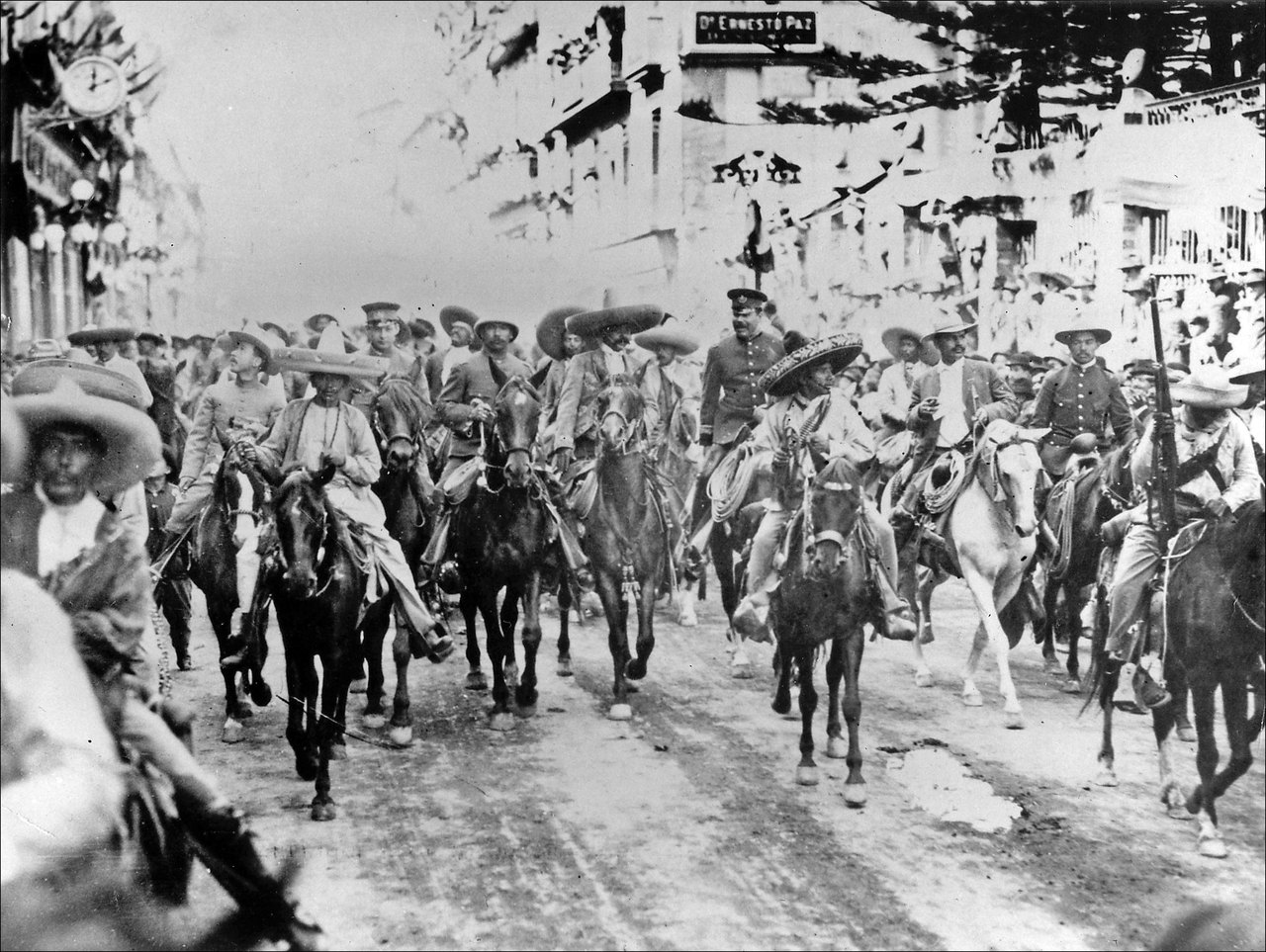
Esperanza’s world sits on ground that had trembled for a decade. Mexico’s Revolution (1910–1920) was fought in large part over land — a few wealthy families owned enormous estates while millions of farm workers owned nothing. By 1924 the fighting had cooled, but the resentment had not: bandits still roamed the countryside, and wealthy landowners like Papa were exactly the targets that revolutionary anger had taught people to hate. Papa is different — he treats his workers as family and even talks of giving them land — but to bandits a rich man’s title deed is a prize and his kindness is invisible. That is the hinge the whole novel turns on. Papa is killed not for anything he did but for what he owned, in a country where owning land had been the argument for ten years — and Esperanza spends the rest of the book learning what her family looked like from the other side.
Visual AidThe country the story stands on
Revolutionary horsemen riding into a Mexican town during the Revolution of 1910 to 1920. The Knowledge Bank explains that the fighting was largely about land — a few families held enormous estates while millions who worked the fields held nothing — and that by 1924 the war had cooled but the anger had not. Look at how many riders there are, and at the townspeople watching from above. Ten years of this is what stands behind the bandits on Papa’s road, and behind why a landowner was a target no matter how kind he was.
Revolutionary cavalry entering a Mexican town during the Mexican Revolution. Source: Wikimedia Commons, public domain.
Think back over the opening. A father kneels beside his daughter and tells her to be still and listen — and the ground answers with something like a pulse. Days of roses and servants and a birthday nearly here. Then a night that will not end, an empty saddle, and a wagon rolling slowly up the lane carrying the man who taught her the land was alive. In the parlor an old woman keeps crocheting stripes that climb and fall, climb and fall, and says softly that a person is like the blanket: never stop, even in the valley. Two men in black arrive with the mourners, their sympathy smooth and their eyes already counting the rows of vines.
Original passage written for Garden Heights — not a quotation from the novel.
1Claim: “Part 1 argues that Esperanza’s fall is dangerous because she has never had to be strong.” — choose the two details that best prove it.Claim & Evidence
2The world before Papa’s death, or The world after Papa’s death? Tap each detail to sort it — tap again to switch sides. You can keep tapping to change your answer.Sort into two
◄ The world before Papa’s deathThe world after Papa’s death ►
3Match each cause to its result. For each cause, pick its result.Cause & Effect
Papa presses her ear to the ground→
Bandits kill Papa for his land→
Abuelita crochets mountains and valleys→
Tio Luis arrives with smooth sympathy→
🧠Knowledge Bank question
4Fill both blanks to complete the reasoning.Build the Argument
The Knowledge Bank argues that a landowner like Papa was in real danger in 1924 because , which shows that .
Part 5
Standardized Test
Reading passage · The Mexican Revolution & the Land · SAT & TOEFL-style practice
Read the passage — the highlighted words are tested — then answer. Tap an answer, then tap it again to confirm.
SATCentral Ideas — the passage's main point
SATWords in Context — a word's meaning in this passage
SATInference — a conclusion the passage implies
SATDetail — a fact stated in the passage
TOEFLFactual Information — a fact stated in the passage
TOEFLVocabulary — a tested word's meaning here
TOEFLRhetorical Purpose — why the author included a detail
TOEFLInference — what the passage implies
Mexico's Revolution Over Land
To understand why bandits would kill a kind man like Papa, you have to understand what Mexico had just lived through. From 1910 to 1920, Mexico was torn by a revolution, one of the great upheavals of the twentieth century. At its heart lay a single burning question: who should own the land? For generations, a small number of wealthy families had held enormous estates called haciendas, some larger than entire American counties, while the people who worked them owned nothing at all. A family might spend a lifetime tending another family's vineyard and never own a single row of it.
By 1924, when this story begins, the great battles were over, but the anger they had stirred up had not settled. The countryside remained restless and unsafe; armed bands still roamed lonely roads, and a rich landowner was exactly the figure that a decade of revolution had taught people to resent. This is the danger that hangs over Esperanza's father. He is generous, he treats his workers as family, and every harvest he shares the celebration with them. But to a stranger on a dark road he is not a kind man at all; he is simply the owner of a great deal of land, at a moment when owning land was the most dangerous thing a Mexican could do.
Original passage written for Garden Heights — not a quotation from the novel.
1What is the main idea of the passage?SAT · Central Ideas
2According to the passage, the central question of the Revolution was ___.TOEFL · Factual Information
3A hacienda, as described here, was a ___.TOEFL · Factual Information
4In the passage, vineyard most nearly means ___.SAT · Words in Context
5In the passage, harvest most nearly means ___.TOEFL · Vocabulary
6Roughly how many lives did the Revolution cost?TOEFL · Factual Information
7The passage says Papa’s kindness does not protect him because a bandit sees ___.SAT · Inference
8Emiliano Zapata is mentioned as someone who ___.SAT · Detail
9‘The countryside remained restless and unsafe’ helps explain why ___.TOEFL · Rhetorical Purpose
10Which event from Part 1 does this passage BEST help explain?TOEFL · Inference
Part 6 · Optional
Creative Writing
A bonus challenge to practice your English. Take your time and have fun with it.
About This Section
This writing task is optional and is not part of your auto-graded score. The feedback below checks only the basics — length, spelling, and grammar — not whether your ideas are right or wrong. It is meant for classroom discussion and creative practice, so feel free to use your imagination!
Writing Task — Part 1 “The Land’s Heartbeat”
Papa teaches Esperanza that the land is alive and gives to those who love it — a lesson she will carry through everything that follows. Write about a place or thing that someone taught you to love or care for. Who taught you, what did they show you, and why did it matter? 6–10 sentences. End with what you still remember from that lesson.
You can start with: “Someone once showed me how to really pay attention to...”
0 / 40 words minimum
🗣 Teach It · Just for Fun (optional)
No right or wrong — close the screen and tell someone nearby what happened in this part. Can’t find anyone? Tell yourself out loud. The moment you teach it, you truly understand it.
Part 1 Complete!
You finished Aguascalientes & Las Uvas of Esperanza Rising.
Here are your auto-graded results:
-
points out of 100
Teach it to someone
The best last step is to teach it. In your own words, explain what happened — retell a favorite scene, teach a character’s big choice, or sum up the main idea for a parent, friend, or classmate. When you can teach it clearly, you truly own it.
Independent study guide by Garden Heights. Not affiliated with or endorsed by Pam Muñoz Ryan. Contains original analysis only; no text from the novel is reproduced. Reference text: This workbook follows Pam Muñoz Ryan’s classic text (the standard Puffin edition sold worldwide). Revised 2023 UK editions change some wording and may not match the vocabulary studied here.
SAT® is a registered trademark of College Board, which is not affiliated with, and does not endorse, these materials. TOEFL® is a registered trademark of ETS. These materials are not endorsed or approved by ETS. Garden Heights is an independent provider of test-style reading practice.