New here? Just sign up with Google — your account includes Matilda, our gift book, forever.
Esperanza Rising · Garden Heights
Part 3
for Esperanza Rising · Part 3 · Las Guayabas & Los Melones
8 Parts40 min
What Happens in Part 3
The family slips away hidden in a wagon under a load of guavas, then boards a crowded train packed with poor travelers. Esperanza, still thinking like the daughter of a great house, is startled when a poor peasant woman’s little girl reaches for her fine doll, and she pulls it away — a small, ugly moment that shames her later. On the long ride north she meets Carmen, a woman who sells eggs and candy and has almost nothing, yet gives coins to a beggar and laughs that she is rich in family, faith, and song. Mama befriends the poor travelers easily, and Esperanza begins to understand how far she has fallen — and how much she has to learn. At the border the family passes the inspections and crosses into the United States, then rides on to a farm labor camp in California’s great central valley. There Alfonso’s relatives take them in: kind Josefina and Juan, their baby twins Lupe and Pepe, and above all little Isabel, who idolizes Esperanza and cannot wait to hear about her old life of parties and silk dresses. But the camp is rows of small wooden cabins and endless fields, and an older girl named Marta sneers at Esperanza as a spoiled princess who will not last a week. Esperanza’s new life — poor, working, and uncertain — has begun.
Esperanza’s pride, the doll on the train, and a foil named Carmen
Cross-Curricular
California’s farm labor camps in the 1930s
Chapter Summary
Ch.
What happens
Las Guayabas
The Guavas — hidden under guavas, the family flees by wagon and train; Esperanza clutches her doll from a poor child, then meets Carmen, who is poor in money but rich in spirit.
Los Melones
The Cantaloupes — the family crosses into the United States and reaches a California farm camp; Josefina, Juan, and adoring Isabel welcome them, while Marta scorns Esperanza as a princess.
Part 1
Vocabulary
Study 10 key words from Las Guayabas & Los Melones, then answer each question.
🧠Knowledge Bank · Words for a New Country
Lexical Semantics · Words for a New Country
Four words, and the first is the one Esperanza has to swallow. A peasant is a poor person who works the land, and the train north is crowded with peasant families — a word she has used all her life about other people. Humble means modest, not proud or grand, and Carmen is poor and humble and kind, a combination Esperanza has never had to hold in her head at once. A border is the line dividing two countries, and at it guards inspect every traveler, some far more closely than others. A laborer is a person who does hard physical work, and the camp is full of them, following the crops. By the end of this stretch every one of those four words describes Esperanza herself. Ryan lets the vocabulary do the demotion.
peasantn.Las Guayabas
A poor person who works the land
“The train was crowded with peasant families heading north.”
humbleadj.Las Guayabas
Modest; not proud or grand
“Carmen was poor but humble and kind.”
bordern.Los Melones
The line dividing two countries
“At the border, guards inspected every traveler.”
laborern.Los Melones
A person who does hard physical work
“The camp was full of laborers who followed the crops.”
cabinn.Los Melones
A small, simple wooden house
“Their new home was a plain wooden cabin.”
scornv.Los Melones
To treat with open contempt
“Marta liked to scorn the newcomers.”
idolizev.Los Melones
To admire someone greatly
“Isabel came to idolize her older cousin.”
inspectv.Los Melones
To look at closely and carefully
“Officials would inspect the papers at the border.”
wearyadj.Las Guayabas
Very tired
“The weary travelers slept on hard benches.”
generousadj.Las Guayabas
Willing to give and share freely
“Poor Carmen was generous with her last coins.”
ⓘ The vocabulary words in this list are selected to help you understand and complete this workbook. Some may not appear verbatim in the original novel.
🧠Knowledge Bank question
1According to the Knowledge Bank, which word does Esperanza have to swallow?Las Guayabas
2To be ‘humble’ is to be proud and boastful.Las Guayabas
3The line dividing two countries is a ___.Los Melones
4A ‘laborer’ is someone who avoids all work.Los Melones
5Fill in each blank with the correct word.Los Melones
Word choices:cabinborderpeasantsneer- some words will not be used
Their new home was a small wooden .
Guards inspected each traveler at the .
6To ‘scorn’ someone is to treat them with ___.Los Melones
7To ‘idolize’ someone means to admire them greatly.Los Melones
8A ‘generous’ person is one who ___.Las Guayabas
9Fill in each blank with the correct word.Las Guayabas
Word choices:wearygenerouslaborerborder- some words will not be used
The travelers slept on the hard benches.
Poor Carmen was with her last coins.
10To ‘inspect’ something is to ___.Los Melones
Part 2
Comprehension
Show you understood what happens in Las Guayabas & Los Melones.
🧠Knowledge Bank · The Journey and the Camp
Narrative Causality · The Journey and the Camp
This portion of Esperanza Rising links setting to conflict, then measures the human change produced by that collision. The family slips away hidden in a wagon under a load of guavas, then boards a crowded train packed with poor travelers. Esperanza, still thinking like the daughter of a great house, is startled when a poor peasant woman’s little girl reaches for her fine doll, and she pulls it away — a small, ugly moment that shames her later. On the long ride north she meets Carmen, a woman who sells eggs and candy and has almost nothing, yet gives coins to a beggar and laughs that she is rich in family, faith, and song. Mama befriends the poor travelers easily, and Esperanza begins to understand how far she has fallen — and how much she has to learn. This event pattern makes “The Journey and the Camp” the section’s central reversal.
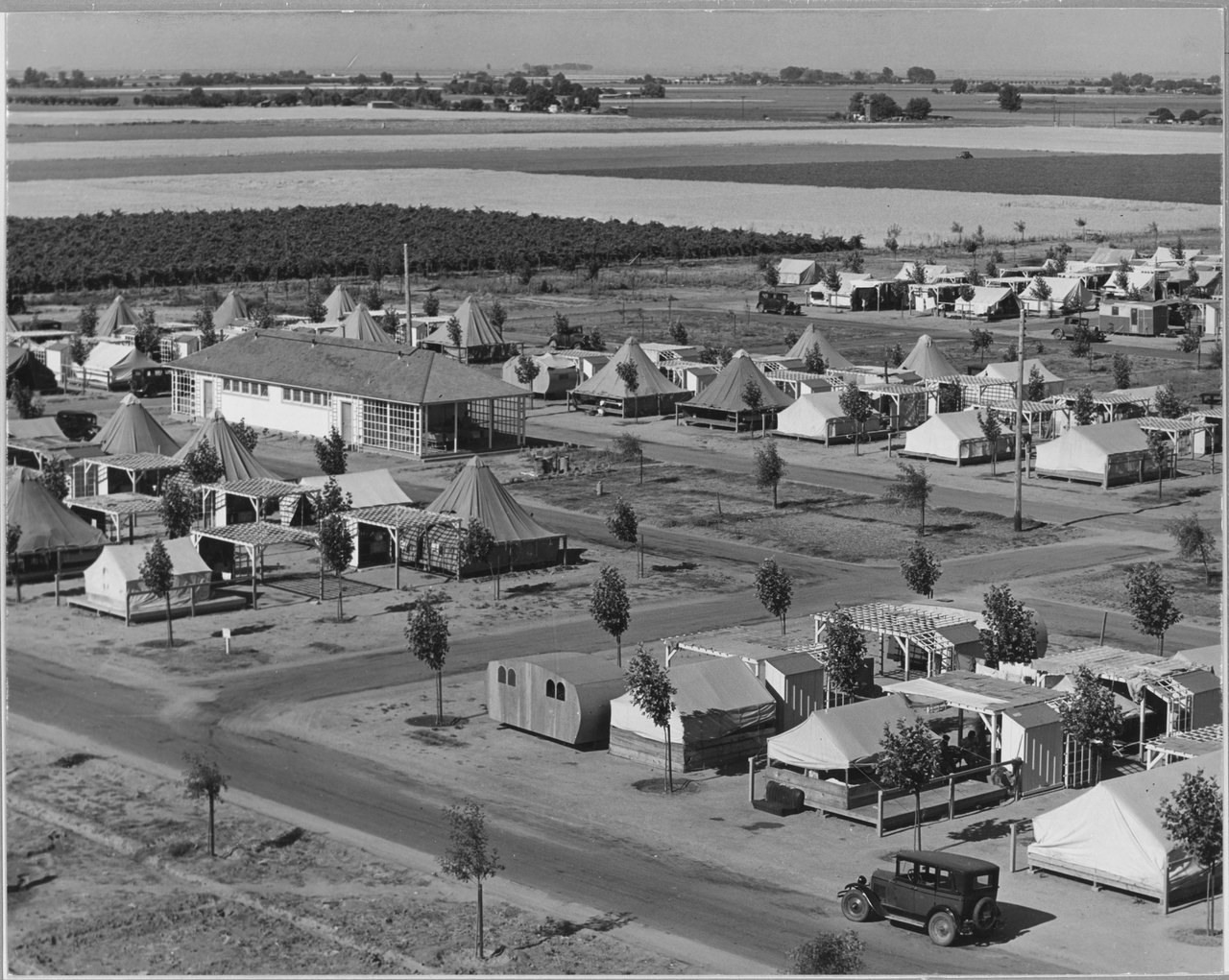
Visual AidThe camp the train arrives at
A farm labor camp at Shafter in Kern County, California, photographed from above in 1939. The Knowledge Bank explains that camps like this one housed the army of workers who picked California’s crops — rows of tiny cabins or tents, shared toilets and washtubs, and a store that sold food on credit against next week’s wages. Look past the last row of tents at the fields. The camp is not near the work; it is inside it, which is the whole reason it exists.
Shafter Farm Labor Camp, Kern County, California, 1939; U.S. National Archives. Source: Wikimedia Commons, public domain.
🧠Knowledge Bank question
1The Knowledge Bank explains that Esperanza is startled on the train when ___.Las Guayabas
2On the train, Esperanza shames herself when she ___.Las Guayabas
3Carmen is a wealthy woman who looks down on the poor.Las Guayabas
4Carmen says she is rich in ___.Las Guayabas
5Write the numbers 1–5 in the boxes to show the correct order of events. Number 1 = what happens first.Las Guayabas & Los Melones
Isabel welcomes Esperanza; Marta scorns her.
On the train, Esperanza meets the generous Carmen.
They reach the farm camp and its rows of cabins.
The family is inspected and crosses the border.
The family hides in a wagon under a load of guavas.
6The family settles into a grand new house at the camp.Los Melones
7At the camp the family is taken in by ___.Los Melones
8Isabel treats Esperanza with ___.Los Melones
9Marta welcomes Esperanza warmly to the camp.Los Melones
10By the end of Part 3, Esperanza’s new life is best described as ___.Los Melones
Part 3
Literary Elements
Understanding HOW and WHY Pam Muñoz Ryan tells the story across Las Guayabas & Los Melones.
🧠Knowledge Bank · Carmen the Foil
Narrative Technique · Carmen the Foil
Across Las Guayabas & Los Melones, foil interacts with symbol and setting to complicate the apparent meaning of events. Meet Carmen, who appears for only a few pages yet changes how we read Esperanza. A foil is a character whose contrast lights up another, and Carmen is Esperanza’s mirror-opposite: she owns almost nothing, sells eggs to survive, and still hands a coin to a beggar and calls herself rich. Set beside Carmen, Esperanza’s wounded pride looks small. Ryan drops Carmen into one train ride to plant a question the whole book will answer: what does it really mean to be rich? Watch how Esperanza slowly grows toward Carmen’s kind of wealth — the kind that a fire and a border cannot burn. That authorial design makes “Carmen the Foil” a lesson in deliberate contrast.
Foil
Carmen — whose cheerful poverty highlights, by contrast, Esperanza’s wounded pride.
Symbol
The porcelain doll — a piece of the old rich life that Esperanza clings to as everything else changes.
Setting
The farm labor camp — rows of cabins and fields that define Esperanza’s new, working world.
🧠Knowledge Bank question
1According to the Knowledge Bank, what is a foil?Las Guayabas
2Fill in each blank with the correct literary term.Las Guayabas
Word choices:foilsymbolsettingrhyme- some words will not be used
Carmen, who highlights Esperanza by contrast, is a .
The porcelain doll, a piece of the old rich life, works as a .
3A story’s setting is only the year it was written.Los Melones
4The porcelain doll mainly stands for ___.Las Guayabas
5Ryan uses Carmen chiefly to make Esperanza’s pride look ___.Las Guayabas
6The camp setting shapes how Esperanza must now live.Los Melones
7The doll on the train reveals that, at first, Esperanza still ___.Las Guayabas
8Fill in each blank with the correct literary term.Los Melones
Word choices:settingfoilmotifnarrator- some words will not be used
The rows of cabins and fields form the story’s .
A character used for contrast, like Carmen, is a .
9A foil must always be the story’s villain.Las Guayabas
10The strongest sign that Esperanza’s world has changed is ___.Los Melones
Part 4
Think Deeper
Four deeper challenges — no single-word recall. Read, weigh the evidence, and reason it out.
🧠Knowledge Bank · Cabins in the Valley
California Farm Labor Camps · Cabins in the Valley
The place Esperanza lands was real and everywhere in 1930s California. To house the small army of workers who picked its crops, the great farms and the government built labor camps — long rows of tiny wooden cabins or tents, shared toilets and washtubs, and a company store that sold food on credit against next week’s wages. A Mexican family and a family from the Dust Bowl might live one cabin apart, both chasing the same harvests up and down the state. The pay was low, the cabins were cramped, and the work followed the seasons, but for many the camp meant steady labor and a roof. Ryan is precise about which camp Esperanza lands in. The Mexican camp has cabins; the Oklahoman camp, when it appears, has better ones and a swimming pool the Mexican workers may use only on the day before the water is changed.
Visual AidTwo camps, one valley
Plan drawing for the Knowledge Bank on the labor camps. Card 1 is the camp Esperanza lands in and card 2 is the one down the road, with what each family gets written underneath. Card 3 is the fact that makes the difference visible: the work is identical. Notice the rule in card 4, and notice that nothing in it is a law — it is just what everyone did, which is what makes it worth putting in a book.
The two labor camps of the Knowledge Bank, drawn in plan. Drawn for Garden Heights Academy.
Think back over these chapters. A wagon rocks along a dark road, and beneath a heap of sweet guavas a girl who once slept on silk holds her breath. On a crowded train she pulls a fine doll away from a barefoot child — and a poor woman across the aisle, who has sold eggs all day, presses a coin into a beggar’s hand and says she is the richest woman she knows. A border, a stamp, a new country. Then a long ride to a place of small wooden cabins in an ocean of fields, where a little girl looks up at her like a queen and an older girl looks at her like a joke.
Original passage written for Garden Heights — not a quotation from the novel.
1Claim: “Part 3 argues that Esperanza’s hardest journey is not across the border but away from her pride.” — choose the two details that best prove it.Claim & Evidence
2Esperanza’s old measure of wealth, or Carmen’s measure of wealth? Tap each detail to sort it — tap again to switch sides. You can keep tapping to change your answer.Sort into two
◄ Esperanza’s old measure of wealthCarmen’s measure of wealth ►
3Match each cause to its result. For each cause, pick its result.Cause & Effect
Esperanza snatches back her doll→
Carmen gives away a coin→
The family crosses the border→
They reach a cabin in the fields→
🧠Knowledge Bank question
4Fill both blanks to complete the reasoning.Build the Argument
The Knowledge Bank argues that the labor camp was an ordinary place rather than an unusual one because , which shows that .
Part 5
Standardized Test
Reading passage · California’s Farm Labor Camps · SAT & TOEFL-style practice
Read the passage — the highlighted words are tested — then answer. Tap an answer, then tap it again to confirm.
SATCentral Ideas — the passage's main point
SATWords in Context — a word's meaning in this passage
SATDetail — a fact stated in the passage
SATInference — a conclusion the passage implies
TOEFLFactual Information — a fact stated in the passage
TOEFLVocabulary — a tested word's meaning here
TOEFLInference — what the passage implies
Life in a Farm Labor Camp
When Esperanza's family reaches California, they move into a farm labor camp, the kind of place that housed much of the state's harvest workforce in the 1930s. California's enormous farms could not run without armies of pickers, and those workers had to live somewhere close to the fields. The answer was the labor camp: long rows of small one- or two-room cabins, or tents on wooden platforms, with shared toilets and washtubs and a company store that sold food on credit against next week's wages. A humble cabin with a plank floor was, for many families, the best housing on offer.
Life in the camps followed the crops. When the grapes ripened, the camp filled; when the picking ended, families packed up and chased the next harvest, cotton in one county, peaches in another, up and down the long valley. Wages were low and never certain, and the same fields drew both Mexican families and white families fleeing the Dust Bowl, all competing for the same work. Camp life had its own warmth, with neighbors sharing food and music after dark, but the days themselves were long enough to leave everybody weary before the light had gone.
Original passage written for Garden Heights — not a quotation from the novel.
1What is the main idea of the passage?SAT · Central Ideas
2According to the passage, why did the great farms need labor camps?TOEFL · Factual Information
3In the passage, humble most nearly means ___.SAT · Words in Context
4A camp cabin is described as ___.SAT · Detail
5According to the passage, camp families moved from place to place in order to ___.TOEFL · Factual Information
6The passage says the same fields drew Mexican families and ___.SAT · Detail
7In the passage, weary most nearly means ___.TOEFL · Vocabulary
8The passage says camp communities were often ___.TOEFL · Factual Information
9‘Wages were low and never certain’ helps explain why camp families were ___.SAT · Inference
10Which detail from Part 3 does this passage BEST help explain?TOEFL · Inference
Part 6 · Optional
Creative Writing
A bonus challenge to practice your English. Take your time and have fun with it.
About This Section
This writing task is optional and is not part of your auto-graded score. The feedback below checks only the basics — length, spelling, and grammar — not whether your ideas are right or wrong. It is meant for classroom discussion and creative practice, so feel free to use your imagination!
Writing Task — Part 3 “Rich in What?”
Carmen owns almost nothing, yet calls herself rich in family, faith, and song. Write about the ways a person can be ‘rich’ that have nothing to do with money. What makes YOU feel rich? Give real examples from your own life. 6–10 sentences. End with the kind of wealth you value most.
You can start with: “Money is one kind of rich, but I think the real kind is...”
0 / 40 words minimum
🗣 Teach It · Just for Fun (optional)
No right or wrong — close the screen and tell someone nearby what happened in this part. Can’t find anyone? Tell yourself out loud. The moment you teach it, you truly understand it.
Part 3 Complete!
You finished Las Guayabas & Los Melones of Esperanza Rising.
Here are your auto-graded results:
-
points out of 100
Teach it to someone
The best last step is to teach it. In your own words, explain what happened — retell a favorite scene, teach a character’s big choice, or sum up the main idea for a parent, friend, or classmate. When you can teach it clearly, you truly own it.
Independent study guide by Garden Heights. Not affiliated with or endorsed by Pam Muñoz Ryan. Contains original analysis only; no text from the novel is reproduced. Reference text: This workbook follows Pam Muñoz Ryan’s classic text (the standard Puffin edition sold worldwide). Revised 2023 UK editions change some wording and may not match the vocabulary studied here.
SAT® is a registered trademark of College Board, which is not affiliated with, and does not endorse, these materials. TOEFL® is a registered trademark of ETS. These materials are not endorsed or approved by ETS. Garden Heights is an independent provider of test-style reading practice.