
Part 4
Now Esperanza must do what she has never done: work. Her first task — sweeping the cabin’s wooden platform — ends in failure and laughter, and it is little Isabel, half her age, who patiently shows her how to hold the broom. She learns to wash clothes, to warm bottles, and to mind the baby twins, Lupe and Pepe, while the grown-ups pick in the fields. The work is humbling, and Esperanza is often clumsy and ashamed, but slowly her hands grow surer and her pride grows softer. At a jamaica — a lively camp fundraiser with music, food, and dancing — the community’s warmth surrounds her, but so does a new tension: Marta and the older workers whisper about a strike, angry that the growers pay so little and pack so many into the camps. Miguel, meanwhile, dreams of working on the railroad and believes that in America a poor man can rise by his own effort. Esperanza is not so sure; she has learned how quickly a life can fall. As the season turns, the fields wait, the babies cry, the strike talk grows — and a rich girl keeps becoming, day by clumsy day, a worker among workers.
| Section | What you will practice |
|---|---|
| Vocabulary | Working words: chore, clumsy, strike, wages, jamaica… |
| Literary Elements | Esperanza’s slow change, humor in failure, and the seeds of conflict |
| Cross-Curricular | The Dust Bowl and the dust that blew across the 1930s |
| Ch. | What happens |
|---|---|
| Las Cebollas | The Onions — Esperanza fails at sweeping and is taught by young Isabel; she learns to wash, warm bottles, and mind the twins — humbling, hand-toughening work. |
| Las Almendras | The Almonds — at a camp jamaica the community celebrates, but Marta stirs talk of a strike over low pay, while Miguel dreams of rising on the railroad. |
Three of these words describe a girl and the fourth describes a camp. A chore is a small, regular job or task, and sweeping is the first one Esperanza has ever attempted in her life. Clumsy means awkward and unskilled with the hands, which is what her first attempts are, and the other women smile. Humbling means making one feel less proud, and failing at simple work does exactly that to a girl raised never to fail at anything visible. A strike is a refusal to work until demands are met, and the word begins moving through the camp in whispers. Ryan puts them in one word list on purpose. Notice that the first three are private and the fourth is not. Esperanza is learning to work at the same moment the camp is learning to stop.
ⓘ The vocabulary words in this list are selected to help you understand and complete this workbook. Some may not appear verbatim in the original novel.
A Princess Learns to Work is organized around a difficult decision, the risk it creates, and the eventual result. Now Esperanza must do what she has never done: work. Her first task — sweeping the cabin’s wooden platform — ends in failure and laughter, and it is little Isabel, half her age, who patiently shows her how to hold the broom. She learns to wash clothes, to warm bottles, and to mind the baby twins, Lupe and Pepe, while the grown-ups pick in the fields. The work is humbling, and Esperanza is often clumsy and ashamed, but slowly her hands grow surer and her pride grows softer. At a jamaica — a lively camp fundraiser with music, food, and dancing — the community’s warmth surrounds her, but so does a new tension: Marta and the older workers whisper about a strike, angry that the growers pay so little and pack so many into the camps. Once decision and result are joined, “A Princess Learns to Work” supplies narrative momentum.
- Isabel teaches her how to hold the broom.
- The camp gathers for a lively jamaica.
- Esperanza fails at sweeping the platform.
- Marta stirs up talk of a strike over low pay.
- Esperanza learns to mind the baby twins.
Pam Muñoz Ryan makes the midpoint turn through arc, humor, and foreshadowing rather than through explanation alone. Notice HOW Ryan shows Esperanza changing — not through a grand speech, but through a broom. A character arc is the path of inner change across a story, and Esperanza’s runs straight through the humblest tasks: a failed sweep, a warmed bottle, a diapered twin. Each small success chips at her pride and adds to her strength. Ryan trusts the reader to measure growth in ordinary things, the same way Part 1 measured the war of the ranch in a heartbeat in the soil. Watch the chores; they are the ruler by which the whole book takes Esperanza’s height. Part 4 sets two beliefs side by side. That authorial design makes “Growth in Small Chores” a lesson in deliberate symbolism.
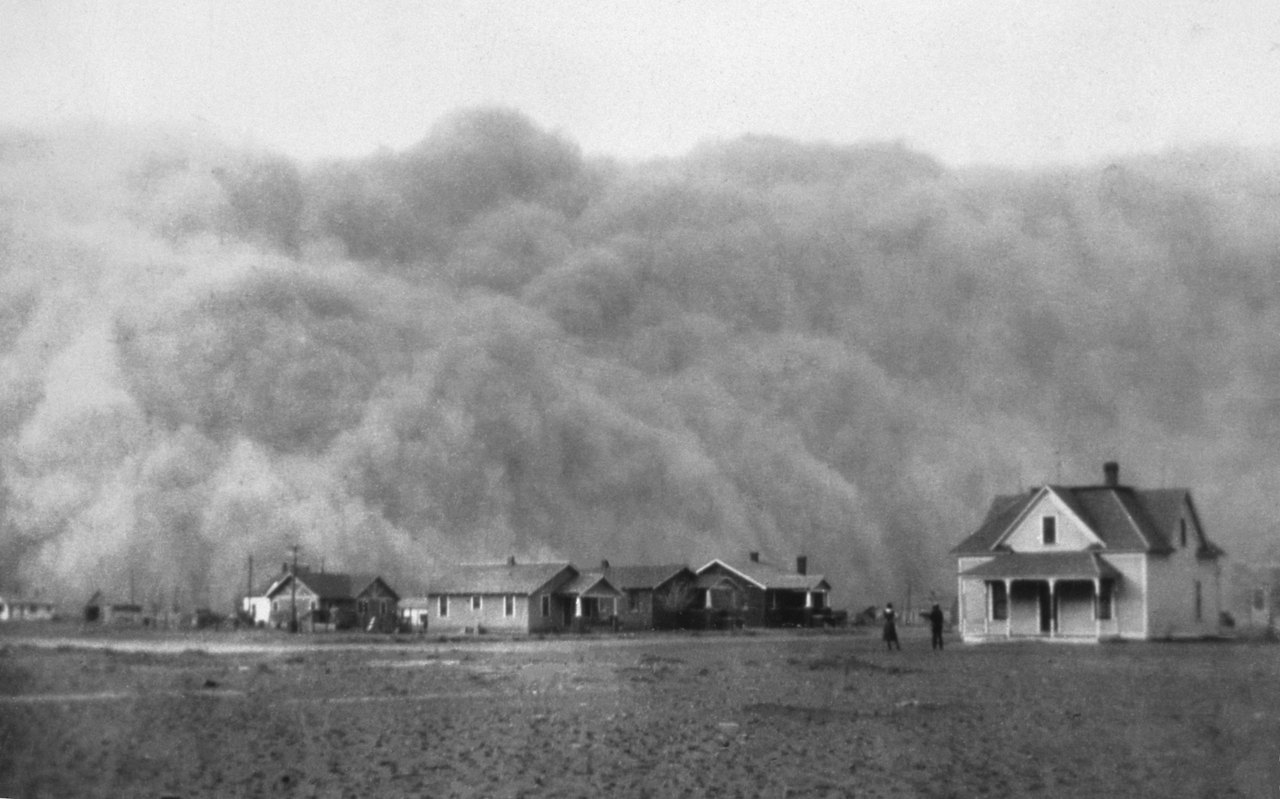
While Esperanza learns to sweep, half a continent was blowing away. Through the 1930s, years of drought and over-plowing turned the southern Great Plains — Oklahoma, Texas, Kansas, and beyond — into the Dust Bowl, where great black storms of dry soil rolled across the sky and buried farms, fences, and hope. Hundreds of thousands of ruined families loaded their trucks and drove west to California, chasing the same field work Esperanza’s family did. The dust did not stay on the Plains, either; wind carried it for hundreds of miles, and dust storms troubled California’s valley too. Ryan is quietly stitching this history into the book: the drought that fed the strikes, the flood of desperate new workers, and — soon — a dust storm that will change Esperanza’s family forever. Notice how little of this the characters know. Nobody in the camp says the words Dust Bowl. They only find that more people suddenly want the same work, and that the air has begun to taste of dirt.
Think back over these chapters. A girl who has never held a broom sends dust flying everywhere but out the door, and a child half her size takes it gently from her hands and shows her the trick of it. Bottles to warm, twins to rock, clothes to scrub — and slowly, hands that once only held roses learn to hold a whole day’s work. Then a night of music: lanterns, a fiddle, food spread on long tables at the jamaica. But under the songs run harder words — an older girl talking low about pay and packed cabins and a strike — while a young man with railroad dreams insists that here, at last, a poor man can climb.
The 1930s brought the United States two disasters at once. The first was the Great Depression, which threw millions out of work; the second, on the southern Great Plains, was the Dust Bowl. For years, farmers had plowed up the tough native grasses that held the soil in place, planting wheat as far as the eye could see. Then a long drought struck. With no rain and no grass, the dry topsoil simply lifted into the wind, and enormous black clouds of it rolled across the sky, burying fences, machinery and whole farms.
Ruined, hundreds of thousands of families packed what they could and drove west, most of them toward California, where they hoped to find work in the fields. There they crowded into the same labor camps and competed for the same picking jobs as Mexican families like Esperanza's, and with so many hands available the wages a grower had to offer fell lower still. A family that had farmed its own land in Oklahoma might arrive with nothing left to sell but its own labor. The dust itself traveled, too: strong winds could carry it hundreds of miles, and even California's Central Valley saw skies turn brown.
“People who lived through it never forgot the day the sky went dark at noon.”
This writing task is optional and is not part of your auto-graded score. The feedback below checks only the basics — length, spelling, and grammar — not whether your ideas are right or wrong. It is meant for classroom discussion and creative practice, so feel free to use your imagination!
Writing Task — Part 4 “Learning Something Hard”
Esperanza fails at sweeping before her hands grow sure — and a much younger child becomes her teacher. Write about a time you had to learn something that was harder than you expected. Who helped you, how did you feel while failing, and how did you improve? 6–10 sentences. End with what the struggle taught you.
No right or wrong — close the screen and tell someone nearby what happened in this part. Can’t find anyone? Tell yourself out loud. The moment you teach it, you truly understand it.


Part 4 Complete!
You finished Las Cebollas & Las Almendras of Esperanza Rising.
Here are your auto-graded results:
The best last step is to teach it. In your own words, explain what happened — retell a favorite scene, teach a character’s big choice, or sum up the main idea for a parent, friend, or classmate. When you can teach it clearly, you truly own it.
Independent study guide by Garden Heights. Not affiliated with or endorsed by Pam Muñoz Ryan. Contains original analysis only; no text from the novel is reproduced. Reference text: This workbook follows Pam Muñoz Ryan’s classic text (the standard Puffin edition sold worldwide). Revised 2023 UK editions change some wording and may not match the vocabulary studied here.