New here? Just sign up with Google — your account includes Matilda, our gift book, forever.
Esperanza Rising · Garden Heights
Part 5
for Esperanza Rising · Part 5 · Las Ciruelas & Las Papas
8 Parts40 min
What Happens in Part 5
Esperanza is truly a worker now, laboring in the packing shed and the fields beside the others. Then the weather turns: a towering dust storm sweeps across the valley, and everyone races indoors as the air fills with choking grit that seeps through every crack. When it finally passes, the world is buried in fine dust — and worse, Mama begins to cough and cannot stop. She has Valley Fever, a sickness caused by dust that settles deep in the lungs, and she grows so ill that she must be taken to a hospital far away, where she will lie for months, weak and in danger. Esperanza is terrified — she has already lost Papa, and now she may lose Mama too. But grief turns to resolve. To pay the hospital bills and to save enough to bring Abuelita north — for Esperanza is sure that her grandmother’s presence will help Mama heal — she throws herself into work, cutting the ‘eyes’ from seed potatoes in the shed and taking every job she can. Isabel and Josefina help with the twins; Miguel and his family stand by her. Slowly, coin by coin, the once-pampered girl becomes the one who holds her family together — still frightened, but no longer helpless.
The storm as a turn, Esperanza’s new strength, and rising stakes
Cross-Curricular
Valley Fever: when dust settles in the lungs
Chapter Summary
Ch.
What happens
Las Ciruelas
The Plums — Esperanza works in shed and field until a huge dust storm buries the valley; when it clears, Mama begins to cough and cannot stop.
Las Papas
The Potatoes — Mama has Valley Fever and is hospitalized for months; terrified but resolved, Esperanza cuts potato eyes and works to pay the bills and save for Abuelita.
Part 1
Vocabulary
Study 10 key words from Las Ciruelas & Las Papas, then answer each question.
🧠Knowledge Bank · Words of Storm and Sickness
Lexical Semantics · Words of Storm and Sickness
Three of these words belong to Mama and the fourth belongs to Esperanza. A fever is a sickness marked by high body heat, and Mama’s will not break for days. A hospital is a place where the sick are treated, and Mama is taken to one far away — far enough that visiting costs a day’s wages. To recover is to get well again after illness, and it will take months, which is a length of time a family living week to week cannot easily hold. Resolve is firm determination to do something, and it is the only one of the four that is not about a body. Fear hardens into resolve as Esperanza works. That sentence is the turn of the whole novel: the girl stops waiting for the adults and starts earning.
dust stormn.Las Ciruelas
A windstorm carrying thick clouds of dust
“The dust storm blotted out the sun at noon.”
fevern.Las Papas
A sickness marked by a high body heat
“Mama’s fever would not break for days.”
hospitaln.Las Papas
A place where the sick are treated
“Mama was taken to a hospital far away.”
recoverv.Las Papas
To get well again after illness
“It would take months for Mama to recover.”
resolven.Las Papas
Firm determination to do something
“Fear hardened into resolve as Esperanza worked.”
chokingadj.Las Ciruelas
Making it hard to breathe
“The choking dust seeped through every crack.”
seepv.Las Ciruelas
To flow slowly through small openings
“Dust began to seep under the door.”
exhaustedadj.Las Papas
Extremely tired
“She fell into bed exhausted each night.”
expensen.Las Papas
The cost of something
“The hospital was a heavy expense.”
steadyadj.Las Papas
Firm and not shaking
“Her hands grew steady at the cutting table.”
ⓘ The vocabulary words in this list are selected to help you understand and complete this workbook. Some may not appear verbatim in the original novel.
🧠Knowledge Bank question
1According to the Knowledge Bank, three of this part's words belong to Mama and the fourth belongs to ___.Las Ciruelas
2To ‘recover’ is to get well again after being sick.Las Papas
3A place where the sick are treated is a ___.Las Papas
4‘Resolve’ means giving up when things get hard.Las Papas
5Fill in each blank with the correct word.Las Papas
Word choices:feverhospitalrecoversneer- some words will not be used
Mama’s would not break for days.
She was taken to a far away.
6Something ‘choking’ makes it hard to ___.Las Ciruelas
7To ‘seep’ is to flow slowly through small openings.Las Ciruelas
8Someone who is ‘exhausted’ is ___.Las Papas
9Fill in each blank with the correct word.Las Papas
Word choices:resolveexpensesteadyfever- some words will not be used
Fear hardened into as Esperanza worked.
The hospital was a heavy .
10An ‘expense’ is ___.Las Papas
Part 2
Comprehension
Show you understood what happens in Las Ciruelas & Las Papas.
🧠Knowledge Bank · Storm, Sickness, and Resolve
Narrative Causality · Storm, Sickness, and Resolve
Part 5 raises a specific threat, answers it through character action, and leaves an altered aftermath. Esperanza is truly a worker now, laboring in the packing shed and the fields beside the others. Then the weather turns: a towering dust storm sweeps across the valley, and everyone races indoors as the air fills with choking grit that seeps through every crack. When it finally passes, the world is buried in fine dust — and worse, Mama begins to cough and cannot stop. She has Valley Fever, a sickness caused by dust that settles deep in the lungs, and she grows so ill that she must be taken to a hospital far away, where she will lie for months, weak and in danger. That progression explains how “Storm, Sickness, and Resolve” produces lasting consequence.
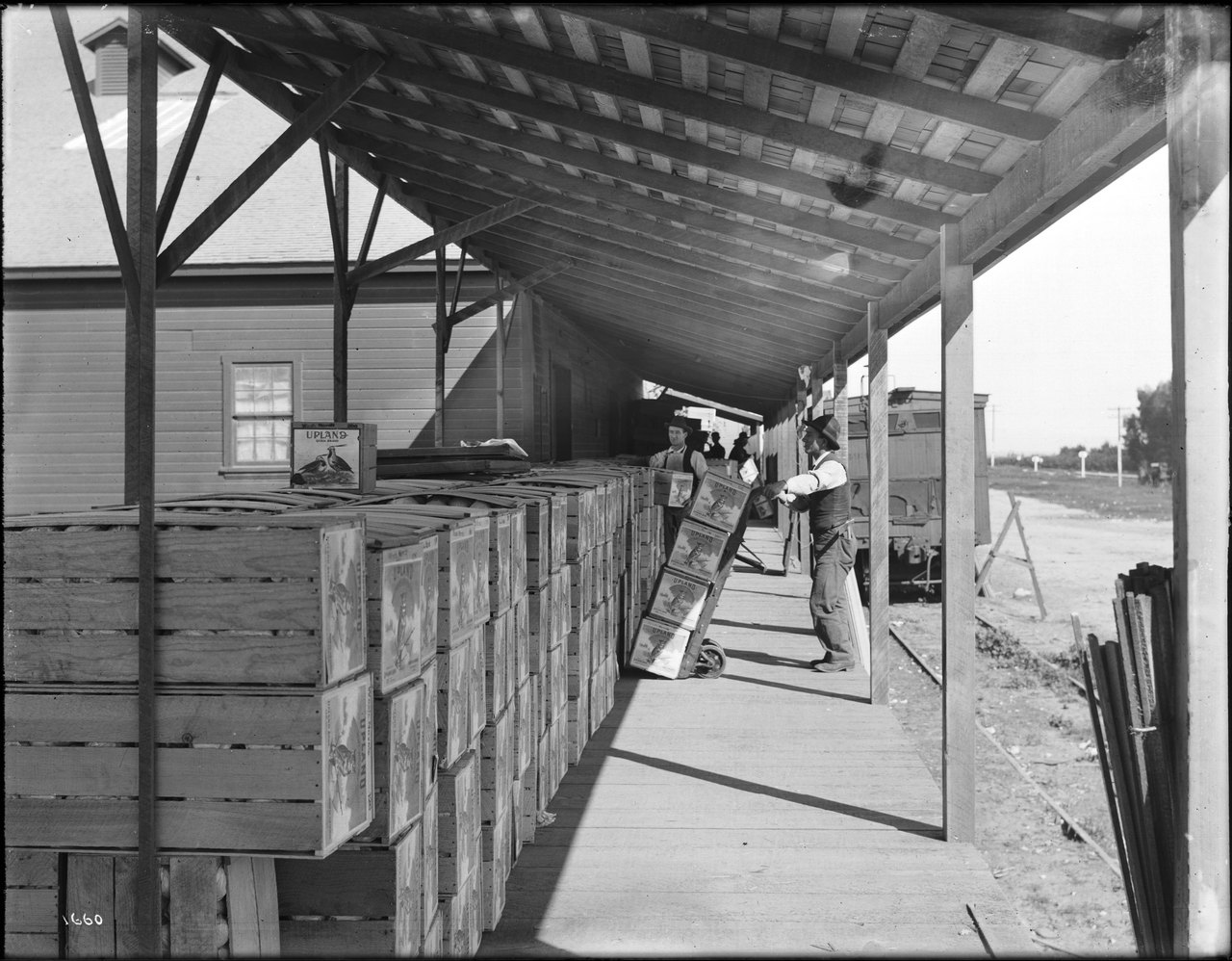
Visual AidThe shed where the crop is packed
A California packing shed, its platform stacked with crates of oranges and a rail car waiting at the edge. The Knowledge Bank explains that by this part of the book Esperanza is a worker like the others, laboring in the packing shed and the fields. Look at how the crates are stacked and where the platform ends. The shed exists to move fruit from the field onto a train in one motion, and the people in it are paid by how fast that happens.
Packing shed for shipping oranges, Ontario, California, about 1915 to 1930; the California Historical Society collection at the University of Southern California. Source: Wikimedia Commons, public domain.
🧠Knowledge Bank question
1The Knowledge Bank explains that the dust storm sends everyone ___.Las Ciruelas
2Soon after the storm, Mama begins to ___.Las Ciruelas
3Mama has a mild cold that passes in a day.Las Papas
4Mama must be taken to ___.Las Papas
5Write the numbers 1–5 in the boxes to show the correct order of events. Number 1 = what happens first.Las Ciruelas & Las Papas
Mama is taken to a distant hospital with Valley Fever.
The family shelters as dust fills the air.
Esperanza works to pay the bills and save for Abuelita.
Mama begins to cough and cannot stop.
A huge dust storm sweeps across the valley.
6Esperanza gives up in despair when Mama falls ill.Las Papas
7Esperanza wants to save money mainly to ___.Las Papas
10By the end of Part 5, Esperanza has become the one who ___.Las Papas
Part 3
Literary Elements
Understanding HOW and WHY Pam Muñoz Ryan tells the story across Las Ciruelas & Las Papas.
🧠Knowledge Bank · The Storm as a Turn
Narrative Technique · The Storm as a Turn
Part 5 layers point, stakes, and symbol so that an ordinary detail carries later significance. The dust storm is the second great hinge of the novel — the fire’s echo. Like the fire in Part 2, it is a physical event that forces a life-changing one: the fire made Esperanza a refugee; the storm makes her, in effect, the head of her family. Notice how Ryan uses weather as fate. In a story about people bound to the land, it is fitting that the land itself — its dust, its seasons — keeps deciding the family’s course. Watch how the plot keeps rhyming: loss, then a rise to meet it. Each valley in the blanket’s zigzag is answered by a climb, and here Esperanza begins the hardest climb yet. That authorial design makes “The Storm as a Turn” a lesson in deliberate irony.
Turning point
The dust storm and Mama’s illness — the event that makes Esperanza the head of her family.
Rising stakes
The threat of losing Mama, on top of Papa — danger that pulls the reader tighter into the story.
Symbol
The dust storm — the land itself, deciding the family’s fate, as it has all along.
🧠Knowledge Bank question
1According to the Knowledge Bank, the dust storm echoes which earlier event?Las Papas
2Fill in each blank with the correct literary term.Las Papas
Word choices:turning pointrising stakessettingrhyme- some words will not be used
Mama’s illness is a that changes Esperanza’s role.
The fear of losing her too creates for the reader.
3‘Rising stakes’ means the danger in a story is growing.Las Papas
4The dust storm can be read as a symbol of ___.Las Ciruelas
5The stakes rise most sharply because Esperanza fears losing ___.Las Papas
6A turning point leaves a character exactly where they began.Las Papas
7Ryan uses weather as fate to fit a story about people bound to ___.Las Ciruelas
8Fill in each blank with the correct literary term.Las Ciruelas
Word choices:symbolturning pointnarratormotif- some words will not be used
The dust storm works as a of the land shaping fate.
Mama falling ill is the of this part.
9Rising stakes tend to make a reader lose interest.Las Papas
10The clearest sign of Esperanza’s rise in Part 5 is that she ___.Las Papas
Part 4
Think Deeper
Four deeper challenges — no single-word recall. Read, weigh the evidence, and reason it out.
🧠Knowledge Bank · The Dust That Reaches the Lungs
Valley Fever · The Dust That Reaches the Lungs
The illness that strikes Mama is real, and it is native to exactly the place the family landed. Valley Fever comes from a fungus that lives in the dry soil of the American Southwest and California’s Central Valley. When the ground is disturbed — by plowing, by construction, and above all by dust storms — the spores lift into the air, and anyone who breathes them in can fall ill. Most people recover, but some, like Mama, develop a serious lung sickness that can take months to heal or turn deadly. In the dusty, wind-blown camps of the 1930s, farm workers were especially exposed. Put the two facts side by side and the novel’s cruelty becomes visible. The storms that ruined the Plains farmers and drove them west are the same storms that lift the spores, so the disaster that filled California’s camps with desperate workers is also the disaster that put Esperanza’s mother in a hospital bed. Nothing in this book is only weather.
Visual AidFrom the soil to a hospital bed
Diagram for the Knowledge Bank on Valley Fever. Cards 1 to 4 are the chain the Knowledge Bank describes, from a fungus in the ground to a person breathing it in, and card 5 is the branch Mama takes. Notice where card 2 sits. The dust storm of the last chapter is not a separate misfortune from Mama’s illness; it is the step that causes it.
How Valley Fever travels from the soil to a person's lungs, as described in the Knowledge Bank. Drawn for Garden Heights Academy.
Think back over these chapters. The sky in the west turns a strange brown, then swallows the sun, and everyone runs for the cabins as the air itself turns to grit that finds every crack. When it clears, the valley is buried — and a mother’s cough will not stop. A long ride to a hospital, a bed far away, months of not knowing. And a girl who once could not hold a broom now bends over a table of seed potatoes late into the night, cutting eye after eye, hiding coin after coin, because the only thing worse than being afraid is doing nothing while someone you love lies sick.
Original passage written for Garden Heights — not a quotation from the novel.
1Claim: “Part 5 argues that Esperanza has truly changed, because she meets disaster with work instead of despair.” — choose the two details that best prove it.Claim & Evidence
2The old Esperanza (Part 1), or The new Esperanza (Part 5)? Tap each detail to sort it — tap again to switch sides. You can keep tapping to change your answer.Sort into two
◄ The old Esperanza (Part 1)The new Esperanza (Part 5) ►
3Match each cause to its result. For each cause, pick its result.Cause & Effect
A dust storm buries the valley→
Mama falls ill with Valley Fever→
Esperanza saves coin by coin→
Neighbors help with the twins→
🧠Knowledge Bank question
4Fill both blanks to complete the reasoning.Build the Argument
The Knowledge Bank argues that farm workers were especially at risk of Valley Fever because , which shows that .
Part 5
Standardized Test
Reading passage · When Dust Makes You Sick · SAT & TOEFL-style practice
Read the passage — the highlighted words are tested — then answer. Tap an answer, then tap it again to confirm.
SATCentral Ideas — the passage's main point
SATDetail — a fact stated in the passage
SATWords in Context — a word's meaning in this passage
TOEFLFactual Information — a fact stated in the passage
TOEFLSentence Simplification — the shorter sentence that keeps the meaning
TOEFLInference — what the passage implies
The Fungus Behind Valley Fever
The sickness that nearly takes Mama has a real name: Valley Fever. It is caused not by a virus you catch from another person, but by a tiny fungus that lives in the dry soil of the American Southwest and California's Central Valley. The fungus makes microscopic spores, and when the ground is disturbed, by digging, by plowing, and above all by dust storms, those spores rise into the air. A person who breathes them in can become infected. Many people who catch Valley Fever have only mild symptoms, or none at all. But some develop a serious lung illness, with fever, weakness, and a deep cough that can drag on for months, exactly as Mama's does.
Farm workers in the 1930s were especially at risk. They lived and labored out in the open, close to freshly turned soil, in a region where the fungus was common and dust storms were frequent. There was no simple cure; the sick could only rest, wait, and hope to recover in their own time. For a poor family, such an illness was a double blow: it threatened a loved one's life and swallowed money in hospital bills while taking a worker out of the fields. Understanding Valley Fever helps explain why a single dust storm could change everything for Esperanza's family.
Original passage written for Garden Heights — not a quotation from the novel.
1What is the main idea of the passage?SAT · Central Ideas
2According to the passage, Valley Fever is caused by a ___.TOEFL · Factual Information
3The spores rise into the air mainly when the ground is ___.TOEFL · Factual Information
4A person catches Valley Fever by ___.SAT · Detail
5According to the passage, many people who catch it have ___.TOEFL · Factual Information
6In the passage, recover most nearly means ___.SAT · Words in Context
7Farm workers were more exposed because they ___.SAT · Detail
8The passage says there was no simple ___ for the sickness.TOEFL · Factual Information
9Why was the illness a ‘double blow’ for a poor family?TOEFL · Sentence Simplification
10Which event from Part 5 does this passage BEST help explain?TOEFL · Inference
Part 6 · Optional
Creative Writing
A bonus challenge to practice your English. Take your time and have fun with it.
About This Section
This writing task is optional and is not part of your auto-graded score. The feedback below checks only the basics — length, spelling, and grammar — not whether your ideas are right or wrong. It is meant for classroom discussion and creative practice, so feel free to use your imagination!
Writing Task — Part 5 “Fear Into Resolve”
When Mama falls ill, Esperanza is terrified — but instead of giving up, she turns her fear into hard work. Write about a time you felt afraid but chose to act anyway. What were you afraid of, what did you do, and what happened? 6–10 sentences. End with what you learned about facing fear.
You can start with: “I was frightened, but I decided that doing nothing would be worse...”
0 / 40 words minimum
🗣 Teach It · Just for Fun (optional)
No right or wrong — close the screen and tell someone nearby what happened in this part. Can’t find anyone? Tell yourself out loud. The moment you teach it, you truly understand it.
Part 5 Complete!
You finished Las Ciruelas & Las Papas of Esperanza Rising.
Here are your auto-graded results:
-
points out of 100
Teach it to someone
The best last step is to teach it. In your own words, explain what happened — retell a favorite scene, teach a character’s big choice, or sum up the main idea for a parent, friend, or classmate. When you can teach it clearly, you truly own it.
Independent study guide by Garden Heights. Not affiliated with or endorsed by Pam Muñoz Ryan. Contains original analysis only; no text from the novel is reproduced. Reference text: This workbook follows Pam Muñoz Ryan’s classic text (the standard Puffin edition sold worldwide). Revised 2023 UK editions change some wording and may not match the vocabulary studied here.
SAT® is a registered trademark of College Board, which is not affiliated with, and does not endorse, these materials. TOEFL® is a registered trademark of ETS. These materials are not endorsed or approved by ETS. Garden Heights is an independent provider of test-style reading practice.