New here? Just sign up with Google — your account includes Matilda, our gift book, forever.
Esperanza Rising · Garden Heights
Part 6
for Esperanza Rising · Part 6 · Los Aguacates & Los Espárragos
8 Parts40 min
What Happens in Part 6
Mama slowly begins to mend, and Esperanza tends her with fierce care, even mashing avocado to soothe her own work-cracked hands and Mama’s dry skin. She keeps saving, hiding money orders in a can, dreaming of the day she can send for Abuelita. But the camp is boiling over. Led by Marta, angry workers plan a strike, demanding higher pay and fairer treatment from the growers who profit while families go hungry. They press everyone to walk out, and those who keep working are branded traitors. Esperanza is torn: she believes the strikers are right that the pay is unjust, yet she cannot stop working — Mama’s bills and Abuelita’s ticket depend on every wage. She chooses her family and keeps picking. Then the strike breaks in the asparagus fields, and the growers answer with terrible force: immigration officers sweep through, arresting strikers and loading them onto buses to be deported to Mexico — even some who were born United States citizens. It is the era of the great repatriation, when Mexican families were driven out to free up jobs. Marta is in danger, and Esperanza, who once might have scorned her, helps hide her from the raids. The strike collapses, crushed not by argument but by the threat of deportation — and Esperanza sees, up close, how little power the workers truly hold.
Esperanza’s hard choice, a moral gray area, and unexpected mercy
Cross-Curricular
1930s farm strikes and the Mexican Repatriation
Chapter Summary
Ch.
What happens
Los Aguacates
The Avocados — Mama slowly mends; Esperanza soothes cracked hands with avocado and keeps saving for Abuelita, while Marta leads a growing push to strike.
Los Espárragos
The Asparagus — the strike erupts; immigration officers deport the strikers, even U.S. citizens, in the great repatriation; Esperanza hides Marta and watches the strike collapse.
Part 1
Vocabulary
Study 10 key words from Los Aguacates & Los Espárragos, then answer each question.
🧠Knowledge Bank · Words of Protest and Power
Lexical Semantics · Words of Protest and Power
Four words, and they move from a decision to a punishment. A strike is a work stoppage to demand better terms, and the workers plan one for higher pay. A protest is a public objection to something unfair, which is what the strike is meant to be. To deport is to force a person out of a country, and officers arrive to do exactly that to the strikers. Injustice is unfair or unequal treatment, and it is the word the workers themselves use. Notice how short the distance is between the second word and the third. A protest is perfectly legal; deportation ends it anyway. Ryan is showing a student exactly what happens when the people with a grievance have no papers, no savings and no vote — the argument never gets heard.
striken.Los Aguacates
A work stoppage to demand better terms
“The workers planned a strike for higher pay.”
protestn.Los Espárragos
A public objection to something unfair
“The strike was a protest against low wages.”
deportv.Los Espárragos
To force a person out of a country
“Officers came to deport the strikers.”
injusticen.Los Aguacates
Unfair or unequal treatment
“The workers spoke out against injustice.”
traitorn.Los Aguacates
One seen as betraying their own side
“Those who kept working were called traitors.”
dilemman.Los Aguacates
A hard choice between two options
“Esperanza faced a painful dilemma.”
shelterv.Los Espárragos
To protect or hide from harm
“She helped shelter Marta from the raid.”
desperateadj.Los Espárragos
Driven by great need or fear
“Growers hired new desperate workers.”
mendv.Los Aguacates
To heal or get better
“Mama began slowly to mend.”
unjustadj.Los Aguacates
Not fair or right
“The low pay felt deeply unjust.”
ⓘ The vocabulary words in this list are selected to help you understand and complete this workbook. Some may not appear verbatim in the original novel.
🧠Knowledge Bank question
1According to the Knowledge Bank, this part's four words move from a decision to ___.Los Aguacates
2To ‘deport’ someone is to welcome them warmly.Los Espárragos
3Unfair or unequal treatment is ___.Los Aguacates
4A ‘dilemma’ is an easy choice with no cost.Los Aguacates
5Fill in each blank with the correct word.Los Espárragos
Word choices:deportproteststrikesneer- some words will not be used
Officers came to the strikers to Mexico.
The strike was a against low wages.
6A ‘traitor’ is one who is seen as ___.Los Aguacates
7To ‘shelter’ someone is to protect them from harm.Los Espárragos
8To ‘mend’ is to ___.Los Aguacates
9Fill in each blank with the correct word.Los Aguacates
Word choices:dilemmaunjusttraitorstrike- some words will not be used
Esperanza faced a painful .
The low pay felt deeply .
10Someone who is ‘desperate’ is driven by ___.Los Espárragos
Part 2
Comprehension
Show you understood what happens in Los Aguacates & Los Espárragos.
🧠Knowledge Bank · The Strike and the Choice
Narrative Causality · The Strike and the Choice
Careful sequence reading reveals the textual evidence, the structural pivot, and the resulting consequence in Los Aguacates & Los Espárragos. Mama slowly begins to mend, and Esperanza tends her with fierce care, even mashing avocado to soothe her own work-cracked hands and Mama’s dry skin. She keeps saving, hiding money orders in a can, dreaming of the day she can send for Abuelita. But the camp is boiling over. Led by Marta, angry workers plan a strike, demanding higher pay and fairer treatment from the growers who profit while families go hungry. They press everyone to walk out, and those who keep working are branded traitors. Esperanza is torn: she believes the strikers are right that the pay is unjust, yet she cannot stop working — Mama’s bills and Abuelita’s ticket depend on every wage. Reading evidence around the pivot turns “The Strike and the Choice” into meaningful convergence.
🧠Knowledge Bank question
1The Knowledge Bank explains that Esperanza mashes avocado in order to ___.Los Aguacates
2Esperanza uses mashed avocado to ___.Los Aguacates
3The strike is led by Miguel.Los Aguacates
4Esperanza keeps working instead of striking because ___.Los Aguacates
5Write the numbers 1–5 in the boxes to show the correct order of events. Number 1 = what happens first.Los Aguacates & Los Espárragos
Esperanza chooses to keep working for her family.
Mama slowly begins to mend.
Immigration officers deport the strikers.
Marta leads a push for a strike over low pay.
The strike erupts in the asparagus fields.
6Esperanza thinks the strikers are completely wrong about the pay.Los Aguacates
7The growers break the strike by ___.Los Espárragos
8Shockingly, some of those deported were ___.Los Espárragos
9Esperanza refuses to help Marta when the raids come.Los Espárragos
10The strike collapses mainly because of ___.Los Espárragos
Part 3
Literary Elements
Understanding HOW and WHY Pam Muñoz Ryan tells the story across Los Aguacates & Los Espárragos.
🧠Knowledge Bank · A Choice With No Clean Answer
Narrative Technique · A Choice With No Clean Answer
The pressure of Los Aguacates & Los Espárragos is crafted through complexity, moment, and irony working in combination. Part 6 hands Esperanza a genuine dilemma — a choice where BOTH sides have a real claim. The strikers are right that the pay is unjust and that only unity can force change. But Esperanza is also right that her sick mother and her distant grandmother depend on wages she cannot afford to lose. Ryan refuses to make this easy: Esperanza is not a coward for working, and the strikers are not fools for striking. This is moral complexity — when a story presents a problem with no clean answer — and it is a sign the book trusts its readers. That authorial design makes “A Choice With No Clean Answer” a lesson in deliberate perspective.
Visual AidTwo claims, both of them real
Diagram for the Knowledge Bank on Esperanza’s dilemma. Card 1 is the strikers’ claim and card 2 is hers, each with its cost written under it, and card 3 is the condition that makes this a dilemma rather than a decision. Card 4 names it. Notice that neither column is weaker than the other, which is exactly why the Knowledge Bank says the book trusts its reader.
The two claims of Part 6's dilemma, as described in the Knowledge Bank. Drawn for Garden Heights Academy.
Moral complexity
Esperanza’s dilemma — the strikers are just, yet her family needs the wages she would lose.
Defining moment
Hiding Marta — a single choice that shows how far Esperanza has grown.
Situational irony
The girl once scorned as a useless princess becomes the one who shelters her scorner.
🧠Knowledge Bank question
1According to the Knowledge Bank, what makes Esperanza's choice a genuine dilemma?Los Aguacates
2Fill in each blank with the correct literary term.Los Aguacates
Word choices:moral complexitydefining momentsettingrhyme- some words will not be used
A choice with no clean answer, like Esperanza’s, shows .
Hiding Marta is a that reveals her growth.
3A defining moment reveals who a character has become.Los Espárragos
4It is ironic that Esperanza shelters Marta because Marta once ___.Los Espárragos
5Ryan makes the strike dilemma hard on purpose in order to ___.Los Aguacates
6Moral complexity means one side is clearly all right and the other all wrong.Los Aguacates
7Esperanza’s choice to keep working shows that her first duty is to ___.Los Aguacates
8Fill in each blank with the correct literary term.Los Espárragos
Word choices:situational ironymoral complexitynarratormotif- some words will not be used
That the scorned girl shelters her scorner is .
A choice with claims on both sides shows .
9Hiding Marta costs Esperanza nothing and risks nothing.Los Espárragos
10The clearest sign of Esperanza’s growth in Part 6 is that she ___.Los Espárragos
Part 4
Think Deeper
Four deeper challenges — no single-word recall. Read, weigh the evidence, and reason it out.
🧠Knowledge Bank · The Strike and the Buses
Farm Labor & Repatriation · The Strike and the Buses
The events of Part 6 grow straight out of 1930s history. As the Depression drove wages down, farm workers across California organized strikes, demanding better pay and conditions from powerful growers — and those strikes were often broken by force. At the same time, a darker campaign was underway: the Mexican Repatriation. Blaming Mexicans for taking jobs during hard times, authorities across the United States pressured, arrested, and deported hundreds of thousands of people of Mexican descent to Mexico — and, shockingly, an estimated majority of them were citizens of the United States by birth. Growers could crush a strike simply by having its leaders deported and replacing them with new desperate workers. That is why Marta’s fate and Esperanza’s are not the same. Both are Mexican, both work the same fields, and only one of them gets on a bus — the difference is not justice but luck, and the book refuses to pretend otherwise.
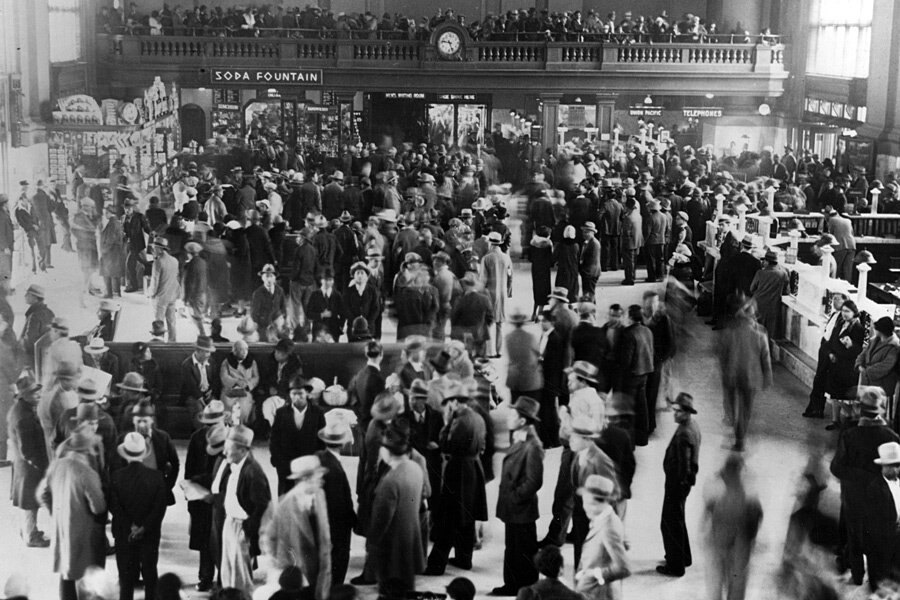
Visual AidA station hall in 1932
A Los Angeles railway station in 1932, its hall filled with people waiting for trains south. The Knowledge Bank explains that during the Depression authorities across the United States pressured, arrested and deported hundreds of thousands of people of Mexican descent — an estimated majority of them United States citizens by birth — and that a strike could be broken simply by deporting its leaders. Count how much of the floor is crowd. This is what stands behind Marta being put on a bus while Esperanza is not.
Mexicans and Mexican Americans at a Los Angeles railway station during the repatriation of 1932; Los Angeles Public Library collection. Source: Wikimedia Commons, public domain.
Think back over these chapters. A mother breathing easier at last; a daughter rubbing avocado into hands cracked by work, guarding a can of coins like a promise. In the fields, voices rise — Marta and the others calling everyone to walk out, to stand together against wages that keep families hungry. And a girl who believes they are right, and still bends to her work, because a sick mother and a far-off grandmother cannot eat justice. Then engines and shouting: officers moving through the camp, loading the strikers onto buses bound for a border, taking even those born on this side of it — while the girl who was once called a useless princess pulls her scorner into hiding.
Original passage written for Garden Heights — not a quotation from the novel.
1Claim: “Part 6 argues that Esperanza’s dilemma is meant to have no easy answer.” — choose the two details that best prove it.Claim & Evidence
2Reasons to join the strike, or Reasons to keep working? Tap each detail to sort it — tap again to switch sides. You can keep tapping to change your answer.Sort into two
◄ Reasons to join the strikeReasons to keep working ►
3Match each cause to its result. For each cause, pick its result.Cause & Effect
Marta leads a push to strike→
Esperanza keeps picking→
Immigration officers sweep the camp→
Esperanza hides Marta→
🧠Knowledge Bank question
4Fill both blanks to complete the reasoning.Build the Argument
The Knowledge Bank argues that the Mexican Repatriation was a particular injustice because , which shows that .
Part 5
Standardized Test
Reading passage · Strikes, Strikers & the Great Repatriation · SAT & TOEFL-style practice
Read the passage — the highlighted words are tested — then answer. Tap an answer, then tap it again to confirm.
SATCentral Ideas — the passage's main point
SATDetail — a fact stated in the passage
SATWords in Context — a word's meaning in this passage
SATInference — a conclusion the passage implies
TOEFLFactual Information — a fact stated in the passage
TOEFLProse Summary — the three sentences that sum it up
TOEFLInference — what the passage implies
Farm Strikes and Forced Deportation
The strike in Esperanza's camp is drawn from real history. During the 1930s, as the Great Depression pushed farm wages lower and lower, workers across California organized strikes, refusing to pick until growers agreed to fairer pay and conditions. These strikes took real courage, because the workers had almost no power and the growers had a great deal. Growers could evict striking families from camp housing, replace them with hungry newcomers, or call in officers, and a family that walked out risked losing its home along with its pay.
One weapon was especially cruel. Through the same decade, the United States carried out the Mexican Repatriation: blaming Mexicans for taking scarce jobs, officials pressured, arrested, and shipped hundreds of thousands of people of Mexican descent across the border to Mexico. Astonishingly, historians estimate that a majority of those forced out were actually United States citizens, many of them children born in this country who had never seen Mexico. The injustice of it is what gives Esperanza's dilemma its weight: to join the strike was to risk not only work but the right to stay.
Original passage written for Garden Heights — not a quotation from the novel.
1What does the passage mainly explain?SAT · Central Ideas
2Farm workers went on strike in order to win ___.TOEFL · Factual Information
3According to the passage, striking took courage because workers had ___.TOEFL · Factual Information
4One way growers broke strikes was to ___.SAT · Detail
5The Mexican Repatriation forced people of Mexican descent to ___.TOEFL · Factual Information
6Astonishingly, a majority of those forced out were ___.SAT · Detail
7In the passage, injustice most nearly means ___.SAT · Words in Context
8A grower could end a strike by having leaders ___.SAT · Inference
9Prose Summary (TOEFL).The passage explains the strikes of the 1930s and the weapon used to break them. This TOEFL task lists six sentences; choose the THREE that best capture the passage’s main ideas. The other three do not belong — they state minor details or ideas the passage does not present.TOEFL · Prose Summary
10Which event from Part 6 does this passage BEST help explain?TOEFL · Inference
Part 6 · Optional
Creative Writing
A bonus challenge to practice your English. Take your time and have fun with it.
About This Section
This writing task is optional and is not part of your auto-graded score. The feedback below checks only the basics — length, spelling, and grammar — not whether your ideas are right or wrong. It is meant for classroom discussion and creative practice, so feel free to use your imagination!
Writing Task — Part 6 “A Hard Choice”
Esperanza believes the strikers are right, yet she keeps working because her family needs the wages — a choice with no easy answer. Write about a time you faced a decision where both choices had something good and something hard about them. What were the two sides, what did you choose, and why? 6–10 sentences. End with how you feel about the choice now.
You can start with: “Both paths had a cost, and I could not have one without losing the other...”
0 / 40 words minimum
🗣 Teach It · Just for Fun (optional)
No right or wrong — close the screen and tell someone nearby what happened in this part. Can’t find anyone? Tell yourself out loud. The moment you teach it, you truly understand it.
Part 6 Complete!
You finished Los Aguacates & Los Espárragos of Esperanza Rising.
Here are your auto-graded results:
-
points out of 100
Teach it to someone
The best last step is to teach it. In your own words, explain what happened — retell a favorite scene, teach a character’s big choice, or sum up the main idea for a parent, friend, or classmate. When you can teach it clearly, you truly own it.
Independent study guide by Garden Heights. Not affiliated with or endorsed by Pam Muñoz Ryan. Contains original analysis only; no text from the novel is reproduced. Reference text: This workbook follows Pam Muñoz Ryan’s classic text (the standard Puffin edition sold worldwide). Revised 2023 UK editions change some wording and may not match the vocabulary studied here.
SAT® is a registered trademark of College Board, which is not affiliated with, and does not endorse, these materials. TOEFL® is a registered trademark of ETS. These materials are not endorsed or approved by ETS. Garden Heights is an independent provider of test-style reading practice.