New here? Just sign up with Google — your account includes Matilda, our gift book, forever.
Esperanza Rising · Garden Heights
Part 7
for Esperanza Rising · Part 7 · Los Duraznos
8 Parts40 min
What Happens in Part 7
Esperanza has almost saved enough — a hidden can of money orders that will bring Abuelita north at last. Meanwhile Miguel, so proud to have found work on the railroad, is suddenly laid off: the company has replaced its Mexican workers with men newly arrived from the Dust Bowl, who are so desperate they will do the same job for even less. The injustice stuns him, and it reopens the old argument between him and Esperanza about whether America truly rewards hard work or simply grinds the poor against one another. Their quarrel is sharp and sad. Then Esperanza reaches for her can — and the money orders are gone. Miguel is gone too, vanished without a word. Heartsick and furious, she is sure he has stolen the savings she bled for, the ticket to her grandmother, and she cannot understand how the boy she trusted could betray her. Part 7 ends in Esperanza’s darkest, most bitter hour: her long climb seems undone, her family’s hope stolen, and the one person she leaned on apparently a thief. It is the last deep valley before the mountain.
The false low point, dramatic irony, and a mystery for the reader
Cross-Curricular
What a dollar was worth in the Great Depression
Chapter Summary
Ch.
What happens
Los Duraznos
The Peaches — Miguel is laid off when cheaper Dust Bowl workers replace him; he and Esperanza quarrel about America’s promise; then her saved money orders vanish along with Miguel, and she believes he has stolen them.
Part 1
Vocabulary
Study 10 key words from Los Duraznos, then answer each question.
🧠Knowledge Bank · Words of Loss and Doubt
Lexical Semantics · Words of Loss and Doubt
Four words about money and the damage it does to trust. Savings is money set aside for later, and Esperanza’s is hidden in a small can — every coin of it earned by hand. A layoff is a loss of a job, often for many at once, and the railroad’s stuns Miguel. To betray is to break the trust of someone, which is what Esperanza believes Miguel has done when the can turns up empty. Bitter means full of hurt, anger, or resentment, and it is what the quarrel leaves behind. Read the four in order and you have the mechanism exactly. Esperanza is not wrong to be angry; she is wrong about who to be angry at. The money goes, and because it went the friendship nearly goes too — which is what poverty does that no wage table ever shows.
savingsn.Los Duraznos
Money set aside for later
“Her savings were hidden in a small can.”
layoffn.Los Duraznos
A loss of a job, often for many at once
“The railroad layoff stunned Miguel.”
betrayv.Los Duraznos
To break the trust of someone
“She believed Miguel had betrayed her.”
bitteradj.Los Duraznos
Full of hurt, anger, or resentment
“The quarrel left a bitter taste.”
replacev.Los Duraznos
To take the place of another
“Cheaper workers came to replace him.”
accusev.Los Duraznos
To blame someone for wrongdoing
“In her heart she began to accuse Miguel.”
vanishv.Los Duraznos
To disappear suddenly
“The money orders seemed to vanish overnight.”
furiousadj.Los Duraznos
Extremely angry
“Esperanza was furious and heartsick.”
trustn.Los Duraznos
A firm belief in someone’s honesty
“Her trust in Miguel was shaken.”
despairn.Los Duraznos
A total loss of hope
“For a night she sank into despair.”
ⓘ The vocabulary words in this list are selected to help you understand and complete this workbook. Some may not appear verbatim in the original novel.
🧠Knowledge Bank question
1According to the Knowledge Bank, what has Esperanza hidden in the small can?Los Duraznos
2To ‘betray’ someone is to keep their trust faithfully.Los Duraznos
3A loss of a job, often for many at once, is a ___.Los Duraznos
4Something ‘bitter’ is full of hurt or resentment.Los Duraznos
5Fill in each blank with the correct word.Los Duraznos
Word choices:vanishreplacesavingssneer- some words will not be used
Cheaper workers came to Miguel on the railroad.
Her money orders seemed to overnight.
6To ‘accuse’ someone is to ___.Los Duraznos
7To ‘vanish’ is to appear slowly over time.Los Duraznos
8Someone who is ‘furious’ is ___.Los Duraznos
9Fill in each blank with the correct word.Los Duraznos
Word choices:trustdespairlayoffbitter- some words will not be used
Her in Miguel was badly shaken.
For one night she sank into .
10‘Despair’ is a total loss of ___.Los Duraznos
Part 2
Comprehension
Show you understood what happens in Los Duraznos.
🧠Knowledge Bank · The Darkest Hour
Narrative Causality · The Darkest Hour
The narrative’s growing tension gives way to a crucial revelation and redirects the story’s direction. Esperanza has almost saved enough — a hidden can of money orders that will bring Abuelita north at last. Meanwhile Miguel, so proud to have found work on the railroad, is suddenly laid off: the company has replaced its Mexican workers with men newly arrived from the Dust Bowl, who are so desperate they will do the same job for even less. The injustice stuns him, and it reopens the old argument between him and Esperanza about whether America truly rewards hard work or simply grinds the poor against one another. Their quarrel is sharp and sad. Then Esperanza reaches for her can — and the money orders are gone. The accumulated tension makes “The Darkest Hour” a genuine story threshold.
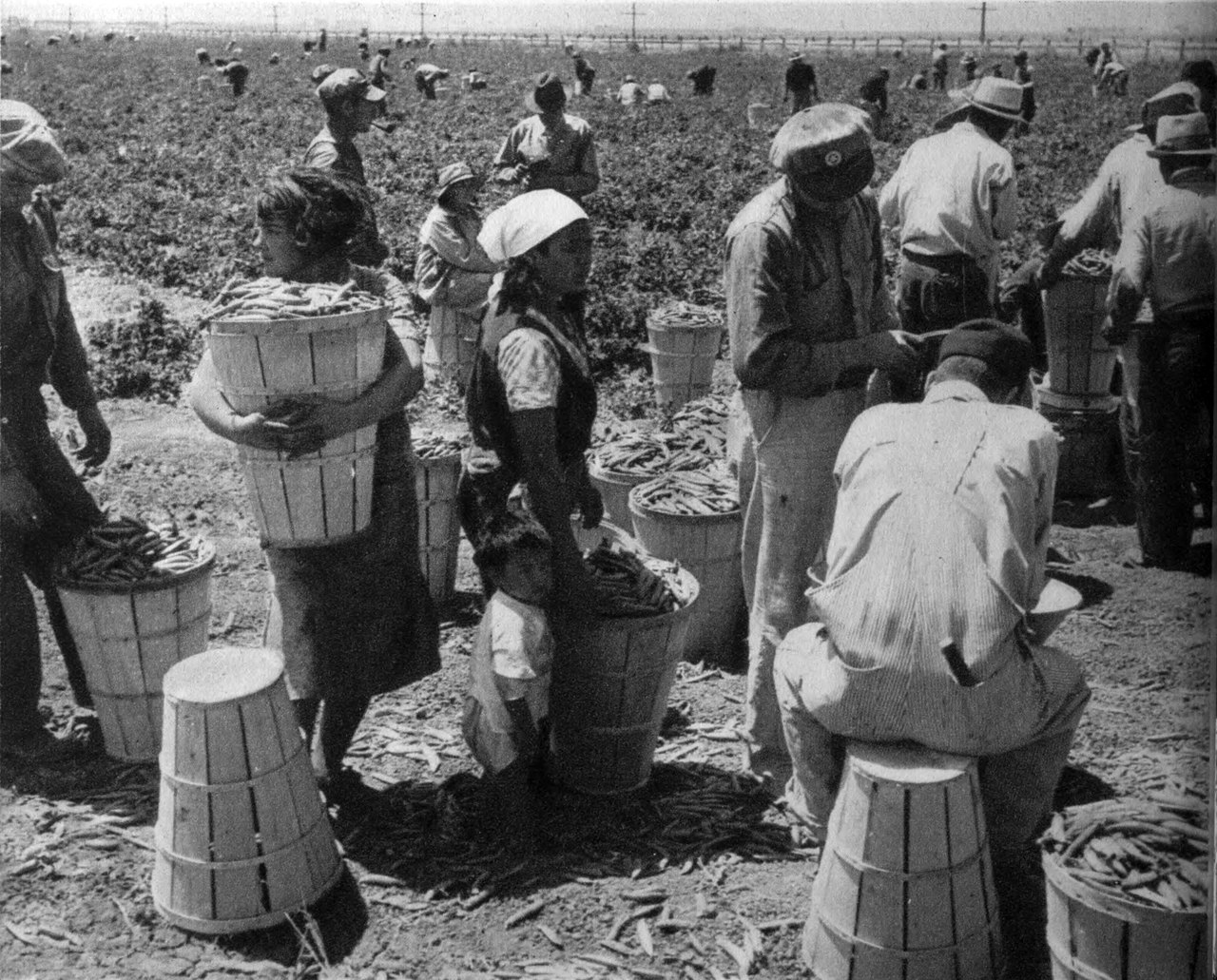
Visual AidPaid by the hamper
Migratory workers weighing peas in a California field in the 1930s. The Knowledge Bank explains that a farm worker might earn only a few cents for a heavy crate and that a whole day’s labor could bring less than two dollars. Look at the woman carrying the full hamper. Every one of those is a few cents, which is the arithmetic behind the can Esperanza has been filling for months.
Migratory workers weighing peas, California, 1939; Federal Writers' Project, Works Progress Administration. Source: Wikimedia Commons, public domain.
🧠Knowledge Bank question
1The Knowledge Bank explains that Miguel loses his railroad job because ___.Los Duraznos
2The layoff reopens Miguel and Esperanza’s argument about ___.Los Duraznos
3Esperanza’s savings are safe and untouched in Part 7.Los Duraznos
4When the money disappears, Esperanza believes that ___.Los Duraznos
5Write the numbers 1–5 in the boxes to show the correct order of events. Number 1 = what happens first.Los Duraznos
Miguel and Esperanza quarrel about America.
Miguel is laid off from the railroad.
Esperanza finds her money orders gone.
She concludes that Miguel has stolen them.
Esperanza has nearly saved enough for Abuelita.
6Esperanza is calm and untroubled when Miguel disappears.Los Duraznos
7The workers who replace Miguel are desperate because they ___.Los Duraznos
8The saved money orders were meant to ___.Los Duraznos
9The reader is told plainly that Miguel is guilty of theft.Los Duraznos
10Part 7 ends at Esperanza’s ___.Los Duraznos
Part 3
Literary Elements
Understanding HOW and WHY Pam Muñoz Ryan tells the story across Los Duraznos.
🧠Knowledge Bank · The False Bottom
Narrative Technique · The False Bottom
As the story nears its end, point, irony, and suspense turn earlier details into consequences. Part 7 is built as a false low point — the moment when everything seems lost, placed just before the turn upward. Ryan has trained us for this: the blanket’s zigzag promised that the deepest valley comes right before the climb. So when the money vanishes and Miguel disappears, an alert reader feels two things at once — Esperanza’s despair, and a flicker of trust that the pattern will hold. Notice how Ryan withholds the truth about Miguel to sharpen the fall. The darkness is real, but it is also a setup: the lower the valley here, the higher the mountain of Part 8 will feel. That authorial design makes “The False Bottom” a lesson in deliberate structure.
False low point
The vanished money and Miguel’s flight — the deepest valley, set just before the climb.
Dramatic irony
The reader, who knows Miguel’s loyalty, may doubt the theft Esperanza is sure of.
Suspense
The mystery of where the money went — a question that pulls the reader into Part 8.
🧠Knowledge Bank question
1According to the Knowledge Bank, why is this part called a false bottom?Los Duraznos
2Fill in each blank with the correct literary term.Los Duraznos
Word choices:false low pointdramatic ironysettingrhyme- some words will not be used
The stolen savings mark the before the rise.
When the reader doubts a truth the character accepts, it is .
3Dramatic irony is when the reader knows or suspects more than a character.Los Duraznos
4Ryan withholds the truth about the money mainly to build ___.Los Duraznos
5The blanket’s zigzag has trained the reader to expect that this deep valley comes right before a ___.Los Duraznos
6A false low point means the story is actually over.Los Duraznos
7The reader’s doubt about Miguel’s guilt shows Ryan trusts the reader to hold a ___.Los Duraznos
8Fill in each blank with the correct literary term.Los Duraznos
Word choices:suspensefalse low pointnarratormotif- some words will not be used
The unanswered question of the money creates .
Esperanza’s darkest hour is the story’s .
9Suspense here comes from a question the reader wants answered.Los Duraznos
10The clearest reason to keep trusting Miguel is his ___.Los Duraznos
Part 4
Think Deeper
Four deeper challenges — no single-word recall. Read, weigh the evidence, and reason it out.
🧠Knowledge Bank · What a Dollar Meant
Money in the Depression · What a Dollar Meant
To feel the weight of Esperanza’s stolen can, you have to know what money was worth in 1930. In the Depression, a farm worker might earn only a few cents for a heavy crate of fruit, and a whole day’s labor could bring less than two dollars. Yet those same dollars stretched surprisingly far: bread cost a nickel or a dime a loaf, and a modest week’s groceries might run a few dollars. This is the brutal arithmetic Esperanza lives inside — wages so low that saving even a small sum takes months of aching work, while a single illness or layoff can erase it overnight. Do that arithmetic on her can and the theft stops being a plot device. Months of crates, at cents apiece, carried by a girl who a year ago had never lifted anything — and the whole of it fits in a tin somebody can pick up with one hand.
Visual AidWhat a day in the field buys
Scale drawing for the Knowledge Bank on Depression money. The long bar is a whole day’s pay and the single segment below it is one loaf of bread, drawn at the same scale, so the twenty divisions are what the day actually buys. Card 3 is where most of it goes. Notice how little of the bar is left over — that leftover, repeated for months, is the whole of what was in the can.
A day's pay measured against a loaf of bread, from the figures in the Knowledge Bank. Drawn for Garden Heights Academy.
Think back over these chapters. A young man comes home with the news that the railroad has let him go — not because he did poorly, but because others, hungrier still, will do it for less. Hard words fly between him and the girl he has helped all year, about whether this country keeps any promise at all. Then a hand reaches under a mattress for a can that holds a year of aching work — and finds it empty. The friend is gone. And a girl who has climbed so far, coin by coin, feels the whole climb collapse beneath her, certain she has been robbed by the last person she trusted.
Original passage written for Garden Heights — not a quotation from the novel.
1Claim: “Part 7 is designed as a false low point — the deepest valley placed right before the rise.” — choose the two details that best prove it.Claim & Evidence
2What Esperanza believes, or What the careful reader suspects? Tap each detail to sort it — tap again to switch sides. You can keep tapping to change your answer.Sort into two
◄ What Esperanza believesWhat the careful reader suspects ►
3Match each cause to its result. For each cause, pick its result.Cause & Effect
Cheaper workers replace Miguel→
Miguel and Esperanza quarrel→
The money orders vanish→
Miguel disappears without a word→
🧠Knowledge Bank question
4Fill both blanks to complete the reasoning.Build the Argument
The Knowledge Bank argues that the stolen can is worse than a sum of money because , which shows that .
Part 5
Standardized Test
Reading passage · What a Dollar Was Worth in 1930 · SAT & TOEFL-style practice
Read the passage — the highlighted words are tested — then answer. Tap an answer, then tap it again to confirm.
SATCentral Ideas — the passage's main point
SATDetail — a fact stated in the passage
SATWords in Context — a word's meaning in this passage
SATInference — a conclusion the passage implies
TOEFLFactual Information — a fact stated in the passage
TOEFLInference — what the passage implies
The Value of a Depression-Era Dollar
When Esperanza's hidden money orders vanish, the loss is enormous, but to feel just how enormous, you have to understand money in the 1930s. During the Great Depression, wages for farm work were painfully low. A picker might earn only a few cents for filling a heavy crate of fruit, and a long day in the fields could bring home less than two dollars. Every coin was earned with an aching back, and a family often needed everyone, even children, to work just to eat. Against such wages, saving any real sum took months of steady, exhausting labor.
Yet those same dollars could buy a surprising amount, because prices were low too. A loaf of bread might cost only a nickel or a dime; a week's modest groceries for a family might run just a few dollars. This is the cruel math of Esperanza's world: money was hard to earn and slow to save, but a single setback, an illness, a layoff, a theft, could wipe out months of it in an instant, and drop a family into despair overnight. Her can of money orders was never just cash. It was time, sweat, and hope, saved coin by coin.
Original passage written for Garden Heights — not a quotation from the novel.
1What is the main idea of the passage?SAT · Central Ideas
2According to the passage, a picker might earn only ___ for a heavy crate of fruit.TOEFL · Factual Information
3A long day in the fields could bring home less than ___.SAT · Detail
4The passage says saving any real sum took ___.TOEFL · Factual Information
5Prices in 1930 were ___ compared with wages today.TOEFL · Factual Information
6The passage says a family often needed ___ to work just to eat.SAT · Detail
7In the passage, despair most nearly means ___.SAT · Words in Context
8A single setback that could wipe out savings included an illness, a layoff, or a ___.TOEFL · Factual Information
9The passage says the can of money orders was really ___.SAT · Inference
10Which event from Part 7 does this passage BEST help explain?TOEFL · Inference
Part 6 · Optional
Creative Writing
A bonus challenge to practice your English. Take your time and have fun with it.
About This Section
This writing task is optional and is not part of your auto-graded score. The feedback below checks only the basics — length, spelling, and grammar — not whether your ideas are right or wrong. It is meant for classroom discussion and creative practice, so feel free to use your imagination!
Writing Task — Part 7 “When Something Is Lost”
Esperanza loses a can of savings that stood for months of hard work and hope — and blames the person she trusted most. Write about a time you lost something you had worked hard for, or wrongly blamed someone. What happened, how did you feel, and what did you do? 6–10 sentences. End with what you understand now that you did not then.
You can start with: “I had worked so hard for it, and in one moment it seemed to be gone...”
0 / 40 words minimum
🗣 Teach It · Just for Fun (optional)
No right or wrong — tell someone nearby what happened in this part. Can’t find anyone? Tell yourself out loud. The moment you teach it, you truly understand it.
Part 7 Complete!
You finished Los Duraznos of Esperanza Rising.
Here are your auto-graded results:
-
points out of 100
Teach it to someone
The best last step is to teach it. In your own words, explain what happened — retell a favorite scene, teach a character’s big choice, or sum up the main idea for a parent, friend, or classmate. When you can teach it clearly, you truly own it.
Independent study guide by Garden Heights. Not affiliated with or endorsed by Pam Muñoz Ryan. Contains original analysis only; no text from the novel is reproduced. Reference text: This workbook follows Pam Muñoz Ryan’s classic text (the standard Puffin edition sold worldwide). Revised 2023 UK editions change some wording and may not match the vocabulary studied here.
SAT® is a registered trademark of College Board, which is not affiliated with, and does not endorse, these materials. TOEFL® is a registered trademark of ETS. These materials are not endorsed or approved by ETS. Garden Heights is an independent provider of test-style reading practice.