New here? Just sign up with Google — your account includes Matilda, our gift book, forever.
Fantastic Mr. Fox · Garden Heights Academy
Part 1
for Fantastic Mr. Fox · Part 1 · Chapters 1–3
a story by Roald Dahl
30 min6 Parts
This workbook is built on a solid pedagogical foundation, effectively integrating content and language learning based on the CLIL framework (Content and Language Integrated Learning), elevated by our unique 5th C — Connection — and an integrated Standardized Test section that weaves every SAT & TOEFL question type right into the novel, so learners build real test skills easily, naturally, and with fun.
💭 Before You Read · Just for Fun
No right or wrong answers — just think or chat about it: Have you ever read a story where the “thief” is the hero? Can taking something ever be excusable — for example, to feed a hungry family? And which animal do YOU think is the cleverest of all?
What Happens in Part 1
We meet three rich, greedy farmers — Boggis, Bunce and Bean. One is fat, one is short, and one is lean, but all three are nasty and cruel. Nearby, on top of a hill under a big tree, lives clever Mr. Fox with his family. Every night Mr. Fox creeps down to the farms and quietly steals a chicken, a duck, or a turkey to feed his children. The farmers are furious, and they decide to catch him. They hide outside his hole with their guns in the dark. When Mr. Fox pokes his nose out, they shoot — and they blow his tail clean off! But Mr. Fox is too quick, and he escapes back down his hole.
What We Will Learn
Literary Element
What It Means
Characterization
How a writer shows what characters are like through their looks, actions, and words
Setting
Where and when a story takes place
Rhyme & Repetition
How Dahl uses rhyming words and repeated phrases to make his writing fun and memorable
Chapter Summary
Chapter
Title & Key Events
Ch.1
The Three Farmers — we meet Boggis, Bunce and Bean, three rich, greedy, and disgusting farmers who all hate Mr. Fox
Ch.2
Mr. Fox — Mr. Fox and his family live in a hole on a hill; each night he cleverly steals food from one of the three farms
Ch.3
The Shooting — the farmers hide outside the hole with guns; they shoot off Mr. Fox’s tail, but he escapes underground
Copyright Notice
Independent study guide by Garden Heights Academy. Not affiliated with or endorsed by Roald Dahl or the Roald Dahl Story Company. No text from the novel is reproduced. Students should read the original book. Reference text: This workbook follows Roald Dahl’s classic text (the standard Puffin edition sold worldwide). Revised 2023 UK editions change some wording and may not match the vocabulary studied here.
Part 1
Vocabulary
Study 10 key words from Chapters 1–3, then answer each question.
🧠Knowledge Bank · The Night Hunter
Science · Foxes & Food ChainsA fox is a wild hunter. It sleeps by day and comes out at night to find food. Foxes belong to a food chain: grass feeds the hens, hens feed a hungry fox, and the fox stays alive. That is why a fox visits farms — a shed full of birds is an easy meal. Real foxes have sharp ears, a fine nose, and quiet feet, so they can creep close without a sound. Mr Fox does exactly this each night, slipping past three farms to feed his family. Nature made the fox a clever night hunter.
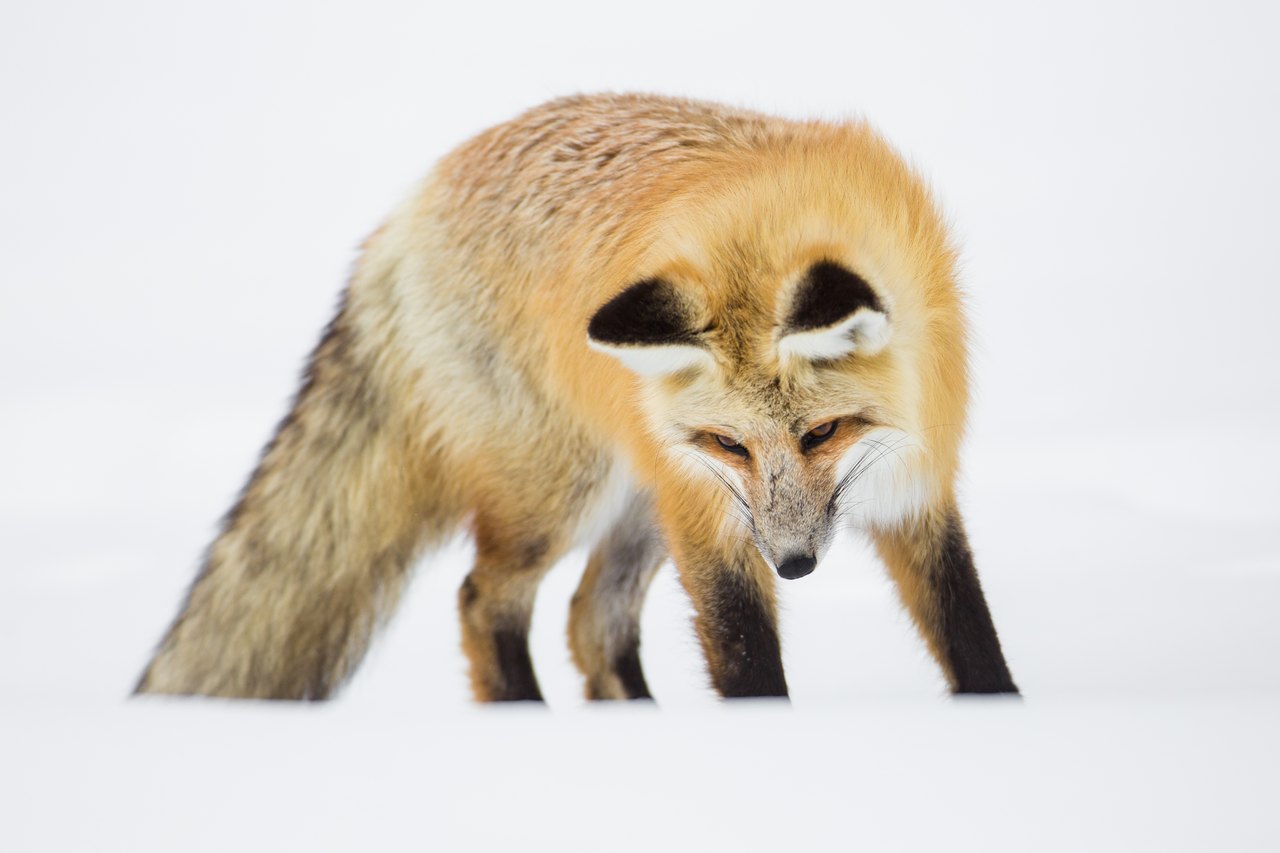
Visual AidA red fox on the hunt
Photograph by Neal Herbert for the National Park Service, taken in March 2016 near Mud Volcano in Yellowstone National Park, of a red fox stepping through deep snow with its head low and its ears forward, hunting. The Knowledge Bank explains that a fox is a wild hunter with sharp ears, a fine nose, and quiet feet, so it can creep close without a sound, and that it belongs to a food chain in which hens feed a hungry fox. This fox is listening and smelling for a meal hidden under the snow. It is a wild American fox in daylight, not Mr Fox creeping to a farm at night. Notice the ears turned forward — a fox hunts by sound as much as by sight.
Red fox hunting near Mud Volcano, Yellowstone National Park, March 2016; photograph by Neal Herbert, National Park Service. Source: Wikimedia Commons, public domain.
ⓘ Vocabulary words are selected to help you understand and complete this workbook. Some may not appear verbatim in the novel.
greedyadj.Ch.1
Always wanting more food, money, or things than you really need
“The three farmers were so greedy that they could never have enough.”
crueladj.Ch.1
Unkind; enjoying causing pain or trouble for others
“Boggis, Bunce and Bean were cruel men who did not care about anyone but themselves.”
crookn.Ch.1
A dishonest person; someone who cheats or steals
“These horrible crooks cared only about getting richer.”
disgustingadj.Ch.1
Horrible; so unpleasant it nearly makes you feel sick
“Bunce ate disgusting doughnuts filled with mashed goose-livers.”
enormousadj.Ch.1
Extremely large; very, very big
“Boggis was an enormous, pot-bellied man who ate three chickens every day.”
burrown.Ch.2
A hole or tunnel that an animal digs to live in
“Mr. Fox and his family lived in a cozy burrow under a great tree.”
cleveradj.Ch.2
Quick to understand and good at solving problems
“Mr. Fox was far too clever to be caught by three slow farmers.”
slyadj.Ch.2
Clever in a sneaky, tricky way
“With a sly grin, Mr. Fox chose which farm to visit that night.”
creptv.Ch.3
Moved slowly, quietly, and carefully so as not to be noticed
“Mr. Fox crept up the dark tunnel and sniffed the night air.”
escapev.Ch.3
To get away from danger or from being caught
“Mr. Fox managed to escape down his hole just as the guns went off.”
🧠Knowledge Bank question
1According to the Knowledge Bank, a fox visits farms because ___.Ch.1
2True or False: To be “cruel” means to be kind and gentle to everyone.Ch.1
3Mr. Fox and his family live in a hole they dug under a big tree. What is this kind of animal home called?Ch.2
4Fill in each blank with the correct word.Ch.2
Word choices:cleverslygreedycruel- some words will not be used
Mr. Fox is very — he is quick to think and good at solving problems.
He is also , choosing each farm with a sneaky, tricky grin.
5True or False: Something “enormous” is very, very small.Ch.1
6A dishonest person who cheats and steals is called a —Ch.1
7Mr. Fox is clever in a sneaky, tricky way. Which word describes this?Ch.2
8True or False: To “escape” means to get away from danger or from being caught.Ch.3
9Fill in each blank with the correct word.Ch.1
Word choices:disgustinggreedyenormousburrow- some words will not be used
Bunce eats doughnuts filled with mashed goose-livers.
All three farmers are , always wanting more than they need.
10Mr. Fox moved slowly and quietly out of his hole so that no one would hear him. Which word means this?Ch.3
Part 2
Comprehension
How well do you understand Chapters 1–3?
🧠Knowledge Bank · Reading for Who, What & Why
Reading Skill · Who, What, WhyGood readers ask three small questions as they read: who is in the scene, what they are doing, and why they do it. In Part 1 the who is three fat farmers and one sly fox. The what is stealing food at night. The why matters most: Mr Fox takes birds because his family is hungry, while the farmers guard their food out of spite. When you know the why, a story stops being a list of events and starts to make sense. Ask why after every page, and the whole book grows clearer and more meaningful.
Visual AidThree small questions
Diagram for the Knowledge Bank on who, what, and why. The three cards are the three questions the Knowledge Bank tells readers to ask, filled with the Knowledge Bank’s own answers for Part 1, and the card beneath is its point about the why. It does not add events from the book. Notice that only the why card is red — the Knowledge Bank says that is the question that matters most.
Who, what and why as described in the Knowledge Bank. Drawn for Garden Heights Academy.
🧠Knowledge Bank question
1The Knowledge Bank says the question that matters most is ___.Ch.1
2True or False: Boggis is a chicken farmer who is very lean and small.Ch.1
3What does Mr. Fox do each night to feed his family?Ch.2
4True or False: Mr. Fox and his family live in a hole under a big tree on top of a hill.Ch.2
5Put the events from Chapters 1–3 in the correct order. Write 1–4 (1 = first).Ch.1–3
The angry farmers hide outside the fox’s hole in the dark, holding their guns.
The farmers shoot and blow off Mr. Fox’s tail, but he escapes down his hole.
We meet the three greedy farmers, Boggis, Bunce and Bean.
Mr. Fox creeps down the hill at night and steals food from the farms.
6True or False: When the farmers shoot at Mr. Fox in Chapter 3, they kill him.Ch.3
7What exactly happens to Mr. Fox in Chapter 3, “The Shooting”?Ch.3
8Why do the three farmers want to catch Mr. Fox?Ch.1–2
9True or False: Bean drinks strong cider and almost never eats any food.Ch.1
10How does Mr. Fox usually know when the farmers are waiting near his hole?Ch.3
Part 3
Literary Elements
Understanding HOW and WHY Dahl writes Chapters 1–3 the way he does.
🧠Knowledge Bank · Boggis, Bunce & Bean
Language · AlliterationSay the farmers’ names out loud: Boggis, Bunce and Bean. Each one begins with the same hard B sound. When words start with the same sound, we call it alliteration. Dahl uses it on purpose. The repeated B makes the names bounce and stick in your head, so three separate men feel like one lumpy team of bullies. Alliteration also sounds a little rude and funny, which fits these mean, greedy farmers. Writers use this trick to make words musical and easy to remember. Listen for repeated first sounds, and you will hear Dahl’s playful alliteration.
📚 Literary Devices in This Part · definitions & examples
Characterization is how a writer shows what a character is like — through their looks, their actions, and their words. Dahl shows us Boggis, Bunce and Bean are nasty by describing how they look and what disgusting things they eat.Setting is where and when a story takes place. The setting of Fantastic Mr. Fox is a country valley with three big farms, and a wooded hill where Mr. Fox lives in a burrow under a great tree.Rhyme is when words end with the same sound, and repetition is repeating a word or phrase for effect. Dahl writes a little verse — “Boggis and Bunce and Bean / One fat, one short, one lean” — and repeats the farmers’ three names again and again so we never forget them.
The questions below are mixed — not grouped by device. Decide which device each one is about.
🧠Knowledge Bank question
1According to the Knowledge Bank, Boggis, Bunce and Bean is an example of ___.Ch.1
2True or False: The setting of a story is where and when it takes place.Ch.1–2
3Fill in the blanks with the correct words.Ch.1
Word choices:rhymerepetitionsettingcharacter- some words will not be used
Words that end with the same sound, like “Bean” and “lean,” make a . Saying the three names over and over is an example of .
4Where does the story mainly take place?Ch.1–2
5True or False: Repetition means using two words that end with the same sound, like “Bean” and “lean.”Ch.1
6Fill in the blanks with the correct words.Ch.1
Word choices:characterizationgreedyrhymesetting- some words will not be used
Showing what a character is like through looks and actions is called . Dahl uses it to show that all three farmers are nasty and .
7In the verse “Boggis and Bunce and Bean / One fat, one short, one lean,” the words “Bean” and “lean” end with the same sound. This is called —Ch.1
8True or False: Characterization means showing what a character is like through their looks, actions, and words.Ch.1
9Fill in the blanks with the correct words.Ch.2
Word choices:settinghillrhymefarmer- some words will not be used
The time and place of a story is called the . Mr. Fox lives in a burrow under a tree on top of a .
10Which of these from Part 1 is the best example of Dahl building the SETTING?Ch.1–2
Part 4
Think Deeper
Four deeper challenges — no single-word recall. Read, weigh the evidence, and reason it through.
🧠Knowledge Bank · Cheering for a Thief?
Ethics · Right & WrongMr Fox is a thief — he steals birds that are not his. Yet most readers cheer for him. Why? Dahl makes the three farmers cruel and greedy, and he makes Mr Fox brave, clever, and loving to his family. So we forgive the stealing. It helps to stop and think for yourself. Taking food to feed hungry children is not the same as taking out of greed. A good reader can enjoy a clever hero and still ask a hard question: is it right? Deciding what you truly believe is the work of your own conscience.
1Claim: “The three farmers are rich and powerful but mean and hated.” — choose the two details that best prove it.Claim & Evidence
2About the three farmers, or about Mr. Fox? Tap each item to sort it — tap again to switch sides. You can keep tapping to change your answer.Sort into two
◄ The three farmersMr. Fox ►
3Match each cause to its result. For each cause, pick its result.Cause & Effect
Mr. Fox raids the farms each night→
The farmers want to catch him→
Mr. Fox pokes his nose out→
The war has begun→
🧠Knowledge Bank question
4Fill both blanks to complete the reasoning.Build the Argument
The Knowledge Bank says most readers forgive Mr Fox's stealing because , yet a good reader can still ask .
Part 5
Standardized Test · Vocabulary in Context & Main Idea
Part 1 builds four exam reading skills — Vocabulary in Context, Main Idea, Inference, and Author’s Purpose — in the styles the SAT and TOEFL use. Read the passage (the highlighted words are tested below), then choose the answer best supported by the text.
Read the passage — the highlighted words are tested — then answer. Tap an answer, then tap it again to confirm.
SATWords in Context — a word's meaning in this passage
SATInference — a conclusion the passage implies
SATCentral Ideas — the passage's main point
SATText Structure & Purpose — how the passage is built, and why
TOEFLFactual Information — a fact stated in the passage
TOEFLVocabulary — a tested word's meaning here
TOEFLInference — what the passage implies
How Foxes Survive by Instinct
The red fox is one of the most successful wild animals on Earth. Foxes live almost everywhere, from remote mountains to busy city parks, because they adapt to nearly any home. A fox is not big or strong; it survives with sharp senses, a clever brain, and immense patience. Its nose is astonishingly keen: it can detect the faint scent of a person or a dog on the night air, and even smell a meal hidden under deep snow. Foxes do most of their hunting after dark, when their excellent hearing guides them, so they rely on smell and sound far more than on sight. Winter is the hardest season, for food grows scarce, and a fox must endure cold, hunger, and danger from hunters. Yet if a threat appears, it makes its escape with an abrupt turn, vanishes, and waits, perfectly still, until the danger has passed.
Original passage written for Garden Heights — not a quotation from the novel.
1A clever brain is one that is ___.SAT · Words in Context
2According to the passage, a fox hunts mostly by using its —TOEFL · Factual Information
3According to the passage, why can foxes live almost everywhere?TOEFL · Factual Information
4To make an escape from a threat is to ___.SAT · Words in Context
5According to the passage, when do foxes do most of their hunting?TOEFL · Factual Information
6The passage most strongly suggests that a fox facing danger survives by —SAT · Inference
7Which statement best expresses the central idea of the passage?SAT · Central Ideas
8In the passage, the word “scarce” is closest in meaning to —TOEFL · Vocabulary
9The passage most strongly suggests that a fox hunting at night —TOEFL · Inference
10Why does the author mention a meal hidden under deep snow?SAT · Text Structure & Purpose
Part 6 · Optional
Creative Writing
A bonus challenge to practice your English.
About This Section
This writing task is optional and not part of your auto-graded score. Feedback checks length, spelling, and grammar only.
Writing Task — Part 1 “The Shooting”
Imagine you are Mr. Fox on the night the farmers are hiding outside with their guns. What do you smell, hear, and feel as you decide whether to leave your hole? Write at least 40 words.
You can start with: “I poked my nose out into the cold night air, and at once I smelled something that made my fur stand up…”
0 / 40 words minimum
🗣 Teach It · Just for Fun (optional)
No right or wrong — close the screen and tell someone nearby what happened in this part. Can’t find anyone? Tell yourself out loud. The moment you teach it, you truly understand it.
Part 1 Complete!
You finished Chapters 1–3 of Fantastic Mr. Fox.
Here are your auto-graded results:
-
points out of 100
Teach it to someone
The best last step is to teach it. In your own words, explain what happened — retell a favorite scene, teach a character’s big choice, or sum up the main idea for a parent, friend, or classmate. When you can teach it clearly, you truly own it.
SAT® is a registered trademark of College Board, which is not affiliated with, and does not endorse, these materials. TOEFL® is a registered trademark of ETS. These materials are not endorsed or approved by ETS. Garden Heights is an independent provider of test-style reading practice.