New here? Just sign up with Google — your account includes Matilda, our gift book, forever.
📚
Garden Heights Academy
Members sign in to continue.
Fantastic Mr. Fox · Garden Heights Academy
Part 2
for Fantastic Mr. Fox · Part 2 · Chapters 4–6
a story by Roald Dahl
30 min6 Parts
This workbook is built on a solid pedagogical foundation, effectively integrating content and language learning based on the CLIL framework (Content and Language Integrated Learning), elevated by our unique 5th C — Connection — and an integrated Standardized Test section that weaves every SAT & TOEFL question type right into the novel, so learners build real test skills easily, naturally, and with fun.
💭 Before You Read · Just for Fun
No right or wrong answers — just think or chat about it: Have you ever watched a huge machine — a digger, a crane — tearing up the ground? Was it exciting or a little scary? When does “never giving up” stop being brave and become stubborn? And have you ever raced against someone (or something) much faster than you?
What Happens in Part 2
The angry farmers will not give up. They grab their shovels and begin to dig Mr. Fox out of his hole. But foxes can dig far faster than men, so Mr. Fox and his family simply dig deeper and deeper, always staying just out of reach. Mrs. Fox is so proud she calls her husband “a fantastic fox.” When digging by hand does not work, Bean has a nasty idea: the farmers bring in two gigantic mechanical diggers. The huge machines tear the whole top off the hill, leaving an enormous crater — but the clever foxes are still racing ahead, deep underground.
What We Will Learn
Literary Element
What It Means
Conflict
The struggle or problem between characters that drives a story forward
Suspense
The excited, nervous feeling that makes you want to know what happens next
Exaggeration
Making something sound much bigger or more extreme than it really is, for effect
Chapter Summary
Chapter
Title & Key Events
Ch.4
The Terrible Shovels — the farmers dig with shovels; the foxes dig deeper to escape; Mrs. Fox calls Mr. Fox “a fantastic fox”
Ch.5
The Terrible Tractors — tired of digging by hand, the farmers bring in two gigantic mechanical diggers to tear out the hill
Ch.6
The Race — the machines dig terrifyingly fast and flatten the hilltop into a huge crater, but the foxes dig for their lives and stay ahead
Copyright Notice
Independent study guide by Garden Heights Academy. Not affiliated with or endorsed by Roald Dahl or the Roald Dahl Story Company. No text from the novel is reproduced. Students should read the original book. Reference text: This workbook follows Roald Dahl’s classic text (the standard Puffin edition sold worldwide). Revised 2023 UK editions change some wording and may not match the vocabulary studied here.
Part 1
Vocabulary
Study 10 key words from Chapters 4–6, then answer each question.
🧠Knowledge Bank · How Foxes Dig
Science · Burrowing AnimalsFoxes are champion diggers. With strong front paws and hard claws, a fox can carve a home called a den or an earth deep in the soil. The den has long tunnels and several doors, so the fox can always slip out a back way. When danger comes, a frightened fox digs astonishingly fast, throwing soil behind it in a spray. This tunnelling keeps foxes, rabbits, and badgers safe below ground, away from bigger hunters. Dahl builds his whole chase on this real fact: no farmer with a spade can ever out-dig a wild fox.
Visual AidA den with a back way out
Diagram for the Knowledge Bank on burrowing animals. The cross-section shows what the Knowledge Bank describes, a den carved deep in the soil with long tunnels and several doors so the fox can always slip out a back way. The shape is simplified, not drawn from a real den. Notice how many doors reach the surface — that is why no farmer waiting at one hole can trap a fox.
Den, tunnels and several doors as described in the Knowledge Bank. Drawn for Garden Heights Academy.
ⓘ Vocabulary words are selected to help you understand and complete this workbook. Some may not appear verbatim in the novel.
shoveln.Ch.4
A tool with a wide blade and a long handle, used for digging
“The three farmers attacked the hill with their shovels, throwing up great heaps of earth.”
furiousadj.Ch.4
Extremely angry
“The farmers were furious that one small fox kept slipping away from them.”
tremblev.Ch.4
To shake, often because of fear or cold
“The little foxes began to tremble as the shovels crashed down above them.”
mechanicaladj.Ch.5
Worked by a machine, not by hand
“Two mechanical diggers roared up the lane, their steel jaws ready to tear the hill apart.”
giganticadj.Ch.5
Extremely large; huge
“The gigantic machines made the farmers’ shovels look like little toys.”
exhaustedadj.Ch.4
Extremely tired; with no energy left
“After digging all night, the foxes were exhausted, but they did not dare to stop.”
cratern.Ch.6
A very large, deep hole in the ground
“By morning the whole top of the hill was gone, leaving a huge crater.”
desperateadj.Ch.6
Feeling there is little hope, and ready to try anything
“In a desperate race, the foxes dug downward as fast as their paws could move.”
mockv.Ch.6
To laugh at or make fun of someone in an unkind way
“The watching villagers began to mock the farmers for destroying a whole hill over one fox.”
terrifiedadj.Ch.4
Extremely frightened
“The small foxes were terrified, but their father stayed calm and kept them digging.”
🧠Knowledge Bank question
1According to the Knowledge Bank, a fox den has several doors so that ___.Ch.4
2True or False: To be “furious” means to be calm and happy.Ch.4
3The two enormous diggers were worked by engines, not by hand. Which word describes machines like this?Ch.5
4Fill in each blank with the correct word.Ch.5–6
Word choices:giganticcratershovelfurious- some words will not be used
The two machines were so huge that they made the shovels look like toys.
By morning they had dug an enormous where the hilltop used to be.
5True or False: If you are “exhausted,” you are full of energy and not at all tired.Ch.4
6A very large, deep hole in the ground is called a —Ch.6
7The foxes had almost no hope left, yet they were ready to dig with everything they had. Which word describes how they felt?Ch.6
8True or False: To “mock” someone means to make fun of them in an unkind way.Ch.6
9Fill in each blank with the correct word.Ch.4
Word choices:terrifiedtremblemockcrater- some words will not be used
The small foxes were so frightened they began to as the shovels crashed above them.
They were , but their father kept them calm and digging.
10Something that is extremely large — like the diggers — can be described as —Ch.5
Part 2
Comprehension
How well do you understand Chapters 4–6?
🧠Knowledge Bank · Following the Action
Reading Skill · SequencingPart 2 moves fast, so track it in order. First the farmers wait with guns. Then they dig with spades. Then they bring huge machines. Each step is bigger than the last. Putting events in the right order is called sequencing, and it helps you follow an exciting chase without getting lost. Watch for time words like first, then, next, and at last; they are signposts that show what happens when. If you can retell the steps in order, you truly understand the action. Good readers keep the events lined up like beads on a string.
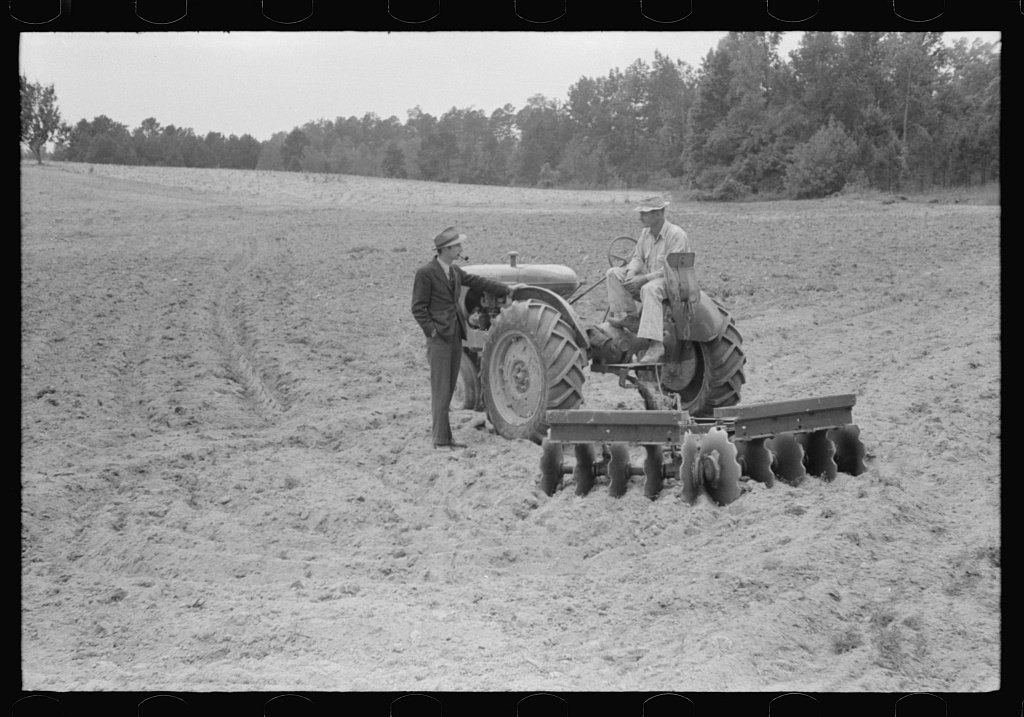
Visual AidA tractor and its disc plow
Photograph taken in October 1940 for the Farm Security Administration of a farmer, Emery Hooper, on his new tractor and disc plow in a field near Prospect Hill, North Carolina, while a government farm supervisor stands beside it talking with him. The Knowledge Bank says Part 2 moves in steps that each grow bigger than the last: first the farmers wait with guns, then they dig with spades, then they bring huge machines. This is what a farm machine of that era looked like, a tractor dragging a row of steel discs that tear up the ground. It is a working farm in America, and this machine is plowing a field, not chasing a fox. Notice how much earth one machine turns in a single pass — that is the step the farmers climb to.
Farmer Emery Hooper with his tractor and disc plow, Caswell County, North Carolina, October 1940; Farm Security Administration, Library of Congress. Source: Wikimedia Commons, public domain.
🧠Knowledge Bank question
1The Knowledge Bank says time words like first, then, next, and at last are ___.Ch.4
2True or False: Mrs. Fox is so proud of her husband that she calls him “a fantastic fox.”Ch.4
3When digging by hand does not work, what do the farmers bring in Chapter 5?Ch.5
4True or False: By the end of Chapter 6, the machines have dug away the whole top of the hill.Ch.6
5Put the events from Chapters 4–6 in the correct order. Write 1–4 (1 = first).Ch.4–6
The foxes dig deeper and faster, escaping the shovels.
The machines flatten the hilltop into a huge crater, but the foxes stay ahead.
Bean fetches machines to tear the hill apart.
The farmers begin digging the hill with their shovels.
6True or False: The farmers give up and go home as soon as the foxes escape the shovels.Ch.5
7Why can the foxes stay ahead of the farmers in Chapter 4, even without any machines?Ch.4
8What do the watching villagers think of the farmers by the end of Part 2?Ch.6
9True or False: The foxes find the race against the machines easy and relaxing.Ch.6
10By the end of Part 2, who is winning the battle?Ch.6
Part 3
Literary Elements
Understanding HOW and WHY Dahl writes Chapters 4–6 the way he does.
🧠Knowledge Bank · The Giant Crater
Language · HyperboleDahl says the farmers dig away so much of the hill that they leave a crater. A real crater is the giant bowl blasted out by a volcano or a falling meteor — huge and violent. A dug-up English hillside is not really that big. Calling it a crater is hyperbole, which means a wild exaggeration on purpose. Dahl stretches the truth to show how crazy the farmers have become: they will wreck a whole hill to catch one small fox. Exaggeration also makes us laugh. Look for over-the-top words, and you will spot Dahl’s bold hyperbole.
📚 Literary Devices in This Part · definitions & examples
Conflict is the struggle or problem between characters that drives a story forward. In Part 2 the conflict is clear: the farmers are trying to dig the foxes out, and the foxes are trying to escape by digging deeper.Suspense is the excited, nervous feeling that makes you want to know what happens next. As the machines roar closer and the foxes dig for their lives, Dahl keeps us on the edge of our seats, wondering who will win the race.Exaggeration means making something sound much bigger or more extreme than it really is, for effect. Dahl says the machines tear off the whole top of the hill, leaving a giant crater — an exciting, larger-than-life way of showing the farmers’ wild anger.
The questions below are mixed — not grouped by device. Decide which device each one is about.
🧠Knowledge Bank question
1According to the Knowledge Bank, calling the dug-up hillside a crater is ___.Ch.4–6
2True or False: Suspense means making something sound far bigger or more extreme than it really is.Ch.6
3Fill in the blanks with the correct words.Ch.6
Word choices:exaggerationcratersuspensesetting- some words will not be used
Making something sound far bigger than real life is called . Dahl uses it when the machines leave a giant where the hill used to be.
4As the machines dig faster and the foxes dig for their lives, Dahl makes us nervous and eager to know who will win. This feeling is called —Ch.6
5True or False: Exaggeration means making something sound much bigger or more extreme than it really is.Ch.5–6
6Fill in the blanks with the correct words.Ch.4–6
Word choices:conflictdeeperrhymesetting- some words will not be used
The struggle between the farmers and the foxes is the story’s . The foxes win each round by digging and faster.
7Dahl describes the machines flattening an entire hilltop into a giant crater. Making something sound much bigger than real life, for effect, is called —Ch.6
8True or False: Conflict is the struggle or problem between characters that drives a story forward.Ch.4–6
9Fill in the blanks with the correct words.Ch.6
Word choices:suspensewinconflictsetting- some words will not be used
The nervous, excited feeling that keeps us reading is called . Dahl builds it by making us wonder who will the race.
10Dahl says the machines flattened the ENTIRE hilltop into a giant crater. Which literary element is he leaning on here?Ch.5–6
Part 4
Think Deeper
Four deeper challenges — no single-word recall. Read, weigh the evidence, and reason it through.
🧠Knowledge Bank · When Anger Goes Too Far
Social-Emotional · AngerAt the start the farmers only wanted to protect their food. But when the fox keeps winning, they grow furious. Their anger pushes them to tear up a whole hill and even stop eating and sleeping. Dahl is showing that anger can make people foolish. When we let a bad feeling take over, we stop thinking clearly and do things we later regret. A wise person notices anger rising and chooses to calm down. As you read, watch how the calm foxes keep their heads while the raging farmers lose theirs. Staying calm is a quiet kind of strength.
1Claim: “The foxes survive the farmers’ machines by digging deeper.” — choose the two details that best prove it.Claim & Evidence
2The farmers’ brute force, or the foxes’ quick digging? Tap each item to sort it — tap again to switch sides. You can keep tapping to change your answer.Sort into two
◄ The farmers’ brute forceThe foxes’ quick digging ►
3Match each cause to its result. For each cause, pick its result.Cause & Effect
The farmers attack with shovels→
The farmers bring in tractors→
The machines rip up the hill→
Brute force keeps failing→
🧠Knowledge Bank question
4Fill both blanks to complete the reasoning.Build the Argument
The Knowledge Bank says the farmers' anger pushes them to , which shows that .
Part 5
Standardized Test · Main Idea & Detail
Part 2 sharpens two core exam skills — Main Idea and Factual Detail — with Vocabulary in Context practice, in the styles the SAT and TOEFL use. Read the passage (the highlighted words are tested below), then choose the answer best supported by the text.
Read the passage — the highlighted words are tested — then answer. Tap an answer, then tap it again to confirm.
SATWords in Context — a word's meaning in this passage
SATInference — a conclusion the passage implies
SATText Structure & Purpose — how the passage is built, and why
TOEFLFactual Information — a fact stated in the passage
TOEFLProse Summary — the three sentences that sum it up
The Tractor's Transformation of Farming
For most of history, farmers did every task by hand: they dug with shovels, cut their grain with curved blades, and relied on horses and oxen to pull the heaviest loads. The work was slow and left them exhausted. Then mechanical power began to transform the countryside, and the tractor was the most remarkable invention of all. One farmer operating a tractor could plow in a morning what had once taken days. Change came gradually at first, because many farmers could not afford the new machines, but by the middle of the twentieth century tractors had replaced horses on most farms. Machines made farms far more efficient, yet power brought a new danger: a machine has no judgment of its own. It does exactly what the person driving it commands, wise or foolish, and a careless command can scar a field, or a whole hillside, in a single afternoon.
Original passage written for Garden Heights — not a quotation from the novel.
1Farmers left exhausted were ___.SAT · Words in Context
2According to the passage, what replaced horses on most farms?TOEFL · Factual Information
3According to the passage, what pulled the heaviest loads before machines arrived?TOEFL · Factual Information
4Mechanical power is power that comes from ___.SAT · Words in Context
5According to the passage, what could one farmer with a tractor do?TOEFL · Factual Information
6The passage most strongly suggests that a machine is dangerous mainly because it —SAT · Inference
7Prose Summary (TOEFL).The passage traces how machines changed farming. This TOEFL task lists six sentences; choose the THREE that best capture the passage’s main ideas. The other three do not belong — they state minor details or ideas the passage does not present.TOEFL · Prose Summary
8According to the passage, why did change come gradually at first?TOEFL · Factual Information
9As used in the passage, the word “efficient” most nearly means —SAT · Words in Context
10Why does the author say that a machine “has no judgment of its own”?SAT · Text Structure & Purpose
Part 6 · Optional
Creative Writing
A bonus challenge to practice your English.
About This Section
This writing task is optional and not part of your auto-graded score. Feedback checks length, spelling, and grammar only.
Writing Task — Part 2 “The Race”
Imagine you are one of the small foxes, digging as fast as you can while the giant machines roar above your head. What do you hear, feel, and think as you race downward? Write at least 40 words.
You can start with: “The ground shook above us, and my paws were aching, but I did not dare to stop digging because…”
0 / 40 words minimum
🗣 Teach It · Just for Fun (optional)
No right or wrong — close the screen and tell someone nearby what happened in this part. Can’t find anyone? Tell yourself out loud. The moment you teach it, you truly understand it.
Part 2 Complete!
You finished Chapters 4–6 of Fantastic Mr. Fox.
Here are your auto-graded results:
-
points out of 100
Teach it to someone
The best last step is to teach it. In your own words, explain what happened — retell a favorite scene, teach a character’s big choice, or sum up the main idea for a parent, friend, or classmate. When you can teach it clearly, you truly own it.
SAT® is a registered trademark of College Board, which is not affiliated with, and does not endorse, these materials. TOEFL® is a registered trademark of ETS. These materials are not endorsed or approved by ETS. Garden Heights is an independent provider of test-style reading practice.