New here? Just sign up with Google — your account includes Matilda, our gift book, forever.
📚
Garden Heights Academy
Members sign in to continue.
Fantastic Mr. Fox · Garden Heights Academy
Part 6
for Fantastic Mr. Fox · Part 6 · Chapters 13–14
a story by Roald Dahl
30 min6 Parts
This workbook is built on a solid pedagogical foundation, effectively integrating content and language learning based on the CLIL framework (Content and Language Integrated Learning), elevated by our unique 5th C — Connection — and an integrated Standardized Test section that weaves every SAT & TOEFL question type right into the novel, so learners build real test skills easily, naturally, and with fun.
💭 Before You Read · Just for Fun
No right or wrong answers — just think or chat about it: If you had to make food last a whole winter with no refrigerator, what would you do? Have you ever doubted whether a friend’s plan was right — and did you say so out loud? And where does your family keep its emergency snacks?
What Happens in Part 6
Mr. Fox leads Badger and the foxes along a new tunnel to Bunce’s giant storehouse. Inside, they find a vast store of ducks, geese, hams, and bacon hanging everywhere. They carefully select a modest amount — only what they need — to share with all the families. But then Badger begins to feel uneasy. He has doubts: is taking the farmers’ food really right? Mr. Fox argues back: their families are starving, and the farmers are cruel men who are trying to kill them. In the end, Mr. Fox convinces Badger, and the two friends dig on toward Bean’s farm.
What We Will Learn
Literary Element
What It Means
Imagery
Words that paint a picture by appealing to the senses (sight, smell, taste)
Foil
A character who is different from another, so their differences stand out
Persuasion
Using good reasons to change someone’s mind
Chapter Summary
Chapter
Title & Key Events
Ch.13
Bunce’s Giant Storehouse — the tunnel reaches Bunce’s storehouse, full of ducks, geese, and hams; they take a modest amount to share
Ch.14
Badger Has Doubts — Badger worries that taking the food is wrong; Mr. Fox argues their families are starving and the farmers are cruel, and convinces him
Copyright Notice
Independent study guide by Garden Heights Academy. Not affiliated with or endorsed by Roald Dahl or the Roald Dahl Story Company. No text from the novel is reproduced. Students should read the original book. Reference text: This workbook follows Roald Dahl’s classic text (the standard Puffin edition sold worldwide). Revised 2023 UK editions change some wording and may not match the vocabulary studied here.
Part 1
Vocabulary
Study 10 key words from Chapters 13–14, then answer each question.
🧠Knowledge Bank · Where Farm Food Comes From
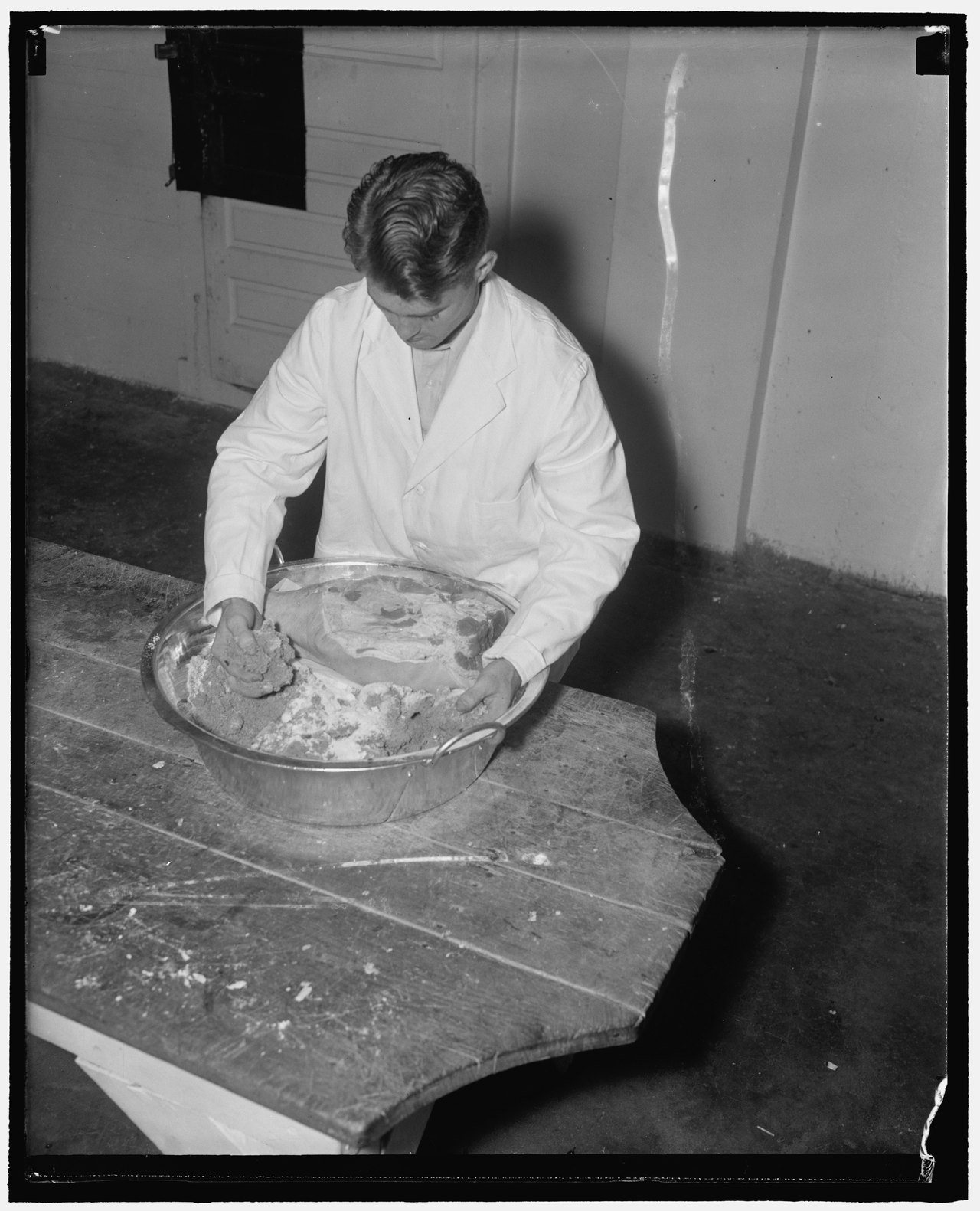
Agriculture · Farm FoodWhere does all the food in Bunce’s storehouse come from? From farms. Farmers raise ducks, geese, and chickens for their meat and eggs, and pigs for ham and bacon. Long ago, before fridges, people kept meat from spoiling by smoking and salting it, then hanging it in a cool, dark store. That is why Bunce’s room is packed with hanging birds and cured hams. To a wild fox, a farm is simply a place bursting with easy prey. Farming feeds people, but it also draws hungry hunters. Behind every full storehouse stand months of careful farming.
Visual AidCuring a ham with salt
Photograph by the Harris and Ewing studio, taken in 1938, of a man rubbing a cured ham in a basin of salt, brown sugar, and saltpeter, the step that came just before the ham was hung in the smoke. The Knowledge Bank explains that long ago, before fridges, people kept meat from spoiling by smoking and salting it and then hanging it in a cool, dark store, which is why Bunce’s room is packed with hanging birds and cured hams. This is the salting, done by hand. The man is a curer at work in America in the 1930s, not a farmer in the story, and the ham will be smoked, not stolen. Notice how thoroughly he works the salt in — every surface has to be covered or the meat will rot.
Rubbing a cured ham with salt, brown sugar, and saltpeter before smoking, 1938; photograph by Harris and Ewing, Library of Congress. Source: Wikimedia Commons, public domain.
ⓘ Vocabulary words are selected to help you understand and complete this workbook. Some may not appear verbatim in the novel.
storehousen.Ch.13
A building where food or goods are kept in large amounts
“Bunce’s storehouse was packed from floor to ceiling with food.”
suppliesn.Ch.13
Food and goods that are kept ready to be used
“The farmer kept enough supplies to last for many months.”
vastadj.Ch.13
Extremely large in size or amount
“A vast number of ducks and geese hung from the ceiling.”
selectv.Ch.13
To choose something carefully
“They paused to select only the plumpest birds.”
modestadj.Ch.13
Not too much; small and reasonable in amount
“They took only a modest share, never more than they needed.”
doubtn./v.Ch.14
A feeling of not being sure about something
“Badger was full of doubt about whether the plan was right.”
arguev.Ch.14
To give reasons for or against something
“Mr. Fox began to argue that taking the food was perfectly fair.”
honestadj.Ch.14
Truthful; not lying, cheating, or stealing
“Badger had always tried to be an honest animal.”
deservev.Ch.14
To have earned something, good or bad, by your actions
“Mr. Fox said the cruel farmers deserved to lose a little of their food.”
convincev.Ch.14
To make someone believe or agree with you
“In the end, Mr. Fox managed to convince Badger that he was right.”
🧠Knowledge Bank question
1According to the Knowledge Bank, before fridges people kept meat from spoiling by ___.Ch.13
2True or False: Something “vast” is extremely large in size or amount.Ch.13
3The foxes did not grab everything — they chose only the best birds with care. Which word means to choose carefully?Ch.13
4Fill in each blank with the correct word.Ch.13
Word choices:suppliesmodesthonestdoubt- some words will not be used
Bunce’s store held enough to last for months.
The foxes took only a share — never more than they needed.
5True or False: A “doubt” is a feeling of not being sure about something.Ch.14
6Mr. Fox gave clear reasons for why taking the food was fair. Which word means to give reasons for or against something?Ch.14
7Mr. Fox said the cruel farmers had earned their bad luck by their own actions. Which word means to have earned something by what you do?Ch.14
8True or False: To “convince” someone means to make them believe or agree with you.Ch.14
9Fill in each blank with the correct word.Ch.14
Word choices:honestconvincevastselect- some words will not be used
Badger had always tried to be an animal who never stole.
It took some time for Mr. Fox to him that the plan was fair.
10Someone who is truthful and never lies, cheats, or steals is —Ch.14
Part 2
Comprehension
How well do you understand Chapters 13–14?
🧠Knowledge Bank · Reading Both Sides
Reading Skill · Comparing ViewsPart 6 holds a small argument, so a good reader listens to both sides. Badger says taking the food is stealing and feels wrong. Mr Fox answers that the farmers are trying to kill their families, and that the foxes take only what they need. When two characters disagree, do not rush to pick one. Weigh each reason fairly, as a judge would. Comparing viewpoints helps you understand people who think differently from you. It also helps you decide, with care, what you truly believe. Hearing both sides before you judge is the mark of a thoughtful, fair-minded reader.
Visual AidWeigh both sides, like a judge
Diagram for the Knowledge Bank on comparing views. The two pans of the scale hold the two sides the Knowledge Bank sets out, Badger’s worry that taking the food is stealing and Mr Fox’s answer that the farmers are trying to kill their families; the red note is the Knowledge Bank’s instruction to weigh each reason fairly. It does not decide the argument. Notice that the scale is drawn level — the reader, not the diagram, is the judge.
Badger's side and Mr Fox's side as described in the Knowledge Bank. Drawn for Garden Heights Academy.
🧠Knowledge Bank question
1The Knowledge Bank says that when two characters disagree, a good reader ___.Ch.13
2True or False: The foxes grab every single bird in the storehouse and leave nothing behind.Ch.13
3What is Badger worried about in Chapter 14?Ch.14
4True or False: Mr. Fox argues that taking the food is fair because their families are starving and the farmers are trying to kill them.Ch.14
5Put the events from Chapters 13–14 in the correct order. Write 1–4 (1 = first).Ch.13–14
They find the storehouse packed with stolen meat.
Badger has doubts, but Mr. Fox argues with him and convinces him it is fair.
They carefully select a modest amount of food to share.
Mr. Fox leads Badger and the foxes through a tunnel to Bunce’s storehouse.
6True or False: By the end of Chapter 14, Badger is still completely against the plan.Ch.14
7How is the foxes’ way of taking food different from the farmers’ way of living?Ch.13–14
8After their talk, where do Mr. Fox and Badger plan to dig next?Ch.14
9True or False: Badger’s worry shows that he cares about doing the right thing.Ch.14
10What is hanging all through Bunce’s giant storehouse?Ch.13
Part 3
Literary Elements
Understanding HOW and WHY Dahl writes Chapters 13–14 the way he does.
🧠Knowledge Bank · The Vast Storehouse
Language · ImageryStep into Bunce’s store and Dahl piles up the picture: a vast room with ducks, geese, hams, and bacon hanging on every side. Language that paints a picture for your senses is called imagery. Here you can almost see the rows of birds and smell the smoky meat. The word vast does heavy work, stretching the room wide in your mind so the food feels endless. Dahl uses rich imagery on purpose, making the hoard huge so the farmers’ greed feels huge too. When words wake up your eyes, ears, and nose, you are enjoying a writer’s imagery.
📚 Literary Devices in This Part · definitions & examples
Imagery is words that paint a picture by appealing to the senses — sight, smell, taste, sound, and touch. When Dahl describes Bunce’s storehouse stuffed with ducks, geese, hams, and bacon, we can almost see and smell it.A foil is a character who is different from another, so that their differences stand out. Worried, careful Badger is a foil to bold, confident Mr. Fox — next to each other, each one’s nature is clearer.Persuasion is using good reasons to change someone’s mind. Mr. Fox persuades Badger by giving reasons: the families are starving, the farmers are cruel, and the foxes take only what they need.
The questions below are mixed — not grouped by device. Decide which device each one is about.
🧠Knowledge Bank question
1According to the Knowledge Bank, the word vast does heavy work by ___.Ch.13
2True or False: A foil is a character who is almost identical to another in every way.Ch.14
3Fill in the blanks with the correct words.Ch.14
Word choices:persuasionreasonsrhymefoil- some words will not be used
Changing someone’s mind with good arguments is called . Mr. Fox gives Badger several until he agrees.
4Careful, worried Badger is placed next to bold, confident Mr. Fox so that their differences stand out. A character used this way is called a —Ch.14
5True or False: Persuasion means using good reasons to change someone’s mind.Ch.14
6Fill in the blanks with the correct words.Ch.13
Word choices:imagerysensesrhymedoubt- some words will not be used
Description that paints a picture is called . It works by appealing to the reader’s .
7Mr. Fox gives Badger reasons until Badger agrees with him. Using good reasons to change someone’s mind is called —Ch.14
8True or False: Imagery is words that paint a picture by appealing to the reader’s senses.Ch.13
9Fill in the blanks with the correct words.Ch.14
Word choices:foilBadgerrhymeimagery- some words will not be used
A character who highlights another by being different is a . Cautious makes bold Mr. Fox stand out.
10Mr. Fox wins Badger over with reasons — our families are starving; the farmers started this war. Which element is this, and why?Ch.14
Part 4
Think Deeper
Four deeper challenges — no single-word recall. Read, weigh the evidence, and reason it through.
🧠Knowledge Bank · Need or Greed?
Ethics · Need vs GreedPart 6 asks a real question: when is taking wrong? Dahl sets up a clear contrast. Mr Fox takes only enough to feed his hungry family — that is need. The farmers pile up far more food than they could ever eat, and still want more — that is greed. Dahl does not hand us an easy answer; he wants us to think. Taking to survive is not the same as hoarding out of selfishness. As you read, ask which characters act from need and which from greed. Telling those two apart is a big step toward being truly fair.
1Claim: “Mr. Fox argues that the foxes steal only to survive.” — choose the two details that best prove it.Claim & Evidence
2Badger’s moral doubt, or Mr. Fox’s answer? Tap each item to sort it — tap again to switch sides. You can keep tapping to change your answer.Sort into two
◄ Badger’s doubtMr. Fox’s answer ►
3Match each cause to its result. For each cause, pick its result.Cause & Effect
They break into Bunce’s storehouse→
Badger feels uneasy→
Mr. Fox explains their plight→
It is a matter of survival→
🧠Knowledge Bank question
4Fill both blanks to complete the reasoning.Build the Argument
The Knowledge Bank says Mr Fox takes only enough to feed his family, which is , while the farmers pile up more than they could eat, which is .
Part 5
Standardized Test · Reference & Sentence Simplification
Part 6 introduces two TOEFL specialties — Reference (what a pronoun points back to) and Sentence Simplification (keeping a long sentence’s core meaning) — alongside Vocabulary in Context, Factual Detail and Inference, in the styles the SAT and TOEFL use. Read the passage (the highlighted words are tested below), then choose the answer best supported by the text.
Read the passage — the highlighted words are tested — then answer. Tap an answer, then tap it again to confirm.
SATWords in Context — a word's meaning in this passage
SATInference — a conclusion the passage implies
TOEFLVocabulary — a tested word's meaning here
TOEFLFactual Information — a fact stated in the passage
TOEFLReference — what a pronoun refers to
TOEFLSentence Simplification — the shorter sentence that keeps the meaning
TOEFLInference — what the passage implies
TOEFLProse Summary — the three sentences that sum it up
Old Ways to Preserve Food
Today we drop our food into a refrigerator and forget about it, but for most of human history food would spoil within days, milk soured, meat rotted, bread grew mold, so people invented clever techniques to preserve what they had. Every technique fought the same three enemies of stored supplies: air, warmth, and moisture. Salting meat draws the moisture out, so the tiny living things that cause rot cannot grow; smoking dries meat over a slow fire and seals in flavor; fruit can be dried in the sun, vegetables pickled, and almost anything keeps longer in a cool, dark cellar. Farmers hung their hams and bacon high from the storehouse ceiling; this kept them safely beyond the reach of rats. A family that had preserved a plentiful supply in autumn could pass even the longest winter in comfort, while a family that had not faced months of anxious rationing. Preserved food was essential to survival, which is exactly why storehouses were built strong, locked tight, and watched carefully. Where there is treasure, there may be thieves.
Original passage written for Garden Heights — not a quotation from the novel.
1As used in the passage, the word “preserve” most nearly means —SAT · Words in Context
2A storehouse is a building for ___.TOEFL · Vocabulary
3According to the passage, what are the three enemies of stored food?TOEFL · Factual Information
4In the passage, the word “them” in “kept them safely beyond the reach of rats” refers to —TOEFL · Reference
5Stored supplies are ___.SAT · Words in Context
6According to the passage, why does salting keep meat from rotting?TOEFL · Factual Information
7Which sentence best keeps the meaning of: “A family that had preserved a plentiful supply in autumn could pass even the longest winter in comfort, while a family that had not faced months of anxious rationing”?TOEFL · Sentence Simplification
8The passage most strongly suggests that storehouses were locked and guarded because the food inside was —SAT · Inference
9The passage most strongly suggests that storehouses were locked and watched because —TOEFL · Inference
10Prose Summary (TOEFL).The passage explains how people kept food safe before refrigerators. This TOEFL task lists six sentences; choose the THREE that best capture the passage’s main ideas. The other three do not belong — they state minor details or ideas the passage does not present.TOEFL · Prose Summary
Part 6 · Optional
Creative Writing
A bonus challenge to practice your English.
About This Section
This writing task is optional and not part of your auto-graded score. Feedback checks length, spelling, and grammar only.
Writing Task — Part 6 “Badger Has Doubts”
Imagine you are Badger, unsure whether taking the farmers’ food is right. What are you thinking and feeling? Or write as Mr. Fox, giving your best reason why it is fair. Write at least 40 words.
You can start with: “I have always tried to be honest, so when I looked at all that food I could not help wondering…”
0 / 40 words minimum
🗣 Teach It · Just for Fun (optional)
No right or wrong — close the screen and tell someone nearby what happened in this part. Can’t find anyone? Tell yourself out loud. The moment you teach it, you truly understand it.
Part 6 Complete!
You finished Chapters 13–14 of Fantastic Mr. Fox.
Here are your auto-graded results:
-
points out of 100
Teach it to someone
The best last step is to teach it. In your own words, explain what happened — retell a favorite scene, teach a character’s big choice, or sum up the main idea for a parent, friend, or classmate. When you can teach it clearly, you truly own it.
SAT® is a registered trademark of College Board, which is not affiliated with, and does not endorse, these materials. TOEFL® is a registered trademark of ETS. These materials are not endorsed or approved by ETS. Garden Heights is an independent provider of test-style reading practice.