New here? Just sign up with Google — your account includes Matilda, our gift book, forever.
📚
Garden Heights Academy
Members sign in to continue.
Fantastic Mr. Fox · Garden Heights Academy
Part 7
for Fantastic Mr. Fox · Part 7 · Chapters 15–16
a story by Roald Dahl
30 min6 Parts
This workbook is built on a solid pedagogical foundation, effectively integrating content and language learning based on the CLIL framework (Content and Language Integrated Learning), elevated by our unique 5th C — Connection — and an integrated Standardized Test section that weaves every SAT & TOEFL question type right into the novel, so learners build real test skills easily, naturally, and with fun.
💭 Before You Read · Just for Fun
No right or wrong answers — just think or chat about it: Have you ever had to stay perfectly still so you would not be found — how long did you last? Have you ever met someone who simply refused to share? And after days of plain water, what is the most delicious drink you can imagine?
What Happens in Part 7
The diggers break through a brick wall straight into Bean’s secret cider cellar. It is a cool, dark room with hundreds of jars of golden cider. There they meet Rat, a grumpy, selfish creature who guzzles the cider and does not want to share. The animals taste the delicious cider — and then they hear footsteps on the stairs! A woman named Mabel is coming down to fetch cider for the farmers. Everyone freezes. Mr. Fox crouches behind the jars and just manages to stay hidden. After a very narrow escape, the animals slip away with two jars of cider.
What We Will Learn
Literary Element
What It Means
Minor Character
A character who appears briefly and is not the main hero of the story
Tension
The tight, nervous feeling created when characters are in danger of being caught
Humor
Writing that is meant to make the reader laugh
Chapter Summary
Chapter
Title & Key Events
Ch.15
Bean’s Secret Cider Cellar — they break into Bean’s cellar of cider; they meet the selfish Rat and taste the delicious cider; footsteps approach
Ch.16
The Woman — Mabel comes down for cider; the animals freeze and Mr. Fox hides; after a narrow escape they slip away with two jars
Copyright Notice
Independent study guide by Garden Heights Academy. Not affiliated with or endorsed by Roald Dahl or the Roald Dahl Story Company. No text from the novel is reproduced. Students should read the original book. Reference text: This workbook follows Roald Dahl’s classic text (the standard Puffin edition sold worldwide). Revised 2023 UK editions change some wording and may not match the vocabulary studied here.
Part 1
Vocabulary
Study 10 key words from Chapters 15–16, then answer each question.
🧠Knowledge Bank · What Is a Cellar?
Agriculture · Cider & CellarsBean keeps his cider in a cool, dark cellar beneath his house. Cider is a drink pressed from apples, and long ago nearly every English farm made its own. People stored it below ground because a cellar stays cool all year, which keeps food and drink from going bad. A cellar is really just a room dug into the earth — humans burrowing for the very same reason animals do: the ground below stays safe and steady. So the foxes, who live in tunnels, feel at home creeping into Bean’s buried store. Cool, dark, and hidden: that is the quiet gift of a good cellar.
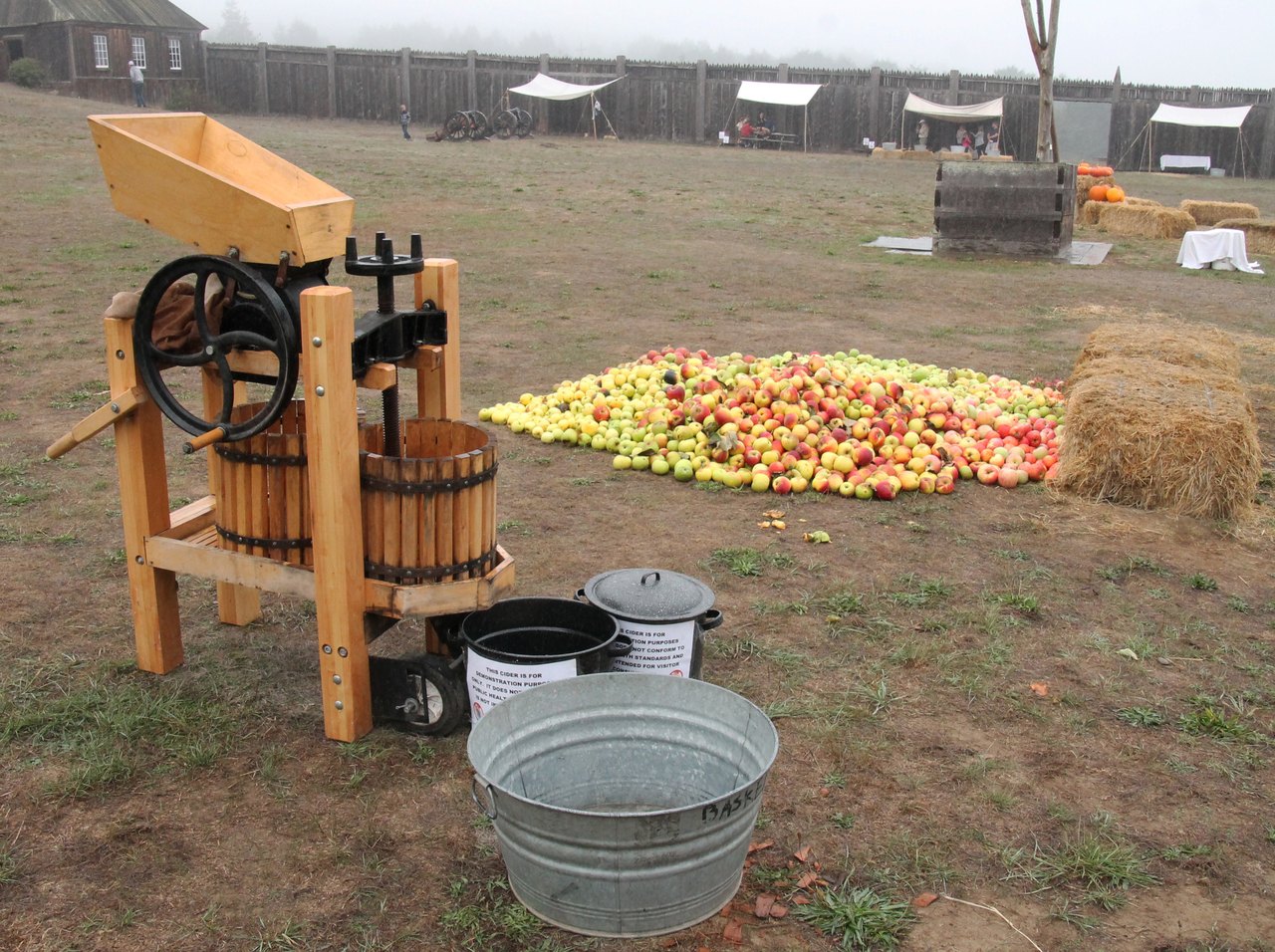
Visual AidPressing apples into cider
Photograph by Sarah Stierch, taken in October 2015 at the harvest festival of Fort Ross State Historic Park in California, of a wooden cider press with its crank grinder and slatted barrel standing beside a heap of apples ready to be crushed. The Knowledge Bank explains that cider is a drink pressed from apples, that long ago nearly every English farm made its own, and that it was stored below ground in a cellar that stays cool all year. This is the pressing that happens before the cellar: apples in, juice out. The press is in California, not on Bean’s farm, and it is a festival demonstration. Notice the slatted barrel — the juice runs out between the slats while the pulp stays inside.
Apple cider press at the Fort Ross State Historic Park harvest festival, California, October 2015; photograph by Sarah Stierch, released under CC0. Source: Wikimedia Commons, CC0.
ⓘ Vocabulary words are selected to help you understand and complete this workbook. Some may not appear verbatim in the novel.
cellarn.Ch.15
A room below the ground, often used for storing things
“Bean kept his cider in a cool, dark cellar under the farm.”
brickn.Ch.15
A hard, baked block used for building walls
“They had to dig through a brick wall to reach the cellar.”
deliciousadj.Ch.15
Tasting or smelling very good
“The cider was the most delicious drink the foxes had ever tasted.”
guzzlev.Ch.15
To eat or drink quickly and greedily
“The Rat liked to guzzle the cider all day long.”
selfishadj.Ch.15
Caring only about yourself and not wanting to share
“The selfish Rat told them the cider was all his.”
freezev.Ch.16
To suddenly stop moving and stay completely still
“At the sound of footsteps, every animal froze.”
footstepsn.Ch.16
The sound made by a person’s feet as they walk
“Heavy footsteps came slowly down the cellar stairs.”
crouchv.Ch.16
To bend low, close to the ground, often to hide
“Mr. Fox had to crouch behind the cider jars and keep silent.”
tiptoev.Ch.16
To walk quietly on your toes so as not to be heard
“When the woman left, the foxes tiptoed back to the tunnel.”
narrowadj.Ch.16
Only just managing to avoid danger; barely (as in “a narrow escape”)
“It was a narrow escape — the woman almost saw them.”
🧠Knowledge Bank question
1According to the Knowledge Bank, people stored cider below ground because ___.Ch.15
2True or False: A “selfish” person loves to share everything with others.Ch.15
3When the animals heard footsteps, they suddenly stopped moving and stayed completely still. Which word means this?Ch.16
4Fill in each blank with the correct word.Ch.15
Word choices:deliciousguzzlenarrowcrouch- some words will not be used
The golden cider was the most drink the foxes had ever tasted.
The greedy Rat liked to the cider all day long.
5True or False: To “tiptoe” means to walk quietly on your toes so as not to be heard.Ch.16
6Mr. Fox bent down low behind the jars to stay hidden. Which word means to bend low, close to the ground?Ch.16
7The animals only just avoided being caught. We would call this a — escape.Ch.16
8True or False: “Footsteps” are the sounds made by a person’s feet as they walk.Ch.16
9Fill in each blank with the correct word.Ch.15–16
Word choices:brickcellarfootstepsselfish- some words will not be used
To reach the cider, the diggers had to break through a hard wall.
Suddenly they heard coming down the stairs.
10To eat or drink quickly and greedily, like the Rat with his cider, is to —Ch.15
Part 2
Comprehension
How well do you understand Chapters 15–16?
🧠Knowledge Bank · Feeling the Danger
Reading Skill · SuspenseSometimes a writer wants you to feel nervous, and noticing that feeling is a reading skill. In Part 7 the foxes and Rat creep through Bean’s cellar while Mrs Bean sits just above with a lamp. Dahl slows the moment down and makes it quiet, so every small sound feels loud. This build-up of worry is called suspense. Good readers pause and ask, ‘Why do I feel scared here?’ Usually it is because danger is close but has not struck yet. Feeling the tension is not a mistake; it means you are truly living inside the story.
Visual AidWhy the cellar feels so quiet
Diagram for the Knowledge Bank on suspense. The two cards are the situation the Knowledge Bank describes, Mrs Bean above with a lamp and the foxes and Rat creeping below, and the red card is the Knowledge Bank’s explanation of how Dahl builds the worry by slowing the moment down and making it quiet. It does not say what happens next. Notice the dashed floor between the cards — the whole tension lives in that thin line.
Above, below, and the slowing-down that builds suspense, as described in the Knowledge Bank. Drawn for Garden Heights Academy.
🧠Knowledge Bank question
1The Knowledge Bank says Dahl builds suspense in the cellar by ___.Ch.15
2True or False: In the cellar, the animals meet a friendly Rat who happily shares all his cider.Ch.15
3What is stored in Bean’s cellar?Ch.15
4True or False: A woman named Mabel comes down to the cellar to fetch cider.Ch.16
5Put the events from Chapters 15–16 in the correct order. Write 1–4 (1 = first).Ch.15–16
They meet the selfish Rat and taste the delicious cider.
The diggers break through a brick wall into Bean’s cider cellar.
Mr. Fox hides, and after a narrow escape they slip away with two jars.
Footsteps are heard, and the animals freeze as the woman comes down.
6How does Mr. Fox avoid being seen by the woman?Ch.16
7True or False: The scene with the woman is calm and relaxing, with no danger at all.Ch.16
8What do the animals take with them when they leave the cellar?Ch.16
9True or False: The grumpy Rat is very different from the kind, sharing animals around Mr. Fox.Ch.15
10How do the animals react the moment they hear the footsteps?Ch.16
Part 3
Literary Elements
Understanding HOW and WHY Dahl writes Chapters 15–16 the way he does.
🧠Knowledge Bank · One Word, One Character
Literary Craft · CharacterizationDahl says the Rat guzzles Bean’s cider. To guzzle is to drink greedily and noisily. With that one verb, Dahl shows us the Rat’s whole nature: mean, selfish, and thirsty for what is not his. Showing what a character is like through small actions is called characterization. Dahl rarely stops to say ‘the Rat is greedy’; instead he lets a word like guzzles prove it. This is the difference between telling and showing. As you read, watch the verbs a character earns — they quietly and clearly reveal that character’s true nature.
📚 Literary Devices in This Part · definitions & examples
A minor character appears only briefly and is not the main hero of the story. The grumpy Rat and the woman Mabel are minor characters — they show up for one part, add something, and then the story moves on.Tension is the tight, nervous feeling created when characters are in danger of being caught. When the woman comes down the cellar steps and the animals freeze, the whole scene is filled with tension.Humor is writing that is meant to make the reader laugh. The grumpy Rat — guzzling cider and crossly calling it all his own — is one of Dahl’s funny touches, lightening the tense cellar scene.
The questions below are mixed — not grouped by device. Decide which device each one is about.
🧠Knowledge Bank question
1According to the Knowledge Bank, the single verb guzzles shows the Rat is ___.Ch.15
2True or False: Tension is the tight, nervous feeling created when characters are in danger of being caught.Ch.16
3Fill in the blanks with the correct words.Ch.15
Word choices:humorlaughrhymetension- some words will not be used
Writing designed to be funny uses . The grumpy Rat is there partly to make us .
4As the woman comes down the stairs and the animals freeze, hoping not to be seen, the scene fills with a tight, nervous feeling. This feeling is called —Ch.16
5True or False: Humor is the tight, nervous feeling created when characters are in danger of being caught.Ch.15
6Fill in the blanks with the correct words.Ch.15
Word choices:minorRatrhymesetting- some words will not be used
A character who appears only briefly is a character. In the cellar we meet one such character, the grumpy .
7The grumpy Rat who guzzles cider and snaps that it is all his own is one of Dahl’s funny touches. Writing meant to make us laugh is called —Ch.15
8True or False: A minor character appears only briefly and is not the main hero of the story.Ch.15–16
9Fill in the blanks with the correct words.Ch.16
Word choices:tensionfreezerhymehumor- some words will not be used
The nervous feeling of nearly being caught is called . Dahl builds it by making the animals as the woman appears.
10Within two pages, the grumpy Rat makes us laugh and Mabel’s footsteps make our hearts stop. What does this quick mixture of humor and tension do?Ch.15–16
Part 4
Think Deeper
Four deeper challenges — no single-word recall. Read, weigh the evidence, and reason it through.
🧠Knowledge Bank · Calm Under Pressure
Social-Emotional · Staying CalmSneaking into Bean’s cellar is terribly dangerous, yet Mr Fox stays calm. He thinks clearly, moves quietly, and does not panic even when Mrs Bean is near. Staying calm under pressure is a real strength. When we are afraid, our hearts race and we may act without thinking, which often makes things worse. A cool head lets us notice the safe way out, while a frightened mind only stumbles. Dahl shows the panicking farmers on one side and the steady fox on the other, and it is the calm thinker who finds the safest escape.
1Claim: “The foxes cleverly raid Bean’s cider cellar despite the dangers.” — choose the two details that best prove it.Claim & Evidence
2A danger in the cider cellar, or how the foxes get past it? Tap each item to sort it — tap again to switch sides. You can keep tapping to change your answer.Sort into two
◄ A dangerHow they get past it ►
3Match each cause to its result. For each cause, pick its result.Cause & Effect
The animals want cider→
Rat guards the barrels→
The woman Mabel comes down→
The raid succeeds→
🧠Knowledge Bank question
4Fill both blanks to complete the reasoning.Build the Argument
The Knowledge Bank says that when we are afraid, our hearts race and , so it is the calm thinker who .
Part 5
Standardized Test · Cohesion & Insert Text
Part 7 practices Cohesion & Transitions and a trickier exam specialty, Insert Text (placing a sentence where it best fits), plus Command of Evidence, Inference and Vocabulary in Context, in the styles the SAT and TOEFL use. Read the passage (the highlighted words are tested below), then choose the answer best supported by the text.
Read the passage — the highlighted words are tested — then answer. Tap an answer, then tap it again to confirm.
SATWords in Context — a word's meaning in this passage
SATCommand of Evidence — the detail that best supports a claim
SATInference — a conclusion the passage implies
SATCentral Ideas — the passage's main point
TOEFLVocabulary — a tested word's meaning here
TOEFLFactual Information — a fact stated in the passage
TOEFLInsert Text — where a sentence best fits
How Cider Is Made
Cider begins in an orchard. Through the summer the apples swell and sweeten, and by autumn they hang ripe and heavy on the branches, ready for the harvest, and cider makers often prize special cider apples, smaller and sharper than eating apples, because their juice carries the strongest flavor. Turning fruit into a delicious drink is a careful process with several stages: the apples are washed, chopped, and crushed into a soft pulp, then the pulp is wrapped in strong cloth and squeezed in a heavy press until the golden liquid runs free. Nothing is wasted; even the dry leftover pulp is fed to the farm animals. The fresh juice is then poured into jars and barrels and carried down into the cellar, where it is cool and dark all year round, ideal conditions for keeping. There, week by week, the juice slowly ferments and its taste deepens and changes. A farmer's cider was his private treasure: many kept the cellar locked, counted every jar, and carried the key wherever they went.
Original passage written for Garden Heights — not a quotation from the novel.
1A delicious drink is ___.SAT · Words in Context
2In the passage, the word “harvest” is closest in meaning to —TOEFL · Vocabulary
3According to the passage, why do cider makers prize special cider apples?TOEFL · Factual Information
4A cellar is ___.SAT · Words in Context
5According to the passage, what happens to the leftover pulp after pressing?TOEFL · Factual Information
6According to the passage, where is the fresh juice stored to ferment?TOEFL · Factual Information
7Insert Text. Look at the four spots in the box below. Where would this sentence best fit? Sentence: “Chopping alone, however, is not enough to set the juice free.”TOEFL · Insert Text
[1] Cider apples are small and sharp, quite different from eating apples. [2] At the mill, the fruit is washed and chopped into pieces. [3] The pieces are crushed into a soft, wet pulp. [4] Finally, the pulp is wrapped in strong cloth and squeezed in a heavy press until the golden juice runs free.
8Which detail from the passage best supports the idea that farmers treasured their cider?SAT · Command of Evidence
9The passage most strongly suggests that fresh juice left in a warm, bright room would —SAT · Inference
10Which statement best expresses the central idea of the passage?SAT · Central Ideas
Part 6 · Optional
Creative Writing
A bonus challenge to practice your English.
About This Section
This writing task is optional and not part of your auto-graded score. Feedback checks length, spelling, and grammar only.
Writing Task — Part 7 “The Woman”
Imagine you are a fox in the cellar at the moment the woman starts coming down the steps. You must freeze and stay hidden. What do you see, hear, and feel as you wait? Write at least 40 words.
You can start with: “The footsteps grew louder, and I pressed myself against the cold jars, not daring to breathe, because…”
0 / 40 words minimum
🗣 Teach It · Just for Fun (optional)
No right or wrong — close the screen and tell someone nearby what happened in this part. Can’t find anyone? Tell yourself out loud. The moment you teach it, you truly understand it.
Part 7 Complete!
You finished Chapters 15–16 of Fantastic Mr. Fox.
Here are your auto-graded results:
-
points out of 100
Teach it to someone
The best last step is to teach it. In your own words, explain what happened — retell a favorite scene, teach a character’s big choice, or sum up the main idea for a parent, friend, or classmate. When you can teach it clearly, you truly own it.
SAT® is a registered trademark of College Board, which is not affiliated with, and does not endorse, these materials. TOEFL® is a registered trademark of ETS. These materials are not endorsed or approved by ETS. Garden Heights is an independent provider of test-style reading practice.