New here? Just sign up with Google — your account includes Matilda, our gift book, forever.
Fish in a Tree · Garden Heights
Part 1
for Fish in a Tree · Part 1 · Chapters 1–6
8 Parts40 min
What Happens in Part 1
Ally Nickerson is a smart, funny sixth-grader hiding an enormous secret: she cannot really read or write. To her, letters shimmer and move on the page, and rather than let anyone see her struggle, she causes trouble — getting sent to the principal’s office so often that she has already been through seven schools. The disasters keep coming. At a baby shower for her pregnant teacher, Mrs. Hall, Ally hands over a card meant for a funeral instead of a celebration, and the class laughs; she was only picking the card with the prettiest flowers, unable to read the words inside. The class bully, Shay, and her follower Jessica are quick to call Ally stupid. But Ally is far from stupid. She escapes into her ‘Sketchbook of Impossible Things,’ where she draws wonders like a wheelchair that flies, and she thinks in vivid pictures. Her older brother Travis, who quietly struggles with reading too, takes her to a coin shop and teaches her that a coin’s value comes from being rare and different — a lesson Ally does not yet know how to apply to herself. Ally is drowning in silence, convinced that being different means being broken.
First-person voice, the Sketchbook motif, and a secret shaping every scene
Cross-Curricular
What dyslexia is — a reading difference, not a lack of smarts
Chapter Summary
Ch.
What happens
Chapters 1–3
The Secret and the Card — Ally hides that she cannot read by misbehaving; at the baby shower she gives a sympathy card by mistake and is laughed at, while Shay calls her stupid.
Chapters 4–6
Sketchbook and Coins — Ally escapes into her drawings of impossible things; her brother Travis takes her coin shopping and shows her that value comes from being rare and different.
Part 1
Vocabulary
Study 10 key words from Chapters 1–6, then answer each question.
🧠Knowledge Bank · Words of a Hidden Struggle
Lexical Semantics · Words of a Hidden Struggle
Four words, and only the first is a fact; the rest are what a child does with it. Dyslexia is a difference that makes reading hard, and Ally’s is undiagnosed, which is why the letters seem to move. To disguise is to hide the true nature of something, and Ally disguises her struggle by acting up — a strategy that works, in the sense that nobody finds out. To humiliate is to make someone feel ashamed, and the card mistake does exactly that. Impossible means not able to happen or be done, and Ally’s sketchbook is full of impossible things. Notice which word she owns. Three of them are done to her or forced on her; the fourth is the one she draws in, and it is the only place she is ever free.
dyslexian.Ch.1
A difference that makes reading hard
“Ally’s undiagnosed dyslexia made letters move.”
disguisev.Ch.1
To hide the true nature of
“She would disguise her struggle by acting up.”
humiliatev.Ch.2
To make someone feel ashamed
“The card mistake seemed to humiliate her.”
impossibleadj.Ch.4
Not able to happen or be done
“Her sketchbook was full of impossible things.”
rareadj.Ch.5
Not often found; unusual
“A rare coin is worth the most.”
misbehavev.Ch.1
To act up or break the rules
“Ally would misbehave to hide her secret.”
principaln.Ch.1
The head of a school
“Ally was sent to the principal often.”
escapen.Ch.4
A way to get free of something hard
“Drawing was Ally’s escape.”
valuen.Ch.5
How much something is worth
“A coin’s value comes from being rare.”
silencen.Ch.3
The state of saying nothing
“Ally suffered in silence.”
ⓘ The vocabulary words in this list are selected to help you understand and complete this workbook. Some may not appear verbatim in the original novel.
🧠Knowledge Bank question
1According to the Knowledge Bank, how does Ally hide her struggle?Ch.1
2To ‘disguise’ something is to show it plainly.Ch.1
3To ‘humiliate’ someone is to make them feel ___.Ch.2
4Something ‘impossible’ cannot happen or be done.Ch.4
5Fill in each blank with the correct word.Ch.5
Word choices:rarevaluedisguisesneer- some words will not be used
A coin is precious because it is .
Its comes from being different.
6To ‘misbehave’ is to ___.Ch.1
7A ‘principal’ is the head of a school.Ch.1
8For Ally, drawing is an ___ from a hard day.Ch.4
9Fill in each blank with the correct word.Ch.2
Word choices:humiliatesilenceimpossiblerare- some words will not be used
The mistake seemed to Ally.
She often suffered in .
10Something ‘rare’ is ___.Ch.5
Part 2
Comprehension
Show you understood what happens in Chapters 1–6.
🧠Knowledge Bank · The Girl With a Secret
Narrative Causality · The Girl With a Secret
In Chapters 1–6, plot comprehension depends on locating the trigger, tracing mounting pressure, and recognizing the decisive turn. Ally Nickerson is a smart, funny sixth-grader hiding an enormous secret: she cannot really read or write. To her, letters shimmer and move on the page, and rather than let anyone see her struggle, she causes trouble — getting sent to the principal’s office so often that she has already been through seven schools. The disasters keep coming. At a baby shower for her pregnant teacher, Mrs. Hall, Ally hands over a card meant for a funeral instead of a celebration, and the class laughs; she was only picking the card with the prettiest flowers, unable to read the words inside. Seen as cause and effect, “The Girl With a Secret” becomes the opening catalyst.
Visual AidThe loop that keeps the secret
Diagram for the Knowledge Bank on Ally’s first chapters. Cards 1 to 4 are the routine the Knowledge Bank describes, and the dashed arrow is the part that matters: it runs back to the top and starts again. Card 5 says why the routine is a disaster rather than a success. Notice that nothing in the loop is stupid. Every step is a sensible way to protect yourself, which is exactly why it has held for seven schools.
The routine by which Ally keeps her secret, as described in the Knowledge Bank. Drawn for Garden Heights Academy.
🧠Knowledge Bank question
1The Knowledge Bank explains that Ally causes trouble in order to ___.Ch.1
2When Ally reads, the letters seem to ___.Ch.1
3Ally has attended only one school in her life.Ch.1
4At the baby shower, Ally accidentally gives Mrs. Hall a ___.Ch.2
5Write the numbers 1–5 in the boxes to show the correct order of events. Number 1 = what happens first.Chapters 1–6
Ally escapes into her Sketchbook of Impossible Things.
At the shower she gives Mrs. Hall a sympathy card.
Travis teaches Ally that rare coins are the most valuable.
Shay and Jessica call Ally stupid.
Ally hides her reading trouble by acting up.
6Ally chose the sympathy card because she liked its flowers.Ch.2
7Ally’s Sketchbook is full of ___.Ch.4
8Travis takes Ally to shop for old ___.Ch.5
9Ally is actually not very smart.Ch.4
10By the end of Part 1, Ally believes that being different means being ___.Ch.6
Part 3
Literary Elements
Understanding HOW and WHY Lynda Mullaly Hunt tells the story across Chapters 1–6.
🧠Knowledge Bank · The Sketchbook of Impossible Things
Narrative Technique · The Sketchbook of Impossible Things
In Chapters 1–6, Lynda Mullaly Hunt coordinates narrator, symbol, and irony to establish the novel’s opening design. Watch Ally’s ‘Sketchbook of Impossible Things’ — the private notebook where she draws wonders like a flying wheelchair. It is the book’s central symbol, and it works two ways at once. On the surface it is Ally’s escape, the one place she feels smart and free. Deeper down, it is proof of exactly the intelligence her reading hides: a mind bursting with vision, invention, and picture-thinking. Hunt uses the Sketchbook to remind us, page after page, that the girl the school calls ‘trouble’ is actually brimming with gifts. Keep an eye on what Ally draws; her impossible things are quietly possible, and by the end the Sketchbook will become a bridge between the girl she hides and the girl she is. That authorial design makes “The Sketchbook of Impossible Things” a lesson in deliberate atmosphere.
First-person narrator
Ally tells her own story with ‘I,’ so we feel the moving letters and the shame from inside.
Symbol
The Sketchbook of Impossible Things — Ally’s escape, and proof of the gifts her reading hides.
Dramatic irony
The reader knows Ally is smart and dyslexic; the characters who mock her do not.
🧠Knowledge Bank question
1According to the Knowledge Bank, the Sketchbook of Impossible Things is proof of ___.Ch.1
2Fill in each blank with the correct literary term.Ch.1
Word choices:first-person narratorsymbolsettingrhyme- some words will not be used
Because Ally tells her own story with ‘I,’ she is the .
The Sketchbook of Impossible Things is a .
3A first-person narrator tells the story using the word ‘I.’Ch.1
4The Sketchbook mainly stands for Ally’s hidden ___.Ch.4
5We know Ally is smart while the bullies do not, which is ___.Ch.3
6A first-person narrator can share thoughts no one else hears.Ch.1
7Hunt writes the moving letters from inside Ally’s view so the reader can ___.Ch.1
8Fill in each blank with the correct literary term.Ch.3
Word choices:dramatic ironysymbolnarratormotif- some words will not be used
The reader knowing Ally is smart while bullies mock her is .
The Sketchbook that stands for her gifts is a .
9A symbol is an object that also stands for a bigger idea.Ch.4
10The strongest clue that Ally is gifted, not ‘dumb,’ is her ___.Ch.4
Part 4
Think Deeper
Four deeper challenges — no single-word recall. Read, weigh the evidence, and reason it out.
🧠Knowledge Bank · A Different Kind of Reader
What Dyslexia Is · A Different Kind of Reader
Ally’s secret has a name she does not yet know: dyslexia. Dyslexia is the most common learning difference, affecting perhaps one in five people, and it has nothing to do with how smart a person is. It is a difference in how the brain processes written language — connecting letters to the sounds they make. For a person with dyslexia, reading can feel exhausting and confusing; letters may seem to swap, blur, or move, and turning print into meaning takes enormous effort. Crucially, people with dyslexia are usually of average or above-average intelligence, and many are gifted thinkers, artists, and problem-solvers. Hunt puts that fact in front of the reader before Ally knows it, and the gap is the engine of the book. Part 1 shows a clever girl doing clever things, and every adult reads the behavior as trouble — because nobody has thought to ask why a bright child would rather sit in the principal’s office than read a page.
Visual AidLetters you can pick up
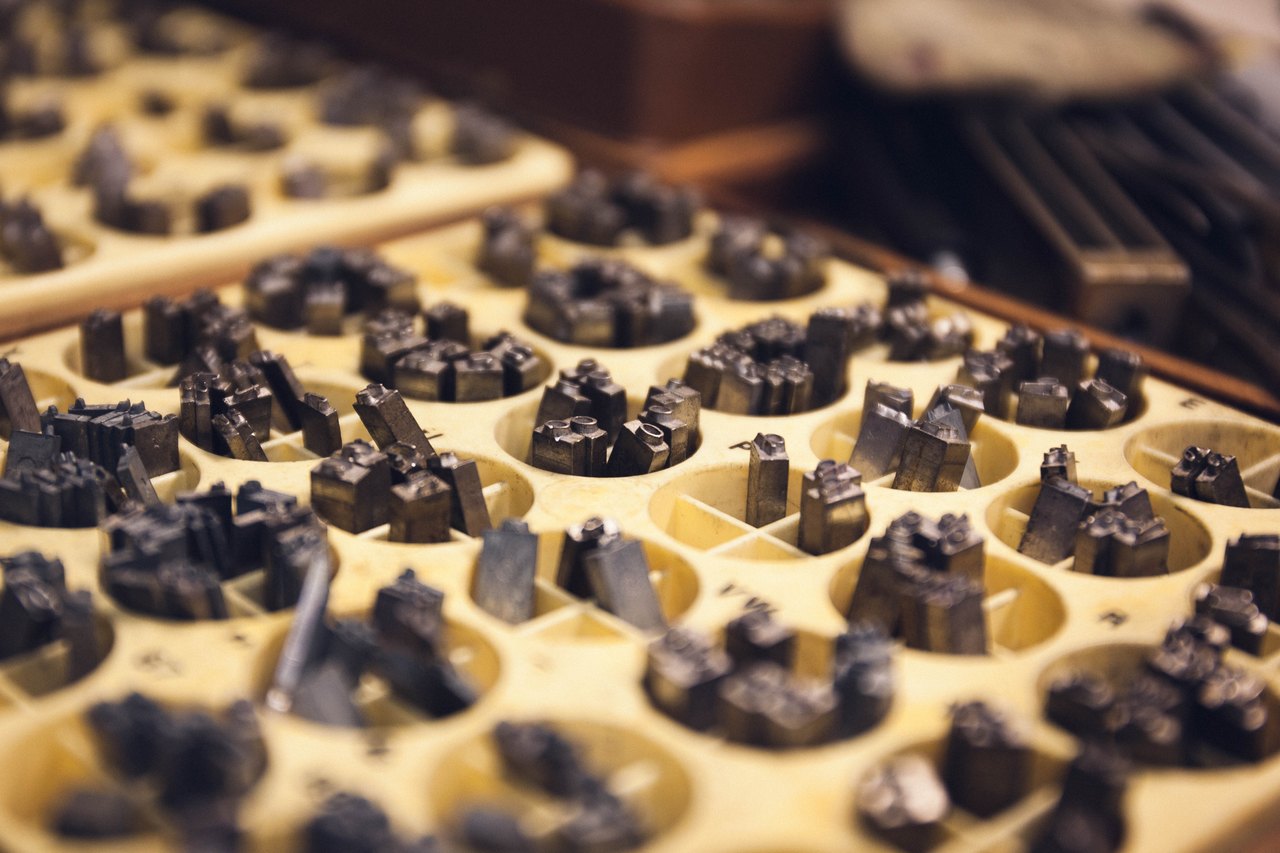
A printer’s case of metal type, each compartment holding one letter. The Knowledge Bank explains that dyslexia is a difference in how the brain works with written language, especially in connecting letters to the sounds they stand for. Look at how many separate pieces one page of print is made of. Reading asks a brain to turn every one of those shapes back into a sound and then into meaning, and for Ally that last stretch of the journey never becomes automatic.
A letterpress type case. Source: Wikimedia Commons, CC0.
Think back over the opening. A girl stares at a page where the letters will not hold still, and rather than let anyone see, she makes herself the class troublemaker — because being ‘bad’ hurts less than being ‘stupid.’ At a party she hands her kind teacher exactly the wrong card and the room laughs, and a mean girl says the word Ally most fears. But alone, she opens a sketchbook and fills it with impossible, beautiful machines, and her brother slides a rare coin across a shop counter and tells her that different is not worthless — different is precious. Ally hears the words. She just cannot yet believe they are about her.
Original passage written for Garden Heights — not a quotation from the novel.
1Claim: “Part 1 argues that Ally is intelligent, even though she cannot read.” — choose the two details that best prove it.Claim & Evidence
2How the world sees Ally, or Who Ally really is? Tap each detail to sort it — tap again to switch sides. You can keep tapping to change your answer.Sort into two
◄ How the world sees AllyWho Ally really is ►
3Match each cause to its result. For each cause, pick its result.Cause & Effect
Ally acts up in class→
She gives the wrong card→
She fills her Sketchbook→
Travis explains rare coins→
🧠Knowledge Bank question
4Fill both blanks to complete the reasoning.Build the Argument
The Knowledge Bank argues that Ally's trouble says nothing about how clever she is because , which shows that .
Part 5
Standardized Test
Reading passage · What Is Dyslexia? · SAT & TOEFL-style practice
Read the passage — the highlighted words are tested — then answer. Tap an answer, then tap it again to confirm.
SATCentral Ideas — the passage's main point
SATDetail — a fact stated in the passage
SATWords in Context — a word's meaning in this passage
SATText Connections — how two parts of the text relate
TOEFLFactual Information — a fact stated in the passage
TOEFLNegative Factual — the statement the passage does NOT support
What Dyslexia Really Is
Ally’s secret struggle has a name: dyslexia. Dyslexia is the most common learning difference in the world, thought to affect roughly one in five people to some degree. It is important to understand what it is — and what it is not. Dyslexia is a difference in the way the brain works with written language, especially in connecting letters to the sounds they stand for. For someone with dyslexia, reading does not become automatic the way it does for most people; instead it stays slow and effortful, and letters or words may seem to swap places, blur, or move on the page, exactly as they do for Ally.
What dyslexia is NOT is a sign of low intelligence — the most important fact of all, and the one Ally has never been told. People with dyslexia are usually of average or above-average intelligence, and a great many are exceptionally creative, curious, and gifted at solving problems, building things, and thinking in pictures — just as Ally is. Their difficulty is specific: turning printed symbols into meaning. Given the right kind of teaching — methods that use sound, touch, and sight together — people with dyslexia can absolutely learn to read. The tragedy in stories like Ally’s is not the dyslexia itself but the years spent learning to disguise it before anyone understands. Learning what dyslexia really is turns Ally from a ‘problem student’ into what she has been all along: a bright girl who simply needs to be taught in the way her brain learns.
Original passage written for Garden Heights — not a quotation from the novel.
1What is the main idea of the passage?SAT · Central Ideas
2About how many people does dyslexia affect to some degree?TOEFL · Factual Information
3Dyslexia is a difference in how the brain works with ___.SAT · Detail
4For a person with dyslexia, letters may seem to ___.TOEFL · Factual Information
5The passage says dyslexia is NOT a sign of ___.TOEFL · Negative Factual
6Many people with dyslexia are gifted at ___.SAT · Detail
7With the right teaching, people with dyslexia can ___.TOEFL · Factual Information
8In the passage, disguise most nearly means ___.SAT · Words in Context
9The real tragedy in Ally’s story, the passage says, is the years of ___.SAT · Detail
10Which detail from Part 1 does this passage BEST help explain?SAT · Text Connections
Part 6 · Optional
Creative Writing
A bonus challenge to practice your English. Take your time and have fun with it.
About This Section
This writing task is optional and is not part of your auto-graded score. The feedback below checks only the basics — length, spelling, and grammar — not whether your ideas are right or wrong. It is meant for classroom discussion and creative practice, so feel free to use your imagination!
Writing Task — Part 1 “A Hidden Struggle”
Ally hides something hard about herself and pretends everything is fine. Write about a time you found something difficult but tried to hide it — or a time you felt misunderstood. What was the struggle, how did you cover it up, and how did it feel? 6–10 sentences. End with what you wish others had understood.
You can start with: “On the outside I looked fine, but inside...”
0 / 40 words minimum
🗣 Teach It · Just for Fun (optional)
No right or wrong — close the screen and tell someone nearby what happened in this part. Can’t find anyone? Tell yourself out loud. The moment you teach it, you truly understand it.
Part 1 Complete!
You finished Chapters 1–6 of Fish in a Tree.
Here are your auto-graded results:
-
points out of 100
Teach it to someone
The best last step is to teach it. In your own words, explain what happened — retell a favorite scene, teach a character’s big choice, or sum up the main idea for a parent, friend, or classmate. When you can teach it clearly, you truly own it.
Independent study guide by Garden Heights. Not affiliated with or endorsed by Lynda Mullaly Hunt. Contains original analysis only; no text from the novel is reproduced. Reference text: This workbook follows Lynda Mullaly Hunt’s classic text (the standard Puffin edition sold worldwide). Revised 2023 UK editions change some wording and may not match the vocabulary studied here.
SAT® is a registered trademark of College Board, which is not affiliated with, and does not endorse, these materials. TOEFL® is a registered trademark of ETS. These materials are not endorsed or approved by ETS. Garden Heights is an independent provider of test-style reading practice.