New here? Just sign up with Google — your account includes Matilda, our gift book, forever.
Fish in a Tree · Garden Heights
Part 2
for Fish in a Tree · Part 2 · Chapters 7–13
8 Parts40 min
What Happens in Part 2
A new teacher, Mr. Daniels, takes over the class while Mrs. Hall is away, and he is unlike any teacher Ally has known. He calls his students ‘fantasticos,’ hands out notebooks that are never graded so kids can write and draw freely, and he seems genuinely curious about how each mind works. Ally, who has learned to expect the worst from teachers, does not trust him yet — in one ungraded notebook she draws a dark, empty room, a picture of how invisible she feels. Still hungry to belong somewhere, she drifts toward Shay and Jessica’s popular group, only to feel sick with guilt when they turn their cruelty on other kids. Everything changes at the holiday concert. When a classmate snatches away the flowers meant for shy, kind Keisha, Ally quietly breaks her own bouquet in half and shares it — and in that small, brave act, a real friendship is born. Keisha, confident and funny, sees Ally clearly. Meanwhile Ally starts to want, almost against her will, for Mr. Daniels to think well of her; she even attempts a writing assignment, though when it overwhelms her she invents a fake broken arm to get out of it. Slowly, in spite of herself, Ally is being pulled toward people who might finally see who she really is.
A foil to the old teachers, the dark-room symbol, and a friendship earned by kindness
Cross-Curricular
How the brain learns to read — letters, sounds, and practice
Chapter Summary
Ch.
What happens
Chapters 7–10
Mr. Daniels Arrives — the warm new teacher hands out ungraded notebooks and calls his students ‘fantasticos’; wary Ally draws a dark, empty room to show how invisible she feels.
Chapters 11–13
The Shared Flowers — Ally drifts toward Shay’s cruel group but feels guilty; at the concert she breaks her bouquet to share with Keisha, and a true friendship begins.
Part 1
Vocabulary
Study 10 key words from Chapters 7–13, then answer each question.
🧠Knowledge Bank · Words of a New Start
Lexical Semantics · Words of a New Start
Four words, and the middle two are what Ally has been living on. To encourage is to give support and confidence, which is what Mr. Daniels sets out to do for every student in the room, including the one who does not want it. Invisible means unable to be seen or noticed, and Ally has worked hard to be exactly that. Guilt is the bad feeling of having done wrong, and going along with the bullies fills her with it. Genuine means real and sincere, and Keisha is Ally’s first genuine friendship. Notice how the four line up against each other. Invisibility and guilt are what hiding costs. Encouragement and a real friend are what it costs to stop, and Hunt makes Ally pay the second price before she gets anything back.
encouragev.Ch.7
To give support and confidence
“Mr. Daniels wanted to encourage every student.”
invisibleadj.Ch.8
Unable to be seen or noticed
“Ally often felt invisible at school.”
guiltn.Ch.11
The bad feeling of having done wrong
“Going along with the bullies filled her with guilt.”
genuineadj.Ch.12
Real and sincere
“It was Ally’s first genuine friendship.”
befriendv.Ch.12
To become a friend to someone
“Ally quietly befriended Keisha.”
waryadj.Ch.7
Cautious and distrustful
“Ally was wary of the new teacher.”
bouquetn.Ch.12
A bunch of flowers
“She broke her bouquet to share it.”
belongv.Ch.11
To have a rightful place
“Ally just wanted to belong somewhere.”
patientadj.Ch.9
Calm and not easily upset
“Mr. Daniels was patient with her.”
noticev.Ch.9
To become aware of something
“He began to notice how Ally avoided reading.”
ⓘ The vocabulary words in this list are selected to help you understand and complete this workbook. Some may not appear verbatim in the original novel.
🧠Knowledge Bank question
1According to the Knowledge Bank, what does Mr. Daniels set out to do for every student?Ch.7
2If you feel ‘invisible,’ you feel seen and noticed.Ch.8
3‘Guilt’ is the bad feeling of having done ___.Ch.11
4A ‘genuine’ friendship is real and sincere.Ch.12
5Fill in each blank with the correct word.Ch.12
Word choices:befriendbouquetencouragesneer- some words will not be used
Ally broke her in half to share it.
That kindness helped her Keisha.
6To be ‘wary’ is to be ___.Ch.7
7To ‘befriend’ someone is to become their friend.Ch.12
8Someone ‘patient’ is ___.Ch.9
9Fill in each blank with the correct word.Ch.8
Word choices:invisibleguiltgenuinewary- some words will not be used
At school Ally often felt .
Going along with the bullies gave her .
10To ‘notice’ something is to become ___ of it.Ch.9
Part 2
Comprehension
Show you understood what happens in Chapters 7–13.
🧠Knowledge Bank · A Teacher and a Friend
Narrative Causality · A Teacher and a Friend
The events of Chapters 7–13 become clearer when readers separate a character’s motive from the obstacle encountered and the response that follows. A new teacher, Mr. Daniels, takes over the class while Mrs. Hall is away, and he is unlike any teacher Ally has known. He calls his students ‘fantasticos,’ hands out notebooks that are never graded so kids can write and draw freely, and he seems genuinely curious about how each mind works. Ally, who has learned to expect the worst from teachers, does not trust him yet — in one ungraded notebook she draws a dark, empty room, a picture of how invisible she feels. Still hungry to belong somewhere, she drifts toward Shay and Jessica’s popular group, only to feel sick with guilt when they turn their cruelty on other kids. Following motive through response reveals why “A Teacher and a Friend” forms a consequential sequence.
🧠Knowledge Bank question
1The Knowledge Bank explains that Mr. Daniels hands out notebooks that ___.Ch.7
2Mr. Daniels calls his students ___.Ch.7
3Ally trusts Mr. Daniels completely right away.Ch.7
4In an ungraded notebook, Ally draws ___.Ch.8
5Write the numbers 1–5 in the boxes to show the correct order of events. Number 1 = what happens first.Chapters 7–13
Ally drifts toward Shay’s group and feels guilty.
At the concert, a classmate takes Keisha’s flowers.
Ally draws a dark, empty room.
Ally breaks her bouquet to share with Keisha.
Mr. Daniels arrives and hands out ungraded notebooks.
6Ally feels good about joining in when Shay bullies others.Ch.11
7Ally and Keisha become friends when Ally ___.Ch.12
8Ally starts to want ___ to think well of her.Ch.13
9Ally finishes the writing assignment easily.Ch.13
10By the end of Part 2, Ally is being pulled toward people who might ___.Ch.13
Part 3
Literary Elements
Understanding HOW and WHY Lynda Mullaly Hunt tells the story across Chapters 7–13.
🧠Knowledge Bank · Mr. Daniels, the Anti-Teacher
Narrative Technique · Mr. Daniels, the Anti-Teacher
The craft of Part 2 works through foil, symbol, and characterization, each shaping how readers judge the new conflict. Mr. Daniels works as a foil to every teacher Ally has ever had. Where past teachers graded, judged, and gave up on her, he offers ungraded notebooks, curiosity, and patience; where they saw a problem, he looks for a person. His difference measures, by contrast, exactly how badly the school system has failed Ally until now. Hunt uses him to make a quiet argument: Ally was never the only thing that needed to change — the teaching did too. Watch how Mr. Daniels notices things others missed — how Ally avoids reading, how her eyes work on a page — without shaming her. That authorial design makes “Mr. Daniels, the Anti-Teacher” a lesson in deliberate suspense.
Visual AidThe same girl, two classrooms
Diagram for the Knowledge Bank on Mr. Daniels as a foil. Card 1 is how she was taught before and card 2 is how she is taught now, and card 3 is the control that makes the comparison mean something: the student did not change. Card 4 names the technique. Notice that a foil is not a rival. It is a measuring stick, and what it measures here is the school.
Mr. Daniels set against every teacher before him, as described in the Knowledge Bank. Drawn for Garden Heights Academy.
Foil
Mr. Daniels against Ally’s past teachers — his curiosity measures how they failed her.
Symbol
The dark, empty room Ally draws — a picture of how invisible she feels at school.
Indirect characterization
Ally’s worth shown by an act — sharing flowers — not by a test score.
🧠Knowledge Bank question
1According to the Knowledge Bank, Mr. Daniels works as a foil because he ___.Ch.7
2Fill in each blank with the correct literary term.Ch.8
Word choices:foilsymbolsettingrhyme- some words will not be used
Mr. Daniels, who contrasts with Ally’s past teachers, is a .
The dark, empty room Ally draws is a .
3A foil is a character whose contrast highlights another.Ch.7
4The dark, empty room Ally draws stands for feeling ___.Ch.8
5Showing Ally’s worth through the flower-sharing act is ___.Ch.12
6Indirect characterization shows a character through actions and choices.Ch.12
7Mr. Daniels’s difference quietly argues that what also needed to change was the ___.Ch.7
8Fill in each blank with the correct literary term.Ch.12
Word choices:indirect characterizationfoilnarratormotif- some words will not be used
Showing Ally’s kindness through her actions is .
Mr. Daniels contrasting with past teachers makes him a .
9Hunt lets Ally shine in kindness because she cannot shine on tests.Ch.12
10The clearest sign Ally’s life is turning is that she begins to ___.Ch.13
Part 4
Think Deeper
Four deeper challenges — no single-word recall. Read, weigh the evidence, and reason it out.
🧠Knowledge Bank · How the Brain Learns to Read
The Reading Brain · How the Brain Learns to Read
Mr. Daniels is curious about how Ally’s mind works, and the science behind that question is worth knowing. Speaking is something a child picks up simply by being spoken to; reading is not. Written language is an invention only a few thousand years old, and no part of the brain evolved for it, so every reader has to borrow circuits built for other jobs and stitch them together. The key link is phonological awareness — hearing that a spoken word is made of separate small sounds, and matching those sounds to marks on a page. In most children that link forms quietly with practice. In a dyslexic reader it forms slowly and unreliably, which is why the effort never becomes automatic, and why the difficulty has nothing whatever to do with intelligence.
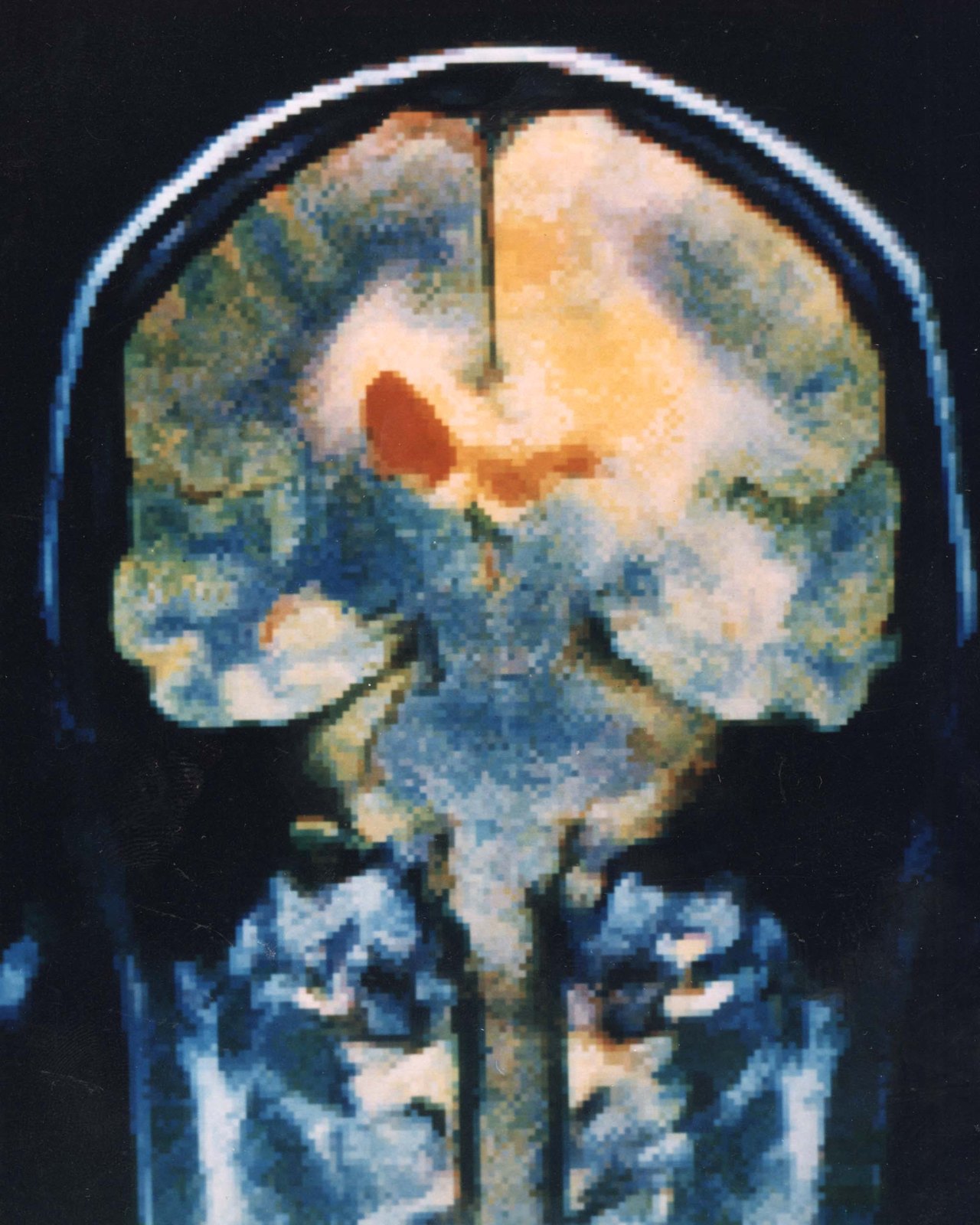
Visual AidThe organ that was never built for this
A magnetic resonance scan — an image made with magnets rather than X-rays — showing a slice straight through a human head. The Knowledge Bank explains that no part of the brain evolved for reading, so every reader has to borrow circuits built for other jobs and stitch them together. Look at how much of the picture is brain. All of it was ready to learn speech; none of it was waiting for print, which is why reading has to be taught to every single child.
Magnetic resonance image of a human head; NASA. Source: Wikimedia Commons, public domain.
Think back over these chapters. A new teacher walks in and, instead of a red pen, hands out notebooks no one will grade, and calls a roomful of ordinary kids ‘fantasticos’ as if he means it. A wary girl tests him by drawing a dark, empty room — herself, unseen. She drifts toward the popular crowd and hates how it feels to laugh at someone else’s expense. Then, at a concert, a shy girl’s flowers are snatched away, and without a word Ally snaps her own bouquet in two and holds out half — and just like that, in an act instead of a sentence, she has a friend, and a first small proof that she is worth knowing.
Original passage written for Garden Heights — not a quotation from the novel.
1Claim: “Part 2 shows that Ally’s real worth appears in her actions, not her schoolwork.” — choose the two details that best prove it.Claim & Evidence
2Where Ally cannot shine, or Where Ally truly shines? Tap each detail to sort it — tap again to switch sides. You can keep tapping to change your answer.Sort into two
◄ Where Ally cannot shineWhere Ally truly shines ►
3Match each cause to its result. For each cause, pick its result.Cause & Effect
Mr. Daniels hands out ungraded notebooks→
Ally draws a dark, empty room→
Ally feels guilty near the bullies→
Ally shares her bouquet→
🧠Knowledge Bank question
4Fill both blanks to complete the reasoning.Build the Argument
The Knowledge Bank argues that every single reader has to be taught because , which shows that .
Part 5
Standardized Test
Reading passage · How the Brain Learns to Read · SAT & TOEFL-style practice
Read the passage — the highlighted words are tested — then answer. Tap an answer, then tap it again to confirm.
SATCentral Ideas — the passage's main point
SATDetail — a fact stated in the passage
SATInference — a conclusion the passage implies
TOEFLFactual Information — a fact stated in the passage
TOEFLVocabulary — a tested word's meaning here
TOEFLProse Summary — the three sentences that sum it up
The Brain's Struggle to Read
Mr. Daniels is curious about how Ally’s mind works, and the science of reading makes that a rich question. Here is a surprising fact: the human brain is born ready to learn to speak and listen, but it is NOT born ready to read. Speaking is tens of thousands of years old and comes naturally to children who simply hear it; reading and writing are much more recent inventions, only a few thousand years old, and every single reader’s brain has to be specially trained to do it. No one is born knowing how to turn marks on a page into words.
Learning to read means wiring together three jobs the brain already does separately: seeing the shapes of letters, hearing the sounds those letters stand for, and reaching the meanings of words. With practice, most children build these connections until reading becomes fast and automatic — the letters seem to melt straight into meaning. In dyslexia, the letter-to-sound part of that wiring works differently, so the connections form slowly and reading stays effortful no matter how hard the reader tries. The encouraging truth is that the reading brain can keep changing at any age. With the right kind of practice — especially patient methods that link seeing, saying and touching letters at once — new pathways can be built, and readers who struggled can succeed. What this science means for Ally is powerful: her trouble is not a lack of intelligence but a difference in wiring, and the right teaching can rewire the path.
Original passage written for Garden Heights — not a quotation from the novel.
1What is the main idea of the passage?SAT · Central Ideas
2The brain IS born ready to ___.TOEFL · Factual Information
3Compared with speaking, reading is a ___ invention.SAT · Detail
4Reading wires together seeing letters, hearing sounds, and reaching ___.TOEFL · Factual Information
5For most children, practice makes reading ___.SAT · Detail
6In dyslexia, which part of the wiring works differently?TOEFL · Factual Information
7The passage says the reading brain can ___.SAT · Detail
8In the passage, patient most nearly means ___.TOEFL · Vocabulary
9Prose Summary (TOEFL).The passage explains how the brain learns to read and what happens in dyslexia. This TOEFL task lists six sentences; choose the THREE that best capture the passage’s main ideas. The other three do not belong — they state minor details or ideas the passage does not present.TOEFL · Prose Summary
10What does this science mean for Ally?SAT · Inference
Part 6 · Optional
Creative Writing
A bonus challenge to practice your English. Take your time and have fun with it.
About This Section
This writing task is optional and is not part of your auto-graded score. The feedback below checks only the basics — length, spelling, and grammar — not whether your ideas are right or wrong. It is meant for classroom discussion and creative practice, so feel free to use your imagination!
Writing Task — Part 2 “A Teacher Who Saw Me”
Mr. Daniels notices Ally as a person, not a problem. Write about a teacher, coach, or adult who really saw you — who noticed something good in you or believed in you. What did they do, and how did it change how you felt about yourself? 6–10 sentences. End with what their belief gave you.
You can start with: “Most people looked right past it, but one person noticed...”
0 / 40 words minimum
🗣 Teach It · Just for Fun (optional)
No right or wrong — close the screen and tell someone nearby what happened in this part. Can’t find anyone? Tell yourself out loud. The moment you teach it, you truly understand it.
Part 2 Complete!
You finished Chapters 7–13 of Fish in a Tree.
Here are your auto-graded results:
-
points out of 100
Teach it to someone
The best last step is to teach it. In your own words, explain what happened — retell a favorite scene, teach a character’s big choice, or sum up the main idea for a parent, friend, or classmate. When you can teach it clearly, you truly own it.
Independent study guide by Garden Heights. Not affiliated with or endorsed by Lynda Mullaly Hunt. Contains original analysis only; no text from the novel is reproduced. Reference text: This workbook follows Lynda Mullaly Hunt’s classic text (the standard Puffin edition sold worldwide). Revised 2023 UK editions change some wording and may not match the vocabulary studied here.
SAT® is a registered trademark of College Board, which is not affiliated with, and does not endorse, these materials. TOEFL® is a registered trademark of ETS. These materials are not endorsed or approved by ETS. Garden Heights is an independent provider of test-style reading practice.