New here? Just sign up with Google — your account includes Matilda, our gift book, forever.
Fish in a Tree · Garden Heights
Part 3
for Fish in a Tree · Part 3 · Chapters 14–19
8 Parts40 min
What Happens in Part 3
Ally notices that Albert, a big, brilliant, oddly formal boy who loves science and wears the same Star Trek shirt, keeps showing up with bruises — he is being beaten up by a gang of bullies called the Chums, and, believing in nonviolence, he refuses to fight back. Ally invites him to eat lunch with her and Keisha, and the three of them — the misfits no one else wants — become a real team. Shay sneers that they are like the ‘Island of Misfit Toys,’ but Ally begins to understand that being a misfit just means being different, not being less. In class, Mr. Daniels leads a discussion about the difference between being ‘alone’ and being ‘lonely,’ and Ally — who knows loneliness from the inside — gives an answer so wise it surprises everyone, including herself. Her confidence flickers to life. But it is fragile: when Ally wins a poetry contest, her joy collapses as she realizes the award was really given out of pity, a consolation prize, not earned respect — and the humiliation stings worse than losing would have. Still, something is shifting. With Keisha and Albert beside her, Ally is no longer facing the world alone, and the idea that different might be good is beginning, slowly, to take root.
The misfit trio, the alone/lonely theme, and a victory that stings
Cross-Curricular
Many ways to be smart — intelligence beyond reading
Chapter Summary
Ch.
What happens
Chapters 14–16
The Misfit Team — Ally sees Albert is being hurt by bullies and invites him to join her and Keisha; the three misfits become real friends, and Ally learns different is not less.
Chapters 17–19
Alone vs. Lonely — Ally gives a wise answer about loneliness, and her confidence stirs; but a poetry prize turns out to be a pity award, and the humiliation stings.
Part 1
Vocabulary
Study 10 key words from Chapters 14–19, then answer each question.
🧠Knowledge Bank · Words of the Misfits
Lexical Semantics · Words of the Misfits
Four words, and one of them is doing a job the others are not. A misfit is a person who does not fit in, and Shay uses it as an insult for the three friends. A bruise is a dark mark on the skin from a blow, and Albert keeps arriving at school with them. Nonviolence is the refusal to use force or fighting, and Albert believes in it firmly, which is why the bruises keep happening. Lonely means sad from being without company, and Ally has been lonely in a crowd for years. Hunt lets that sit without comment, and it is the quietest act of courage in the novel. Three of these words describe how the world treats these children. Nonviolence is the only one that describes a choice a child has made.
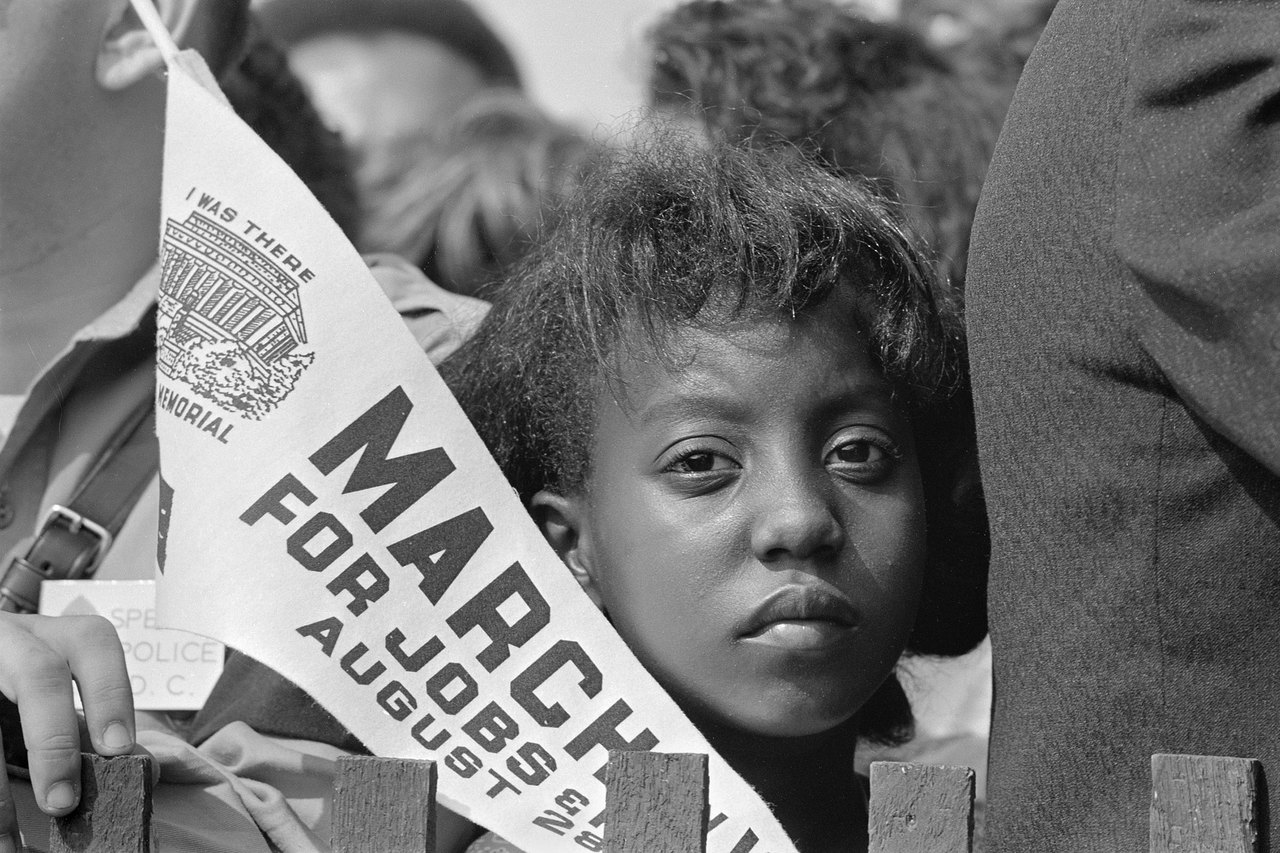
Visual AidWhat the word nonviolence means
A young woman in the crowd at the March on Washington in 1963, holding her pennant. The Knowledge Bank explains that nonviolence is the refusal to use force or fighting, and that Albert believes in it firmly, which is why the bruises keep happening. This photograph is not from the novel; it is where the word comes from. Hundreds of thousands of people that day chose to make their case without raising a hand, and Albert is holding to the same rule alone, in a school corridor, with nobody watching.
A young woman at the March on Washington, 1963; U.S. National Archives, photograph by Rowland Scherman. Source: Wikimedia Commons, public domain.
misfitn.Ch.14
A person who does not fit in
“Shay called the three friends misfits.”
bruisen.Ch.14
A dark mark on the skin from a blow
“Albert kept showing up with bruises.”
nonviolencen.Ch.14
The refusal to use force or fighting
“Albert believed firmly in nonviolence.”
lonelyadj.Ch.17
Sad from being without company
“Ally had been lonely in a crowd.”
consolationn.Ch.19
Comfort given after a loss
“The prize felt like a mere consolation.”
geniusn.Ch.15
A person of great natural ability
“Albert was a scientific genius.”
confidencen.Ch.18
Belief in oneself
“Her confidence began to stir.”
reclaimv.Ch.16
To take back for good use
“Ally began to reclaim the word ‘different.’”
wisdomn.Ch.17
Deep understanding and good sense
“Her answer showed real wisdom.”
fragileadj.Ch.19
Easily broken or weakened
“Ally’s new confidence was still fragile.”
ⓘ The vocabulary words in this list are selected to help you understand and complete this workbook. Some may not appear verbatim in the original novel.
🧠Knowledge Bank question
1According to the Knowledge Bank, why does Albert keep arriving with bruises?Ch.14
2A ‘bruise’ is a mark from being hurt.Ch.14
3‘Nonviolence’ is the refusal to use ___.Ch.14
4To be ‘lonely’ is to feel happy in a crowd.Ch.17
5Fill in each blank with the correct word.Ch.14
Word choices:misfitnonviolencebruisesneer- some words will not be used
Albert believed in and would not fight.
Shay called the three friends a group.
6‘Consolation’ is comfort given after a ___.Ch.19
7A ‘genius’ is a person of great natural ability.Ch.15
8‘Confidence’ is belief in ___.Ch.18
9Fill in each blank with the correct word.Ch.19
Word choices:fragilewisdomconsolationbruise- some words will not be used
Her answer about loneliness showed real .
But her new confidence was still .
10To ‘reclaim’ a word is to ___ it for good use.Ch.16
Part 2
Comprehension
Show you understood what happens in Chapters 14–19.
🧠Knowledge Bank · Three Misfits, One Team
Narrative Causality · Three Misfits, One Team
This portion of Fish in a Tree links setting to conflict, then measures the human change produced by that collision. Ally notices that Albert, a big, brilliant, oddly formal boy who loves science and wears the same Star Trek shirt, keeps showing up with bruises — he is being beaten up by a gang of bullies called the Chums, and, believing in nonviolence, he refuses to fight back. Ally invites him to eat lunch with her and Keisha, and the three of them — the misfits no one else wants — become a real team. Shay sneers that they are like the ‘Island of Misfit Toys,’ but Ally begins to understand that being a misfit just means being different, not being less. This event pattern makes “Three Misfits, One Team” the section’s central reversal.
🧠Knowledge Bank question
1The Knowledge Bank explains that Ally invites Albert to ___.Ch.14
2Albert refuses to fight back because he believes in ___.Ch.14
3Ally, Keisha, and Albert become real friends.Ch.15
4Shay mocks the trio as the ___.Ch.15
5Write the numbers 1–5 in the boxes to show the correct order of events. Number 1 = what happens first.Chapters 14–19
Ally wins a poetry prize but learns it was given out of pity.
The three misfits become a real team.
Ally notices Albert’s bruises from the bullies.
Ally gives a wise answer about being alone versus lonely.
She invites Albert to lunch with her and Keisha.
6Ally decides that being a misfit means being worthless.Ch.15
7In the class discussion, Ally gives a wise answer about ___.Ch.17
8Ally can speak so wisely about loneliness because she ___.Ch.17
9Winning the poetry prize makes Ally purely happy.Ch.19
10By the end of Part 3, Ally is beginning to believe that different might be ___.Ch.19
Part 3
Literary Elements
Understanding HOW and WHY Lynda Mullaly Hunt tells the story across Chapters 14–19.
🧠Knowledge Bank · The Island of Misfit Toys
Narrative Technique · The Island of Misfit Toys
Across Chapters 14–19, allusion interacts with theme and irony to complicate the apparent meaning of events. When Shay mocks the trio as the ‘Island of Misfit Toys,’ she is making an allusion — a reference to another famous story, here the toys in a classic holiday special who are cast aside for being different. Shay means it as an insult, but Hunt turns it inside out. In that very story, the ‘misfit’ toys turn out to be lovable and needed exactly as they are. So the insult accidentally tells the truth: Ally, Keisha, and Albert are not broken toys but rare ones. Watch how the book keeps taking the words meant to wound Ally — ‘different,’ ‘misfit,’ ‘stupid’ — and quietly flipping them into badges of worth. That authorial design makes “The Island of Misfit Toys” a lesson in deliberate contrast.
Allusion
Shay’s ‘Island of Misfit Toys’ — a reference to a story where the misfits turn out to be lovable.
Theme
Alone versus lonely — and the wider idea that difference is worth, not shame.
Irony
Ally ‘wins’ a poetry prize, yet the pity behind it makes the victory hurt.
🧠Knowledge Bank question
1According to the Knowledge Bank, what is an allusion?Ch.15
2Fill in each blank with the correct literary term.Ch.15
Word choices:allusionthemesettingrhyme- some words will not be used
Shay’s ‘Island of Misfit Toys’ jab is an .
The idea that different is worth, not shame, is a .
3An allusion is a reference to another story or work.Ch.15
4It is ironic that Ally ‘wins’ the poetry prize because the win ___.Ch.19
5Hunt keeps flipping cruel words like ‘misfit’ into ___.Ch.16
6Irony is when the outcome is the opposite of what is expected.Ch.19
7The alone-versus-lonely lesson mainly develops the book’s ___.Ch.17
8Fill in each blank with the correct literary term.Ch.19
Word choices:ironyallusionnarratormotif- some words will not be used
A prize won out of pity, which wounds instead of pleases, is .
Shay’s ‘Island of Misfit Toys’ jab is an .
9The misfit-toys story Shay alludes to actually ends with the toys being unloved.Ch.15
10That Ally can explain loneliness so well hints she may become a ___.Ch.17
Part 4
Think Deeper
Four deeper challenges — no single-word recall. Read, weigh the evidence, and reason it out.
🧠Knowledge Bank · Many Ways to Be Smart
Intelligence Beyond Reading · Many Ways to Be Smart
The friendship of Ally, Keisha, and Albert quietly makes one of the book’s biggest points: there is more than one way to be smart. Schools mostly measure a narrow kind of intelligence — reading, writing, and test-taking — but human ability is far wider than that. Psychologists have long argued that people are gifted in many different areas: some think in words, others in numbers, others in pictures and space, or music, or their bodies, or their deep understanding of people. Albert is a scientific genius; Keisha is a gifted baker and a fearless communicator; Ally is a brilliant visual thinker, an artist, a chess mind, and a person of rare emotional wisdom. Hunt is not arguing that everyone is smart in their own way, which would be a compliment and nothing more. She is arguing something narrower and harder: that the one kind of intelligence school measures happens to be the exact kind Ally cannot demonstrate, and that this is a fact about the test.
Visual AidWhat a test can and cannot see
Diagram for the Knowledge Bank on the many kinds of intelligence. The two gold cards are what school mostly measures and the six teal cards are what it rarely does, all of them equally real. Card 3 places the three friends among them. Notice which row is longer. The word misfit describes the length of the top row, not anything that is wrong with Ally, Keisha or Albert.
The kinds of intelligence named in the Knowledge Bank. Drawn for Garden Heights Academy.
Think back over these chapters. A girl notices that a brilliant, gentle boy keeps arriving marked with bruises, and that he will not raise a hand to stop it. She makes room at her table, and suddenly three kids the school has written off — the artist, the baker, the scientist — have each other. A mean girl calls them broken toys, not knowing that in the story she is quoting, the broken toys are the ones who are loved best. And when a teacher asks the class what it means to be lonely, the girl who has been lonely in every crowded room she ever sat in says something so true that the whole class goes quiet — and, for a moment, so does the voice inside her that keeps saying she is nothing.
Original passage written for Garden Heights — not a quotation from the novel.
1Claim: “Part 3 argues that Ally, Keisha, and Albert are each highly intelligent, just not in the way school measures.” — choose the two details that best prove it.Claim & Evidence
2What school measures, or What the misfits actually have? Tap each detail to sort it — tap again to switch sides. You can keep tapping to change your answer.Sort into two
◄ What school measuresWhat the misfits actually have ►
3Match each cause to its result. For each cause, pick its result.Cause & Effect
Albert takes bruises without fighting→
Ally invites the misfits to lunch→
Ally explains alone versus lonely→
Shay says ‘Misfit Toys’→
🧠Knowledge Bank question
4Fill both blanks to complete the reasoning.Build the Argument
The Knowledge Bank argues that the word misfit is the wrong label because , which shows that .
Part 5
Standardized Test
Reading passage · Many Ways to Be Smart · SAT & TOEFL-style practice
Read the passage — the highlighted words are tested — then answer. Tap an answer, then tap it again to confirm.
SATCentral Ideas — the passage's main point
SATDetail — a fact stated in the passage
SATWords in Context — a word's meaning in this passage
SATInference — a conclusion the passage implies
SATText Connections — how two parts of the text relate
TOEFLFactual Information — a fact stated in the passage
TOEFLVocabulary — a tested word's meaning here
Multiple Kinds of Intelligence
Ally, Keisha, and Albert are called misfits, but a look at how intelligence really works shows how wrong that label is. Schools tend to measure a narrow band of ability: reading, writing, spelling, and test-taking. A child who struggles there, like Ally, is quickly labeled ‘behind’ or worse. But human intelligence is far wider than any test. Researchers who study the mind have argued for decades that people are gifted in many separate ways — some think powerfully in words, others in numbers, others in pictures and space, in music, in physical movement, in nature, or in a deep understanding of other people.
Seen through that wider lens, the three friends are not misfits at all; they are a gallery of different talents. Albert reasons with the quiet genius of a scientist; Keisha runs a small baking business and speaks her mind without fear. Ally thinks in vivid images, invents impossible machines, reads a chessboard at a glance, and understands other people’s feelings with unusual depth. Not one of these gifts appears on a spelling test — which is exactly the danger the book exposes. When a school prizes only one kind of smart, it strips the confidence from children who are brilliant in other ways. The truth is the opposite of the ‘misfit’ label: difference is not a lack of intelligence but a different shape of it, and a classroom is richest when it makes room for every kind.
Original passage written for Garden Heights — not a quotation from the novel.
1What is the main idea of the passage?SAT · Central Ideas
2Schools tend to measure a ___ band of ability.TOEFL · Factual Information
3Researchers say people are gifted in ___ separate ways.SAT · Detail
4Albert reasons like a born ___.TOEFL · Factual Information
5Keisha runs a small ___ business.SAT · Detail
6Ally’s gifts include art, invention, chess, and ___.TOEFL · Factual Information
7In the passage, genius most nearly means ___.SAT · Words in Context
8The danger of prizing only one kind of smart is that it ___.SAT · Inference
9In the passage, confidence most nearly means ___.TOEFL · Vocabulary
10Which idea from Part 3 does this passage BEST support?SAT · Text Connections
Part 6 · Optional
Creative Writing
A bonus challenge to practice your English. Take your time and have fun with it.
About This Section
This writing task is optional and is not part of your auto-graded score. The feedback below checks only the basics — length, spelling, and grammar — not whether your ideas are right or wrong. It is meant for classroom discussion and creative practice, so feel free to use your imagination!
Writing Task — Part 3 “My Kind of Smart”
Ally, Keisha, and Albert are each smart in a way no test measures. Write about a way YOU are smart or talented that does not show up on a regular test — art, sports, understanding people, building things, humor, or anything else. What is your gift, and how have you used it? 6–10 sentences. End with why this kind of smart matters.
You can start with: “There is a kind of smart that no test has ever measured in me...”
0 / 40 words minimum
🗣 Teach It · Just for Fun (optional)
No right or wrong — close the screen and tell someone nearby what happened in this part. Can’t find anyone? Tell yourself out loud. The moment you teach it, you truly understand it.
Part 3 Complete!
You finished Chapters 14–19 of Fish in a Tree.
Here are your auto-graded results:
-
points out of 100
Teach it to someone
The best last step is to teach it. In your own words, explain what happened — retell a favorite scene, teach a character’s big choice, or sum up the main idea for a parent, friend, or classmate. When you can teach it clearly, you truly own it.
Independent study guide by Garden Heights. Not affiliated with or endorsed by Lynda Mullaly Hunt. Contains original analysis only; no text from the novel is reproduced. Reference text: This workbook follows Lynda Mullaly Hunt’s classic text (the standard Puffin edition sold worldwide). Revised 2023 UK editions change some wording and may not match the vocabulary studied here.
SAT® is a registered trademark of College Board, which is not affiliated with, and does not endorse, these materials. TOEFL® is a registered trademark of ETS. These materials are not endorsed or approved by ETS. Garden Heights is an independent provider of test-style reading practice.