New here? Just sign up with Google — your account includes Matilda, our gift book, forever.
Fish in a Tree · Garden Heights
Part 6
for Fish in a Tree · Part 6 · Chapters 32–38
8 Parts40 min
What Happens in Part 6
The class holds an election for class president, and the campaign becomes a contest between two ways of seeing the world. Jessica nominates Shay; then Shay, expecting easy laughs, mockingly nominates Ally — certain the ‘dumb’ girl could never really run. But Ally, terrified and determined, decides to try. Shay’s campaign is all flashy, impossible promises: bigger lockers, longer recess, whatever will win a cheap cheer. Ally, with help shaping her words, writes something different and true — a speech about listening to everyone, about making the quietest voices in the class heard and valued, exactly the kindness she has learned from being unseen herself. When Mr. Daniels counts the ballots openly in front of the class, the result is a genuine shock: Ally wins. It is a triumph earned not by tricks but by heart, and it marks how far she has come from the girl who hid in the back row. Shay, humiliated and furious, strikes back the only way she knows: she forges a fake love letter, pretending it is from a popular boy named Max, and plants it to embarrass Ally in front of everyone. But the scheme collapses — Max realizes the letter is a fraud and turns his anger on Shay, not Ally. The bully’s cruelty, for once, rebounds on herself.
Two kinds of persuasion, a triumph earned, and a scheme that backfires
Cross-Curricular
Words that persuade — speeches, elections, and honesty
Chapter Summary
Ch.
What happens
Chapters 32–35
The Campaign — Shay mockingly nominates Ally for class president; against Shay’s flashy promises, Ally writes a sincere speech about hearing every voice — and wins the election.
Chapters 36–38
The Forged Letter — humiliated, Shay forges a fake love letter from Max to embarrass Ally, but Max sees the fraud and turns his anger on Shay instead.
Part 1
Vocabulary
Study 10 key words from Chapters 32–38, then answer each question.
🧠Knowledge Bank · Words of the Election
Lexical Semantics · Words of the Election
Four words that turn a cruel joke into the best thing that happens to Ally. An election is a vote to choose a leader, and the class holds one for president. To nominate is to name someone as a candidate, and Shay nominates Ally purely to humiliate her. A campaign is the effort to win an election, and Shay’s is all flashy promises. Sincere means honest and truly meant, and Ally’s speech is quiet and sincere. Notice that the joke only works if everyone agrees Ally is a joke. It is a small moment and Hunt does not underline it. Shay nominates her expecting the room to laugh, and the room does not — the first sign in the whole book that the class has stopped seeing what Shay tells it to see.
Visual AidThe box a vote goes into
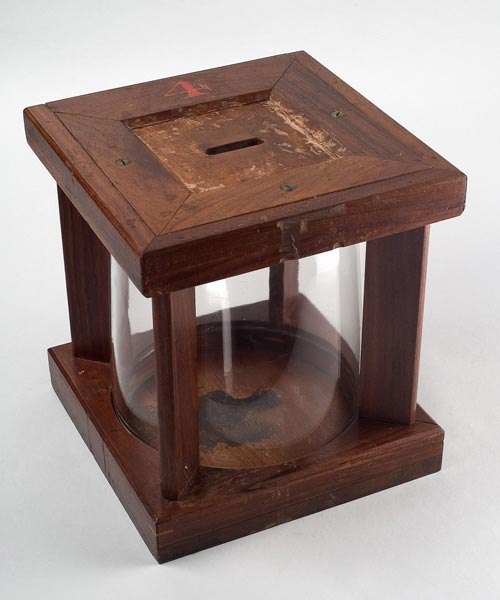
A ballot box from the nineteenth century, kept in a museum of American history. The Knowledge Bank explains that an election is a vote to choose a leader and that a ballot is the slip a voter marks and casts. Notice that the jar is glass. It was made that way on purpose, so that everyone in the room could see it was empty when the voting started and that nothing was added after.
A glass ballot box, National Museum of American History. Source: Wikimedia Commons, public domain.
electionn.Ch.32
A vote to choose a leader
“The class held an election for president.”
nominatev.Ch.32
To name someone as a candidate
“Shay nominated Ally as a joke.”
campaignn.Ch.33
The effort to win an election
“Shay’s campaign was all flashy promises.”
sincereadj.Ch.34
Honest and truly meant
“Ally’s speech was quiet and sincere.”
forgev.Ch.36
To make a fake copy to deceive
“Shay tried to forge a love letter.”
candidaten.Ch.32
A person running for a position
“Each candidate gave a speech.”
ballotn.Ch.35
A slip used to cast a vote
“Mr. Daniels counted every ballot.”
triumphn.Ch.35
A great victory or success
“Winning was a real triumph for Ally.”
backfirev.Ch.37
To go wrong against the one who tried it
“Shay’s scheme began to backfire.”
humiliatev.Ch.36
To make someone feel ashamed
“The letter was meant to humiliate Ally.”
ⓘ The vocabulary words in this list are selected to help you understand and complete this workbook. Some may not appear verbatim in the original novel.
🧠Knowledge Bank question
1According to the Knowledge Bank, why does Shay nominate Ally?Ch.32
2To ‘nominate’ someone is to name them as a candidate.Ch.32
3A ‘campaign’ is the effort to ___.Ch.33
4Something ‘sincere’ is fake and not meant.Ch.34
5Fill in each blank with the correct word.Ch.36
Word choices:forgeballotelectionsneer- some words will not be used
Shay tried to a fake love letter.
Mr. Daniels counted every openly.
6A ‘candidate’ is a person running for a ___.Ch.32
7A ‘triumph’ is a great victory.Ch.35
8When a scheme ‘backfires,’ it goes wrong against ___.Ch.37
9Fill in each blank with the correct word.Ch.33
Word choices:campaignsincerenominateelection- some words will not be used
Shay’s was full of flashy promises.
Ally’s speech was quiet and .
10To ‘humiliate’ someone is to make them feel ___.Ch.36
Part 2
Comprehension
Show you understood what happens in Chapters 32–38.
🧠Knowledge Bank · The Election and the Letter
Narrative Causality · The Election and the Letter
Careful sequence reading reveals the textual evidence, the structural pivot, and the resulting consequence in Chapters 32–38. The class holds an election for class president, and the campaign becomes a contest between two ways of seeing the world. Jessica nominates Shay; then Shay, expecting easy laughs, mockingly nominates Ally — certain the ‘dumb’ girl could never really run. But Ally, terrified and determined, decides to try. Shay’s campaign is all flashy, impossible promises: bigger lockers, longer recess, whatever will win a cheap cheer. Ally, with help shaping her words, writes something different and true — a speech about listening to everyone, about making the quietest voices in the class heard and valued, exactly the kindness she has learned from being unseen herself. Reading evidence around the pivot turns “The Election and the Letter” into meaningful convergence.
🧠Knowledge Bank question
1The Knowledge Bank explains that Ally's speech promises to ___.Ch.32
2Shay’s campaign is built on ___.Ch.33
3Ally decides not to run and drops out.Ch.33
4Ally’s speech promises to ___.Ch.34
5Write the numbers 1–5 in the boxes to show the correct order of events. Number 1 = what happens first.Chapters 32–38
Ally gives a sincere speech about hearing every voice.
Shay forges a fake love letter, which backfires.
Shay mockingly nominates Ally.
The class holds an election for president.
Mr. Daniels counts the ballots and Ally wins.
6Ally loses the election to Shay.Ch.35
7Ally wins because of ___.Ch.35
8To get back at Ally, Shay ___.Ch.36
9The forged letter successfully humiliates Ally.Ch.37
10By the end of Part 6, Shay’s cruelty has ___.Ch.37
Part 3
Literary Elements
Understanding HOW and WHY Lynda Mullaly Hunt tells the story across Chapters 32–38.
🧠Knowledge Bank · A Triumph Earned
Narrative Technique · A Triumph Earned
The pressure of Chapters 32–38 is crafted through arc, rhetoric, and justice working in combination. Measure how far Ally has traveled. In Part 1 she hid in the back row, certain she was stupid and worthless, causing trouble so no one would look too closely. Now she stands in front of the whole class, speaks true words, and wins their trust — on purpose, out loud. Her election victory is a milestone in her character arc, the clearest proof yet that the girl who thought she was nothing has become someone others choose to follow. Notice WHY she wins: not by hiding her difference, and not by copying Shay’s tricks, but by offering the very gift her hard road gave her — knowing exactly what it feels like to be unheard. That authorial design makes “A Triumph Earned” a lesson in deliberate perspective.
Character arc
Ally’s rise from the hidden back-row girl to an elected leader others choose to follow.
Rhetoric
Ally’s sincere, values-based speech against Shay’s flashy, empty promises.
Poetic justice
Shay’s forged letter backfires — the bully undone by her own cruelty.
🧠Knowledge Bank question
1According to the Knowledge Bank, how does Ally win the election?Ch.35
2Fill in each blank with the correct literary term.Ch.35
Word choices:character arcpoetic justicesettingrhyme- some words will not be used
Ally’s rise from hidden girl to elected leader is her .
Shay’s forged letter backfiring is .
3Poetic justice is when a wrongdoer is undone by their own scheme.Ch.37
4Ally’s speech beats Shay’s because Ally’s words are ___.Ch.34
5Ally wins by offering the gift her hard road gave her: knowing how it feels to be ___.Ch.34
6A character arc traces a character’s inner change across a story.Ch.35
7Hunt has Shay’s cruelty backfire rather than letting Ally take revenge, showing that ___.Ch.37
8Fill in each blank with the correct literary term.Ch.34
Word choices:rhetoriccharacter arcnarratormotif- some words will not be used
Ally’s honest, values-based speech is skillful .
Her rise to elected leader is her .
9Shay’s flashy, impossible promises are an example of empty persuasion.Ch.33
10The clearest measure of Ally’s arc in Part 6 is that classmates now ___.Ch.35
Part 4
Think Deeper
Four deeper challenges — no single-word recall. Read, weigh the evidence, and reason it out.
🧠Knowledge Bank · Words That Persuade
Speeches, Elections & Honesty · Words That Persuade
The class election puts Ally in the middle of a real civics lesson about how persuasion works. Whenever people choose a leader — in a classroom, a town, or a country — candidates try to win support with words, and not all persuasion is equal. Some appeals are empty: flashy, impossible promises (bigger lockers, endless recess) designed to grab a quick cheer without any plan or truth behind them — the classic tactics of a candidate who cares more about winning than serving. Other appeals are substantive: honest speech that names a real value, offers something a leader can actually deliver, and treats listeners as thoughtful people. Hunt gives Ally the harder of the two and lets it win, which is not how these scenes usually go. Ally cannot read a speech off a card. She has to mean it and say it, and the class votes for the girl who offered them nothing except the truth.
Visual AidTwo speeches, one room
Diagram for the Knowledge Bank on persuasion. Card 1 is the empty kind and card 2 is the substantive kind, with card 3 naming the difference between them in one line. Card 4 is the test the Knowledge Bank offers a reader. Notice that the test is not about how clever the words are; it is about whether the speaker means them, which is something an audience can usually feel.
The two kinds of persuasion in the class election, as described in the Knowledge Bank. Drawn for Garden Heights Academy.
Think back over these chapters. A mean girl, sure of an easy laugh, nominates the ‘dumb’ kid for class president — and the dumb kid, hands shaking, says yes. One campaign is all fireworks: bigger lockers, endless recess, anything for a cheer. The other is quiet and true: a promise that every voice in the room, even the smallest, will finally be heard, from a girl who knows precisely how it feels to be unheard. The ballots are counted out loud, and the room gasps, because the quiet true words have won. And when the loser strikes back with a forged letter meant to shame the winner, the lie falls apart in her own hands.
Original passage written for Garden Heights — not a quotation from the novel.
1Claim: “Part 6 argues that Ally wins by honesty and heart, not by copying Shay’s empty tricks.” — choose the two details that best prove it.Claim & Evidence
2Shay’s empty persuasion, or Ally’s honest persuasion? Tap each detail to sort it — tap again to switch sides. You can keep tapping to change your answer.Sort into two
3Match each cause to its result. For each cause, pick its result.Cause & Effect
Shay nominates Ally as a joke→
Ally gives a sincere speech→
Ally wins the election→
Shay’s forged letter backfires→
🧠Knowledge Bank question
4Fill both blanks to complete the reasoning.Build the Argument
The Knowledge Bank argues that Ally's persuasion is the substantive kind because , which shows that .
Part 5
Standardized Test
Reading passage · Words That Persuade · SAT & TOEFL-style practice
Read the passage — the highlighted words are tested — then answer. Tap an answer, then tap it again to confirm.
SATCentral Ideas — the passage's main point
SATDetail — a fact stated in the passage
SATWords in Context — a word's meaning in this passage
SATInference — a conclusion the passage implies
SATText Connections — how two parts of the text relate
TOEFLFactual Information — a fact stated in the passage
TOEFLProse Summary — the three sentences that sum it up
Empty Promises Versus Real Persuasion
The class election drops Ally into a lesson every citizen needs: how persuasion works. Whenever a group chooses a leader — in a classroom, a town, or a whole country — the people who want the job try to win support with words long before the first ballot is cast. But not all persuasion is the same, and telling the difference is a useful skill. Some appeals are empty. A candidate may make flashy, impossible promises — bigger lockers, endless recess, something for nothing — designed only to grab a quick cheer, with no plan or truth behind them. Shay’s campaign is built entirely of these.
Other persuasion is substantive: it names a real value, offers something a leader can actually deliver, and treats listeners as thoughtful people rather than an easy crowd. Ally’s winning promise — to make every classmate’s voice heard — is this second kind. Skilled speakers also use the tools of good rhetoric: they appeal to shared values, keep their message clear and simple, and, most important, they are believed because they are sincere. A speech can be clever and still ring false; what makes words truly persuasive over time is that the person means them. This is why Ally, who is neither the loudest nor the most popular, can win: she offers the class something real, spoken honestly, from someone who knows what it is to be ignored. The election teaches a lesson far bigger than sixth grade — that the most powerful and trustworthy words are usually the honest ones.
Original passage written for Garden Heights — not a quotation from the novel.
1What does the passage mainly explain?SAT · Central Ideas
2Whenever a group chooses a leader, candidates try to win support with ___.TOEFL · Factual Information
3An example of empty persuasion is ___.SAT · Detail
4Shay’s campaign is built entirely of ___.TOEFL · Factual Information
5Substantive persuasion names a real ___.SAT · Detail
6In the passage, a ballot is ___.SAT · Words in Context
7What makes words persuasive over time, the passage says, is that the speaker ___.TOEFL · Factual Information
8Ally can win though she is not the loudest because she offers something ___.SAT · Inference
9Prose Summary (TOEFL).The passage explains how persuasion works and why honest words win. This TOEFL task lists six sentences; choose the THREE that best capture the passage’s main ideas. The other three do not belong — they state minor details or ideas the passage does not present.TOEFL · Prose Summary
10Why does this passage matter for Part 6?SAT · Text Connections
Part 6 · Optional
Creative Writing
A bonus challenge to practice your English. Take your time and have fun with it.
About This Section
This writing task is optional and is not part of your auto-graded score. The feedback below checks only the basics — length, spelling, and grammar — not whether your ideas are right or wrong. It is meant for classroom discussion and creative practice, so feel free to use your imagination!
Writing Task — Part 6 “Words That Matter”
Ally wins by speaking honestly about something she truly believes: that every voice should be heard. Write a short persuasive paragraph about a change you would truly make if you led your class or school — and why it matters. Make a real, honest promise, not a flashy one. 6–10 sentences. End with why people should trust your words.
You can start with: “If I could change one real thing, it would be...”
0 / 40 words minimum
🗣 Teach It · Just for Fun (optional)
No right or wrong — close the screen and tell someone nearby what happened in this part. Can’t find anyone? Tell yourself out loud. The moment you teach it, you truly understand it.
Part 6 Complete!
You finished Chapters 32–38 of Fish in a Tree.
Here are your auto-graded results:
-
points out of 100
Teach it to someone
The best last step is to teach it. In your own words, explain what happened — retell a favorite scene, teach a character’s big choice, or sum up the main idea for a parent, friend, or classmate. When you can teach it clearly, you truly own it.
Independent study guide by Garden Heights. Not affiliated with or endorsed by Lynda Mullaly Hunt. Contains original analysis only; no text from the novel is reproduced. Reference text: This workbook follows Lynda Mullaly Hunt’s classic text (the standard Puffin edition sold worldwide). Revised 2023 UK editions change some wording and may not match the vocabulary studied here.
SAT® is a registered trademark of College Board, which is not affiliated with, and does not endorse, these materials. TOEFL® is a registered trademark of ETS. These materials are not endorsed or approved by ETS. Garden Heights is an independent provider of test-style reading practice.