
Part 2
Chet Duncan moves in and watches the Bakers' yard; the sycamore comes down and Bryce says nothing.
Grandfather at the windowIn Chapter 3 Bryce reports that his grandfather, Chet Duncan, moved in with the Loskis in seventh grade after his wife's death. Chet now sits by the window watching the Bakers' overgrown yard, saying very little to anyone else in the house.
The bus-stop sycamoreBryce explains the sycamore at the bus stop, where Juli used to perch and shout down how far off the bus still was. The morning the crew arrives with chainsaws, Juli climbs up and will not come down for anyone.
Riding awayBryce boards the bus and rides to school. He comes home to half a tree and never manages to say he is sorry. The next day Chet hands him the paper with Juli's photograph on the front and tells him to get to know her, which only irritates Bryce.
What the tree wasChapter 4 gives the sycamore to Juli: the fifth-grade kite, the view from the top, the years of climbing, the chainsaws, and her father riding up in a lift to carry her out of it. Afterward Robert Baker gives her his painting of the tree.
| Section | What you will practice |
|---|---|
| Vocabulary | Words for height, land, and loss: vacant, canopy, panorama, defiant, grief… |
| Literary Elements | A setting that turns into a symbol, vantage point as point of view, and what a narrator leaves out |
| Cross-Curricular | Trees — how a sycamore grows and what a mature tree is worth to a street |
| Ch. | What happens |
|---|---|
| 3 | Buddy, Beware! — Bryce narrates. In seventh grade his grandfather, Chet Duncan, moves in after his wife’s death, and Bryce cannot make him out: he sits by the front window looking across at the Bakers’ overgrown yard and says almost nothing. Bryce also explains the sycamore at the bus stop, Juli’s perch, from which she used to shout down how far off the bus was. The morning a crew came with chainsaws, Juli climbed up and would not leave; Bryce got on the bus and rode to school, and by afternoon half the tree was gone. He wanted to tell her he was sorry and never did. The next day Chet hands him the newspaper with Juli’s photograph on the front page and tells him a neighbor like that is a rare thing — the first real conversation his grandfather has wanted, and it only irritates him. |
| 4 | The Sycamore Tree — Juli narrates. Her father, Robert Baker, lays bricks for a living and paints landscapes on his own time, and he keeps telling her that a painting comes to more than the parts inside it. In fifth grade she climbed the sycamore after a kite caught in its branches — the kite was Bryce’s, though she did not know it — and from the top she saw the whole valley and felt something she could not name. She climbed it for years, and had just invited her father up to see it for himself when the chainsaws arrived. Juli refuses to come down, a crowd gathers, and her father has to ride up in a lift to bring her out. For two weeks she bikes the long way to school rather than pass the lot, until he surprises her with his painting of the tree, which she hangs across from her bed. |
ⓘ The vocabulary words in this list are selected to help you understand and complete this workbook. Some may not appear verbatim in the original novel.
- A crew arrives with chainsaws, and Juli climbs up and refuses to come down.
- Her father rides up in a lift and brings her out of the tree.
- In fifth grade Juli climbs the sycamore after a kite tangles in its branches.
- She climbs it for years, calling down to the kids waiting at the bus stop.
- The next day Chet shows Bryce the newspaper photo and tells him to know her.
Think back over these two chapters. There is a tree on an empty lot at the top of a street, and for most of the neighborhood it is scenery — something to park beside, something that drops leaves in the fall. One girl climbs it in fifth grade after a stuck kite and finds a view of the whole valley waiting up there, so she keeps going back, a little higher every year. Then the lot is sold, a crew arrives with chainsaws, and she will not come down. A crowd gathers on the sidewalk below her. One boy in that crowd climbs onto the school bus instead and rides away, comes home to half a tree, thinks about apologizing, and says nothing — until his grandfather hands him the newspaper the next morning and the question arrives anyway.
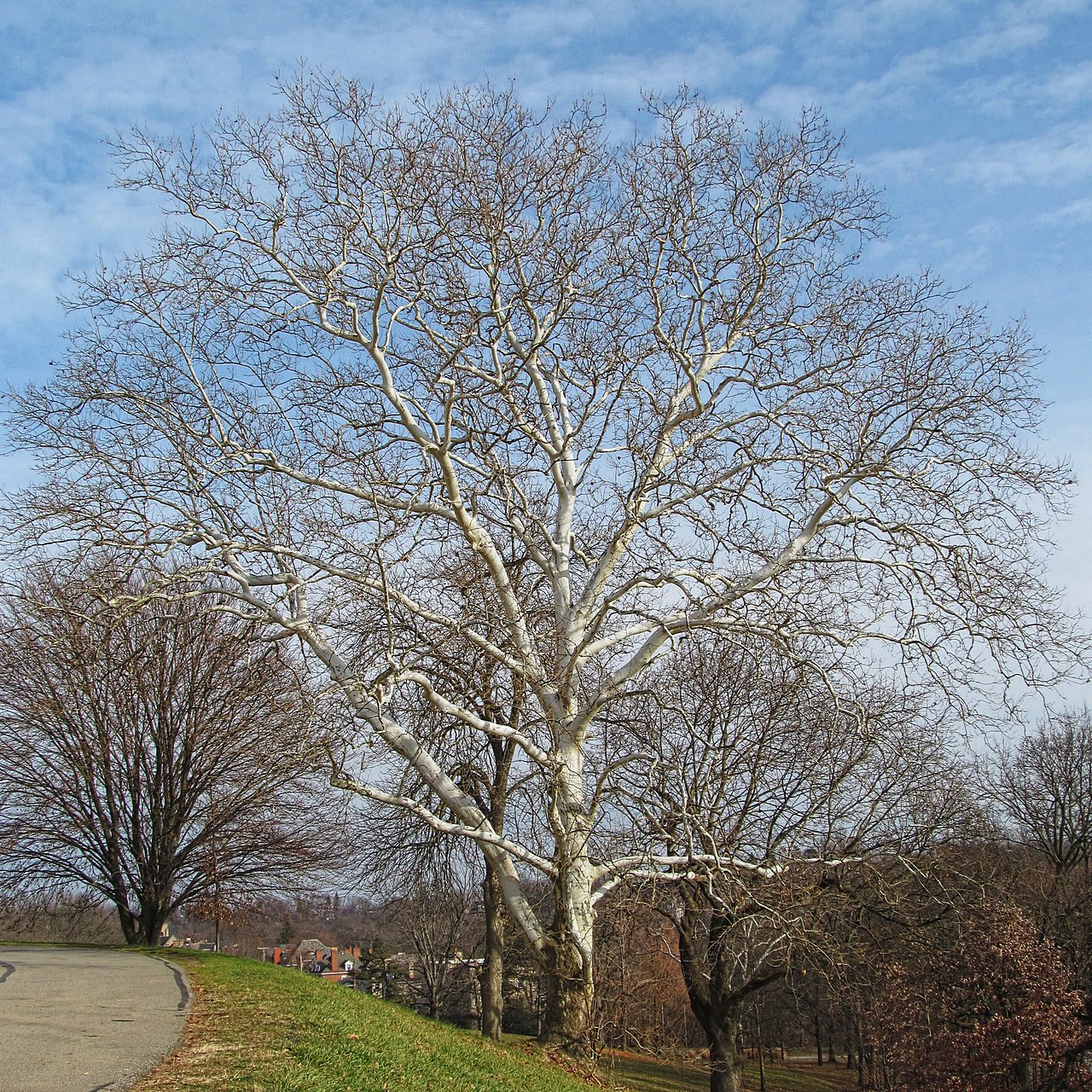
The American sycamore is one of the biggest trees in the eastern United States, and one of the quickest. A young one can add two or three feet (91 cm) in a good year, and an old one may stand more than a hundred feet (30.5 m) tall on a trunk two children cannot reach around. What matters most to a street, though, is not the height but the canopy — the spreading layer of leaves and branches a tree holds above the ground. Sycamore leaves are broad, some as wide as a dinner plate, so one old tree can roof a yard, and from the top a climber gets a panorama of the neighborhood.
That canopy does steady work. It blocks sunlight before it reaches roofs and pavement, and shaded walls keep a house cooler on a summer afternoon. The tree cools the air directly as well: water pulled up by the roots escapes as vapor through tiny pores in the leaves, a process called transpiration that carries heat away. Leaves and branches also catch rain, slowing water that would otherwise rush into the storm drains.
Cities put numbers on all of this. Arborists appraise a tree much as an inspector appraises a building, measuring the trunk, judging its health and weighing where it stands; one healthy shade tree in a good spot is often valued in the thousands of dollars. Studies of home sales keep finding that lots on tree-lined streets sell for more than identical lots without them, and even a vacant lot gains value from a big tree. The one thing the arithmetic cannot supply is time. A sapling planted the afternoon a mature tree comes down needs thirty or forty years to do the work the old tree was doing that morning.
This writing task is optional and is not part of your auto-graded score. The feedback below checks only the basics — length, spelling, and grammar — not whether your ideas are right or wrong. It is meant for classroom discussion and creative practice, so feel free to use your imagination!
Writing Task — Part 2 “The Tree You Would Sit In”
Juli spends years in a tree nobody else on the street bothered to look at, and loses it in one morning. Think of a place that matters to you more than it would to a stranger walking past — a room, a corner of a park, a route you take, a bench. Describe it so that a reader who has never seen it understands why you would be sorry to lose it. 6–10 sentences. End with one detail that only somebody who spent time there would know.
No right or wrong — close the screen and tell someone nearby what happened in this part. Can’t find anyone? Tell yourself out loud. The moment you teach it, you truly understand it.


Part 2 Complete!
You finished Chapters 3–4 of Flipped.
Here are your auto-graded results:
The best last step is to teach it. In your own words, explain what happened — retell a favorite scene, teach a character’s big choice, or sum up the main idea for a parent, friend, or classmate. When you can teach it clearly, you truly own it.
Independent study guide by Garden Heights. Not affiliated with or endorsed by Wendelin Van Draanen. Contains original analysis only; no text from the novel is reproduced. Reference text: This workbook follows Wendelin Van Draanen’s classic text (the standard Puffin edition sold worldwide). Revised 2023 UK editions change some wording and may not match the vocabulary studied here.