New here? Just sign up with Google — your account includes Matilda, our gift book, forever.
Freak the Mighty · Garden Heights
Part 1
for Freak the Mighty · Part 1 · Chapters 1–3
8 Parts40 min
What Happens in Part 1
Lonely Max Kane reunites with brilliant, tiny Kevin, and on Max's shoulders the two become one hero: Freak the Mighty.
The down underMaxwell Kane — big for his age, quiet, slow with words on a page — admits he once believed he had no brain worth using. He lives in the basement he calls the down under, raised by his grandparents, gentle Gram and gruff Grim, who watch him fearfully because he is growing to resemble his father.
Remembering KevinMax remembers meeting Kevin years earlier in daycare: a tiny, fierce boy whose rare condition keeps his body small, who wears leg braces and swings along on crutches, with a quick, dazzling mind. Now Kevin and his mother move into the neighborhood, and the boys fall back together — Kevin brings imagination and a love of King Arthur; Max brings size and steady patience.
Two become oneOne afternoon, to reach into a tree, Max lifts Kevin onto his broad shoulders, and something clicks: Kevin can see far and think fast, Max can carry them anywhere. Together they become one towering hero named Freak the Mighty, and for the first time Max feels not slow or strange but part of something strong.
First-person narration, the ‘Freak the Mighty’ metaphor, and direct characterization
Cross-Curricular
How the human body grows — and why difference is not the same as deficiency
Chapter Summary
Ch.
What happens
Chapters 1–2
The Down Under — Max introduces himself, his life in the basement with Gram and Grim, and his memory of meeting fierce, brilliant little Kevin back in daycare.
Chapter 3
Freak the Mighty Is Born — Kevin moves nearby; when Max lifts him onto his shoulders, the two become one towering hero, part strong body and part sharp mind.
Part 1
Vocabulary
Study 10 key words from Chapters 1–3, then answer each question.
🧠Knowledge Bank · Words of a Beginning
Lexical Semantics · Words of a Beginning
Four words, and they split into two pairs that do not belong together. To vanquish is to defeat someone completely, and in the games the boys invent, Freak the Mighty vanquishes every enemy it meets. Invincible means impossible to defeat or harm, which is how Kevin feels riding high on Max’s shoulders. A brace is a device that supports a weak limb, and metal ones hold Kevin’s legs straight. A crutch is a support that helps a person walk, and he swings himself forward on one with each step. The first pair comes from King Arthur and the second from a hospital supply room, and neither one is a metaphor. Philbrick puts them in the same paragraph on purpose, because the whole novel turns on a boy who is both at once: invincible eight feet off the ground, and everywhere else fragile.
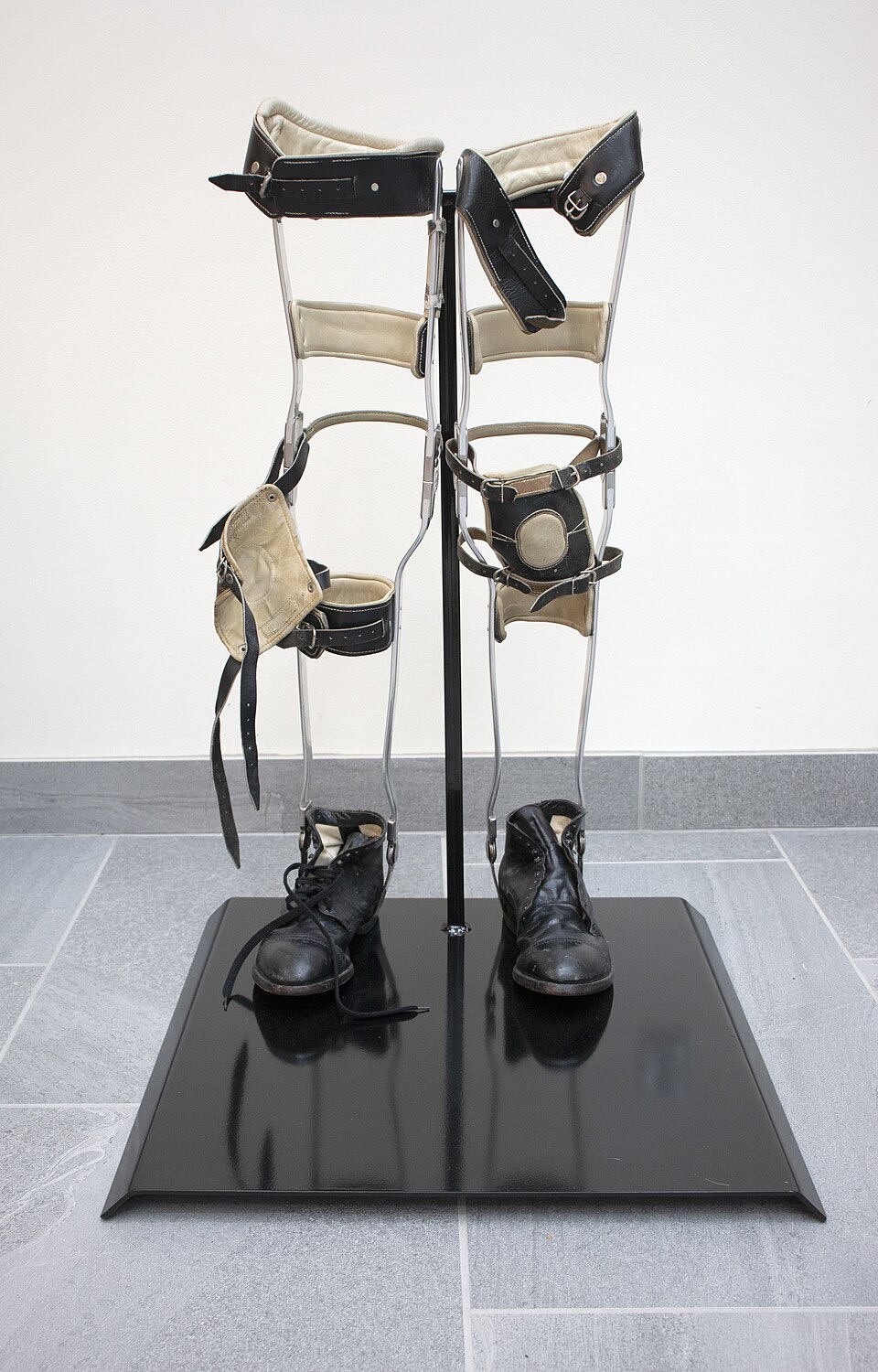
Visual AidWhat a brace and a crutch really are
Photograph of a pair of child-size leg braces on a museum stand — steel uprights, leather pads and straps, and boots built right in, of the kind worn in the years when polio weakened children’s legs. This is the plain hospital-supply object behind two of the Words of a Beginning Knowledge Bank’s words: a brace supports a weak limb and holds it straight. These are not Kevin’s — his rare condition is not polio, and Rodman Philbrick (author) never describes his braces’ make. Notice the weight of the steel: walking in these took real effort, which is what riding high on Max’s shoulders set aside.
Child’s leg braces with attached boots, as worn by polio patients; photograph by Janet Rhodes, via the Digital Public Library of America. Source: Wikimedia Commons, File:Leg Braces - DPLA - 40a4f50fc46a6c810633dd48853ef475.jpg, CC0.
vanquishv.Ch.1
To defeat someone completely
“In their games, Freak the Mighty would vanquish every enemy.”
invincibleadj.Ch.3
Impossible to defeat or harm
“Riding high on Max’s shoulders, Kevin felt invincible.”
bracen.Ch.1
A device that supports a weak limb
“Kevin’s legs were held straight by a metal brace.”
crutchn.Ch.1
A support that helps a person walk
“He swung himself forward on each crutch.”
imaginationn.Ch.2
The power to form pictures and ideas in the mind
“Kevin’s imagination turned a plain street into a kingdom.”
companionn.Ch.3
A person who shares time and adventures with you
“Max became Kevin’s constant companion.”
lumberv.Ch.1
To move in a slow, heavy way
“Max would lumber down the hall like a friendly giant.”
timidadj.Ch.2
Shy and easily frightened
“Around strangers, Max grew quiet and timid.”
fierceadj.Ch.2
Full of bold, intense energy
“For all his small size, Kevin had a fierce spirit.”
questn.Ch.3
A long search or adventure toward a goal
“Kevin declared that every walk was a new quest.”
ⓘ The vocabulary words in this list are selected to help you understand and complete this workbook. Some may not appear verbatim in the original novel.
🧠Knowledge Bank question
1The Knowledge Bank explains that vanquish and invincible come from a different world than brace and crutch — the first pair belongs to ___.Ch.1
2Someone ‘invincible’ can be easily defeated.Ch.3
3A ‘brace’ is a device that ___ a weak limb.Ch.1
4A ‘crutch’ helps a person walk.Ch.1
5Fill in each blank with the correct word.Ch.2
Word choices:imaginationcompanionbraceengine- some words will not be used
Kevin’s turned the street into a kingdom.
In Max he found a loyal .
6To ‘lumber’ is to move in a ___ way.Ch.1
7A person who is ‘timid’ is ___.Ch.2
8Someone ‘fierce’ is full of ___.Ch.2
9Fill in each blank with the correct word.Ch.3
Word choices:questinvincibletimidcrutch- some words will not be used
Kevin called every walk a new .
High on Max’s shoulders, he felt .
10A ‘quest’ is a long ___ toward a goal.Ch.3
Part 2
Comprehension
Show you understood what happens in Chapters 1–3.
🧠Knowledge Bank · How the Two Boys Meet
Narrative Causality · How the Two Boys Meet
In Chapters 1–3, plot comprehension depends on locating the trigger, tracing mounting pressure, and recognizing the decisive turn. Maxwell Kane — big for his age, quiet, and slow with words on a page — introduces himself and admits he once believed he had no brain worth using. He lives in the basement he calls ‘the down under,’ raised by his grandparents, gentle Gram and gruff Grim, who watch him a little fearfully because he is growing to resemble his father. Max remembers meeting Kevin years earlier in daycare: a tiny, fierce boy with a rare condition that keeps his body small, who wears leg braces and swings along on crutches, and whose mind is quick and dazzling. Now Kevin and his mother move into the neighborhood, and the two boys fall back together. Seen as cause and effect, “How the Two Boys Meet” becomes the opening catalyst.
Visual AidOne arrival sets the whole book moving
Sequence diagram of the opening the How the Two Boys Meet Knowledge Bank walks through: Max settled in the down under, Kevin’s arrival as the trigger, the boys falling back together as the pressure mounts, and the turn — one boy up on the other’s shoulders. The boxes compress three chapters to four moments and show nothing about how either boy feels; the labels underneath are the Knowledge Bank’s own reading terms, not events.
Sequence as described in the How the Two Boys Meet Knowledge Bank, from Freak the Mighty, Chapters 1–3. Drawn for Garden Heights Academy.
🧠Knowledge Bank question
1According to the Knowledge Bank, Grim and Gram watch Max a little fearfully because ___.Ch.1
2Max calls the basement where he lives ___.Ch.1
3Max feels sure from the start that he is very smart.Ch.1
4Where did Max first meet Kevin years earlier?Ch.2
5Write the numbers 1–5 in the boxes to show the correct order of events. Number 1 = what happens first.Chapters 1–3
Kevin and his mother move into the neighborhood.
Max introduces his life in the down under with Gram and Grim.
Together the two boys become Freak the Mighty.
Max recalls meeting fierce little Kevin at daycare.
Max lifts Kevin high onto his shoulders.
6Kevin uses leg braces and crutches to get around.Ch.1
7What does Kevin bring to the friendship?Ch.3
8When Max lifts Kevin up, the two of them become ___.Ch.3
9Gram and Grim watch Max a little fearfully as he grows.Ch.1
10For the first time, being Freak the Mighty makes Max feel ___.Ch.3
Part 3
Literary Elements
Understanding HOW and WHY Rodman Philbrick (author) tells the story across Chapters 1–3.
🧠Knowledge Bank · Freak the Mighty: One Hero From Two
Narrative Technique · Freak the Mighty: One Hero From Two
In Chapters 1–3, Rodman Philbrick coordinates narrator, metaphor, and characterization to establish the novel’s opening design. When Max hoists Kevin onto his shoulders, Philbrick gives us the book’s central metaphor. ‘Freak the Mighty’ is not really two boys anymore but one imagined hero — Max’s powerful body joined to Kevin’s brilliant mind, walking high above the world. The metaphor works because each boy supplies exactly what the other lacks. Alone, Max feels slow and invisible and Kevin feels trapped in a body that will not carry him; together they are complete, strong AND clever, able to go anywhere and solve anything. Watch how often the book returns to this image of Kevin riding high on Max’s shoulders; it is the physical picture of true friendship, in which two people become more than the sum of their parts. That authorial design makes “Freak the Mighty: One Hero From Two” a lesson in deliberate atmosphere.
First-person narrator
Max tells his own story with ‘I,’ so every person and event reaches us through a boy long underestimated.
Metaphor
‘Freak the Mighty’ — Max’s body and Kevin’s mind imagined as one towering hero, the picture of their friendship.
Direct characterization
Max states plainly who he is — slow, quiet, large — even as his rich storytelling shows he is more.
🧠Knowledge Bank question
1The Knowledge Bank explains that the metaphor 'Freak the Mighty' works because ___.Ch.1
2Fill in each blank with the correct literary term.Ch.3
Word choices:metaphorfirst-person narratorsettingrhyme- some words will not be used
Max telling his own story with ‘I’ makes him the .
Calling the two boys one hero is a .
3A first-person narrator tells the story using the word ‘I.’Ch.1
4‘Freak the Mighty,’ one hero made of two boys, is a ___.Ch.3
5When Max plainly tells us he is slow and quiet, Philbrick is using ___.Ch.1
6A metaphor describes one thing as if it truly were another.Ch.3
7Fill in each blank with the correct literary term.Ch.1
Word choices:direct characterizationmetaphornarratorclimax- some words will not be used
Max stating outright that he feels dumb is .
Two boys imagined as one hero is a .
8The gap between Max calling himself dumb and telling a rich story creates ___.Ch.1
9Because Max narrates, every other character reaches us through his eyes.Ch.1
10The clearest sign Max is smarter than he thinks is his ___.Ch.1
Part 4
Think Deeper
Four deeper challenges — no single-word recall. Read, weigh the evidence, and reason it out.
🧠Knowledge Bank · Different Bodies, Different Strengths
The Human Body · Different Bodies, Different Strengths
From the very first pages, Philbrick asks us to look closely at two bodies. Max is unusually large and strong for his age; Kevin is unusually small, because of a rare condition that keeps his body from growing the way most bodies do, so he depends on leg braces and crutches to move. It would be easy, and wrong, to call one boy ‘normal’ and the other ‘broken.’ The truth the book insists on is subtler: every body has strengths and limits, and a difference is not a deficiency. Kevin cannot walk far, but his mind is one of the sharpest in the story; Max can carry almost anything, yet he struggles to read a page. Philbrick sets that up in the first three chapters so the rest of the book cannot be misread. Neither boy is carrying the other, whatever it looks like from the sidewalk. Max supplies the legs and Kevin supplies the plan, and the name they take is for the pair, never for either boy alone.
Picture a large, gentle boy who has decided he is stupid, keeping to a basement he calls the down under because up in the world he feels too big and too slow. Then picture a tiny boy on crutches whose legs are strapped in braces but whose mind runs faster than anyone’s, burning to go on quests like the knights he loves. Apart, each is stuck: one cannot think well of himself, the other cannot carry himself far. Then, reaching for something high in a tree, the big boy swings the small one up onto his shoulders — and all at once they are tall and quick and strong together, seeing far and going anywhere, a single hero they name Freak the Mighty. Neither has changed his body. They have simply discovered that what one lacks, the other has.
Original passage written for Garden Heights — not a quotation from the novel.
1Claim: “Part 1 shows that Max and Kevin complete each other, each supplying what the other lacks.” — choose the two details that best prove it.Claim & Evidence
2What Max brings, or What Kevin brings? Tap each detail to sort it — tap again to switch sides. You can keep tapping to change your answer.Sort into two
◄ What Max bringsWhat Kevin brings ►
3Match each cause to its result. For each cause, pick its result.Cause & Effect
Max feels slow and invisible alone→
Kevin cannot walk far on his own→
Max lifts Kevin up into a tree→
The two combine body and mind→
🧠Knowledge Bank question
4Fill both blanks to complete the reasoning.Build the Argument
The Knowledge Bank argues that neither boy is simply carrying the other because , which shows that .
Part 5
Standardized Test
Reading passage · How the Body Grows, and Why Difference Is Not Deficiency · SAT & TOEFL-style practice
Read the passage — the highlighted words are tested — then answer. Tap an answer, then tap it again to confirm.
SATCentral Ideas — the passage's main point
SATDetail — a fact stated in the passage
SATWords in Context — a word's meaning in this passage
SATText Structure & Purpose — how the passage is built, and why
SATText Connections — how two parts of the text relate
TOEFLFactual Information — a fact stated in the passage
TOEFLVocabulary — a tested word's meaning here
When Bodies Grow Differently
Max and Kevin are the same age, yet their bodies look utterly different. Growth is one of the most complicated things a human body does: from birth to the late teens, the body follows a plan written partly in a person’s genes and carried out by chemical messengers called hormones. But in a small number of people one part of it works differently, so that the body grows faster, slower, taller, or smaller than average — and Kevin has a rare condition of this kind, one that keeps his body small even as his mind races ahead.
It is tempting, but mistaken, to treat a body that grows differently as a body that is simply ‘wrong.’ A difference is not the same as a deficiency. No human body, not even the biggest and strongest, is invincible. Every human body has strengths and limits: some people see poorly and wear glasses, some cannot hear and use their hands to speak, some cannot walk far and use braces or wheelchairs. Kevin cannot climb a tree, but he can out-think nearly everyone around him, and Max can lift almost anything, yet a page of print defeats him.
This is why the tools that help different bodies matter so much. Doctors call them assistive devices: eyeglasses, hearing aids, wheelchairs, and the leg braces and crutches Kevin uses every day. Such tools do not ‘fix’ a broken person; they simply close the gap between what a body can do alone and what its owner wants to do. Reaching for such a tool is not weak or timid; it is smart, ordinary problem-solving, the same way a tall person uses a ladder — and understood this way, Kevin stops looking like a boy to be pitied and starts looking like what he is.
Original passage written for Garden Heights — not a quotation from the novel.
1What is the main idea of the passage?SAT · Central Ideas
2Body growth is guided partly by genes and by chemical messengers called ___.TOEFL · Factual Information
3For most children, the growth plan unfolds ___.TOEFL · Factual Information
4Kevin has a rare condition that keeps his body ___.SAT · Detail
5The passage says a difference is NOT the same as a ___.SAT · Detail
6According to the passage, every human body has ___.TOEFL · Factual Information
7In the passage, invincible most nearly means ___.SAT · Words in Context
8The passage compares using braces to a tall person using a ___.SAT · Text Structure & Purpose
9In the passage, timid most nearly means ___.TOEFL · Vocabulary
10Which idea from Part 1 does this passage BEST help explain?SAT · Text Connections
Part 6 · Optional
Creative Writing
A bonus challenge to practice your English. Take your time and have fun with it.
About This Section
This writing task is optional and is not part of your auto-graded score. The feedback below checks only the basics — length, spelling, and grammar — not whether your ideas are right or wrong. It is meant for classroom discussion and creative practice, so feel free to use your imagination!
Writing Task — Part 1 “Two People, One Team”
Freak the Mighty works because each boy gives what the other lacks. Write about a time you teamed up with someone whose strengths were different from yours. What could each of you do that the other could not, and how did working together change what was possible? 6–10 sentences. End with what the partnership taught you.
You can start with: “On my own I could only get so far, but together we...”
0 / 40 words minimum
🗣 Teach It · Just for Fun (optional)
No right or wrong — close the screen and tell someone nearby what happened in this part. Can’t find anyone? Tell yourself out loud. The moment you teach it, you truly understand it.
Part 1 Complete!
You finished Chapters 1–3 of Freak the Mighty.
Here are your auto-graded results:
-
points out of 100
Teach it to someone
The best last step is to teach it. In your own words, explain what happened — retell a favorite scene, teach a character’s big choice, or sum up the main idea for a parent, friend, or classmate. When you can teach it clearly, you truly own it.
Independent study guide by Garden Heights. Not affiliated with or endorsed by Rodman Philbrick. Contains original analysis only; no text from the novel is reproduced. Reference text: This workbook follows Rodman Philbrick’s classic text (the standard Puffin edition sold worldwide). Revised 2023 UK editions change some wording and may not match the vocabulary studied here.
SAT® is a registered trademark of College Board, which is not affiliated with, and does not endorse, these materials. TOEFL® is a registered trademark of ETS. These materials are not endorsed or approved by ETS. Garden Heights is an independent provider of test-style reading practice.