New here? Just sign up with Google — your account includes Matilda, our gift book, forever.
Freak the Mighty · Garden Heights
Part 2
for Freak the Mighty · Part 2 · Chapters 4–6
8 Parts40 min
What Happens in Part 2
Now inseparable, the boys turn the neighborhood into King Arthur's realm, and each risky escapade makes both of them braver.
The knightly codeObsessed with King Arthur and the Knights of the Round Table, Kevin lends Max a dictionary and a book of legends and teaches him that a true knight is measured by deeds, not size or speed. With Kevin riding high on Max's shoulders, ordinary streets become a realm of dragons and damsels, and their made-up adventures feel gloriously real.
Two night escapadesOn the Fourth of July the boys slip out into the night to watch the fireworks up close, wandering where they are not supposed to go and tasting a heady freedom. Another escapade leads them down to the millpond, where a plunge into the water nearly turns dangerous; Max's steady strength keeps them both safe while Kevin's quick thinking keeps them out of worse trouble.
Braver togetherThrough it all, Rodman Philbrick (author) shows the friendship deepening: Kevin gives Max a story to live inside and words to grow into, and Max gives Kevin the mobility and courage to actually go on the quests he has only dreamed of. Each boy is becoming braver, and more himself, because of the other.
Allusion to King Arthur, vivid imagery, and the extended quest metaphor
Cross-Curricular
The legend of King Arthur and the knightly quest
Chapter Summary
Ch.
What happens
Chapters 4–5
Knights and Quests — Kevin shares his love of King Arthur, lends Max a dictionary and legends, and recasts the neighborhood as a realm of dragons and daring quests.
Chapter 6
Fireworks and the Millpond — on the Fourth of July the boys roam free to watch fireworks; another adventure at the millpond turns risky, and their strengths save them.
Part 1
Vocabulary
Study 10 key words from Chapters 4–6, then answer each question.
🧠Knowledge Bank · Words of the Quest
Lexical Semantics · Words of the Quest
Five words, and every one of them is borrowed from a book Kevin has read too many times. A legend is an old, famous story handed down over time, and Kevin knows every King Arthur legend by heart. Chivalry is the knightly code of honor and bravery, and he does not just admire it — he lives by it. Noble means showing high, honorable character, which is what a knight’s deeds were supposed to be. Peril is serious danger, and the millpond holds real peril for two boys, whatever they call it. To venture is to go somewhere risky or unknown, which they do on the Fourth of July. Notice which of the five is not pretend. The games are borrowed, the code is borrowed, the quest is borrowed — but the millpond is real water, and it has never heard of Arthur.
legendn.Ch.4
An old, famous story handed down over time
“Kevin knew every legend of King Arthur by heart.”
chivalryn.Ch.4
The knightly code of honor and bravery
“Kevin lived by the rules of chivalry.”
nobleadj.Ch.4
Showing high, honorable character
“A knight was expected to do noble deeds.”
periln.Ch.6
Serious danger
“The millpond held real peril for the boys.”
venturev.Ch.6
To go somewhere risky or unknown
“They dared to venture out on the Fourth of July.”
realmn.Ch.4
A kingdom or region ruled by someone
“Kevin turned the neighborhood into his realm.”
damseln.Ch.4
A young woman in old tales, often in need of help
“Every quest seemed to need a damsel to rescue.”
dictionaryn.Ch.5
A book that lists words and their meanings
“Kevin lent Max a dictionary to explore.”
dwellv.Ch.5
To live in a particular place
“Kevin imagined dragons that dwell nearby.”
gallantadj.Ch.4
Brave and grandly polite
“Max learned to make a gallant bow.”
ⓘ The vocabulary words in this list are selected to help you understand and complete this workbook. Some may not appear verbatim in the original novel.
🧠Knowledge Bank question
1According to the Knowledge Bank, the games, the code, and the quest are all borrowed from books, but one of the five words names something real. Which is it?Ch.4
2‘Chivalry’ is a knightly code of honor and bravery.Ch.4
3A ‘noble’ deed shows ___ character.Ch.4
4‘Peril’ means safety and comfort.Ch.6
5Fill in each blank with the correct word.Ch.6
Word choices:ventureperillegendgallant- some words will not be used
The boys dared to out into the night.
At the millpond they met real .
6A ‘realm’ is a ___ ruled by someone.Ch.4
7In old tales, a ‘damsel’ is a young woman who often ___.Ch.4
8To ‘dwell’ somewhere is to ___ there.Ch.5
9Fill in each blank with the correct word.Ch.4
Word choices:gallantchivalrydictionaryperil- some words will not be used
Max learned to make a bow.
Kevin lived by the code of .
10A ‘dictionary’ is a book that lists words and their ___.Ch.5
Part 2
Comprehension
Show you understood what happens in Chapters 4–6.
🧠Knowledge Bank · Adventures Begin
Narrative Causality · Adventures Begin
The events of Chapters 4–6 become clearer when readers separate a character’s motive from the obstacle encountered and the response that follows. Now inseparable, the boys let Kevin’s imagination remake the whole neighborhood. Kevin is obsessed with King Arthur, the Knights of the Round Table, and the code of the quest; he lends Max a dictionary and a book of legends and teaches him that a true knight is measured by deeds, not size or speed. With Kevin riding high on Max’s shoulders, ordinary streets become a realm of dragons and damsels, and the pair set off on made-up adventures that feel gloriously real. On the Fourth of July they slip out into the night to watch the fireworks up close, wandering where they are not supposed to go and tasting a heady sense of freedom. Following motive through response reveals why “Adventures Begin” forms a consequential sequence.
Visual AidMotive, obstacle, response
Sequence diagram of the reading frame the Adventures Begin Knowledge Bank names: the motive (living by the knightly code), the obstacle (a forbidden night out on the Fourth of July), and the response (a quest, and a first taste of freedom). One chain stands for many — every made-up adventure in these chapters runs the same three steps with a different obstacle — and the drawing claims nothing about how the night ends; that is the next part’s business.
Motive, obstacle, and response as described in the Adventures Begin Knowledge Bank, from Freak the Mighty, Chapters 4–6. Drawn for Garden Heights Academy.
🧠Knowledge Bank question
1According to the Knowledge Bank, Kevin teaches Max that a true knight is measured by ___.Ch.4
2Kevin teaches Max that a true knight is measured by his ___.Ch.4
3Kevin lends Max a dictionary and a book of legends.Ch.5
4With Kevin on his shoulders, Max turns ordinary streets into a ___.Ch.4
5Write the numbers 1–5 in the boxes to show the correct order of events. Number 1 = what happens first.Chapters 4–6
Kevin lends Max a dictionary and a book of legends.
On the Fourth of July they roam out to see the fireworks.
The boys recast the neighborhood as a realm of quests.
Kevin shares his love of King Arthur and the knights.
A millpond adventure turns risky, and their strengths save them.
6The boys stay safely indoors on the Fourth of July.Ch.6
7The millpond adventure becomes ___.Ch.6
8What keeps the boys safe at the millpond?Ch.6
9Kevin gives Max a story to live inside and words to grow into.Ch.5
10By the end of Part 2, each boy is becoming ___ because of the other.Ch.6
Part 3
Literary Elements
Understanding HOW and WHY Rodman Philbrick (author) tells the story across Chapters 4–6.
🧠Knowledge Bank · Borrowing King Arthur
Narrative Technique · Borrowing King Arthur
The craft of Part 2 works through allusion, imagery, and metaphor, each shaping how readers judge the new conflict. Philbrick fills these chapters with allusion — references to another famous story, here the legends of King Arthur, his knights, and their quests. When Kevin speaks of the Round Table, of chivalry, of vanquishing enemies and rescuing the helpless, he is borrowing a whole world the reader may already half-know, and letting its meaning pour into the boys’ small adventures. The allusion does real work. It lifts an ordinary walk to the fireworks into a noble quest, and it gives Max a heroic role to grow into. It also tells us something about Kevin: a boy trapped in a body that cannot fight has chosen a fantasy in which honor, not muscle, makes the hero. That authorial design makes “Borrowing King Arthur” a lesson in deliberate suspense.
Allusion
Kevin’s talk of Arthur, the Round Table, and quests borrows a whole famous world to lift the boys’ small adventures.
Imagery
Sensory writing — booming fireworks, cold pond water — makes the boys’ freedom and danger feel physical.
Extended metaphor
The knightly ‘quest’ runs through the whole book as a picture of the friendship’s courage and purpose.
🧠Knowledge Bank question
1The Knowledge Bank explains that Kevin's King Arthur fantasy fits him because in that world the hero is made by ___.Ch.4
2Fill in each blank with the correct literary term.Ch.6
Word choices:imageryallusionrhymefootnote- some words will not be used
The booming fireworks are vivid .
Kevin’s talk of Arthur’s knights is an .
3An allusion is a reference to another well-known story or work.Ch.4
4The cold shock of the millpond water is an example of ___.Ch.6
5The knightly ‘quest’ that runs through the whole book is an ___.Ch.4
6Imagery is language that appeals to the reader’s senses.Ch.6
7Fill in each blank with the correct literary term.Ch.4
Word choices:extended metaphorallusionnarratorclimax- some words will not be used
The quest that runs through the whole book is an .
Naming the Round Table is an .
8An allusion works best when readers know the story being referenced.Ch.4
9By borrowing Arthur’s world, Kevin gives Max a heroic ___ to grow into.Ch.4
10The Arthur allusion mainly turns the boys’ ordinary outings into ___.Ch.4
Part 4
Think Deeper
Four deeper challenges — no single-word recall. Read, weigh the evidence, and reason it out.
🧠Knowledge Bank · The Legend of King Arthur
Cross-Curricular Context · Supporting Lens · Story as a Map to Live By
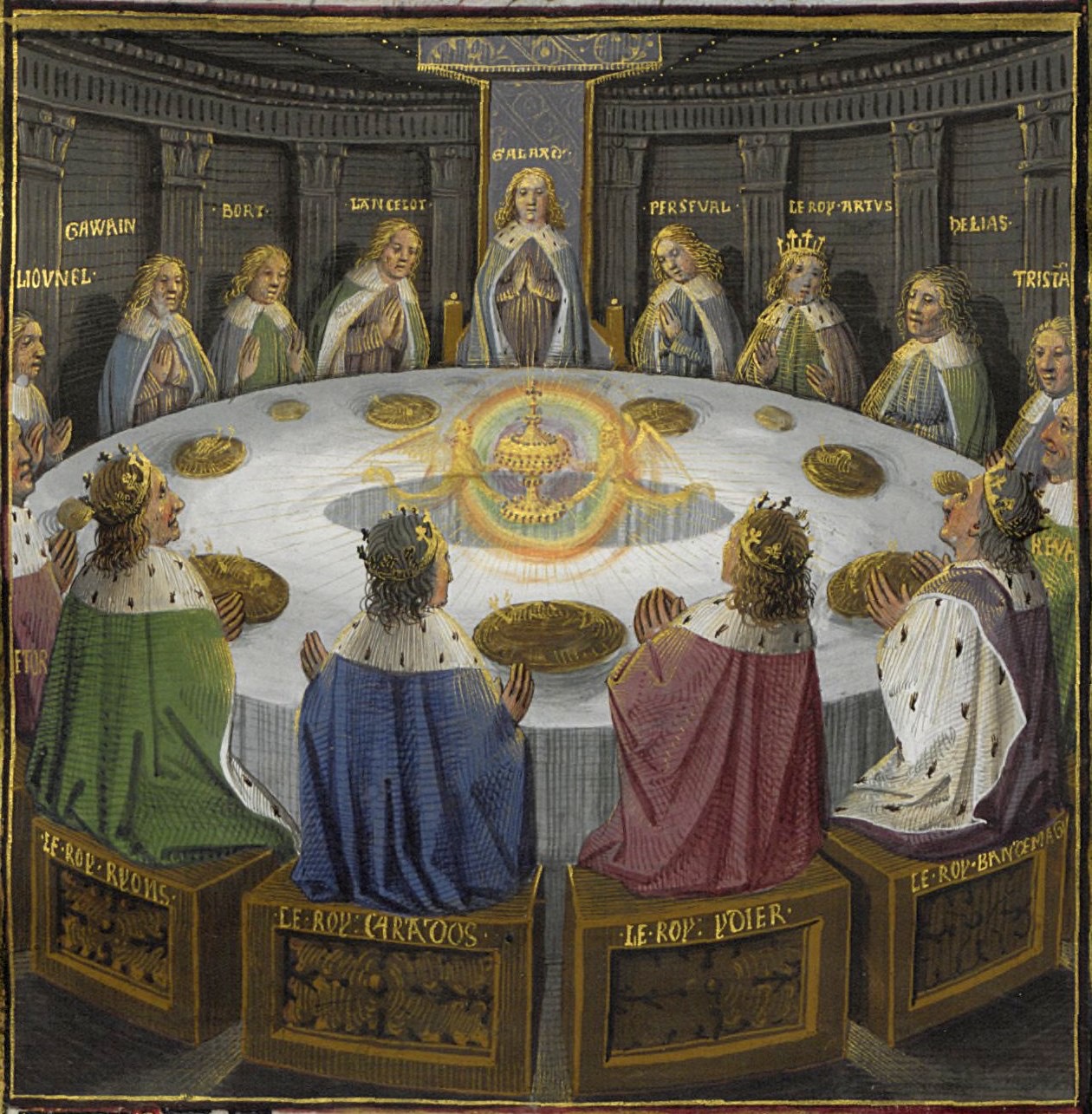
Kevin does not just like the King Arthur stories; he uses them as a map for how to live, and it helps to know what those stories are. The legend of King Arthur is one of the oldest and most retold tales in the English language, gathered over centuries into a great cycle about a boy who pulls a sword from a stone, becomes king, and gathers the bravest knights of the land at a Round Table — round so that no one sits above anyone else. Their code, called chivalry, prized courage, loyalty, honesty, and the protection of the weak, and the knights proved themselves not by boasting but by going on quests, dangerous journeys toward a worthy goal. That last detail is why the legend suits Kevin so exactly. A quest does not ask how fast you can run or how much you can lift. It asks where you are going and whether the goal is worth it — which is the only contest in the world a boy on crutches can enter on equal terms.
Visual AidThe Round Table, painted five centuries ago
Photograph of a page painted by Évrard d’Espinques around 1475 for a French manuscript of the Arthurian romances, now kept at the Bibliothèque nationale de France: Arthur (lettered LE ROY ARTUS) and his knights — Gawain, Lancelot, Perceval and the rest — seated at the Round Table as the Holy Grail appears. The round shape is the very detail The Legend of King Arthur Knowledge Bank singles out: no seat outranks another. The picture records the legend, not history — it was painted a thousand years after any real Arthur could have lived, and the table, like the code, is the story’s.
King Arthur’s knights at the Round Table with a vision of the Holy Grail; illumination by Évrard d’Espinques, c. 1475, Bibliothèque nationale de France, MS Français 116. Source: Wikimedia Commons, File:Holy-grail-round-table-bnf-ms fr-116F-f610v-15th-detail.jpg, public domain.
Imagine a boy who will never run or fight, who has decided instead to live inside the grandest story he knows: knights, a Round Table, a code that says honor matters more than muscle. He cannot go on a quest alone, so he finds a giant of a friend, climbs onto his shoulders, and points the way — and suddenly the plain streets are a realm, the fireworks are dragon-fire, and two outsiders are knights. There is real danger in it, a cold pond and a dark Fourth-of-July night where they are not supposed to be, and there is real joy, the kind that makes a body feel gloriously alive. And underneath the game, something true is happening: one boy is handing the other words, and stories, and a braver way to see himself.
Original passage written for Garden Heights — not a quotation from the novel.
1Claim: “Part 2 shows that Kevin’s love of the King Arthur legends changes how Max sees himself.” — choose the two details that best prove it.Claim & Evidence
2The golden joy of the days, or The real danger in the days? Tap each detail to sort it — tap again to switch sides. You can keep tapping to change your answer.Sort into two
◄ The golden joy of the daysThe real danger in the days ►
3Match each cause to its result. For each cause, pick its result.Cause & Effect
Kevin shares the Arthur legends→
Kevin lends Max the dictionary→
The boys roam free on the Fourth→
The millpond plunge turns risky→
🧠Knowledge Bank question
4Fill both blanks to complete the reasoning.Build the Argument
The Knowledge Bank argues that the quest is the one contest Kevin can enter on equal terms because , which shows that .
Part 5
Standardized Test
Reading passage · The Legend of King Arthur and the Knightly Quest · SAT & TOEFL-style practice
Read the passage — the highlighted words are tested — then answer. Tap an answer, then tap it again to confirm.
SATCentral Ideas — the passage's main point
SATDetail — a fact stated in the passage
SATWords in Context — a word's meaning in this passage
SATInference — a conclusion the passage implies
TOEFLFactual Information — a fact stated in the passage
TOEFLRhetorical Purpose — why the author included a detail
TOEFLVocabulary — a tested word's meaning here
TOEFLProse Summary — the three sentences that sum it up
Chivalry and the Knight's Quest
Kevin’s favorite stories are among the oldest in the English language: the legends of King Arthur. These tales were not written all at once by a single author; they grew over many centuries, told and retold by poets and storytellers across Britain and France, until they were gathered into a great web of stories about a legendary king. Whether a real Arthur ever lived is uncertain and probably unknowable. What is certain is that the legend became one of the most beloved stories in the world, returning again and again in new books, plays, and films.
The heart of the legend is a set of ideas about how a person ought to live. In the stories, a boy named Arthur proves his right to be king by drawing a magical sword from a stone when no grown warrior can. As king, he gathers the bravest and most gallant knights of the land at a Round Table — and the table is round on purpose, so that no knight sits at the head and all are counted as equals. The knights follow a code called chivalry, which prized courage, loyalty, honesty, generosity, and above all the protection of the weak.
Knights proved their honor not by boasting but by going on quests. A quest is a long and dangerous journey undertaken to reach a worthy goal — to right a wrong, rescue someone in danger, or seek a sacred prize. What matters is not how large or strong a knight is, but how he behaves when the quest grows hard and the road fills with peril. In the legend, a person’s worth is measured entirely by deeds and honor, never by the size or strength of the body — which is exactly why this world grips a boy like Kevin.
Original passage written for Garden Heights — not a quotation from the novel.
1What is the passage mainly about?SAT · Central Ideas
2The Arthur legends were created ___.TOEFL · Factual Information
3Young Arthur proves his right to be king by ___.SAT · Detail
4The Round Table is round so that the knights are ___.TOEFL · Rhetorical Purpose
5The knightly code of honor is called ___.TOEFL · Factual Information
6In the passage, gallant most nearly means ___.SAT · Words in Context
7In these stories, a knight’s worth is measured by his ___.SAT · Detail
8In the passage, peril most nearly means ___.TOEFL · Vocabulary
9Prose Summary (TOEFL).This passage explains the legend of King Arthur and the knightly code it teaches. This TOEFL task lists six sentences; choose the THREE that best capture the passage’s main ideas. The other three do not belong — they state minor details or ideas the passage does not present.TOEFL · Prose Summary
10Why would the legend grip a boy like Kevin?SAT · Inference
Part 6 · Optional
Creative Writing
A bonus challenge to practice your English. Take your time and have fun with it.
About This Section
This writing task is optional and is not part of your auto-graded score. The feedback below checks only the basics — length, spelling, and grammar — not whether your ideas are right or wrong. It is meant for classroom discussion and creative practice, so feel free to use your imagination!
Writing Task — Part 2 “A Story I Live By”
Kevin uses the King Arthur legend as a map for how to be brave and good. Write about a story, book, movie, or hero that shapes how you try to act. What is the story, what does it teach, and how has it changed something you have done? 6–10 sentences. End with the one idea from it you most want to live by.
You can start with: “Whenever I have to be brave, I think of...”
0 / 40 words minimum
🗣 Teach It · Just for Fun (optional)
No right or wrong — close the screen and tell someone nearby what happened in this part. Can’t find anyone? Tell yourself out loud. The moment you teach it, you truly understand it.
Part 2 Complete!
You finished Chapters 4–6 of Freak the Mighty.
Here are your auto-graded results:
-
points out of 100
Teach it to someone
The best last step is to teach it. In your own words, explain what happened — retell a favorite scene, teach a character’s big choice, or sum up the main idea for a parent, friend, or classmate. When you can teach it clearly, you truly own it.
Independent study guide by Garden Heights. Not affiliated with or endorsed by Rodman Philbrick. Contains original analysis only; no text from the novel is reproduced. Reference text: This workbook follows Rodman Philbrick’s classic text (the standard Puffin edition sold worldwide). Revised 2023 UK editions change some wording and may not match the vocabulary studied here.
SAT® is a registered trademark of College Board, which is not affiliated with, and does not endorse, these materials. TOEFL® is a registered trademark of ETS. These materials are not endorsed or approved by ETS. Garden Heights is an independent provider of test-style reading practice.