New here? Just sign up with Google — your account includes Matilda, our gift book, forever.
Freak the Mighty · Garden Heights
Part 3
for Freak the Mighty · Part 3 · Chapters 7–9
8 Parts40 min
What Happens in Part 3
Returning a handbag they rescue from a storm drain lands the boys under suspicion — until Kevin's quick tongue clears them.
The storm drainOn one of their quests the boys spot something glinting down in a storm drain. With Kevin directing and Max reaching, they fish a woman's lost handbag out of the muck, and true to their knightly code they set out to return it to its owner — but doing the right thing lands them in trouble.
An easy targetBefore the truth comes out, they are suspected of having stolen the bag themselves, and Max — large, silent, and already feared because of his father — makes an easy target. The tense misunderstanding shows how quickly the world judges Max by his size and his family name rather than his actions.
Blade lurkingKevin's quick tongue and clear thinking untangle the mess, explaining what really happened and clearing them both, while Max's steadiness keeps things from turning uglier. Danger still edges their world: the bully Tony D., nicknamed Blade, and his gang are a lurking threat, and the handbag hints at harder trials to come — friendship proving itself under pressure, brain and brawn as one.
External conflict, situational irony, and rising suspense
Cross-Curricular
First impressions and the danger of judging by appearances
Chapter Summary
Ch.
What happens
Chapters 7–8
The Handbag Quest — the boys pull a lost handbag from a storm drain and set out to return it, living up to their knightly code of helping others.
Chapter 9
Suspected — before the truth is known, the boys are suspected of stealing the bag; Kevin’s quick words clear them, and the lurking threat of Tony D. grows.
Part 1
Vocabulary
Study 10 key words from Chapters 7–9, then answer each question.
🧠Knowledge Bank · Words of Suspicion
Lexical Semantics · Words of Suspicion
Five words, and four of them are about what other people decide before they know anything. To accuse is to say someone has done something wrong, and strangers are quick to accuse Max of stealing. Suspicion is a feeling that someone has done wrong, and it falls on the boys before the truth is anywhere near. To retrieve is to get something back or bring it out, and that is all Max actually did — reach into a storm drain and pull out a handbag. Innocent means not guilty of doing wrong, which the boys entirely are. Reputation is what people generally believe about someone, and Max has inherited his from a father he did not choose. Line the five up and the order is exactly backwards. The reputation comes first, the suspicion second, the accusation third — and the truth arrives last.
Visual AidTwo orders of judgment
Sequence diagram of the point the Words of Suspicion Knowledge Bank ends on: lined up fairly, judgment would run deed → facts → verdict, but for Max the order runs exactly backwards — reputation first, suspicion second, accusation third, truth last. The two rows are the Knowledge Bank’s own five words rearranged as a timeline; nothing here measures how long each stage lasted, and the fair row is an ideal, not a scene from the novel.
Order of events as described in the Words of Suspicion Knowledge Bank, from Freak the Mighty, Chapters 7–9. Drawn for Garden Heights Academy.
accusev.Ch.9
To say someone has done something wrong
“Strangers were quick to accuse Max of stealing.”
suspicionn.Ch.9
A feeling that someone has done wrong
“Suspicion fell on the boys before the truth was known.”
retrievev.Ch.7
To get something back or bring it out
“Max reached down to retrieve the handbag from the drain.”
innocentadj.Ch.9
Not guilty of doing wrong
“The boys were completely innocent.”
reputationn.Ch.9
What people generally believe about someone
“Max’s family name gave him a fearsome reputation.”
lurkv.Ch.9
To wait hidden, ready to cause harm
“Tony D. and his gang seemed to lurk everywhere.”
misjudgev.Ch.9
To form a wrong opinion of someone
“The neighbors misjudge Max by his size.”
untanglev.Ch.9
To clear up something confused or knotted
“Kevin’s words helped untangle the mess.”
honorableadj.Ch.7
Deserving respect for doing right
“Returning the bag was the honorable thing to do.”
threatn.Ch.9
A sign or source of possible harm
“Blade was a growing threat to the boys.”
ⓘ The vocabulary words in this list are selected to help you understand and complete this workbook. Some may not appear verbatim in the original novel.
🧠Knowledge Bank question
1The Knowledge Bank explains that in Max's life the words of suspicion line up exactly backwards. Which comes first?Ch.9
2‘Suspicion’ is a feeling that someone has done wrong.Ch.9
3To ‘retrieve’ something is to ___ it.Ch.7
4An ‘innocent’ person is guilty of doing wrong.Ch.9
5Fill in each blank with the correct word.Ch.9
Word choices:reputationsuspicionretrievehonorable- some words will not be used
Max’s family name gave him a fearsome .
Because of it, fell on him quickly.
6To ‘lurk’ is to wait ___, ready to cause harm.Ch.9
7To ‘misjudge’ someone is to form a ___ opinion of them.Ch.9
8To ‘untangle’ a mess is to ___ it.Ch.9
9Fill in each blank with the correct word.Ch.7
Word choices:honorablethreataccuseinnocent- some words will not be used
Returning the bag was the thing to do.
Meanwhile, Blade was a growing .
10A ‘threat’ is a sign or source of possible ___.Ch.9
Part 2
Comprehension
Show you understood what happens in Chapters 7–9.
🧠Knowledge Bank · A Good Deed Gone Wrong
Narrative Causality · A Good Deed Gone Wrong
This portion of Freak the Mighty links setting to conflict, then measures the human change produced by that collision. On one of their ‘quests,’ the boys spot something glinting down in a storm drain and, with Kevin directing and Max reaching, they fish out a woman’s lost handbag from the muck. True to their knightly code, they set out to return it to its owner — but doing the right thing lands them in trouble. Before the truth comes out, they are suspected of having stolen the bag themselves, and Max, large and silent and already feared because of who his father is, makes an easy target for suspicion. The tense misunderstanding shows how quickly the world judges Max by his size and his family name rather than his actions. This event pattern makes “A Good Deed Gone Wrong” the section’s central reversal.
Visual AidWhere the good deed started
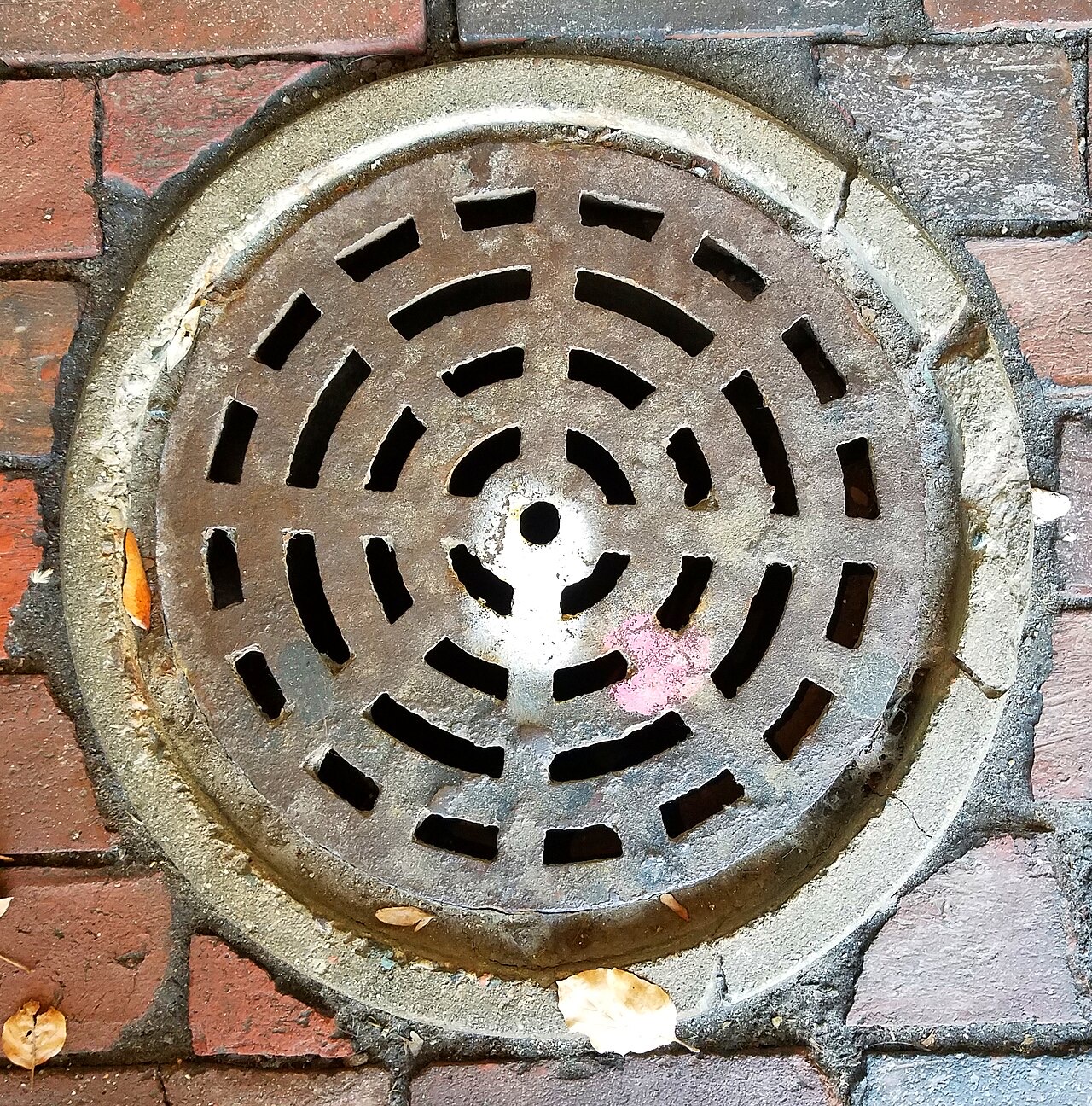
Photograph of an ordinary storm drain set in a brick sidewalk in Cambridge, Massachusetts. A storm drain carries rainwater off the street into pipes below, and the Knowledge Bank’s chain begins at a fixture like this one — the kind, not the one in the novel, whose town is invented. Look at the narrow curved slots and the dark underneath. Anything that goes down there is out of reach and hard to see, which is why fishing something back out took two boys working as one: the Knowledge Bank’s point that a setting can create the trouble, and the trouble can then change the people.
Storm drain in a brick sidewalk, Cambridge, Massachusetts; photograph by Daderot. Source: Wikimedia Commons, File:Storm drain - Cambridge, MA.jpg, CC0.
🧠Knowledge Bank question
1According to the Knowledge Bank, why does 'A Good Deed Gone Wrong' work as the section's central reversal?Ch.7
2What do the boys pull from the drain?Ch.7
3The boys decide to keep the handbag for themselves.Ch.7
4Doing the right thing lands the boys in ___.Ch.9
5Write the numbers 1–5 in the boxes to show the correct order of events. Number 1 = what happens first.Chapters 7–9
They set out to return the bag to its owner.
Max reaches down and pulls out a lost handbag.
Kevin’s quick words clear them both.
Before the truth is known, they are suspected of stealing it.
The boys spot something glinting in a storm drain.
6Max is an easy target for suspicion partly because of who his father is.Ch.9
7Who untangles the misunderstanding with quick thinking?Ch.9
8The lurking threat at the edges of these chapters is ___.Ch.9
9The world judges Max by his actions rather than his size.Ch.9
10The handbag episode mainly proves the friendship can ___.Ch.9
Part 3
Literary Elements
Understanding HOW and WHY Rodman Philbrick (author) tells the story across Chapters 7–9.
🧠Knowledge Bank · Punished for a Good Deed
Narrative Technique · Punished for a Good Deed
Across Chapters 7–9, conflict interacts with irony and suspense to complicate the apparent meaning of events. The heart of these chapters is situational irony — when what happens is the opposite of what we would reasonably expect. The boys do something genuinely good: they rescue a lost handbag and try to return it to its owner, exactly as their knightly code demands. The expected reward for a good deed is thanks. Instead, they are suspected of stealing — punished, nearly, for their honesty. Philbrick uses this irony to make a sharp point about Max’s world: doing right is not always rewarded, and a boy who is already misjudged can have even his kindness turned against him. Notice how the irony deepens our sympathy for Max, who cannot catch a break from a world that has decided who he is. That authorial design makes “Punished for a Good Deed” a lesson in deliberate contrast.
External conflict
The boys struggle against forces outside themselves — suspicion, the crowd’s snap judgment, and the threat of Blade’s gang.
Situational irony
The boys are nearly punished for a kindness — the opposite of the thanks a good deed should earn.
Suspense
Warnings like Blade’s glares plant an uneasy dread that pulls the reader forward toward worse trials.
🧠Knowledge Bank question
1The Knowledge Bank explains that situational irony happens when ___.Ch.9
2Fill in each blank with the correct literary term.Ch.9
Word choices:situational ironyexternal conflictrhymefootnote- some words will not be used
Being suspected for a good deed is .
Their fight against the crowd’s doubt is an .
3External conflict is a struggle between a character and an outside force.Ch.9
4Getting blamed for returning a lost bag is an example of ___.Ch.9
5The lurking menace of Tony D. mainly builds ___.Ch.9
6Suspense is the uneasy feeling that something may be about to happen.Ch.9
7Fill in each blank with the correct literary term.Ch.9
Word choices:suspenseexternal conflictnarratorclimax- some words will not be used
Blade’s hovering gang builds .
The clash with the doubting crowd is an .
8Situational irony means the outcome is what everyone expects.Ch.9
9The irony of these chapters deepens the reader’s ___ for Max.Ch.9
10Philbrick plants Blade’s threat to prepare readers for ___.Ch.9
Part 4
Think Deeper
Four deeper challenges — no single-word recall. Read, weigh the evidence, and reason it out.
🧠Knowledge Bank · Judging by Appearances
First Impressions · Judging by Appearances
The handbag trouble happens for one unfair reason: people look at Max — large, quiet, and the son of a man everyone fears — and assume the worst before he has done anything. This is worth understanding, because it happens to real people every day. Human brains form first impressions astonishingly fast, sizing up a stranger in a fraction of a second based on face, size, clothing, and reputation. This speed once helped our ancestors judge danger quickly, but it comes with a serious flaw: snap judgments are often wrong, and they cling stubbornly even when the facts say otherwise. Psychologists call the habit of assuming a big or unusual-looking person is dangerous, or a small and bookish one harmless, a bias — a lean in our thinking we may not even notice. Philbrick makes the point without ever naming it. He lets a reader spend three chapters inside Max’s head, hearing how careful and gentle he is, and then shows a stranger looking at the same boy and seeing his father.
Picture two boys who have decided to live like knights, and who now find a real chance to prove it: a lost handbag glinting in the filth of a storm drain. They fish it out and set off to return it, certain they are doing exactly the right thing. But the world does not see two knights. It sees one very large, very quiet boy whose father’s name makes grown-ups lower their voices, and it decides, in the half-second it takes to look, that he must be a thief. The good deed curdles into an accusation. And here is where the friendship earns its name: the boy who cannot run supplies the words the boy who cannot read does not have, and together, brain beside brawn, they hand the truth back to a world that did not want it.
Original passage written for Garden Heights — not a quotation from the novel.
1Claim: “Part 3 shows that Max is judged by his size and family name rather than by what he actually does.” — choose the two details that best prove it.Claim & Evidence
2What Max actually does, or What the world assumes about him? Tap each detail to sort it — tap again to switch sides. You can keep tapping to change your answer.Sort into two
◄ What Max actually doesWhat the world assumes about him ►
3Match each cause to its result. For each cause, pick its result.Cause & Effect
The boys spot the bag in the drain→
They set out to return the handbag→
People see Max’s size and family name→
Kevin explains what really happened→
🧠Knowledge Bank question
4Fill both blanks to complete the reasoning.Build the Argument
According to the Knowledge Bank, snap judgments once helped our ancestors because , yet they remain risky today because .
Part 5
Standardized Test
Reading passage · First Impressions and the Danger of Judging by Appearances · SAT & TOEFL-style practice
Read the passage — the highlighted words are tested — then answer. Tap an answer, then tap it again to confirm.
SATCentral Ideas — the passage's main point
SATDetail — a fact stated in the passage
SATWords in Context — a word's meaning in this passage
SATText Connections — how two parts of the text relate
TOEFLFactual Information — a fact stated in the passage
TOEFLVocabulary — a tested word's meaning here
How Fast We Judge a Stranger
When strangers look at Max and instantly decide he must be dangerous, they are doing something every human brain does automatically: forming a first impression. Studies suggest that people size up a stranger in less than a second, reading a face, a body, and clothing almost before they are aware of it. This lightning-fast judgment is not a sign of a cruel mind; it is a built-in feature of how human attention works. Long ago, when quick guesses about a stranger could mean the difference between safety and danger, the ability to judge in an instant was genuinely useful.
The trouble is that fast judgments are often wrong, and they are stubborn. Once the brain has decided something about a person, it tends to notice whatever fits that first impression and to ignore whatever does not. A tendency to lean one way in our thinking, without good reason, is called a bias, and because biases lurk unseen in the mind, they can be quietly unfair. A big, silent boy may be assumed to be threatening; a person whose family has a bad name may be treated as guilty before doing anything at all.
Max is the living proof of that danger. He is gentle, loyal, and honest, yet strangers misjudge him again and again: he is treated as a suspect because of his size and his father’s reputation — things he did not choose and cannot change. Real character does not show in a face or a family name; it shows in what a person actually does over time. That slower, fairer kind of seeing is exactly what the crowd around Max refuses to do, and exactly what the reader is invited to learn.
Original passage written for Garden Heights — not a quotation from the novel.
1What is the passage mainly about?SAT · Central Ideas
2People form a first impression of a stranger in about ___.TOEFL · Factual Information
3The passage says fast judgments are often ___.SAT · Detail
4A lean in our thinking without good reason is called a ___.TOEFL · Factual Information
5Once the brain decides about a person, it tends to notice what ___.TOEFL · Factual Information
6Max is treated as a suspect because of his size and his ___.SAT · Detail
7In the passage, lurk most nearly means ___.SAT · Words in Context
8The passage says real character shows in what a person ___.SAT · Central Ideas
9In the passage, misjudge most nearly means ___.TOEFL · Vocabulary
10Which event from Part 3 does this passage BEST help explain?SAT · Text Connections
Part 6 · Optional
Creative Writing
A bonus challenge to practice your English. Take your time and have fun with it.
About This Section
This writing task is optional and is not part of your auto-graded score. The feedback below checks only the basics — length, spelling, and grammar — not whether your ideas are right or wrong. It is meant for classroom discussion and creative practice, so feel free to use your imagination!
Writing Task — Part 3 “Judged Too Quickly”
Max is judged by his size and family name before anyone learns who he really is. Write about a time you were misjudged, or a time you misjudged someone else, based on a first impression. What was the wrong assumption, and what was the truth underneath it? 6–10 sentences. End with what you wish people had done differently.
You can start with: “They took one look at me and decided...”
0 / 40 words minimum
🗣 Teach It · Just for Fun (optional)
No right or wrong — close the screen and tell someone nearby what happened in this part. Can’t find anyone? Tell yourself out loud. The moment you teach it, you truly understand it.
Part 3 Complete!
You finished Chapters 7–9 of Freak the Mighty.
Here are your auto-graded results:
-
points out of 100
Teach it to someone
The best last step is to teach it. In your own words, explain what happened — retell a favorite scene, teach a character’s big choice, or sum up the main idea for a parent, friend, or classmate. When you can teach it clearly, you truly own it.
Independent study guide by Garden Heights. Not affiliated with or endorsed by Rodman Philbrick. Contains original analysis only; no text from the novel is reproduced. Reference text: This workbook follows Rodman Philbrick’s classic text (the standard Puffin edition sold worldwide). Revised 2023 UK editions change some wording and may not match the vocabulary studied here.
SAT® is a registered trademark of College Board, which is not affiliated with, and does not endorse, these materials. TOEFL® is a registered trademark of ETS. These materials are not endorsed or approved by ETS. Garden Heights is an independent provider of test-style reading practice.