New here? Just sign up with Google — your account includes Matilda, our gift book, forever.
Freak the Mighty · Garden Heights
Part 6
for Freak the Mighty · Part 6 · Chapters 16–19
8 Parts40 min
What Happens in Part 6
Killer Kane kidnaps Max, and tiny Kevin's fearless acid bluff breaks Kane's grip and sets his friend free.
Taken in the nightOn a dark night Killer Kane seizes Max from the down under and holds him captive in an abandoned building, trying to force the frightened boy to take his side against everyone else. Kane is menacing and unstable, and Max, alone with the father he has feared his whole life, must find a courage he did not know he had.
The acid bluffLoretta Lee, a neighborhood woman, tries to help and is hurt for it. Then rescue arrives from the most unlikely hero of all: tiny Kevin tracks Max down and refuses to leave. Bluffing the far larger man, he squirts Kane in the face with a squirt gun of soapy liquid he claims is acid; the trick, and arriving help, free Max. Kane is arrested and returned to custody.
Courage made realThe chapters show, more powerfully than any quest game they ever played, what Freak the Mighty truly is: not a fantasy at all, but two boys whose combined courage — Max's steady strength and Kevin's quick, daring mind — is real enough to face down a dangerous grown man and win.
The climax of the story, the antagonist, and rising-and-breaking suspense
Cross-Curricular
Courage — standing up in a frightening moment
Chapter Summary
Ch.
What happens
Chapters 16–17
Taken — Killer Kane seizes Max from the down under and holds him captive in an abandoned building, trying to turn him against everyone else.
Chapters 18–19
The Rescue — Kevin tracks Max down and bluffs Kane with a squirt gun of soapy liquid; Max gets free and Kane is arrested.
Part 1
Vocabulary
Study 10 key words from Chapters 16–19, then answer each question.
🧠Knowledge Bank · Words of the Rescue
Lexical Semantics · Words of the Rescue
Five words, and the middle one is the whole chapter. A captive is a person held against their will, which is what Kane makes of his own son. Menacing means threatening and dangerous, and Kane’s voice is that before he has laid a hand on anyone. A bluff is a bold trick meant to fool someone, and Kevin’s — a squirt gun and a lie told with total conviction — works on a grown man twice his size. A rescue is the act of saving someone from danger, and it belongs to the boy who cannot walk. To defy is to boldly refuse to obey, which is what Max finally does to his father. Notice what the bluff proves. Kevin has no strength at all, no height and no speed, so he wins with the only thing he has ever had, which is nerve.
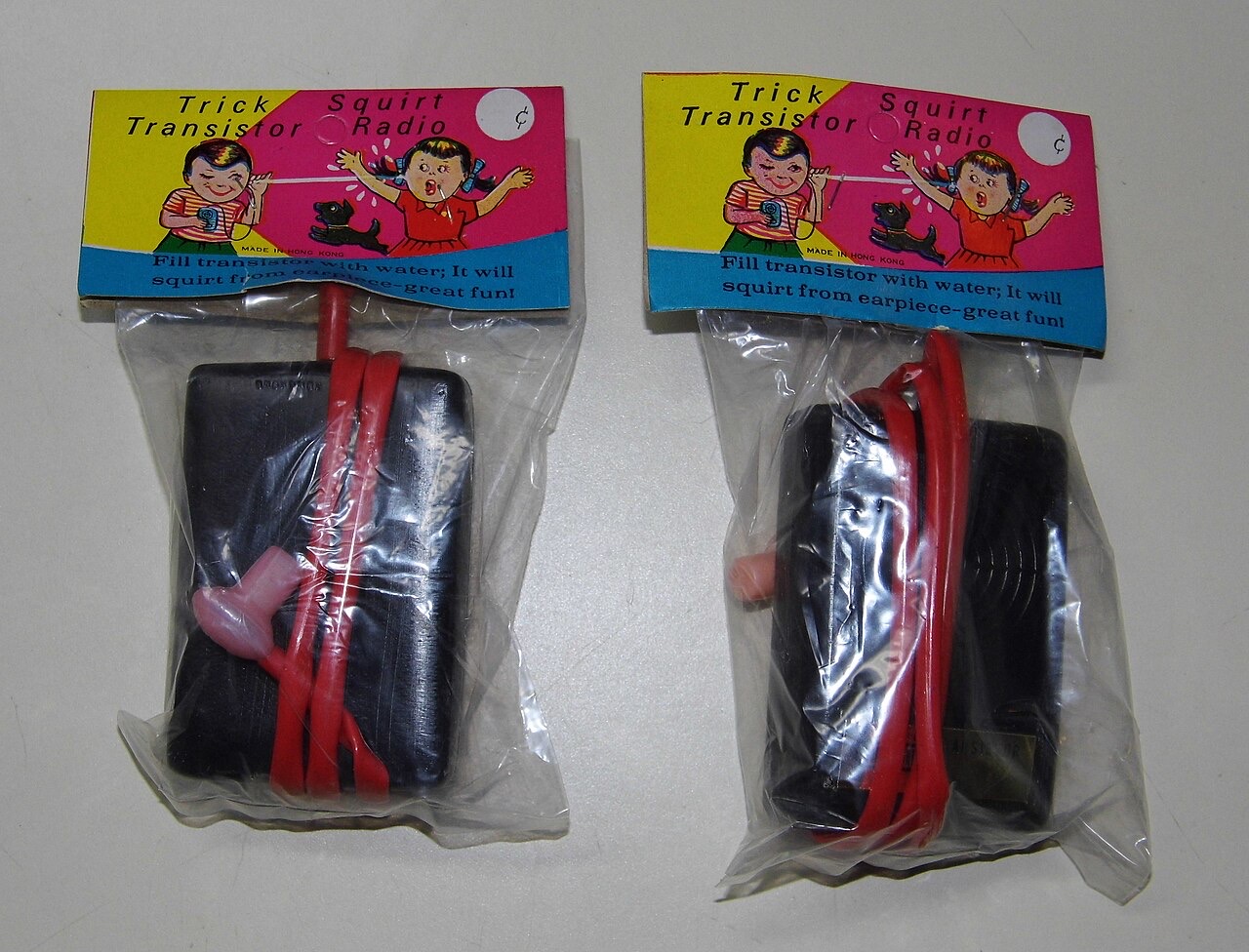
Visual AidA bluff you could buy for a dime
Photograph of two dimestore novelty toys, still sealed in their bags: squirt guns molded to look like pocket transistor radios — fill one with water, the card promises, and it squirts from the earpiece. The Words of the Rescue Knowledge Bank defines a bluff as a bold trick told with conviction, and this toy is a bluff made of plastic: it works only as long as the target trusts the surface. Kevin’s squirt gun in the novel is an ordinary one, never described, and nothing in this picture belongs to the story — what to notice is simply how cheap the trick is, and how completely it depends on belief.
‘Trick Squirt Radio’ dimestore novelty squirt guns, made in Hong Kong; photograph by Joe Haupt. Source: Wikimedia Commons, File:Vintage Dimestore Plastic Trick Transistor Radio, Squirt Gun (8395715794).jpg, public domain.
captiven.Ch.16
A person held against their will
“Kane made Max his captive.”
menacingadj.Ch.16
Threatening and dangerous
“Kane’s menacing voice frightened Max.”
bluffn.Ch.19
A bold trick meant to fool someone
“Kevin’s squirt-gun bluff fooled Kane.”
rescuen.Ch.19
The act of saving someone from danger
“Kevin’s rescue saved his friend.”
defyv.Ch.17
To boldly refuse to obey
“Max found the courage to defy his father.”
captorn.Ch.16
A person who holds someone prisoner
“Max stared at his captor in the dark.”
unstableadj.Ch.16
Likely to change suddenly and dangerously
“Kane was violent and unstable.”
nerven.Ch.19
Steady courage under pressure
“It took nerve to face down a grown man.”
abandonedadj.Ch.16
Left empty and no longer used
“Kane hid Max in an abandoned building.”
custodyn.Ch.19
The state of being held by the police or law
“Kane was returned to custody after his arrest.”
ⓘ The vocabulary words in this list are selected to help you understand and complete this workbook. Some may not appear verbatim in the original novel.
🧠Knowledge Bank question
1According to the Knowledge Bank, what does Kevin's successful bluff prove about him?Ch.16
2Something ‘menacing’ is threatening and dangerous.Ch.16
3A ‘bluff’ is a bold trick meant to ___ someone.Ch.19
4To ‘defy’ someone is to obey them at once.Ch.17
5Fill in each blank with the correct word.Ch.19
Word choices:rescuecustodycaptivenerve- some words will not be used
Kevin’s daring set Max free.
Afterward, Kane was returned to .
6A ‘captor’ is a person who ___ someone.Ch.16
7Someone ‘unstable’ is likely to change ___.Ch.16
8‘Nerve’ is steady ___ under pressure.Ch.19
9Fill in each blank with the correct word.Ch.16
Word choices:abandonedmenacingdefybluff- some words will not be used
Kane hid Max in an building.
His manner filled Max with fear.
10To be in ‘custody’ is to be held by the ___.Ch.19
Part 2
Comprehension
Show you understood what happens in Chapters 16–19.
🧠Knowledge Bank · Captured and Rescued
Narrative Causality · Captured and Rescued
Careful sequence reading reveals the textual evidence, the structural pivot, and the resulting consequence in Chapters 16–19. The storm breaks. On a dark night, Killer Kane seizes Max from the down under and carries him off, holding him captive in an abandoned building and trying to force the frightened boy to take his side against everyone else. Kane is menacing and unstable, and Max, alone with the father he has feared his whole life, must find a courage he did not know he had. Loretta Lee, a neighborhood woman, tries to help and is hurt for it, sharpening the danger. Then, in the book’s tense climax, rescue arrives from the most unlikely hero of all: tiny Kevin — Freak — tracks Max down and refuses to leave him. With his quick, fearless mind, Kevin bluffs the far larger, dangerous man, squirting him in the face with a squirt gun full of soapy liquid while claiming it is acid; the trick, and the arrival of help, break Kane’s grip long enough for Max to get free. Reading evidence around the pivot turns “Captured and Rescued” into meaningful convergence.
🧠Knowledge Bank question
1According to the Knowledge Bank, how does Kevin's trick actually work on Kane?Ch.16
2Where does Kane hold Max captive?Ch.16
3Kane tries to turn Max against everyone else.Ch.17
4Who is hurt while trying to help Max?Ch.18
5Write the numbers 1–5 in the boxes to show the correct order of events. Number 1 = what happens first.Chapters 16–19
Kevin tracks Max down and bluffs Kane with a squirt gun.
Killer Kane seizes Max from the down under.
Max gets free and Kane is arrested.
Kane holds Max captive in an abandoned building.
Loretta Lee is hurt trying to help Max.
6Kevin gives up and leaves Max to face Kane alone.Ch.18
7How does Kevin fool Kane?Ch.19
8What happens to Kane after the rescue?Ch.19
9The rescue proves Freak the Mighty is real, not just a game.Ch.19
10The hero of the rescue is the most unlikely one: ___.Ch.19
Part 3
Literary Elements
Understanding HOW and WHY Rodman Philbrick (author) tells the story across Chapters 16–19.
🧠Knowledge Bank · The Highest Point of the Story
Narrative Technique · The Highest Point of the Story
The pressure of Chapters 16–19 is crafted through climax, antagonist, and suspense working in combination. These chapters contain the climax — the moment of greatest tension and the turning point toward which the whole book has been building. Every earlier thread comes together here: Max’s lifelong fear of his father, the dread that gathered over Christmas, the meaning of ‘Freak the Mighty,’ and Kevin’s belief that honor and mind matter more than muscle. In the climax, the danger is at its highest and the outcome is truly in doubt, and then the story turns: the smaller boy saves the larger one, and the fantasy hero becomes real. A climax is not just the most exciting part; it is the moment when a story’s deepest question is answered. That authorial design makes “The Highest Point of the Story” a lesson in deliberate perspective.
Visual AidThe staircase up to the climax
Structure diagram of the shape The Highest Point of the Story Knowledge Bank describes: pressure climbing step by step — the old fear, the parole, the kidnapping — to the climax, where Kevin’s bluff answers the book’s deepest question, and then the single step down as the rescue lets the tension fall. The staircase measures nothing: box heights are position, not amounts of fear, and the many quiet chapters between the steps are left out. The peak’s place near the end, not at it, is the one proportion the drawing does keep.
Story shape as described in The Highest Point of the Story Knowledge Bank, from Freak the Mighty, Chapters 16–19; the rising-action pyramid after Gustav Freytag, Die Technik des Dramas (1863). Drawn for Garden Heights Academy.
Climax
The kidnapping and rescue are the story’s turning point, where its deepest question is answered.
Antagonist
Killer Kane, the force against the hero, embodies exactly what Max fears he might become.
Suspense
The captivity coils the tension tight until Kevin’s daring bluff finally breaks it.
🧠Knowledge Bank question
1The Knowledge Bank explains that a climax is not just the most exciting part; it is the moment when ___.Ch.19
2Fill in each blank with the correct literary term.Ch.16
Word choices:antagonistclimaxrhymefootnote- some words will not be used
Killer Kane, the force against the hero, is the .
The tense rescue is the story’s .
3The climax is the moment of greatest tension and the story’s turning point.Ch.19
4An antagonist is the character whose force ___ the hero.Ch.16
5The tight, coiling dread of the captivity is ___.Ch.17
6A good antagonist often embodies exactly what the hero must overcome.Ch.16
7Fill in each blank with the correct literary term.Ch.19
Word choices:suspenseclimaxnarratorrhyme- some words will not be used
The coiling dread of the captivity is .
The breathless rescue is the .
8After the climax, the events that follow are its consequences.Ch.19
9By facing his father, Max is really facing down a fear about ___.Ch.17
10Defeating the antagonist here requires ___.Ch.19
Part 4
Think Deeper
Four deeper challenges — no single-word recall. Read, weigh the evidence, and reason it out.
🧠Knowledge Bank · Courage in a Frightening Moment
Cross-Curricular Context · Supporting Lens · The Psychology of Bravery
The rescue asks the reader to think about what courage really is, and the answer is surprising. Courage is not the absence of fear. People often imagine that a brave person feels no fear, but psychologists who study bravery find the opposite: the truly courageous feel fear fully — the pounding heart, the urge to run — and choose to act anyway, for the sake of someone or something that matters more than their own safety. By that definition, the smallest, physically weakest character in the whole book performs its greatest act of courage. Kevin cannot fight, cannot run, cannot overpower anyone; he is terrified, and he has every reason to be. He does it anyway, with a squirt gun and a sentence. Philbrick has spent five parts letting the reader assume Max is the strong one because Max is the one who can lift things. The rescue is where the book collects on that assumption.
Picture the worst night of Max’s life. The father he has feared his whole life takes him in the dark and shuts him away in an empty building, trying to make him choose his side, and Max — big as he is — is just a frightened boy alone with a dangerous man. And then help comes, not from the police, not from a giant, but from the smallest person in the whole story: a boy on crutches who cannot run or fight, who is surely terrified, and who comes anyway because his friend is in danger. With nothing but nerve and a squirt gun full of soapy water he calls acid, Kevin bluffs a grown man long enough to crack his grip — and Max goes free. This is the moment the game stops being a game. Freak the Mighty was never a fantasy. It was two boys brave enough to be real.
Original passage written for Garden Heights — not a quotation from the novel.
1Claim: “Part 6 shows that true courage is not about size or strength but about acting despite fear.” — choose the two details that best prove it.Claim & Evidence
2Max’s part in the rescue, or Kevin’s part in the rescue? Tap each detail to sort it — tap again to switch sides. You can keep tapping to change your answer.Sort into two
◄ Max’s part in the rescueKevin’s part in the rescue ►
3Match each cause to its result. For each cause, pick its result.Cause & Effect
Kane seizes Max in the night→
Kane tries to turn Max against everyone→
Kevin tracks Max down→
Kevin bluffs Kane with the squirt gun→
🧠Knowledge Bank question
4Fill both blanks to complete the reasoning.Build the Argument
The Knowledge Bank reports that psychologists who study bravery find that truly courageous people , which means the book's greatest act of courage belongs to .
Part 5
Standardized Test
Reading passage · Courage: Standing Up in a Frightening Moment · SAT & TOEFL-style practice
Read the passage — the highlighted words are tested — then answer. Tap an answer, then tap it again to confirm.
SATCentral Ideas — the passage's main point
SATDetail — a fact stated in the passage
SATWords in Context — a word's meaning in this passage
SATText Connections — how two parts of the text relate
TOEFLFactual Information — a fact stated in the passage
TOEFLVocabulary — a tested word's meaning here
TOEFLProse Summary — the three sentences that sum it up
Courage Is Not Fearlessness
When tiny Kevin faces down a dangerous grown man to save his friend, he shows us something important about what courage actually is. Most people picture a brave person as someone who feels no fear — who charges into danger with a calm, steady heart. But that picture is wrong: researchers who study bravery, and the firefighters and rescuers they interview, report that the brave almost always feel fear, and feel it strongly. Courage is not the absence of that fear; courage is feeling it fully and choosing to act anyway.
This matters because it means courage is available to everyone, not just the big and the strong. A person does not need powerful muscles or a fearless heart to be brave; they need only something they care about more than their own comfort, and the will to act on it. In fact, the most striking acts of courage often come from those who seem least equipped for them. Someone small, frightened, and physically weak who still steps forward to defy an attacker and protect another person is showing more courage, not less, precisely because they act while feeling every ounce of the danger.
Kevin is the perfect proof. He cannot run, cannot fight, and cannot overpower anyone; he is surely terrified, and he has every reason to be. Yet he tracks his captured friend into real danger and stands up to a violent, menacing man with nothing but his wits and a bold bluff. His courage is a thinking courage — he does not overpower the danger, he outsmarts it, and what makes the act heroic is not that Kevin is unafraid but that he acts for someone he loves in the face of genuine fear.
Original passage written for Garden Heights — not a quotation from the novel.
1What is the passage mainly about?SAT · Central Ideas
2The common picture of a brave person as feeling no fear is ___.SAT · Detail
3According to the passage, courage is feeling fear and choosing to ___.SAT · Central Ideas
4The passage says courage is available to ___.TOEFL · Factual Information
5To be brave, a person needs something they care about more than their own ___.TOEFL · Factual Information
6Striking acts of courage often come from those who seem ___ for them.SAT · Detail
7In the passage, defy most nearly means to ___.TOEFL · Vocabulary
8In the passage, menacing most nearly means ___.SAT · Words in Context
9Prose Summary (TOEFL).This passage explains what courage really is and why Kevin’s rescue counts as heroic. This TOEFL task lists six sentences; choose the THREE that best capture the passage’s main ideas. The other three do not belong — they state minor details or ideas the passage does not present.TOEFL · Prose Summary
10How does this passage best help explain Kevin’s rescue?SAT · Text Connections
Part 6 · Optional
Creative Writing
A bonus challenge to practice your English. Take your time and have fun with it.
About This Section
This writing task is optional and is not part of your auto-graded score. The feedback below checks only the basics — length, spelling, and grammar — not whether your ideas are right or wrong. It is meant for classroom discussion and creative practice, so feel free to use your imagination!
Writing Task — Part 6 “Brave While Afraid”
Kevin is terrified yet acts anyway to save his friend — the truest kind of courage. Write about a time you did something brave even though you were scared, or watched someone else do so. What was frightening, why did you (or they) act anyway, and how did it feel afterward? 6–10 sentences. End with what the moment taught you about courage.
You can start with: “My heart was pounding, but I knew I had to...”
0 / 40 words minimum
🗣 Teach It · Just for Fun (optional)
No right or wrong — close the screen and tell someone nearby what happened in this part. Can’t find anyone? Tell yourself out loud. The moment you teach it, you truly understand it.
Part 6 Complete!
You finished Chapters 16–19 of Freak the Mighty.
Here are your auto-graded results:
-
points out of 100
Teach it to someone
The best last step is to teach it. In your own words, explain what happened — retell a favorite scene, teach a character’s big choice, or sum up the main idea for a parent, friend, or classmate. When you can teach it clearly, you truly own it.
Independent study guide by Garden Heights. Not affiliated with or endorsed by Rodman Philbrick. Contains original analysis only; no text from the novel is reproduced. Reference text: This workbook follows Rodman Philbrick’s classic text (the standard Puffin edition sold worldwide). Revised 2023 UK editions change some wording and may not match the vocabulary studied here.
SAT® is a registered trademark of College Board, which is not affiliated with, and does not endorse, these materials. TOEFL® is a registered trademark of ETS. These materials are not endorsed or approved by ETS. Garden Heights is an independent provider of test-style reading practice.