New here? Just sign up with Google — your account includes Matilda, our gift book, forever.
Freak the Mighty · Garden Heights
Part 7
for Freak the Mighty · Part 7 · Chapters 20–22
8 Parts40 min
What Happens in Part 7
Just as life brightens after the rescue, Kevin's birthday celebration ends in a sudden, frightening medical emergency.
Heroes for realIn the wake of the rescue, life briefly brightens. Kane is back in custody, Max is safe, and the two friends are closer than ever — heroes now in a way that is finally real. They celebrate Kevin's birthday, a warm, hopeful gathering that feels like a reward after everything they have survived.
The bionic dreamKevin is his usual dazzling self, full of plans, jokes, and grand ideas about the future, including a favorite fantasy he has long told Max: that he will one day be the first person to receive a bionic body, a rebuilt mechanical form that will finally let his brilliant mind go anywhere. For a moment it is possible to believe the hardest days are behind them.
The party breaksBut Kevin's body cannot keep up with his soaring spirit. His rare condition means his insides have been growing while his small frame cannot, and at the height of the celebration he suffers a sudden, frightening medical emergency and is rushed to the hospital. Rodman Philbrick (author) lets the joy of these chapters make the turn all the more painful: the one enemy strength and courage cannot defeat.
Foreshadowing of loss, dramatic irony, and a sudden reversal of fortune
Cross-Curricular
Assistive technology and the limits of the body
Chapter Summary
Ch.
What happens
Chapters 20–21
The Birthday — with Kane in custody and Max safe, the friends celebrate Kevin’s birthday; Kevin shares his hopeful dream of one day getting a bionic body.
Chapter 22
The Emergency — Kevin’s fragile body cannot keep up with his spirit; he suffers a sudden medical emergency and is rushed to the hospital.
Part 1
Vocabulary
Study 10 key words from Chapters 20–22, then answer each question.
🧠Knowledge Bank · Words of Joy and Warning
Lexical Semantics · Words of Joy and Warning
Five words, and the party is holding three of them apart from the other two. To celebrate is to mark a happy event with joy, which is what the friends gather to do for Kevin’s birthday. Bionic means having body parts rebuilt with machines, and it is the future Kevin has been promising himself out loud. An emergency is a sudden, serious situation needing fast help, and his collapse is one. Frail means weak and easily harmed, and for all his spirit, that is what his body has been the entire book. To collapse is to fall down suddenly from weakness, which is what he does in the middle of his own party. Read them in order and you have the exact shape of the chapter: a celebration, a dream about a rebuilt future, and then the body arriving to interrupt.
Visual AidThe five words, read in order, are the chapter
Sequence diagram of the observation the Words of Joy and Warning Knowledge Bank closes on: read the vocabulary in order and you get the chapter’s exact shape — a celebration, a dream said out loud, and then the body interrupting. The three boxes compress a whole party to its turning points and say nothing about what follows the emergency; the split of the five words into joy and warning is the Knowledge Bank’s own arithmetic, drawn rather than argued.
Chapter shape as described in the Words of Joy and Warning Knowledge Bank, from Freak the Mighty. Drawn for Garden Heights Academy.
celebratev.Ch.20
To mark a happy event with joy
“The friends gathered to celebrate Kevin’s birthday.”
bionicadj.Ch.21
Having body parts rebuilt with machines
“Kevin dreamed of a bionic body one day.”
emergencyn.Ch.22
A sudden, serious situation needing fast help
“Kevin’s collapse was a true emergency.”
frailadj.Ch.22
Weak and easily harmed
“For all his spirit, Kevin’s body was frail.”
collapsev.Ch.22
To fall down suddenly from weakness
“At the party Kevin began to collapse.”
hopefuladj.Ch.20
Full of hope and looking forward
“For a while the friends felt hopeful again.”
reversaln.Ch.22
A sudden change to the opposite state
“Joy turned to fear in a swift reversal.”
strainv.Ch.22
To put too much pressure on something
“His growing insides began to strain his heart.”
dazzlingadj.Ch.20
Wonderfully bright and impressive
“Kevin was his usual dazzling self at the party.”
urgentadj.Ch.22
Needing immediate action
“The doctors saw at once that his case was urgent.”
ⓘ The vocabulary words in this list are selected to help you understand and complete this workbook. Some may not appear verbatim in the original novel.
🧠Knowledge Bank question
1The Knowledge Bank explains that reading celebrate, bionic, emergency, frail, and collapse in order gives the reader ___.Ch.20
2A ‘bionic’ body has parts rebuilt with machines.Ch.21
3An ‘emergency’ is a sudden situation needing ___ help.Ch.22
4Someone ‘frail’ is strong and sturdy.Ch.22
5Fill in each blank with the correct word.Ch.22
Word choices:collapsereversalcelebratebionic- some words will not be used
At the party Kevin began to .
Joy turned to fear in a swift .
6Someone ‘hopeful’ is full of ___.Ch.20
7To ‘strain’ something is to put too much ___ on it.Ch.22
8Something ‘dazzling’ is wonderfully ___.Ch.20
9Fill in each blank with the correct word.Ch.22
Word choices:urgentfrailhopefulstrain- some words will not be used
For all his spirit, Kevin’s body was .
The doctors saw his case was .
10An ‘urgent’ case needs ___ action.Ch.22
Part 2
Comprehension
Show you understood what happens in Chapters 20–22.
🧠Knowledge Bank · Joy and a Sudden Turn
Narrative Causality · Joy and a Sudden Turn
The narrative’s growing tension gives way to a crucial revelation and redirects the story’s direction. In the wake of the rescue, life seems, for a little while, to brighten. Kane is back in custody, Max is safe, and the two friends are closer than ever, heroes now in a way that is finally real. They celebrate Kevin’s birthday, a warm, hopeful gathering that feels like a reward after everything they have survived. Kevin is his usual dazzling self — full of plans, jokes, and grand ideas about the future, including a favorite fantasy he has long told Max: that he will one day be the first person to receive a ‘bionic’ body, a rebuilt, mechanical form that will finally let his brilliant mind go anywhere. For a moment it is possible to believe the hardest days are behind them. The accumulated tension makes “Joy and a Sudden Turn” a genuine story threshold.
🧠Knowledge Bank question
1According to the Knowledge Bank, the narrative's growing tension in this part gives way to ___.Ch.20
2What happy event do the friends celebrate?Ch.20
3Kevin has long told Max about a dream of getting a bionic body.Ch.21
4Kevin’s bionic dream is that he will one day get a ___.Ch.21
5Write the numbers 1–5 in the boxes to show the correct order of events. Number 1 = what happens first.Chapters 20–22
Kevin’s fragile body suddenly fails him.
With Kane in custody, life brightens for the boys.
The friends gather to celebrate Kevin’s birthday.
He is rushed to the hospital.
Kevin shares his hopeful dream of a bionic body.
6Kevin’s body easily keeps up with his soaring spirit.Ch.22
7What happens to Kevin at the height of the celebration?Ch.22
8Where is Kevin taken after the emergency?Ch.22
9The one enemy the boys cannot defeat is Kevin’s fragile body.Ch.22
10Philbrick makes the birthday joyful mainly to make the turn feel ___.Ch.22
Part 3
Literary Elements
Understanding HOW and WHY Rodman Philbrick (author) tells the story across Chapters 20–22.
🧠Knowledge Bank · The Dream of a Bionic Body
Narrative Technique · The Dream of a Bionic Body
As the story nears its end, foreshadowing, irony, and reversal turn earlier details into consequences. Kevin’s cheerful talk of one day getting a bionic body creates painful dramatic irony — a situation in which the reader begins to understand something the character does not fully face. To Kevin, and to the trusting Max, the bionic body is a real plan, a hopeful future, a reason to believe the best is still ahead. But an older reader senses the sadder truth beneath the dream: it is the brave, beautiful story a boy tells to make peace with a body that is failing him. Philbrick handles this with great tenderness. He does not mock Kevin’s hope or expose it cruelly; he lets it stand as an act of imagination and courage, the same story-making gift that turned a plain neighborhood into a realm of quests. That authorial design makes “The Dream of a Bionic Body” a lesson in deliberate structure.
Foreshadowing
The warmth of the birthday and hints of Kevin’s frail frame quietly prepare the reader for the emergency.
Dramatic irony
The reader senses the bionic dream is a brave story about a failing body — a truth Kevin does not fully face.
Reversal
Fortune turns suddenly from earned joy to sudden fear when Kevin collapses.
🧠Knowledge Bank question
1According to the Knowledge Bank, Kevin's bionic-body talk creates dramatic irony because ___.Ch.20
2Fill in each blank with the correct literary term.Ch.21
Word choices:dramatic ironyforeshadowingrhymefootnote- some words will not be used
The reader sensing the sad truth behind the bionic dream is .
The warm birthday placed before the fall is .
3Foreshadowing gives the reader early hints about what may happen later.Ch.20
4The gap between the reader’s sense of loss and Kevin’s hope is ___.Ch.21
5The sudden turn from joy to fear at the party is a ___.Ch.22
6Dramatic irony is when the reader knows more than a character does.Ch.21
7Fill in each blank with the correct literary term.Ch.22
Word choices:reversalforeshadowingnarratorclimax- some words will not be used
The swift turn from joy to fear is a .
The warm party placed before the fall is .
8Philbrick handles the bionic dream cruelly, mocking Kevin’s hope.Ch.21
9Placing a peak of joy just before the fall makes the loss land ___.Ch.22
10On a second reading, the foreshadowing makes the emergency feel ___.Ch.22
Part 4
Think Deeper
Four deeper challenges — no single-word recall. Read, weigh the evidence, and reason it out.
🧠Knowledge Bank · Assistive Technology and the Body’s Limits
Helping the Body, and Its Edges · Assistive Technology and the Body’s Limits
Kevin’s dream of a ‘bionic’ body sits at the meeting point of hope and hard truth, and it is worth understanding both. Assistive technology is any tool that helps a body do what it cannot do alone, and Kevin already depends on it every day: his leg braces and crutches let a boy who cannot walk unaided still move through the world. Modern medicine has taken such tools astonishingly far. Real people now use powered wheelchairs, robotic limbs controlled by muscle signals, cochlear implants that carry sound to the brain, and machines that help a weak heart keep beating. It is not foolish for Kevin to dream of a rebuilt, mechanical body; he is imagining, with a child’s hope, the far edge of a real and growing field. But the chapter is not only about hope. Assistive technology extends what a body can do; it does not change what a body is. Kevin’s braces have carried him for years and cannot carry him past this, which is the sentence the book has been walking toward since page one.
Visual AidAssistive technology, worn in the real world
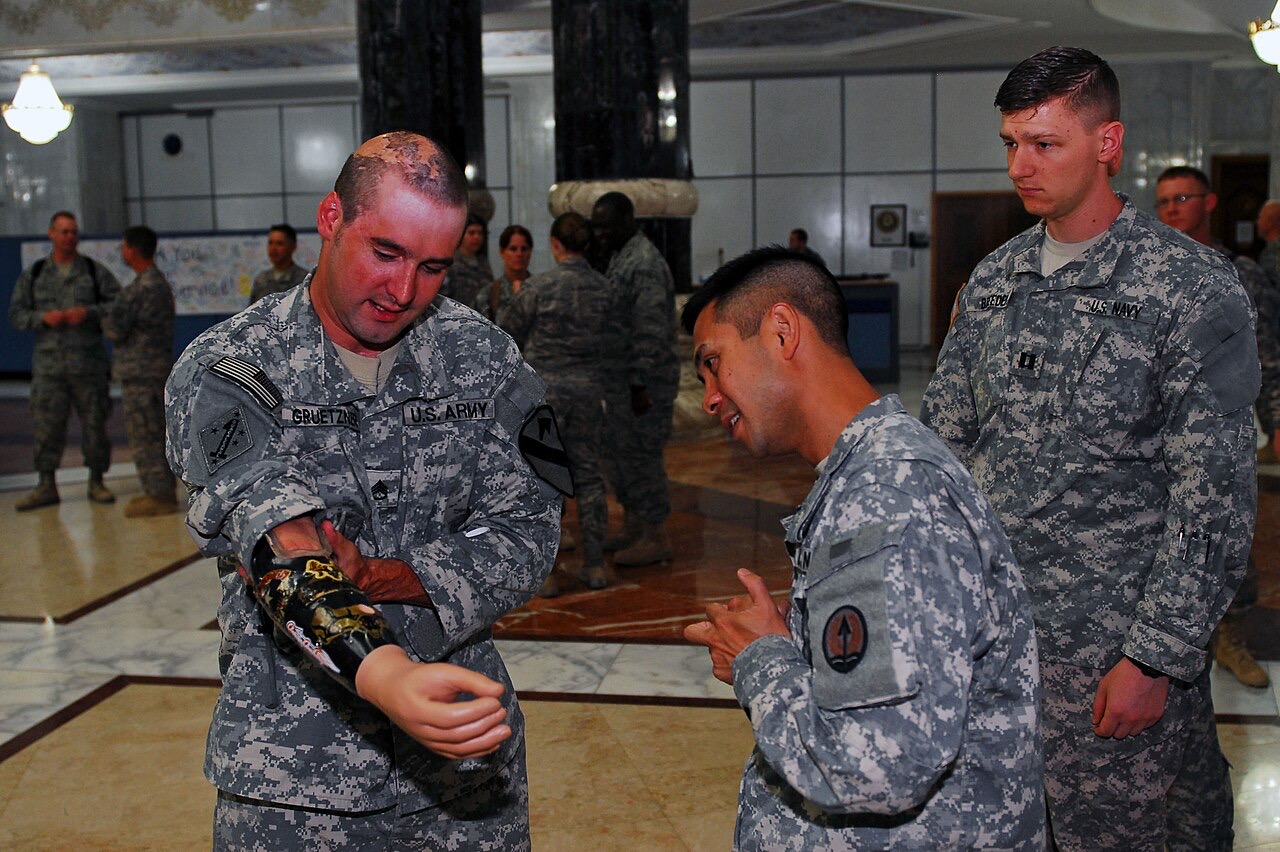
Photograph from June 2009: retired U.S. Army Staff Sgt. Bradley Gruetzner, wounded in service, shows fellow soldiers in Baghdad the prosthetic arm he wears — a molded socket over the elbow, a lifelike hand, and decoration he chose himself. This is the real, growing field the Assistive Technology and the Body’s Limits Knowledge Bank describes, photographed on an ordinary day rather than in a laboratory. The picture shows what such tools restore; it makes no claim about what they cannot, and none at all about Kevin, whose bionic body is a boy’s brave imagining, not a device anyone has built.
Retired Staff Sgt. Bradley K. Gruetzner showing his prosthetic arm to servicemembers, Al Faw Palace, Camp Victory, Iraq, June 21, 2009; U.S. Army photograph. Source: Wikimedia Commons, File:Flickr - The U.S. Army - Operation "Proper Exit".jpg, public domain.
Picture the boys at their happiest. The monster is locked away, the danger is past, and for once the two friends get to simply be heroes and celebrate — a birthday, jokes, plans, the whole bright future spread out ahead. Kevin is dazzling, spinning out his favorite dream: someday he will be the first boy with a bionic body, rebuilt and mechanical, and then nothing will hold him back. It is impossible not to hope with him. And that is exactly why what comes next hurts so much. Because Kevin’s body, for all his soaring mind, cannot keep the pace his spirit sets, and right there in the middle of the joy it fails him, and the party becomes an emergency, and the friend who out-thought a grown man is carried away to a hospital. The one enemy strength could not beat was inside him all along.
Original passage written for Garden Heights — not a quotation from the novel.
1Claim: “Part 7 lifts the boys to their happiest moment in order to make the coming loss more painful.” — choose the two details that best prove it.Claim & Evidence
2The joy of these chapters, or The warning signs beneath it? Tap each detail to sort it — tap again to switch sides. You can keep tapping to change your answer.Sort into two
◄ The joy of these chaptersThe warning signs beneath it ►
3Match each cause to its result. For each cause, pick its result.Cause & Effect
Kane is locked away and Max is safe→
The friends celebrate Kevin’s birthday→
Kevin shares his bionic dream→
Kevin’s fragile body suddenly fails→
🧠Knowledge Bank question
4Fill both blanks to complete the reasoning.Build the Argument
The Knowledge Bank argues that Kevin's bionic dream is not foolish because , yet it also warns that .
Part 5
Standardized Test
Reading passage · Assistive Technology and the Limits of the Body · SAT & TOEFL-style practice
Read the passage — the highlighted words are tested — then answer. Tap an answer, then tap it again to confirm.
SATCentral Ideas — the passage's main point
SATDetail — a fact stated in the passage
SATWords in Context — a word's meaning in this passage
SATText Connections — how two parts of the text relate
TOEFLFactual Information — a fact stated in the passage
TOEFLVocabulary — a tested word's meaning here
The Real Science of Assistive Technology
Kevin dreams of a ‘bionic’ body, and while that exact dream belongs to imagination, it grows from something real: the field of assistive technology. Assistive technology is any tool that helps a person’s body do something it cannot do on its own, and Kevin already relies on it every day. His leg braces support frail limbs that cannot hold him upright, and his crutches let a boy who cannot walk unaided still cross a room, a street, a whole neighborhood of quests. None of these tools is a sign of weakness; each is a clever solution that closes the gap between what a body can do alone and what its owner wants to do.
In recent decades, this field has advanced in astonishing ways. Engineers and doctors have built powered wheelchairs a person can steer with a puff of breath, artificial limbs that respond to the tiny electrical signals of a user’s own muscles, and cochlear implants that carry sound past a damaged ear directly toward the brain. Seen against this real and growing science, Kevin’s dream of a rebuilt, mechanical body is not silly at all; it is a hopeful guess, one that expects good things from where the field is already heading.
And yet technology has edges, and so do bodies. Assistive tools are wonderful, but they are not magic, and Kevin’s rare condition affects him from the inside, straining organs that a crutch cannot support. A tool can carry a body farther than it could go alone, but it cannot always overcome what is happening within. Rodman Philbrick (author) lets the reader hold both truths at once — the genuine power of the tools that help Kevin move, and the sorrowful fact that some limits of the body cannot be fixed.
Original passage written for Garden Heights — not a quotation from the novel.
1What is the passage mainly about?SAT · Central Ideas
2Assistive technology is any tool that helps a body do what it ___.TOEFL · Factual Information
3Which of these does Kevin already rely on every day?SAT · Detail
4The passage says such tools are ___, not a sign of weakness.TOEFL · Factual Information
5Modern artificial limbs can respond to the signals of a user’s own ___.TOEFL · Factual Information
6A cochlear implant carries ___ toward the brain.SAT · Detail
7The passage says Kevin’s bionic dream is ___.SAT · Central Ideas
8In the passage, frail most nearly means ___.TOEFL · Vocabulary
9In the passage, hopeful most nearly means ___.SAT · Words in Context
10Which idea from Part 7 does this passage BEST help explain?SAT · Text Connections
Part 6 · Optional
Creative Writing
A bonus challenge to practice your English. Take your time and have fun with it.
About This Section
This writing task is optional and is not part of your auto-graded score. The feedback below checks only the basics — length, spelling, and grammar — not whether your ideas are right or wrong. It is meant for classroom discussion and creative practice, so feel free to use your imagination!
Writing Task — Part 7 “Help That Has Limits”
Kevin’s braces and crutches help him greatly, yet some things they cannot fix. Write about a tool, treatment, or kind of help that made a real difference for you or someone you know — and, if it applies, about what it could not solve. What did the help do, and where were its limits? 6–10 sentences. End with what you learned about help and its edges.
You can start with: “It helped more than I can say, and still...”
0 / 40 words minimum
🗣 Teach It · Just for Fun (optional)
No right or wrong — tell someone nearby what happened in this part. Can’t find anyone? Tell yourself out loud. The moment you teach it, you truly understand it.
Part 7 Complete!
You finished Chapters 20–22 of Freak the Mighty.
Here are your auto-graded results:
-
points out of 100
Teach it to someone
The best last step is to teach it. In your own words, explain what happened — retell a favorite scene, teach a character’s big choice, or sum up the main idea for a parent, friend, or classmate. When you can teach it clearly, you truly own it.
Independent study guide by Garden Heights. Not affiliated with or endorsed by Rodman Philbrick. Contains original analysis only; no text from the novel is reproduced. Reference text: This workbook follows Rodman Philbrick’s classic text (the standard Puffin edition sold worldwide). Revised 2023 UK editions change some wording and may not match the vocabulary studied here.
SAT® is a registered trademark of College Board, which is not affiliated with, and does not endorse, these materials. TOEFL® is a registered trademark of ETS. These materials are not endorsed or approved by ETS. Garden Heights is an independent provider of test-style reading practice.