New here? Just sign up with Google — your account includes Matilda, our gift book, forever.
The Giver · Garden Heights Academy
Part 1
for The Giver · Part 1 · Chapters 1–3
a novel by Lois Lowry
35 min5 Parts
This workbook is built on a solid pedagogical foundation, effectively integrating content and language learning based on the CLIL framework (Content and Language Integrated Learning), elevated by our unique 5th C — Connection — and an integrated Standardized Test section that weaves every SAT & TOEFL question type right into the novel, so learners build real test skills easily, naturally, and with fun.
What Happens in Part 1
Jonas waits uneasily for the Ceremony of Twelve in a Community where every choice has already been made for him.
A community without surprisesJonas, eleven, lives in a Community that has removed pain, danger and difference through a system called Sameness. Families are assigned rather than formed, each adult's work is chosen for them, and every evening the family unit shares its feelings aloud. Rules are followed without argument, and the language everyone uses is careful and exact.
The ceremony aheadDecember is coming, and with it the Ceremony of Twelve, where every child receives a life Assignment decided by the Elders. Jonas feels apprehensive. The Assignment is permanent, it is chosen by adults who have watched him for years, and unlike every other ceremony in the Community it happens only once.
The newchild GabrielJonas's father, a Nurturer, brings home a fretful newchild named Gabriel who is not thriving well enough to be named and placed. The family unit is allowed to keep him at night. Jonas notices the baby has pale eyes like his own, an oddity almost no one in the Community shares.
The apple that changesPlaying catch with his friend Asher, Jonas sees an ordinary apple briefly become something else. The change lasts an instant, he has no word for it, and Asher notices nothing at all. It is the first sign that Jonas can sense something the rest of the Community cannot.
What We Will Learn
Focus
What It Means
Setting (Dystopia)
Jonas’s controlled Community and ‘Sameness’
Character
Jonas, his family unit, and newchild Gabriel
Vocabulary
Words for rules, feelings, and community
Chapter Summary
Chapter
Key Events
Ch.1
Jonas feels apprehensive as the Ceremony of Twelve nears; we meet his ordered Community and its rules
Ch.2
Jonas’s parents explain Assignments and the Ceremonies; we learn how the Community is run
Ch.3
Newchild Gabriel comes to stay; Jonas sees an apple mysteriously ‘change’ as he plays catch
💭 Before You Read · Warm-Up (not scored)
There are no wrong answers here — just think, guess, and talk:
Imagine a town where every job, family, and rule is chosen for you. What would be good about that? What would you miss most?
Predict: what might a community remove to make sure no one is ever hurt, jealous, or embarrassed?
The title is The Giver. In a world like this, what do you think someone might ‘give’?
Copyright Notice
This is an independent study guide created by Garden Heights Academy to support reading comprehension and literary analysis. It contains original analysis questions and does not reproduce any text from the novel. The Giver is a work by Lois Lowry. This guide is not affiliated with, authorized by, or endorsed by the author or any associated rights holders. Students should read the original book, available from libraries and booksellers.
Part 1
Vocabulary
Study 10 key words from Chapters 1–3, then answer each question.
🧠Knowledge Bank · The Words a Society Chooses
Linguistics · Euphemism and Control
Every society trains its members to say some things and avoid others. Linguists call a mild substitute for a blunt idea a euphemism: a hospital says a patient passed rather than died, an employer announces downsizing rather than firing. Euphemism is not always dishonest — it can be kindness — but it always does the same work, which is to soften the picture that forms in a listener’s mind. The opposite move is jargon, specialized wording that makes an ordinary act sound technical and therefore beyond question. Governments have long understood this. Officials who must justify something uncomfortable rarely lie outright; they choose a vocabulary in which the uncomfortable thing has no vivid name at all. A community that insists on exact speech while quietly removing certain words from circulation is not being precise. It is practicing censorship in its most invisible form, deciding in advance which thoughts its citizens will have the vocabulary to think.
communityn.Ch.1
A group living together under shared rules
“Jonas’s whole life is run by the Community.”
ceremonyn.Ch.1
A formal event with set actions
“The Ceremony of Twelve was approaching.”
assignmentn.Ch.2
The job an Elder gives to each Twelve
“Each child receives a life Assignment.”
apprehensiveadj.Ch.1
Worried about what is coming
“Jonas felt apprehensive about the Ceremony.”
ritualn.Ch.2
A set of actions always done the same way
“Sharing feelings was a nightly ritual.”
obedientadj.Ch.2
Doing what you are told
“Citizens were calm and obedient.”
preciseadj.Ch.1
Exact and clearly stated
“The Community demanded precise language.”
identicaladj.Ch.3
Exactly alike
“Sameness made things almost identical.”
nurturev.Ch.3
To care for and raise
“His father helped to nurture newchildren.”
newchildn.Ch.3
A baby in the Community
“The newchild Gabriel cried at night.”
ⓘ The vocabulary words in this list are selected to help you understand and complete this workbook. Some may not appear verbatim in the original novel.
🧠Knowledge Bank question
1According to the Knowledge Bank, a community that demands precise speech while quietly retiring certain words is really —Ch.1
2True or False: Someone “apprehensive” feels worried about what is coming.Ch.1
3The job each child is given at the Ceremony of Twelve is an ___.Ch.2
4True or False: “Identical” things are completely different from each other.Ch.3
5Fill in each blank with the correct word.Ch.1–2
Word choices:communityceremonyapprehensiveobedient- some words will not be used
Jonas felt as the approached in his orderly .
6True or False: An “obedient” person does what they are told.Ch.2
7Exact and clearly stated means ___.Ch.1
8True or False: To “nurture” a child is to neglect it.Ch.3
9Fill in the blanks with the correct words.Ch.3
Word choices:ritualprecisenurturenewchild- some words will not be used
Jonas helped to the named Gabriel.
10A set of actions always done the same way is a ___.Ch.2
Part 2
Comprehension
How well do you understand Chapters 1–3?
🧠Knowledge Bank · Cities Built on Paper
Urban Planning · The Designed Community
Real planners have tried to design whole communities from nothing. Brasilia, the capital of Brazil, was laid out in the 1950s on empty highland: broad avenues, identical apartment blocks, separate zones for working, living and worship. The plan was rational and the result was orderly, but residents coined a word, brasilite, for the loneliness of streets with no corner shops and no crowds. Planners had optimized for efficiency and accidentally removed the messy public spaces where strangers meet. Britain’s post-war new towns and America’s company towns produced similar lessons. When one authority decides where every family lives, what work each adult does and how neighbors may gather, life becomes predictable and remarkably safe. What it loses is choice, and with choice goes the ordinary friction that lets people surprise one another. Sociologists therefore judge a planned settlement not by how neatly it works but by how much genuine variety its residents are still allowed to keep.
Visual AidWhat a city buys when it plans everything
Structure diagram of the trade the Knowledge Bank describes, with what a planned community decides in advance on the left and what it gains and gives up on the right. The two outcomes are drawn as equal boxes, which flattens a real argument — planners were not choosing loneliness, they were optimizing for efficiency and removed the messy public spaces by accident. No real city divides this neatly, and Brasília in particular has been changed by its residents ever since. The drawing maps a trade-off, not Jonas’s Community. Notice which side the word choice sits on.
Planned communities, Brasília and the post-war new towns, as set out in the Knowledge Bank and in standard urban-planning histories. Drawn for Garden Heights Academy.
🧠Knowledge Bank question
1The Knowledge Bank explains that sociologists judge a planned settlement mainly by —Ch.1
2What is the Community’s system for removing pain and difference called?Ch.2
3Why is Jonas apprehensive?Ch.1
4True or False: In the Community, people freely choose their own jobs.Ch.2
5Write the numbers 1–5 in the boxes to show the correct order of events in Part 1.Ch.1–3
The newchild Gabriel comes to stay with the family.
Jonas feels apprehensive as the Ceremony of Twelve nears.
He notices the apple mysteriously ‘change.’
His parents explain the Assignments and Ceremonies.
Jonas plays catch with an apple.
6True or False: Gabriel is a newchild that Jonas’s family helps care for.Ch.3
7What does Jonas notice about the apple?Ch.3
8Who lives together in a ‘family unit’?Ch.2
9True or False: Feelings are shared aloud with the family each evening.Ch.1
10Fill in the blanks.Ch.1–3
Word choices:Samenessapplechoicewar- some words will not be used
The Community uses to erase difference, yet Jonas sees an change.
Part 3
Literary Elements
Understanding HOW and WHY Lois Lowry creates certain feelings across Chapters 1–3.
🧠Knowledge Bank · Making the Strange Sound Normal
Literary Craft · Defamiliarization
Writers of dystopian fiction rarely open with a warning. Instead they use a technique the Russian critic Viktor Shklovsky named defamiliarization: presenting something disturbing in a calm, matter-of-fact register so the reader notices the strangeness before any character does. A narrator who reports an unsettling rule in the same tone he uses for the weather forces the reader to supply the alarm. Lowry builds these opening chapters from that gap. Family conversations are polite, schedules are announced, and the vocabulary is gentle, yet a careful reader begins to collect details that do not fit. This slow accumulation is dramatic tension without a single raised voice. The effect depends on restraint: the moment a narrator explains that his world is frightening, the reader stops working and the spell breaks. Notice how much of the unease in Part 1 is created not by what is said but by what nobody in the community thinks worth saying.
📚 Literary Devices in This Part · definitions & examples
Lowry builds a strange future world piece by piece.The orderly Community creates a calm but slightly unsettling mood.The apple that ‘changes’ is foreshadowing Jonas’s special ability.
The questions below are mixed — not grouped by device. Decide which device each one is about.
🧠Knowledge Bank question
1According to the Knowledge Bank, defamiliarization works because the narrator —Ch.1–3
2Mood is the feeling a setting gives the reader.Ch.1–3
3Fill in each blank with the correct word.Ch.1–3
Word choices:worldbuildingmoodforeshadowingsetting- some words will not be used
Revealing a strange future world piece by piece is
The calm but uneasy feeling of the Community is its .
4Why does Lowry not explain every rule at once?Ch.1–3
5The apple that ‘changes’ is a piece of foreshadowing.Ch.1–3
6Fill in each blank with the correct word.Ch.1–3
Word choices:foreshadowingmoodworldbuildingplot- some words will not be used
The apple that ‘changes’ color is a hint, or
The uneasy feeling Lowry creates is the story’s .
7At first the Community seems perfect but slowly feels —Ch.1–3
8The strange, slightly uneasy feeling of these chapters is the —Ch.1–3
9Fill in each blank with the correct word.Ch.1–3
Word choices:moodworldbuildingforeshadowingsetting- some words will not be used
Lowry reveals her strange world slowly through
An early hint of what is coming is .
10Giving ordinary words like ‘release’ a hidden meaning mainly adds to the —Ch.1–3
Part 4
Think Deeper
Four deeper challenges — no single-word recall. Read, weigh the evidence, and reason it through.
🧠Knowledge Bank · How Human Eyes See Red
Vision Science · Cones and Color
Color is not a property of objects; it is a judgment the brain makes about light. The human retina carries roughly six million cone cells in three types, tuned to short, medium and long wavelengths. Comparing their signals lets us distinguish about a million shades. People who lack one cone type have color blindness, and the most common form makes red and green hard to separate, which is why traffic signals also differ in position and brightness. A rarer condition, achromatopsia, leaves vision entirely in grays; those who have it describe a world that looks perfectly complete until someone tells them what is missing. That last detail matters. A sense you have never had feels like no absence at all, because the brain reports no gap where no signal ever arrived. Perception therefore sets the boundary of what a person can even wonder about, which makes it a quiet instrument of control.
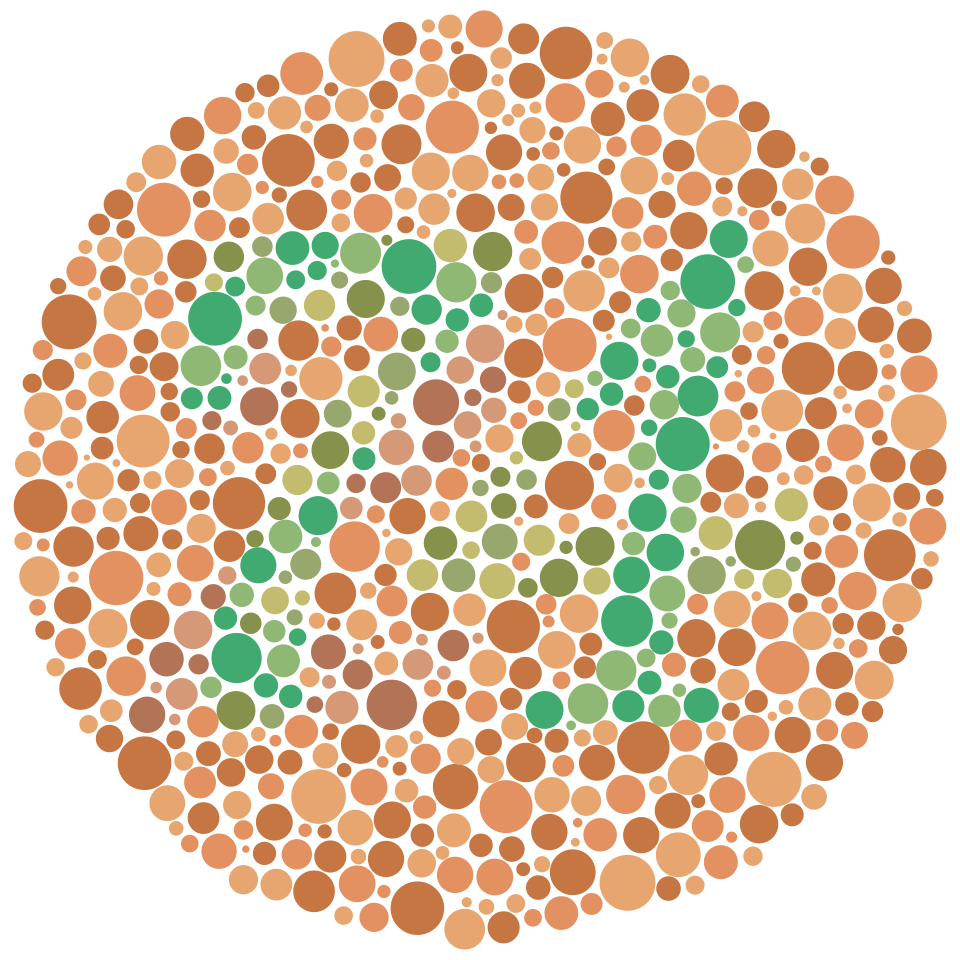
Visual AidA test that shows what an eye cannot report
Photograph of one plate from the color-vision test Shinobu Ishihara designed in 1917, still the standard screen for the red-green confusion the Knowledge Bank describes. The plate works by hiding a figure in the one channel a person may be missing, so two readers looking at the identical page honestly report different things and neither can check the other. That is the whole point, and it is why this belongs beside a chapter about an apple. A screening plate is not a diagnosis, printing and screens shift its colors, and no single plate settles anything. Notice that nothing is concealed here — every dot is in plain view.
Plate from Shinobu Ishihara’s test for color deficiency, first published 1917; vectorized reproduction. Source: Wikimedia Commons, file "Ishihara 9.svg", public domain.
1Claim: “The Community keeps order by removing everything that makes people different.” — choose the two details that best prove it.Claim & Evidence
2A rule that enforces Sameness, or just a detail of Jonas’s life? Tap each item to sort it — tap again to switch sides. You can keep tapping to change your answer.Sort into two
◄ A rule of SamenessJust a detail ►
3Match each cause to its result. For each cause, pick its result.Cause & Effect
The Community fears pain and difference→
The Elders control every choice→
Color and strong feeling are gone→
Jonas glimpses an apple change→
🧠Knowledge Bank question
4Fill both blanks to complete the reasoning.Build the Argument
The Knowledge Bank argues that a community could remove color without anyone protesting because , which shows that .
Part 5
Standardized Test
Vocabulary in Context & Main Idea — SAT & TOEFL-style practice
Read the passage — the highlighted words are tested — then answer. Tap an answer, then tap it again to confirm.
SATWords in Context — a word's meaning in this passage
SATInference — a conclusion the passage implies
SATRhetorical Purpose — why the author put a sentence there
SATCentral Ideas — the passage's main point
TOEFLFactual Information — a fact stated in the passage
TOEFLRhetorical Purpose — why the author included a detail
Cities Designed on Paper
Some cities are not built street by street over centuries — they are designed on paper before anyone moves in. Planners decide in advance where the houses, schools, parks, and roads will go, working from precise drawings so that daily life runs in an orderly way. Brasília, the capital of Brazil, was drawn as a complete city and built in less than four years; Canberra, the capital of Australia, began the same way. In such places everything has a purpose and a position, and almost nothing is left to chance.
Planned cities offer real benefits: short walks to school, quiet neighborhoods, traffic that flows. Many residents enjoy how efficient life feels when a city works like a well-oiled machine. Yet planners have learned something surprising: people also love what cannot be planned — a crooked old lane, a surprising corner café, a neighborhood that grew up on its own. A city of identical blocks that controls everything can feel strangely empty, because part of what makes a place feel alive is the freedom to change it. The best modern planners now leave room for the unplanned — on purpose.
History has taught these lessons slowly. When Brasília first opened, its sweeping avenues looked magnificent from the air, yet some newcomers found street level oddly still. Over time, residents added markets, murals, and gathering spots the original plan had never drawn. Now designers study such places to learn where firm structure truly helps and where a city should quietly step back and let daily life fill the gaps.
Original passage written for Garden Heights — not a quotation from the novel.
1In the passage, “precise” most nearly means —SAT · Words in Context
2Which city does the passage say was built in less than four years?TOEFL · Factual Information
3In the passage, “identical” most nearly means —SAT · Words in Context
4According to the passage, in a planned city the position of houses and roads is decided —TOEFL · Factual Information
5The passage suggests that a fully controlled city may feel —SAT · Inference
6Something “efficient” works —SAT · Words in Context
8Why can a city that controls everything feel “strangely empty”?SAT · Inference
9Which sentence best states the main idea of the passage?SAT · Central Ideas
10The author mentions “a crooked old lane” and “a surprising corner café” mainly to —TOEFL · Rhetorical Purpose
Part 6 · Optional
Creative Writing
A bonus challenge to practice your English. Take your time and have fun with it.
About This Section
This writing task is optional and is not part of your auto-graded score. The feedback below checks only the basics — length, spelling, and grammar — not whether your ideas are right or wrong. It is meant for classroom discussion and creative practice, so feel free to use your imagination!
Writing Task — Part 1 “A Perfect World?”
Jonas’s Community removes all pain and danger but also all choice. Imagine a world where everything is decided for you — your job, your clothes, even your feelings. Would you want to live there? Explain why or why not, with examples. Write at least 40 words.
You can start with: “In a world where everything was decided for me, I would feel…”
0 / 40 words minimum
🗣 Teach It · Just for Fun (optional)
No right or wrong — close the screen and tell someone nearby what happened in this part. Can’t find anyone? Tell yourself out loud. The moment you teach it, you truly understand it.
Part 1 Complete!
You finished Chapters 1–3 of The Giver.
Here are your auto-graded results:
-
points out of 100
Teach it to someone
The best last step is to teach it. In your own words, explain what happened — retell a favorite scene, teach a character’s big choice, or sum up the main idea for a parent, friend, or classmate. When you can teach it clearly, you truly own it.
Independent study guide by Garden Heights Academy. Not affiliated with or endorsed by the author or any rights holders. Contains original analysis only; no text from the novel is reproduced.
SAT® is a registered trademark of College Board, which is not affiliated with, and does not endorse, these materials. TOEFL® is a registered trademark of ETS. These materials are not endorsed or approved by ETS. Garden Heights is an independent provider of test-style reading practice.