New here? Just sign up with Google — your account includes Matilda, our gift book, forever.
The Giver · Garden Heights Academy
Part 3
for The Giver · Part 3 · Chapters 7–9
a novel by Lois Lowry
35 min5 Parts
This workbook is built on a solid pedagogical foundation, effectively integrating content and language learning based on the CLIL framework (Content and Language Integrated Learning), elevated by our unique 5th C — Connection — and an integrated Standardized Test section that weaves every SAT & TOEFL question type right into the novel, so learners build real test skills easily, naturally, and with fun.
What Happens in Part 3
The Chief Elder skips Jonas at the Ceremony of Twelve, then names him the new Receiver of Memory.
Assignments in orderAt the Ceremony of Twelve each child is called by number and given the life Assignment chosen after years of quiet observation. Asher is made Assistant Director of Recreation; Fiona becomes Caretaker of the Old. The order of numbers is strict, and in living memory it has never been broken.
The skipped numberWhen the Chief Elder reaches Jonas's number she passes over him entirely and continues to the next child. The hall turns uneasy. Jonas is left in dread and shame, certain he has done something wrong, with no one to ask and nowhere safe to look.
Selected, not assignedOnly at the very end is the truth given. Jonas has been selected, not assigned, to train as the next Receiver of Memory — the most honored and rare role the Community keeps. The Chief Elder explains the choice must be unanimous, and admits the last selection failed.
The folder of rulesAlone that night Jonas reads his instructions and is stunned. He is exempt from the rules of rudeness, forbidden to discuss his training or to apply for release, barred from sharing dreams — and, hardest of all to take in, permitted to lie.
What We Will Learn
Focus
What It Means
Plot (Turning Point)
Jonas is selected as the new Receiver of Memory
Suspense
How being skipped builds fear before the reveal
Vocabulary
Words for honor, rules, and ability
Chapter Summary
Chapter
Key Events
Ch.7
The Ceremony of Twelve gives Assignments in order, but Jonas’s number is skipped
Ch.8
The Chief Elder announces that Jonas has been selected as the new Receiver of Memory
Ch.9
Jonas reads his folder of unusual rules, including the surprising permission to lie
💭 Before You Read · Warm-Up (not scored)
There are no wrong answers here — just think, guess, and talk:
Imagine a committee has watched you all year and will announce your lifelong job today. What would they pick for you — and would they be right?
Predict: what Assignment do you think Jonas will receive? What are the clues so far?
Which is better — choosing your own career at twenty-five, or being perfectly matched to one at twelve? Take a side.
Copyright Notice
This is an independent study guide created by Garden Heights Academy to support reading comprehension and literary analysis. It contains original analysis questions and does not reproduce any text from the novel. The Giver is a work by Lois Lowry. This guide is not affiliated with, authorized by, or endorsed by the author or any associated rights holders. Students should read the original book, available from libraries and booksellers.
Part 1
Vocabulary
Study 10 key words from Chapters 7–9, then answer each question.
🧠Knowledge Bank · Who Is Allowed to Be an Exception
Civics · Rules and Exemptions
Every legal system contains rules and also carves out exceptions to them. Lawyers call a formal permission to ignore a rule a dispensation or a waiver: a diplomat is exempt from certain prosecutions, a doctor may hold drugs that would otherwise be contraband, a researcher may keep records the public cannot see. Exceptions are not automatically corrupt. A rule written for ordinary cases will fail in unusual ones, and a system with no flexibility eventually breaks. The danger lies elsewhere. An exception granted in secret, to one person, with no review and no expiry, stops being an adjustment to the law and becomes a private power above it. Political theorists therefore ask three questions of any exemption: who granted it, who may inspect it, and how it ends. A privilege that answers none of the three has quietly turned a citizen into something the rest of the community cannot question.
selectedadj.Ch.8
Specially chosen
“Jonas was selected, not assigned.”
Receivern.Ch.8
The person who holds the Community’s memories
“Jonas became the new Receiver.”
honorn.Ch.8
Great respect or privilege
“It was a rare honor.”
rareadj.Ch.8
Not happening often
“The position was very rare.”
dreadn.Ch.7
A feeling of great fear
“Being skipped filled Jonas with dread.”
exemptadj.Ch.9
Freed from a rule
“He was exempt from some rules.”
capacityn.Ch.9
The ability to do something
“He had the Capacity to See Beyond.”
integrityn.Ch.8
Honesty and strong morals
“A Receiver needs great integrity.”
instructionsn.Ch.9
Directions telling you what to do
“His folder held strange instructions.”
anxiousadj.Ch.7
Worried and uneasy
“Jonas grew anxious when skipped.”
ⓘ The vocabulary words in this list are selected to help you understand and complete this workbook. Some may not appear verbatim in the original novel.
🧠Knowledge Bank question
1According to the Knowledge Bank, an exemption becomes dangerous when it is —Ch.8
2True or False: An “honor” is something shameful.Ch.8
3Happening very seldom means ___.Ch.8
4True or False: To be “exempt” from a rule is to be freed from it.Ch.9
5Fill in each blank with the correct word.Ch.8
Word choices:selectedReceiverhonordread- some words will not be used
Jonas was to be the new , a position of great .
6True or False: “Dread” is a feeling of great fear.Ch.7
7Honesty and strong morals together are called ___.Ch.8
8True or False: “Instructions” are directions telling you what to do.Ch.9
9Fill in the blanks with the correct words.Ch.9
Word choices:exemptcapacityanxiousintegrity- some words will not be used
Jonas had the to See Beyond, and was from some rules.
10The ability or power to do something is ___.Ch.9
Part 2
Comprehension
How well do you understand Chapters 7–9?
🧠Knowledge Bank · Memory Is Not a Recording
Neuroscience · Reconstructive Memory
Memory feels like playback, but the brain does not store scenes the way a camera stores frames. Recall is reconstructive: each time you remember an event you rebuild it from fragments, filling gaps with expectation and with whatever you have learned since. Psychologist Elizabeth Loftus demonstrated how easily the rebuild can be nudged. Witnesses shown the same car crash reported higher speeds when asked how fast the cars smashed rather than hit, and some later recalled broken glass that was never there. This is not lying; it is how a flexible system works, and flexibility is what lets memory support imagination and planning. It also means a memory grows slightly less faithful every time it is used. A community that wished to keep the past accurate would face a hard problem, because the only place memories live is inside brains that quietly edit them, and the only way to check one is against another witness.
Visual AidA memory is rebuilt, not replayed
Structure diagram of the reconstruction the Knowledge Bank describes, ending with the experiment that made it famous: witnesses who saw one filmed crash gave higher speeds when the question used a harder verb, and some later recalled broken glass that had never been there. The two lower boxes compress a study of many participants into a single contrast, and the speeds are not given because the point is the direction, not the number. Nothing here suggests witnesses lie. Notice where the rebuilding happens — at recall, not in storage, which is why a memory used often is not the memory best preserved.
Reconstructive memory and Elizabeth Loftus’s work on question wording, as set out in the Knowledge Bank and in standard psychology texts. Drawn for Garden Heights Academy.
🧠Knowledge Bank question
1The Knowledge Bank explains that Loftus's car-crash study showed memory can be —Ch.7
2What shocking thing happens when Jonas’s number is reached?Ch.7
3What is Jonas finally announced as?Ch.8
4True or False: Jonas was ‘selected,’ not simply ‘assigned,’ for his role.Ch.8
5Write the numbers 1–5 in the boxes to show the correct order of events in Part 3.Ch.7–9
Jonas’s number is skipped, filling him with dread.
The Community honors Jonas for the rare position.
Jonas reads the unusual rules in his folder of instructions.
The Chief Elder announces Jonas as the new Receiver of Memory.
The Ceremony of Twelve gives Assignments in order.
6True or False: Being skipped made Jonas feel proud and calm.Ch.7
7How does the Community react to Jonas’s selection?Ch.8
8Which surprising rule is in Jonas’s folder?Ch.9
9True or False: Jonas may not talk about his training with anyone.Ch.9
10Fill in the blanks.Ch.7–9
Word choices:ReceiverMemoryprizeNurturer- some words will not be used
Jonas became the new of .
Part 3
Literary Elements
Understanding HOW and WHY Lois Lowry creates certain feelings across Chapters 7–9.
🧠Knowledge Bank · The Scene a Story Pivots On
Literary Craft · The Turning Point
Classical dramatists called the moment a story changes direction the peripeteia, the reversal. It is not the loudest scene; it is the one after which the earlier chapters can no longer be read the same way. Aristotle argued that the strongest reversals come from something already present rather than from an outside accident, so the audience feels recognition rather than surprise. Novelists usually place this pivot near the end of the first third, giving the reader enough ordinary life to be reversed. A well-built pivot does three jobs at once: it isolates the protagonist, it converts a vague unease into a specific problem, and it makes the rest of the book inevitable. Notice how much of the pivot in Part 3 is delivered through other people’s reactions rather than through the protagonist’s own words. That distance is deliberate, and it is what makes the change feel less like a reward than an exposure.
📚 Literary Devices in This Part · definitions & examples
The skipped number creates suspense before the reveal.Jonas’s selection is the story’s major turning point.The special rules show Jonas is now set apart from everyone.
The questions below are mixed — not grouped by device. Decide which device each one is about.
🧠Knowledge Bank question
1According to the Knowledge Bank, the strongest turning points come from —Ch.7–9
2A turning point is a moment where the story changes direction.Ch.7–9
3Fill in each blank with the correct word.Ch.7–9
Word choices:suspenseturning pointcharacterizationsetting- some words will not be used
The skipped number builds tense
Jonas’s selection, which changes everything, is the major .
4Jonas’s selection as Receiver is the story’s major —Ch.7–9
5How the special rules set Jonas apart is a kind of characterization.Ch.7–9
6Fill in each blank with the correct word.Ch.7–9
Word choices:characterizationsuspenseturning pointmood- some words will not be used
The special rules that mark Jonas as different are a form of
The long, skipped-number wait builds .
7The skipped number before Jonas is named mainly creates —Ch.7–9
8Showing Jonas set apart by strange new rules is a way of —Ch.7–9
9Fill in each blank with the correct word.Ch.7–9
Word choices:turning pointsuspensecharacterizationplot- some words will not be used
The moment the whole story pivots on is a
The rules that reveal Jonas’s new role show .
10Delaying Jonas’s name to the very end mainly keeps readers —Ch.7–9
Part 4
Think Deeper
Four deeper challenges — no single-word recall. Read, weigh the evidence, and reason it through.
🧠Knowledge Bank · Tests That Assign a Future
Psychometrics · Sorting by Aptitude
Societies that assign roles need a defensible way to sort people, so they build tests. Britain’s eleven-plus examination, introduced in 1944, streamed eleven-year-olds into different schools and largely fixed their prospects. Supporters argued it found talent regardless of wealth; critics showed that scores tracked family income closely and that a single morning could not measure a child still developing. Psychometricians judge such instruments by two standards. Reliability asks whether the same person would score the same next month, and validity asks whether the score predicts anything that matters. Many sorting tests are reliable while being only weakly valid — consistent, and consistently measuring the wrong thing. The deeper problem is circular: once a test assigns a role, the training that follows makes the prediction come true. That is why an aptitude system can look flawless from inside while never having tested aptitude at all.
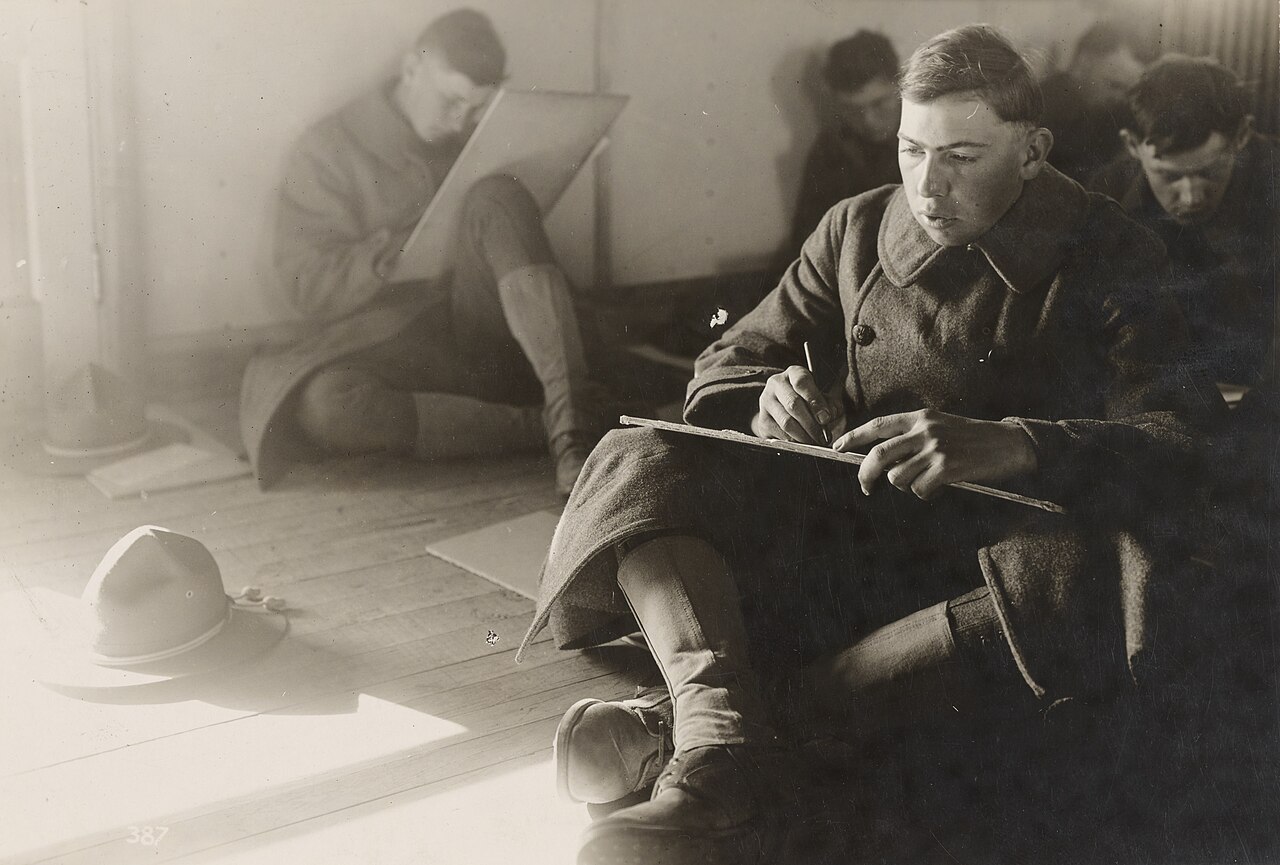
Visual AidA room where a morning decided a future
Photograph from the United States National Archives of soldiers sitting an early version of the Army Alpha in November 1917 — the first time a nation tested minds in bulk and sorted people by the result. It shows what the Knowledge Bank means by a sorting instrument: identical papers, one sitting, and a score that followed a man afterward. These are adult recruits, not the schoolchildren of the eleven-plus, and a photograph cannot show whether the test measured anything real. Notice the scale of the room. The efficiency in this picture is exactly what made the practice spread, and exactly what made it hard to question.
Soldiers taking a predecessor of the Army Alpha examination, November 1917; U.S. National Archives. Source: Wikimedia Commons, public domain.
1Claim: “Being skipped over turns from shame into the highest honor.” — choose the two details that best prove it.Claim & Evidence
2Jonas’s fear and shame, or the honor of his selection? Tap each item to sort it — tap again to switch sides. You can keep tapping to change your answer.Sort into two
◄ Fear and shameThe honor ►
3Match each cause to its result. For each cause, pick its result.Cause & Effect
The Chief Elder skips Jonas’s number→
The other children are all assigned→
At the end Jonas is named Receiver→
The Receiver role is rare and vital→
🧠Knowledge Bank question
4Fill both blanks to complete the reasoning.Build the Argument
The Knowledge Bank argues that an aptitude system can look flawless from the inside because , which shows that .
Part 5
Standardized Test
Detail, NOT/EXCEPT & Inference — SAT & TOEFL-style practice
Read the passage — the highlighted words are tested — then answer. Tap an answer, then tap it again to confirm.
SATWords in Context — a word's meaning in this passage
SATInference — a conclusion the passage implies
SATNOT/EXCEPT — the option the passage does NOT support
SATRhetorical Purpose — why the author put a sentence there
TOEFLFactual Information — a fact stated in the passage
Europe's Old Apprentice System
Long before universities trained workers, Europe ran on the apprentice system. A child of about twelve was placed with a master — an expert in one craft, such as baking, weaving, or silverwork — and often moved into the master's own house to learn. The young apprentice swept floors, carried tools, watched closely, followed the master's instructions exactly, and practiced the same motions thousands of times. The training commonly lasted about seven years, because a true craft cannot be copied from a page: it must pass from skilled hands to learning hands.
The system had a strict ladder built into it. To rise from journeyman to master, a worker usually had to produce one outstanding piece — a masterpiece — judged by the guild that governed the trade. These guilds set fair prices, protected quality, and decided who was allowed to open a shop of his own. In this way a single craft could stay strong for centuries, its methods traveling from hand to hand long before any factory printed them in a manual.
An apprentice's life came with strict duties: obey the master, guard the secrets of the workshop, and practice until the work was worthy. Selling work of one's own before the training ended was forbidden, and a workshop's reputation rested on the integrity of every person inside it. In return, the master owed the apprentice food, lodging, and every skill he knew. The bargain demanded great patience from both — but at its end the apprentice rose to journeyman, and perhaps one day to master, with apprentices of his own. The most precious knowledge in Europe was passed exactly this way: not printed, not announced, but handed quietly from one person to one chosen learner at a time.
Original passage written for Garden Heights — not a quotation from the novel.
1According to the passage, at about what age did an apprenticeship begin?TOEFL · Factual Information
2In the passage, “instructions” most nearly means —SAT · Words in Context
3The passage suggests that learning a craft this old way was mainly —SAT · Inference
4How long did the training commonly last?TOEFL · Factual Information
5In the passage, “integrity” most nearly means —SAT · Words in Context
6According to the passage, ALL of the following were part of an apprentice’s life EXCEPT —SAT · NOT/EXCEPT
7“Duties” are —SAT · Words in Context
8Why did an apprentice often move into the master’s house?SAT · Inference
9The passage presents the old apprentice system mainly as a way to —SAT · Rhetorical Purpose
10The final sentence suggests that Europe’s most precious knowledge was passed on —SAT · Inference
Part 6 · Optional
Creative Writing
A bonus challenge to practice your English. Take your time and have fun with it.
About This Section
This writing task is optional and is not part of your auto-graded score. The feedback below checks only the basics — length, spelling, and grammar — not whether your ideas are right or wrong. It is meant for classroom discussion and creative practice, so feel free to use your imagination!
Writing Task — Part 3 “A Heavy Honor”
Jonas is given a great honor that is also a heavy responsibility. Write about a time you were given an important job or responsibility (real or imagined). How did it feel to be chosen, and what was hard about it? Write at least 40 words.
You can start with: “Being chosen for something important felt…”
0 / 40 words minimum
🗣 Teach It · Just for Fun (optional)
No right or wrong — close the screen and tell someone nearby what happened in this part. Can’t find anyone? Tell yourself out loud. The moment you teach it, you truly understand it.
Part 3 Complete!
You finished Chapters 7–9 of The Giver.
Here are your auto-graded results:
-
points out of 100
Teach it to someone
The best last step is to teach it. In your own words, explain what happened — retell a favorite scene, teach a character’s big choice, or sum up the main idea for a parent, friend, or classmate. When you can teach it clearly, you truly own it.
Independent study guide by Garden Heights Academy. Not affiliated with or endorsed by the author or any rights holders. Contains original analysis only; no text from the novel is reproduced.
SAT® is a registered trademark of College Board, which is not affiliated with, and does not endorse, these materials. TOEFL® is a registered trademark of ETS. These materials are not endorsed or approved by ETS. Garden Heights is an independent provider of test-style reading practice.