New here? Just sign up with Google — your account includes Matilda, our gift book, forever.
The Giver · Garden Heights Academy
Part 5
for The Giver · Part 5 · Chapters 13–15
a novel by Lois Lowry
35 min5 Parts
This workbook is built on a solid pedagogical foundation, effectively integrating content and language learning based on the CLIL framework (Content and Language Integrated Learning), elevated by our unique 5th C — Connection — and an integrated Standardized Test section that weaves every SAT & TOEFL question type right into the novel, so learners build real test skills easily, naturally, and with fun.
What Happens in Part 5
Jonas learns why the Community fears choice, then receives the memories of hunger, loss and war.
The argument for choiceSeeing color makes Jonas want everyone to have it, and with it the choice the Community traded away. The Giver's answer is plain and hard to argue with: if people are allowed to choose, some will choose wrongly. Safety was bought by removing the option entirely.
A burden carried aloneJonas begins to understand that the memories are a burden rather than a privilege. The Giver is worn down by their weight and cannot set it aside or share it, because the Community deliberately keeps only one person who is permitted to remember.
Pain that teachesThe painful memories come. A sled overturns and a bone breaks; there is hunger; poachers kill elephants and leave the bodies. Jonas learns that pain is not punishment but information — the very thing the Community removed when it removed everything else.
The battlefieldWorst is warfare. On a battlefield crowded with the wounded, Jonas holds a boy who is dying and gives him water from a canteen. The anguish is past anything he has imagined, and afterward he cannot bear to be spoken to kindly.
What We Will Learn
Focus
What It Means
Theme
The value of choice and the burden of memory
History
Why painful memories like war must be kept
Character
Jonas grows wiser and more troubled
Chapter Summary
Chapter
Key Events
Ch.13
Jonas longs for others to have color and choice; the Giver explains the Community’s fear of choice
Ch.14
Jonas receives painful memories, including a sledding accident and a broken leg
Ch.15
The Giver, in agony, transmits the memory of warfare; Jonas comforts a dying soldier
💭 Before You Read · Warm-Up (not scored)
There are no wrong answers here — just think, guess, and talk:
What days of remembrance does YOUR country keep? What do people do — and why that day?
If carrying one painful memory meant a hundred other people never had to feel it, would you volunteer? Be honest.
Predict: which memory do you think will be the hardest one The Giver must pass to Jonas?
Copyright Notice
This is an independent study guide created by Garden Heights Academy to support reading comprehension and literary analysis. It contains original analysis questions and does not reproduce any text from the novel. The Giver is a work by Lois Lowry. This guide is not affiliated with, authorized by, or endorsed by the author or any associated rights holders. Students should read the original book, available from libraries and booksellers.
Part 1
Vocabulary
Study 10 key words from Chapters 13–15, then answer each question.
🧠Knowledge Bank · What Pain Is For
Physiology · Nociception
Pain is unpleasant by design. Specialized nerve endings called nociceptors fire when tissue is damaged or threatened, sending signals up the spinal cord to the brain, which then decides how much alarm to raise. That last step explains why pain is not a simple measurement: soldiers have walked on broken bones, and a paper cut can be agonizing. Context, attention and expectation all adjust the volume. The rare people born with congenital insensitivity to pain show what the system is worth. They bite through their tongues, walk on fractures and often die young, because nothing tells them to stop. Chronic pain is the same machinery misfiring, an alarm that keeps sounding after the danger has passed. Doctors therefore treat pain as information rather than as pure suffering, and any attempt to abolish it entirely from a population would also abolish the fastest teacher a body has.
Visual AidPain is information, not punishment
Sequence diagram of the pathway the Knowledge Bank describes, from threatened tissue to the brain’s decision about how much alarm to raise, with the people born unable to feel any of it set out underneath. Drawing it as four clean steps hides how much the last one varies: the same injury can be agony or barely noticed, depending on context, attention and expectation. No timings are given and the nervous system is far messier than four boxes. Notice that the diagram ends in a decision rather than a measurement — which is why a community could not simply switch this off and keep everything else.
Nociception, the modulation of pain and congenital insensitivity to pain, as set out in the Knowledge Bank and in standard physiology references. Drawn for Garden Heights Academy.
choicen.Ch.13
A decision between two or more things
“Jonas wished people could make a choice.”
frustratev.Ch.13
To upset someone who cannot do something
“The Community’s rules began to frustrate him.”
burdenn.Ch.13
A heavy load or responsibility
“The memories were a heavy burden.”
warfaren.Ch.15
The fighting of a war
“Jonas felt the horror of warfare.”
anguishn.Ch.15
Severe pain or suffering
“He was filled with anguish.”
battlefieldn.Ch.15
The place where a battle is fought
“The memory placed him on a battlefield.”
endurev.Ch.14
To suffer through something hard
“Jonas had to endure painful memories.”
couragen.Ch.15
Bravery in the face of danger
“It took courage to hold the memory.”
woundn.Ch.15
An injury to the body
“The soldier had a terrible wound.”
wearyadj.Ch.13
Very tired and worn out
“The Giver looked weary and old.”
ⓘ The vocabulary words in this list are selected to help you understand and complete this workbook. Some may not appear verbatim in the original novel.
🧠Knowledge Bank question
1According to the Knowledge Bank, what do people born unable to feel pain reveal?Ch.13
2True or False: To “frustrate” someone is to make them feel pleased.Ch.13
3A heavy load or responsibility is a ___.Ch.13
4True or False: “Warfare” means the fighting of a war.Ch.15
5Fill in each blank with the correct word.Ch.13
Word choices:choiceburdenfrustratecourage- some words will not be used
The memories were a heavy , and the lack of began to Jonas.
6True or False: “Anguish” is a feeling of severe pain or suffering.Ch.15
7The place where a battle is fought is a ___.Ch.15
8True or False: To “endure” hardship is to suffer through it.Ch.14
9Fill in the blanks with the correct words.Ch.15
Word choices:warfarewoundwearyanguish- some words will not be used
Jonas felt the of and saw a soldier’s terrible .
10Bravery in the face of danger is ___.Ch.15
Part 2
Comprehension
How well do you understand Chapters 13–15?
🧠Knowledge Bank · What Armies Leave Behind
Military History · The Cost of Battle
Histories of war used to be written from maps and casualty totals. Modern historians add a second record: what happened to the people who came home. After the American Civil War, doctors described veterans with racing hearts and terror they could not explain and called it soldier’s heart. The First World War produced the term shell shock, the Second combat fatigue, and since 1980 the diagnosis has been post-traumatic stress disorder. The name changed far more than the condition. Studies of veterans find that the strongest predictor of lasting injury is not the length of a deployment but exposure to sudden, uncontrollable violence, and that recovery depends heavily on whether anyone at home will listen. This is why memoirists insist that battlefield writing avoid glory. A nation that remembers only its victories keeps the useful half of the memory and quietly discards the half that would make it hesitate.
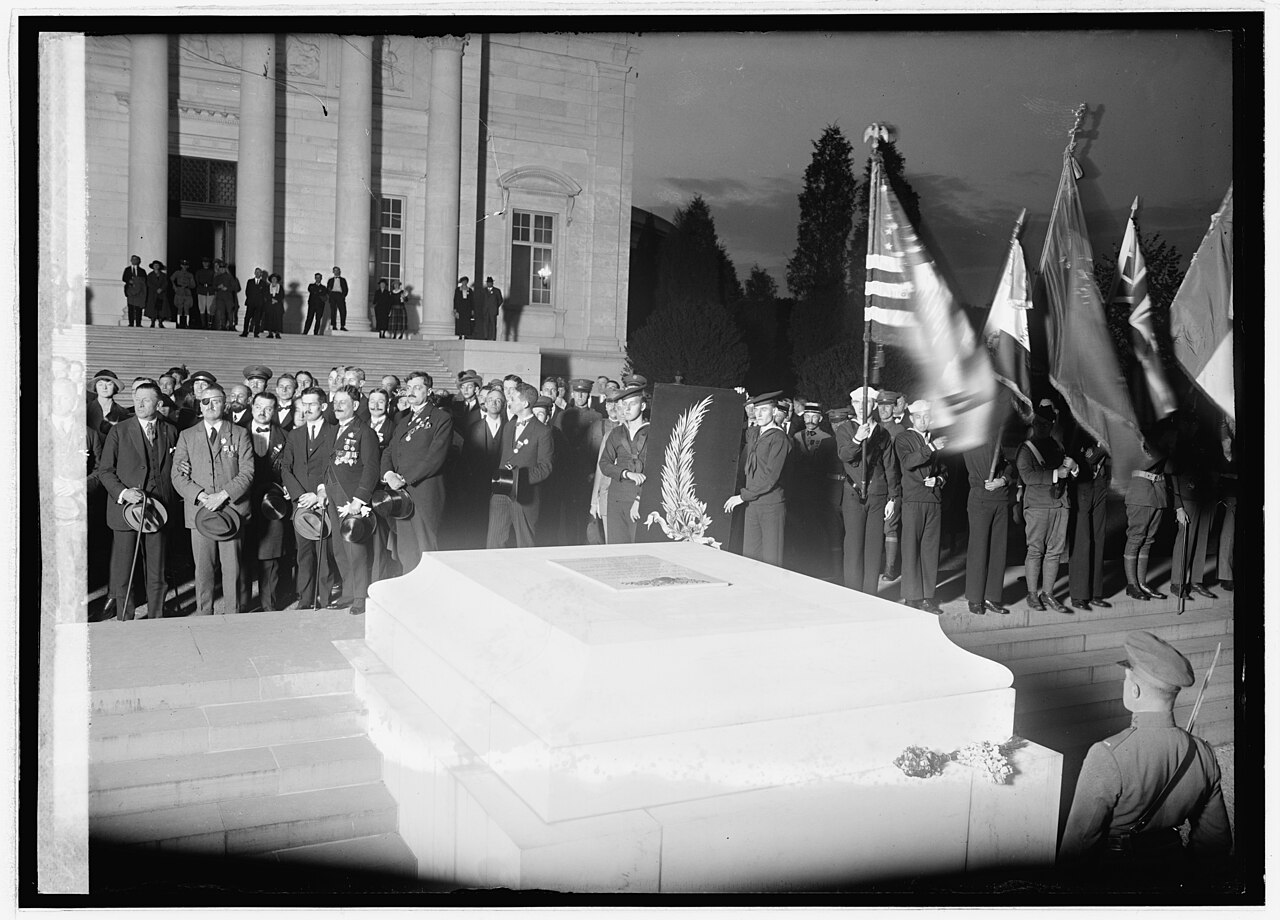
Visual AidA nation standing still on purpose
Photograph taken at Arlington National Cemetery in October 1922, less than a year after the Tomb of the Unknown Soldier was dedicated there. It shows what the Knowledge Bank means when it says a nation keeps the half of the memory that would make it hesitate: thousands of people arranging their day around a stone with no name on it. The crowd is a single gathering on one afternoon and stands for nothing beyond itself; who these people are, and whom each of them was remembering, the photograph cannot say. Notice that everyone is facing the same direction, and that there is nothing to see.
American Legion at Arlington National Cemetery, 11 October 1922; National Photo Company Collection, Library of Congress. Source: Wikimedia Commons, public domain.
🧠Knowledge Bank question
1The Knowledge Bank explains that the strongest predictor of lasting injury in veterans is —Ch.13
2Why does the Giver say choice can be dangerous?Ch.13
3What does Jonas notice about the Giver?Ch.13
4True or False: The Giver transmits a painful memory of a sledding accident.Ch.14
5Write the numbers 1–5 in the boxes to show the correct order of events in Part 5.Ch.13–15
Jonas receives painful memories, like a sledding accident.
The Giver, in agony, shares the memory of warfare.
Jonas wishes others could see color and choose for themselves.
The Giver explains why the Community fears choice.
Jonas comforts a dying soldier and feels deep anguish.
6True or False: The war memory is gentle and pleasant.Ch.15
7What is the terrible memory in Chapter 15?Ch.15
8How does carrying these memories affect Jonas?Ch.15
9True or False: The Giver also suffers from holding painful memories.Ch.13
10Fill in the blanks.Ch.13–15
Word choices:warfarechoicecandysnow- some words will not be used
Jonas learned the anguish of and longed to give people the gift of .
Part 3
Literary Elements
Understanding HOW and WHY Lois Lowry creates certain feelings across Chapters 13–15.
🧠Knowledge Bank · Two Scenes Placed Side by Side
Literary Craft · Juxtaposition
Juxtaposition is the deliberate placing of two unlike things next to each other so that each changes how the other reads. Film editors discovered its power early: the Soviet director Lev Kuleshov intercut one neutral face with a bowl of soup, a coffin and a child, and audiences praised the actor’s hunger, grief and tenderness — all supplied by the cut, not the performance. Novelists use the same effect across chapter breaks, and the join carries the meaning exactly as an edit does. A gentle domestic scene set immediately beside a scene of suffering does not merely contrast them; it makes the gentleness look either precious or willfully blind, depending on what the reader has just been shown. Part 5 works this way repeatedly, and the technique is quieter than argument because the author never states the comparison. The reader draws it, and having drawn it cannot easily set it aside.
📚 Literary Devices in This Part · definitions & examples
The war scene has a grave, sorrowful tone.A key theme emerges: memory and choice give life meaning.Vivid imagery of the battlefield makes the horror feel real.
The questions below are mixed — not grouped by device. Decide which device each one is about.
🧠Knowledge Bank question
1According to the Knowledge Bank, the Kuleshov experiment showed that meaning can come from —Ch.13–15
2Theme is the deeper message a story explores.Ch.13–15
3Fill in each blank with the correct word.Ch.13–15
Word choices:tonethemeimagerysetting- some words will not be used
The grave, sorrowful feeling of the war scene is its
The big idea that memory and choice give life meaning is a .
4Why does Lowry use vivid battlefield imagery?Ch.13–15
5Vivid imagery of the battlefield makes the horror feel real.Ch.13–15
6Fill in each blank with the correct word.Ch.13–15
Word choices:imagerytonethememood- some words will not be used
Vivid battlefield description that we can almost see is
The grave, sorrowful feeling of the scene is its .
7That memory and choice give life meaning is the story’s —Ch.13–15
8Description that lets us picture the battlefield is —Ch.13–15
9Fill in each blank with the correct word.Ch.13–15
Word choices:themetoneimageryplot- some words will not be used
The deeper message about memory and choice is the
Description you can see and feel is .
10The grave tone of the war memory mainly makes readers feel —Ch.13–15
Part 4
Think Deeper
Four deeper challenges — no single-word recall. Read, weigh the evidence, and reason it through.
🧠Knowledge Bank · Protecting Animals That Remember
Conservation · Elephants and Ivory
African elephants live in herds led by the oldest female, the matriarch, and researchers in Amboseli have tracked individuals for over forty years. Those studies show that a matriarch stores knowledge the herd cannot otherwise get — the location of water in a drought year, which lion calls are dangerous — so killing the eldest animals damages a herd long after the shot. Elephants also return to the bones of dead relatives and handle them, behavior scientists describe cautiously but repeatedly. The ivory trade targeted exactly the largest tusks and therefore exactly those elders. An international ban took effect in 1990, populations in protected parks recovered, and poaching surged again whenever enforcement or demand shifted. Conservationists draw a general lesson from it: protecting a species means protecting its knowledge as well as its numbers, because a herd that has lost its elders has also lost the map of water and danger it needs to survive.
1Claim: “Jonas comes to believe people should be free to choose, despite the risks.” — choose the two details that best prove it.Claim & Evidence
2An argument FOR choice, or AGAINST it? Tap each item to sort it — tap again to switch sides. You can keep tapping to change your answer.Sort into two
◄ For choiceAgainst choice ►
3Match each cause to its result. For each cause, pick its result.Cause & Effect
Jonas feels the joy of the memories→
Jonas longs for real choice→
Only Jonas carries the memories→
Jonas sees what Sameness costs→
🧠Knowledge Bank question
4Fill both blanks to complete the reasoning.Build the Argument
The Knowledge Bank argues that killing the oldest elephants harms a herd for years because , which shows that .
Part 5
Standardized Test
Author’s Purpose & Text Structure — SAT & TOEFL-style practice
Read the passage — the highlighted words are tested — then answer. Tap an answer, then tap it again to confirm.
SATWords in Context — a word's meaning in this passage
SATInference — a conclusion the passage implies
SATRhetorical Purpose — why the author put a sentence there
SATText Structure — how the passage is built, and why
TOEFLFactual Information — a fact stated in the passage
Why Nations Build War Memorials
In almost every country on Earth stands a quiet stone memorial carved with names. Some list soldiers who never came home; others remember whole cities lost to disaster; still others carry only a single date, and a flame that is never allowed to go out. Each November, people in Britain and Canada pin red paper poppies to their coats; at eleven o'clock, crowds gather and keep two full minutes of silence. Why do busy nations stop everything to remember their saddest days? Because forgetting, they believe, would be more dangerous than grief, and because the courage those names record deserves to be spoken aloud.
A memorial does three jobs at once: it thanks those whose sacrifice — giving up their own safety, and sometimes their lives — protected everyone else. It comforts the families left behind, giving their sorrow a solemn, dignified home where fresh flowers appear year after year, left by hands that never met the names they honor; grief of that kind is easier to endure when it is shared. And it teaches: a child who asks “What are all these names?” receives history's hardest lesson gently, from a parent instead of a battlefield. “Lest we forget,” many memorials warn — for a nation that remembers the true cost of war thinks twice before beginning another.
Some of the most moving memorials name no one at all. A Tomb of the Unknown Soldier holds a single unidentified body to stand for every soldier never found, and many are watched over by guards day and night. Other nations keep an eternal flame burning beside the stone, so the memory can never quietly fade. Together these customs make one promise across borders: the people who gave everything will not be allowed to slip out of memory.
Original passage written for Garden Heights — not a quotation from the novel.
1According to the passage, what do people in Britain and Canada wear each November?TOEFL · Factual Information
2In the passage, “courage” most nearly means —SAT · Words in Context
3The passage suggests that a shared memorial helps a community feel —SAT · Inference
4The two-minute silence is mainly meant to show —SAT · Rhetorical Purpose
5How long is the remembrance silence in the passage?TOEFL · Factual Information
6As used in the passage, to “endure” is to —SAT · Words in Context
7Something “solemn” is —SAT · Words in Context
8The second paragraph is organized mainly as —SAT · Text Structure
9The author includes the child’s question — “What are all these names?” — mainly to —SAT · Rhetorical Purpose
10The warning “Lest we forget” suggests that —SAT · Inference
Part 6 · Optional
Creative Writing
A bonus challenge to practice your English. Take your time and have fun with it.
About This Section
This writing task is optional and is not part of your auto-graded score. The feedback below checks only the basics — length, spelling, and grammar — not whether your ideas are right or wrong. It is meant for classroom discussion and creative practice, so feel free to use your imagination!
Writing Task — Part 5 “The Power of Choice”
Jonas longs for people to make their own choices. Write about an important choice you have made, or a choice you wish you were allowed to make. Why does being able to choose matter to you? Write at least 40 words.
You can start with: “Being able to make my own choice matters to me because…”
0 / 40 words minimum
🗣 Teach It · Just for Fun (optional)
No right or wrong — close the screen and tell someone nearby what happened in this part. Can’t find anyone? Tell yourself out loud. The moment you teach it, you truly understand it.
Part 5 Complete!
You finished Chapters 13–15 of The Giver.
Here are your auto-graded results:
-
points out of 100
Teach it to someone
The best last step is to teach it. In your own words, explain what happened — retell a favorite scene, teach a character’s big choice, or sum up the main idea for a parent, friend, or classmate. When you can teach it clearly, you truly own it.
Independent study guide by Garden Heights Academy. Not affiliated with or endorsed by the author or any rights holders. Contains original analysis only; no text from the novel is reproduced.
SAT® is a registered trademark of College Board, which is not affiliated with, and does not endorse, these materials. TOEFL® is a registered trademark of ETS. These materials are not endorsed or approved by ETS. Garden Heights is an independent provider of test-style reading practice.