New here? Just sign up with Google — your account includes Matilda, our gift book, forever.
The Giver · Garden Heights Academy
Part 7
for The Giver · Part 7 · Chapters 19–20
a novel by Lois Lowry
35 min5 Parts
This workbook is built on a solid pedagogical foundation, effectively integrating content and language learning based on the CLIL framework (Content and Language Integrated Learning), elevated by our unique 5th C — Connection — and an integrated Standardized Test section that weaves every SAT & TOEFL question type right into the novel, so learners build real test skills easily, naturally, and with fun.
What Happens in Part 7
Jonas watches a release and learns it is killing; he and The Giver plan his escape.
The recordingJonas asks to see a release, and The Giver plays a recording made that morning. Twin boys have been born; only one may be kept. The smaller is to be released, and the Nurturer performing it is Jonas's own father.
What release meansHis father chats cheerfully to the newborn while pushing a needle into its forehead. The baby goes limp and still, and the body is dropped down a chute. The realization arrives whole: release is death, and Jonas has just watched his father kill a child.
A father's ignoranceJonas is devastated and refuses to go home. What undoes him is not cruelty but its absence. His father has no memories and no feelings to measure the act against, and so does not understand what he has done, or that anything is wrong.
The planGrief turns determined. Jonas and The Giver make a plan: Jonas will escape past the boundary, and once he is gone the memories he carries will come back to the people. The Giver will stay behind to help the Community survive them.
What We Will Learn
Focus
What It Means
Plot (Climax)
Jonas learns the terrible truth about release
Ethics
Doing harm without questioning the rules
Plot (The Plan)
Jonas and the Giver decide Jonas must escape
Chapter Summary
Chapter
Key Events
Ch.19
The Giver shows Jonas a recording of a release; Jonas sees his father end a newborn’s life and is horrified
Ch.20
Devastated, Jonas and the Giver plan his escape so the memories will return to the Community
💭 Before You Read · Warm-Up (not scored)
There are no wrong answers here — just think, guess, and talk:
Has a rule ever felt truly WRONG to you? What did you do — and what happened?
You have tracked the word ‘release’ since Part 2. Final prediction: what is it?
If leaving home forever would give everyone you know their deepest feelings back, would you go? Be honest.
Copyright Notice
This is an independent study guide created by Garden Heights Academy to support reading comprehension and literary analysis. It contains original analysis questions and does not reproduce any text from the novel. The Giver is a work by Lois Lowry. This guide is not affiliated with, authorized by, or endorsed by the author or any associated rights holders. Students should read the original book, available from libraries and booksellers.
Part 1
Vocabulary
Study 10 key words from Chapters 19–20, then answer each question.
🧠Knowledge Bank · The Language of Life and Death
Medical Ethics · Naming an Ending
Medicine has to name the hardest decisions it makes, and the names carry arguments inside them. Euthanasia means deliberately ending a life to end suffering; assisted dying means supplying the means while the patient acts; palliative care means treating pain without aiming at death. The distinctions matter legally and morally, and public debate collapses when they are blurred. Bioethicists insist on three tests before any such decision: informed consent from the person themselves, a genuine and documented medical reason, and independent review by someone with nothing to gain. Strip out any one of the three and the same physical act becomes something entirely different. History supplies the warning. Programs that described killing the sick or disabled as mercy invariably removed consent first and kept the vocabulary of care, which is why ethicists treat gentle official language around death as a signal to look harder rather than as a reason to look away.
recordingn.Ch.19
A saved video of an event
“The Giver showed Jonas a recording.”
realizationn.Ch.19
The act of suddenly understanding
“A terrible realization struck Jonas.”
devastatedadj.Ch.20
Deeply shocked and grieved
“Jonas was utterly devastated.”
deceivev.Ch.19
To trick or mislead
“The Community deceives its people.”
innocentadj.Ch.19
Doing no wrong
“The newborn was completely innocent.”
escapev.Ch.20
To get away from a place
“Jonas would escape the Community.”
plann.Ch.20
A worked-out way to do something
“They made a daring plan.”
desperateadj.Ch.20
Filled with hopeless urgency
“A desperate Jonas could not go home.”
determinedadj.Ch.20
Firmly decided
“Jonas was determined to act.”
consciencen.Ch.20
Your sense of right and wrong
“His conscience would not let him stay.”
ⓘ The vocabulary words in this list are selected to help you understand and complete this workbook. Some may not appear verbatim in the original novel.
🧠Knowledge Bank question
1According to the Knowledge Bank, why do ethicists look harder at gentle official language about death?Ch.19
2True or False: To be “devastated” is to be deeply shocked and grieved.Ch.20
3To trick or mislead someone is to ___ them.Ch.19
4True or False: An “innocent” person has done no wrong.Ch.19
5Fill in each blank with the correct word.Ch.19
Word choices:recordingrealizationdevastateddeceive- some words will not be used
The brought a terrible that left Jonas .
6True or False: A person’s “conscience” is their sense of right and wrong.Ch.20
7Firmly decided to do something means ___.Ch.20
8True or False: To “escape” is to get away from a place.Ch.20
9Fill in the blanks with the correct words.Ch.20
Word choices:escapeplandesperatedetermined- some words will not be used
Jonas and the Giver made a for him to the Community.
10Filled with hopeless urgency means ___.Ch.20
Part 2
Comprehension
How well do you understand Chapters 19–20?
🧠Knowledge Bank · Watching Is Not Understanding
Media Studies · What a Recording Shows
Video feels like proof, and courts have learned to be careful with it. A camera has a position, a frame and a duration, and each of those is a choice that excludes something. Research on police body-camera footage found that viewers judged the same encounter differently depending on the angle, and that a camera pointed at one participant made that participant seem more responsible. Editing multiplies the effect: the same clips in a different order produce a different story without a single false frame. This is why investigators ask what happened before a recording began, who started it, and what lies outside the edge. A recording is evidence, which is not the same as truth; it is one witness with a very narrow view and no memory of its own. Understanding footage means reconstructing the situation that produced it, and that work has to be done by a person who is willing to doubt.
Visual AidWhat a recording leaves out
Structure diagram of the limits the Knowledge Bank puts on footage: a frame has one position, one angle and one duration, and each of those excluded something. The four arrows name what a camera cannot hold — what came before, who chose to start it, what stands outside the edge, and what happened after. Drawing the frame as a neat rectangle understates the problem, because editing can reorder true clips into a false story without a single invented frame. This describes how recordings are read in general, not any one scene. Notice that every question here has to be answered by a person willing to doubt.
How recordings are read as evidence, including research on body-camera angle and the effects of editing, as set out in the Knowledge Bank and in standard media-studies references. Drawn for Garden Heights Academy.
🧠Knowledge Bank question
1The Knowledge Bank explains that a recording is best described as —Ch.19
2What does the Giver show Jonas?Ch.19
3What does Jonas realize ‘release’ truly is?Ch.19
4True or False: Jonas’s father performs the release of a newborn twin.Ch.19
5Write the numbers 1–5 in the boxes to show the correct order of events in Part 7.Ch.19–20
The Giver shows a recording of Jonas’s father performing a release.
Jonas asks the Giver to explain release.
Jonas and the Giver make a plan for Jonas to escape.
Jonas realizes that release is the ending of a life.
Devastated, Jonas refuses to return home.
6True or False: Jonas is calm and happy after watching the recording.Ch.19
7Why is Jonas horrified by his father?Ch.19
8What plan do Jonas and the Giver make?Ch.20
9True or False: When Jonas leaves, the memories he holds will return to the Community.Ch.20
10Fill in the blanks.Ch.19–20
Word choices:releaselifeprizetrip- some words will not be used
Jonas learned that means the ending of a .
Part 3
Literary Elements
Understanding HOW and WHY Lois Lowry creates certain feelings across Chapters 19–20.
🧠Knowledge Bank · The Chapter That Removes the Doubt
Literary Craft · Revelation and Climax
Greek critics used the word anagnorisis for the moment a character passes from ignorance to knowledge, and they thought the finest stories place it in the same scene as the reversal of fortune, so that understanding and consequence arrive together. Modern novelists still build toward it, but they usually withhold one detail rather than all of them, letting the reader half-assemble the truth in advance. The effect of a well-placed revelation is not shock; it is recognition, the sensation of a pattern snapping into focus. Everything the reader has already been shown is suddenly re-read. Writers protect this by refusing to over-prepare it: the strongest revelations are delivered plainly, in short sentences, with no narrator explaining what to feel. Part 7 works this way, and the silence around the scene is doing as much work as the disclosure, because horror explained becomes an argument while horror shown remains an experience.
📚 Literary Devices in This Part · definitions & examples
Dramatic irony: the reader knows release is death, but Jonas’s father does not.Learning the truth about release is the story’s dark climax.The scene’s tone shifts to shock and horror.
The questions below are mixed — not grouped by device. Decide which device each one is about.
🧠Knowledge Bank question
1According to the Knowledge Bank, a well-placed revelation produces —Ch.19–20
2The climax is the story’s peak moment of tension.Ch.19–20
3Fill in each blank with the correct word.Ch.19–20
Word choices:dramatic ironyclimaxtonesetting- some words will not be used
We know release is death though Jonas’s father does not — this is
Learning the dark truth about release is the story’s .
4Learning the truth about release is the story’s dark —Ch.19–20
5Tone is the feeling the author’s words create.Ch.19–20
6Fill in each blank with the correct word.Ch.19–20
Word choices:tonedramatic ironyclimaxmood- some words will not be used
The scene’s feeling shifts to shock and horror — its
The reader knowing a truth Jonas’s father misses is .
7The scene’s shift to shock and horror is a change in —Ch.19–20
8We know ‘release’ means death but the father does not — this is —Ch.19–20
9Fill in each blank with the correct word.Ch.19–20
Word choices:climaxtonedramatic ironyplot- some words will not be used
The story’s peak of horror is its
The gap between what we know and the father knows is .
10The horror of the release scene mainly gives the chapter a tone of —Ch.19–20
Part 4
Think Deeper
Four deeper challenges — no single-word recall. Read, weigh the evidence, and reason it through.
🧠Knowledge Bank · Ordinary People Following Orders
Social Psychology · Obedience
In 1961 Stanley Milgram asked volunteers at Yale to deliver what they believed were increasing electric shocks to a stranger whenever an experimenter in a lab coat instructed them to continue. No shocks were real, and a majority of participants went to the highest level. Milgram’s point was not that his volunteers were cruel; most sweated, protested and asked to stop, then obeyed anyway. What predicted compliance was the setting: an authority who accepted responsibility, a task divided into small steps, and physical distance from the person harmed. Later work showed obedience dropped sharply when even one other participant refused, which is why researchers emphasize the value of a single visible dissenter. The finding transfers badly to comfortable conclusions. It suggests that participation in harm usually requires no hatred at all, only a chain of command, a routine, and a job description that lets each person feel the decision was made somewhere else.
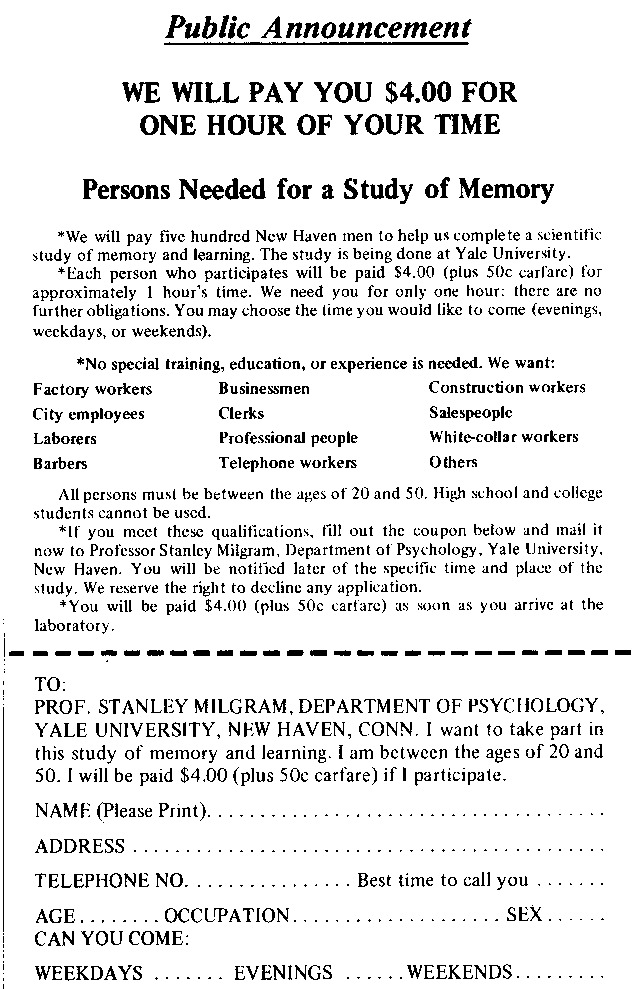
Visual AidThe advertisement that recruited ordinary people
Photograph of the newspaper advertisement used to recruit volunteers for Stanley Milgram’s obedience study at Yale in 1961. It matters because of what it does not say: it asks for ordinary people for a study of memory, and the people who answered it were not selected for cruelty or told what the hour would involve. That is the Knowledge Bank’s point — a majority went to the highest level, most of them sweating and protesting as they did. The notice is one page from one city, and the study has been argued over ever since. Notice the payment offered, and how unremarkable it is.
Newspaper advertisement recruiting participants for Stanley Milgram’s obedience experiment, Yale University, 1961. Source: Wikimedia Commons, file "Milgram Experiment advertising.gif", public domain.
1Claim: “Jonas is horrified to learn that ‘release’ means killing.” — choose the two details that best prove it.Claim & Evidence
2The comforting lie, or the terrible truth? Tap each item to sort it — tap again to switch sides. You can keep tapping to change your answer.Sort into two
◄ The comforting lieThe terrible truth ►
3Match each cause to its result. For each cause, pick its result.Cause & Effect
Jonas asks what release truly is→
The recording shows the newborn twin→
Jonas watches, horrified→
His father does it without knowing→
🧠Knowledge Bank question
4Fill both blanks to complete the reasoning.Build the Argument
The Knowledge Bank argues that Milgram's volunteers obeyed not from cruelty but because , which shows that .
Part 5
Standardized Test
Cohesion & TOEFL Insert Text — SAT & TOEFL-style practice
Read the passage — the highlighted words are tested — then answer. Tap an answer, then tap it again to confirm.
SATWords in Context — a word's meaning in this passage
SATInference — a conclusion the passage implies
SATRhetorical Purpose — why the author put a sentence there
SATCentral Ideas — the passage's main point
TOEFLFactual Information — a fact stated in the passage
Rosa Parks and the Bus Boycott
In December 1955, in Montgomery, Alabama, a seamstress named Rosa Parks boarded a city bus after work. The law of that city said Black passengers had to give up their seats to white passengers, and the driver ordered her to stand. Parks quietly refused. She was arrested for breaking the law — a law she believed was deeply unjust. She had harmed no one, and she considered herself innocent of any real wrongdoing.
Her arrest lit a fire: for 381 days, thousands of citizens walked to work rather than ride the buses, a peaceful protest remembered as the Montgomery Bus Boycott. Old and young, they shared cars, cycled, and crossed the city on foot through winter rain and summer heat, determined to keep going until the rule changed. Nearly the entire Black community took part, and the buses ran mostly empty for more than a year. Church groups organized carpools, some drivers offered free rides, and the lost fares put real pressure on the city. The boycott asked a hard question: what should a person do when the rules themselves are wrong?
Parks broke a law — yet today schools and streets across America carry her name. The courts eventually agreed with her, ruling that bus segregation was illegal. What one tired seamstress began, an entire city finished together. Her quiet “no” continues to inspire people who meet unfair rules anywhere in the world. The lesson is not that rules never matter; it is that a conscience must sometimes speak louder than a rulebook.
Original passage written for Garden Heights — not a quotation from the novel.
1According to the passage, what did the city’s law require?TOEFL · Factual Information
2In the passage, “determined” most nearly means —SAT · Words in Context
3How long did the bus boycott last?TOEFL · Factual Information
4In the passage, “innocent” most nearly means —SAT · Words in Context
5A “protest” is —SAT · Words in Context
6According to the passage, the boycott’s success mainly came from people acting —SAT · Inference
7According to the passage, the boycott was mainly carried out by —TOEFL · Factual Information
8What did the courts eventually rule?TOEFL · Factual Information
9Rosa Parks’s quiet stand mainly served to —SAT · Rhetorical Purpose
10Which sentence best states the passage’s lesson?SAT · Central Ideas
Part 6 · Optional
Creative Writing
A bonus challenge to practice your English. Take your time and have fun with it.
About This Section
This writing task is optional and is not part of your auto-graded score. The feedback below checks only the basics — length, spelling, and grammar — not whether your ideas are right or wrong. It is meant for classroom discussion and creative practice, so feel free to use your imagination!
Writing Task — Part 7 “Doing the Right Thing”
Jonas chooses to act against his Community because he believes it is wrong. Write about a time you stood up for what was right, or explain how a person can decide when a rule should be questioned. Write at least 40 words.
You can start with: “I believe it is right to question a rule when…”
0 / 40 words minimum
🗣 Teach It · Just for Fun (optional)
No right or wrong — close the screen and tell someone nearby what happened in this part. Can’t find anyone? Tell yourself out loud. The moment you teach it, you truly understand it.
Part 7 Complete!
You finished Chapters 19–20 of The Giver.
Here are your auto-graded results:
-
points out of 100
Teach it to someone
The best last step is to teach it. In your own words, explain what happened — retell a favorite scene, teach a character’s big choice, or sum up the main idea for a parent, friend, or classmate. When you can teach it clearly, you truly own it.
Independent study guide by Garden Heights Academy. Not affiliated with or endorsed by the author or any rights holders. Contains original analysis only; no text from the novel is reproduced.
SAT® is a registered trademark of College Board, which is not affiliated with, and does not endorse, these materials. TOEFL® is a registered trademark of ETS. These materials are not endorsed or approved by ETS. Garden Heights is an independent provider of test-style reading practice.