New here? Just sign up with Google — your account includes Matilda, our gift book, forever.
Hatchet · Garden Heights
Part 2
for Hatchet · Part 2 · Chapters 3–4
8 Parts40 min
What Happens in Part 2
Brian crash-lands the plane in a wilderness lake and survives his first terrifying night, realizing self-pity will not save him.
The crashWith the pilot dead, Brian flies on sheer instinct until the fuel runs out, then aims for a long, L-shaped lake and guides the plane down in a controlled crash. It tears through the trees and slams into the water; knocked unconscious, he fights out of the sinking cockpit and drags himself ashore, battered and half-drowned.
Taking stockNot badly broken but bruised, cut, swollen with insect bites, and sick with shock, Brian's mind circles back — the divorce, the Secret, a teacher's advice to stay positive and keep moving — and forward to a crushing truth: no one knows where he is, because the plane drifted far off its filed course before going down.
First nightNight falls, and it is nothing like darkness at home. Mosquitoes swarm him in clouds, every sound is a threat, and hunger and thirst begin their slow work. Alone in the wet dark, Brian weeps — and slowly begins to understand that self-pity will not save him. Only he can do that.
The lake as setting, vivid imagery, and Brian’s inner conflict
Cross-Curricular
How the body and mind respond to a survival crisis
Chapter Summary
Ch.
What happens
Chapter 3
The Crash — out of fuel, Brian brings the plane down in a controlled crash into an L-shaped lake, then fights free of the sinking cockpit and drags himself, injured, onto the shore.
Chapter 4
The First Night — battered and in shock, Brian relives the disaster, grasps that no one knows where he is, and endures a terrible first night of insects, fear, and tears.
Part 1
Vocabulary
Study 10 key words from Chapters 3–4, then answer each question.
💧Knowledge Bank · Ditching on the Water
Aviation & Survival · A Controlled Water LandingWhen an engine dies over the wilderness, a bush pilot’s last option is to ditch — the aviation term for bringing a powerless aircraft down onto water on purpose. Brian, with no training, does by instinct what pilots are taught: he keeps the nose up, holds the wings level, and aims for the longest, clearest stretch of the lake so the plane meets the surface flat rather than nose-first. Water looks soft from above, but at landing speed it strikes almost like a solid, and a plane that hits wing-low or nose-down can cartwheel and break apart. A float-less Cessna will not stay up for long, either; once the cabin fills, it sinks in seconds, which is why the moments right after impact decide everything. The single most dangerous part of any ditching is not the crash itself but the escape — freeing the belt, finding the door, and clawing to the surface before the cockpit is fully submerged.
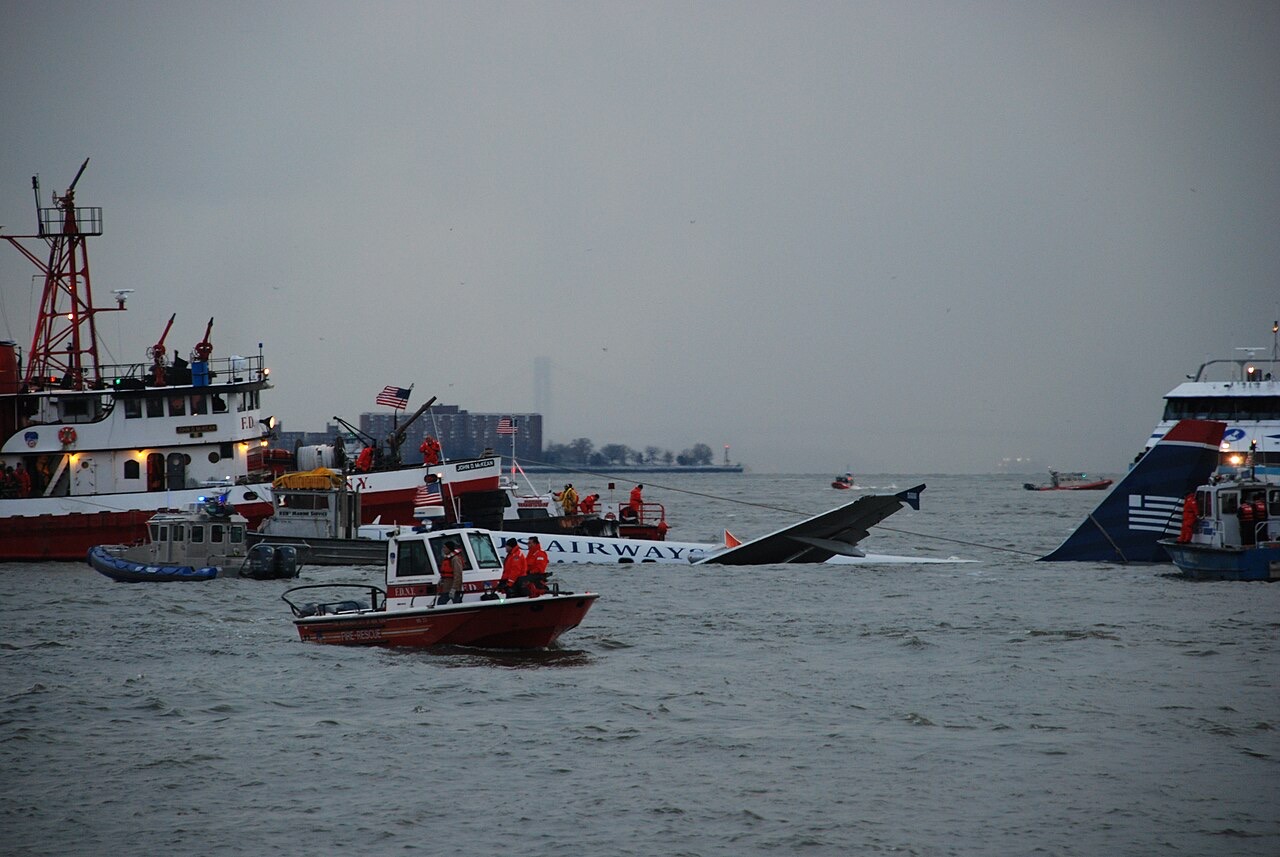
Visual AidA ditching that worked
Photograph taken on January 15, 2009, after US Airways Flight 1549 lost both engines and was ditched on the Hudson River in New York — nose up, wings level, on the longest clear stretch of water available: precisely the technique the Knowledge Bank describes. By the time this frame was taken, every one of the 155 people aboard was off safely and the flooding cabin was settling. The differences matter as much as the likeness: this was an airliner beside a city, with rescue boats alongside in minutes; Brian ditches a small bush plane on a wilderness lake with no witness at all, and his plane goes to the bottom. Notice how low a ‘successfully’ ditched aircraft already sits.
Rescue craft surround US Airways Flight 1549 in the Hudson River, New York, January 15, 2009; photograph by Chris Gardner, U.S. Army Corps of Engineers, New York District. Source: Wikimedia Commons, File:US Air Flight 1549 rescue efforts.jpg, public domain.
instinctn.Ch.3
A natural urge to act without thinking
“By pure instinct Brian pulled the plane’s nose up.”
submergev.Ch.3
To sink under the surface of water
“The cockpit began to submerge as the plane filled.”
controlledadj.Ch.3
Kept steady and under command
“He aimed for a controlled crash rather than a free fall.”
shockn.Ch.4
A numb, dazed state after a trauma
“Cold and shaking, Brian sank into shock on the shore.”
batteredadj.Ch.3
Badly bruised and beaten
“He crawled out battered but with no broken bones.”
despairn.Ch.4
A total loss of hope
“The dark forest filled him with despair.”
rationv.Ch.4
To use a small amount at a time
“He knew he would have to ration whatever he found.”
swarmv.Ch.4
To crowd around in a large mass
“Mosquitoes swarmed him the moment the sun set.”
endurev.Ch.4
To bear something hard without giving up
“Somehow he had to endure the first night.”
relivev.Ch.4
To experience a memory again
“He could not stop reliving the pilot’s death.”
ⓘ The vocabulary words in this list are selected to help you understand and complete this workbook. Some may not appear verbatim in the original novel.
🧠Knowledge Bank question
1According to the Knowledge Bank, the most dangerous part of ditching a plane is ___.Ch.3
2To ‘submerge’ something is to lift it high into the air.Ch.3
3A person in ‘shock’ feels ___.Ch.4
4To ‘ration’ supplies is to use a little at a time.Ch.4
5Fill in each blank with the correct word.Ch.4
Word choices:despairswarmcontrolledthrottle- some words will not be used
Clouds of mosquitoes began to around him.
The black forest filled him with .
6Something ‘battered’ is ___.Ch.3
7To ‘endure’ hardship is to ___.Ch.4
8A ‘controlled’ crash is one that is ___.Ch.3
9Fill in each blank with the correct word.Ch.3
Word choices:instinctsubmergereliveration- some words will not be used
Sheer told him to aim for the water.
He could not stop trying to the crash in his mind.
10To ‘relive’ a memory is to experience it again in your mind.Ch.4
Part 2
Comprehension
Show you understood what happens in Chapters 3–4.
🌡️Knowledge Bank · Cold, Shock, and the Body’s Alarm
Medicine · Hypothermia and the Rule of ThreesSoaked and shaking on the shore, Brian is fighting two hidden dangers at once. The first is shock — in medicine, a state in which the body, overwhelmed by injury or terror, pulls blood toward the core and leaves a person pale, cold, dazed, and slow to think. The second is hypothermia: once wet and exposed, the body loses heat far faster than it can make it, and water steals warmth roughly twenty-five times quicker than air. As the core cools, shivering starts, then clumsiness, then confusion — so at the very moment a survivor most needs to reason clearly, the cold is stealing that ability away. This is why survival experts rank shelter and warmth ahead of food, and even ahead of water, in the ‘rule of threes.’ Hunger is loud, but in the northern night it is exposure that can kill within hours, so the first task of almost anyone lost is to get dry and warm.
Visual AidWater steals warmth twenty-five times faster
Measure diagram of the single number the Knowledge Bank builds on: water carries heat away from a body roughly twenty-five times faster than air, so the two bars share one scale and the difference can be read directly. The figure is a rough working ratio — the real rate shifts with temperature and current — and the diagram does not measure Brian’s night on the shore; no thermometer was there. What to notice is the order underneath: shivering, clumsiness, confusion — the cold attacks judgment before it attacks life.
Heat loss in cold water, and the staged symptoms of hypothermia, as described by the U.S. National Weather Service and the American Red Cross. Drawn for Garden Heights Academy.
🧠Knowledge Bank question
1According to the Knowledge Bank, the 'rule of threes' ranks ___ as a lost person's most urgent need.Ch.3
2The plane finally comes down because it ___.Ch.3
3Brian escapes the sinking cockpit and reaches the shore.Ch.3
4Why does Brian realize no one knows where he is?Ch.4
5Write the numbers 1–5 in the boxes to show the correct order of events. Number 1 = what happens first.Chapters 3–4
He drags himself, injured, onto the shore.
The plane runs out of fuel over the forest.
He endures a terrible first night of insects and fear.
Brian steers a controlled crash into the lake.
He fights free of the sinking cockpit.
6Brian comes out of the crash with several clearly broken bones.Ch.3
7During the first night, Brian is tormented most by ___.Ch.4
8As he relives the past, Brian remembers a teacher who told him to ___.Ch.4
9By the end of Part 2, Brian understands that only he can save himself.Ch.4
10Brian’s biggest first task on the shore is to ___.Ch.4
Part 3
Literary Elements
Understanding HOW and WHY Gary Paulsen (author) tells the story across Chapters 3–4.
🎨Knowledge Bank · Making the Night Real: Imagery
Literary Craft · Sensory ImageryTo make Brian’s first night unbearable for the reader as well as for the boy, Paulsen leans on imagery — language built from sensory detail that lets us hear, feel, see, and even taste what a character does. He does not simply report that Brian was miserable; he fills the dark with the whine of mosquitoes, the sting of countless bites swelling the skin, the wet chill rising from the ground, and the black weight of a forest with no lights in it. Good imagery works because the brain reacts to vivid sensory words almost as if the events were happening to us, so we squirm at the insects and shiver at the cold. Notice that Paulsen favors touch and sound over sight here, exactly because Brian is trapped in darkness and cannot see — the writing narrows to the senses that still work. That careful choosing of details is what turns a plain sentence into an experience the reader can almost physically feel.
Setting
The L-shaped lake and its forest shore both provide for Brian and threaten him at every turn.
Imagery
Sensory writing — swarming mosquitoes, swollen bites, wet cold — makes the first night painfully real.
Internal conflict
Brian’s struggle is inside him: despair and self-pity against the stubborn will to survive.
🧠Knowledge Bank question
1The Knowledge Bank explains that Paulsen favors touch and sound in the night scene because ___.Ch.3
2Fill in each blank with the correct literary term.Ch.4
Word choices:imagerysettingrhymefootnote- some words will not be used
The swarming mosquitoes are vivid .
The L-shaped lake is the story’s .
3Imagery is language that appeals to the reader’s senses.Ch.4
4Brian’s fight between despair and the will to live is a kind of ___.Ch.4
5The clouds of mosquitoes on Brian’s skin are an example of ___.Ch.4
6Internal conflict is a struggle that takes place inside a character.Ch.4
7By making the lake both giver and threat, Paulsen shows that in the wild, place is nearly a ___.Ch.3
8Fill in each blank with the correct literary term.Ch.4
Word choices:internal conflictimageryclimaxsetting- some words will not be used
Brian’s battle with despair is an .
The wet cold and the bites are sharp .
9The setting of a story is only the year it takes place, never the place.Ch.3
10The clearest sign of Brian’s internal conflict is that he ___.Ch.4
Part 4
Think Deeper
Four deeper challenges — no single-word recall. Read, weigh the evidence, and reason it out.
💭Knowledge Bank · Stop, Think, Then Act
Psychology · The First Hours of Being LostSurvival instructors say the deadliest thing a lost person carries is not hunger or cold but panic — the flood of fear that makes people run blindly, waste energy, and make fatal mistakes in the first hours. Their standard advice is captured in a single word, STOP: Stop moving, Think, Observe your situation, and only then Plan. Brian lives out this lesson the hard way. At first he does what frightened people do — he cries, he rages at his situation, he sinks into self-pity, waiting for someone else to fix things. Then he remembers a teacher’s words about staying positive and keeping his mind moving, and something shifts. He begins to understand that feeling sorry for himself changes nothing, and that no rescuer is coming to do his thinking for him. The turn from reacting with raw emotion to reasoning calmly about the next small step is the true beginning of his survival, because in the wild a clear mind is the most important tool.
Imagine the plane skating down out of the sky, no engine now, only the hiss of wind, and a boy holding the wheel because there is no one else. It breaks through the treetops and strikes the lake, and the world goes to water and black. Somehow he claws upward, out of the flooding cockpit, and pulls his body onto muddy ground, where he lies shaking, too stunned even to be glad. Then night comes, and it is not the soft dark of a bedroom but a living thing — insects settling on every inch of him, small sounds circling in the trees, cold seeping up from the ground. He cries, because he is thirteen and alone and hurt. And then, somewhere in that misery, a harder thought arrives: no one is coming to help. If he is going to live, he will have to do it himself.
Original passage written for Garden Heights — not a quotation from the novel.
1Claim: “Part 2 shows that Brian’s hardest first battle is with his own mind, not with the wilderness.” — choose the two details that best prove it.Claim & Evidence
2The wilderness threatens him, or The wilderness provides for him? Tap each detail to sort it — tap again to switch sides. You can keep tapping to change your answer.Sort into two
◄ The wilderness threatens himThe wilderness provides for him ►
3Match each cause to its result. For each cause, pick its result.Cause & Effect
The fuel runs out→
The plane hits the lake→
The plane drifted off course→
Night falls with swarming insects→
🧠Knowledge Bank question
4Fill both blanks to complete the reasoning.Build the Argument
The Knowledge Bank calls panic the deadliest thing a lost person carries because , so Brian's real turning point comes when he .
Part 5
Standardized Test
Reading passage · The Body and Mind in a Survival Crisis · SAT & TOEFL-style practice
Read the passage — the highlighted words are tested — then answer. Tap an answer, then tap it again to confirm.
SATCentral Ideas — the passage's main point
SATDetail — a fact stated in the passage
SATInference — a conclusion the passage implies
SATWords in Context — a word's meaning in this passage
SATText Connections — how two parts of the text relate
TOEFLFactual Information — a fact stated in the passage
TOEFLProse Summary — the three sentences that sum it up
The Body's Fight or Flight Response
In the seconds after the plane strikes the water, Brian's body takes over before his thoughts can. This is not weakness or magic; it is instinct — an inborn reaction no one has to learn. When a person meets sudden, life-threatening danger, the brain triggers what scientists call the 'fight, flight, or freeze' response. A rush of the hormone adrenaline pours into the blood, the heart pounds faster, breathing speeds up, and energy floods the large muscles, so that for a short time a person acts with surprising strength. This emergency gear likely lets Brian claw up from the submerged cockpit before the sinking plane drags him down.
That burst of power fades, and what follows can be as dangerous as the crash. As the adrenaline drains away, many survivors fall into a state called shock. They may shiver even when they are not cold, feel sick or dizzy, and think slowly, as if through fog. Emotions surge without warning — terror, grief, and a heavy despair whispering nothing can be done. All of this is a normal reaction to an abnormal event, not cowardice, and it is exactly the fog and despair that grip Brian during his first terrible night.
The danger of shock is that it strikes in the hours when clear thinking matters most. Survival instructors therefore teach a simple rule for the first minutes of any crisis, remembered by the word STOP: Stop, Think, Observe, and Plan. Instead of running blindly or freezing, a survivor pauses, lets the panic pass, studies the situation, and chooses one action. It is a skill Brian must teach himself. His body kept him alive through the crash; now his hardest work is mental — calming his mind enough to think.
Original passage written for Garden Heights — not a quotation from the novel.
1What is the passage mainly about?SAT · Central Ideas
2The sudden danger response is called ___.TOEFL · Factual Information
3Which hormone floods the body in the crisis response?SAT · Detail
4The adrenaline surge most likely helps Brian ___.SAT · Inference
5After the surge fades, many survivors fall into ___.TOEFL · Factual Information
6According to the passage, shock is ___.SAT · Detail
7The letters in the word STOP stand for Stop, Think, Observe, and ___.TOEFL · Factual Information
8In the passage, instinct most nearly means ___.SAT · Words in Context
9Prose Summary (TOEFL).This passage explains how the body and mind respond to a sudden survival crisis. This TOEFL task lists six sentences; choose the THREE that best capture the passage’s main ideas. The other three do not belong — they state minor details or ideas the passage does not present.TOEFL · Prose Summary
10How does this passage best help explain Brian’s first night?SAT · Text Connections
Part 6 · Optional
Creative Writing
A bonus challenge to practice your English. Take your time and have fun with it.
About This Section
This writing task is optional and is not part of your auto-graded score. The feedback below checks only the basics — length, spelling, and grammar — not whether your ideas are right or wrong. It is meant for classroom discussion and creative practice, so feel free to use your imagination!
Writing Task — Part 2 “When Fear Took Over”
On the shore, Brian is swamped by shock and despair before he can think clearly. Write about a time strong feelings almost took over when you needed a clear head. What was the situation, how did your body and mind react, and how did you finally calm down? 6–10 sentences. End with one thing that helped you think again.
You can start with: “My heart was pounding and my thoughts would not slow down...”
0 / 40 words minimum
🗣 Teach It · Just for Fun (optional)
No right or wrong — close the screen and tell someone nearby what happened in this part. Can’t find anyone? Tell yourself out loud. The moment you teach it, you truly understand it.
Part 2 Complete!
You finished Chapters 3–4 of Hatchet.
Here are your auto-graded results:
-
points out of 100
Teach it to someone
The best last step is to teach it. In your own words, explain what happened — retell a favorite scene, teach a character’s big choice, or sum up the main idea for a parent, friend, or classmate. When you can teach it clearly, you truly own it.
Independent study guide by Garden Heights. Not affiliated with or endorsed by Gary Paulsen. Contains original analysis only; no text from the novel is reproduced. Reference text: This workbook follows Gary Paulsen’s classic text (the standard Puffin edition sold worldwide). Revised 2023 UK editions change some wording and may not match the vocabulary studied here.
SAT® is a registered trademark of College Board, which is not affiliated with, and does not endorse, these materials. TOEFL® is a registered trademark of ETS. These materials are not endorsed or approved by ETS. Garden Heights is an independent provider of test-style reading practice.