New here? Just sign up with Google — your account includes Matilda, our gift book, forever.
Hatchet · Garden Heights
Part 6
for Hatchet · Part 6 · Chapters 14–16
8 Parts40 min
What Happens in Part 6
The storm has raised the plane's tail above the lake, and Brian builds a raft to reach the survival pack inside.
After the stormBrian wakes in the wreckage of the storm, aching and discouraged, and slowly rebuilds what the tornado destroyed — his shelter, his fire, his sense of order. Then he sees it: out in the lake, the tail of the sunken plane juts above the surface, lifted and turned by the storm.
The ideaAt first the sight only reminds him of the dead pilot and the crash. But as he stares, a powerful thought works to the front of his mind: the plane was carrying gear. Inside that flooded fuselage should be a survival pack — food, tools, matches, maybe even a way to call for help. The idea grips him completely.
Building the raftReaching the plane is a serious problem: it lies in deep water, and the slick aluminum body is hard to enter. Brian sets a project worthy of the new Brian — a raft of dead logs lashed together, to pole out to the wreck. The work is slow, frustrating, and dangerous, the logs fighting him at every turn, but by the end he has a rough raft and a fixed purpose: get inside that plane and claim what it holds.
The survival pack as symbol, rising suspense, and Brian’s driving motivation
Cross-Curricular
Severe weather — how tornadoes form and the damage they do
Chapter Summary
Ch.
What happens
Chapters 14–15
After the Storm — Brian rebuilds his wrecked camp and notices the plane’s tail now rising from the lake, lifted by the tornado.
Chapter 16
Building the Raft — realizing the plane holds a survival pack, Brian decides to reach it and struggles to lash together a raft.
Part 1
Vocabulary
Study 10 key words from Chapters 14–16, then answer each question.
🛶Knowledge Bank · Why the Raft Floats
Physics · Buoyancy and Building a RaftTo reach the sunken plane Brian must build a raft, and whether it carries him depends on a principle called buoyancy. More than two thousand years ago the Greek thinker Archimedes worked out the rule: any object placed in water is pushed up by a force equal to the weight of the water it shoves aside. If an object is lighter than the water it displaces, it floats; if it is heavier, it sinks. This is why Brian is careful about which logs he chooses. Dry, dead wood is full of tiny air-filled spaces and weighs far less than the water it pushes away, so it rides high; a green, waterlogged log is heavy and barely floats at all. He must also lash the logs together tightly, because a raft is only as good as its bindings — loose logs roll, spill their rider, and drift apart. Understanding that shape and weight, not luck, keep a raft up is what finally lets Brian turn a pile of driftwood into something that will bear his weight.
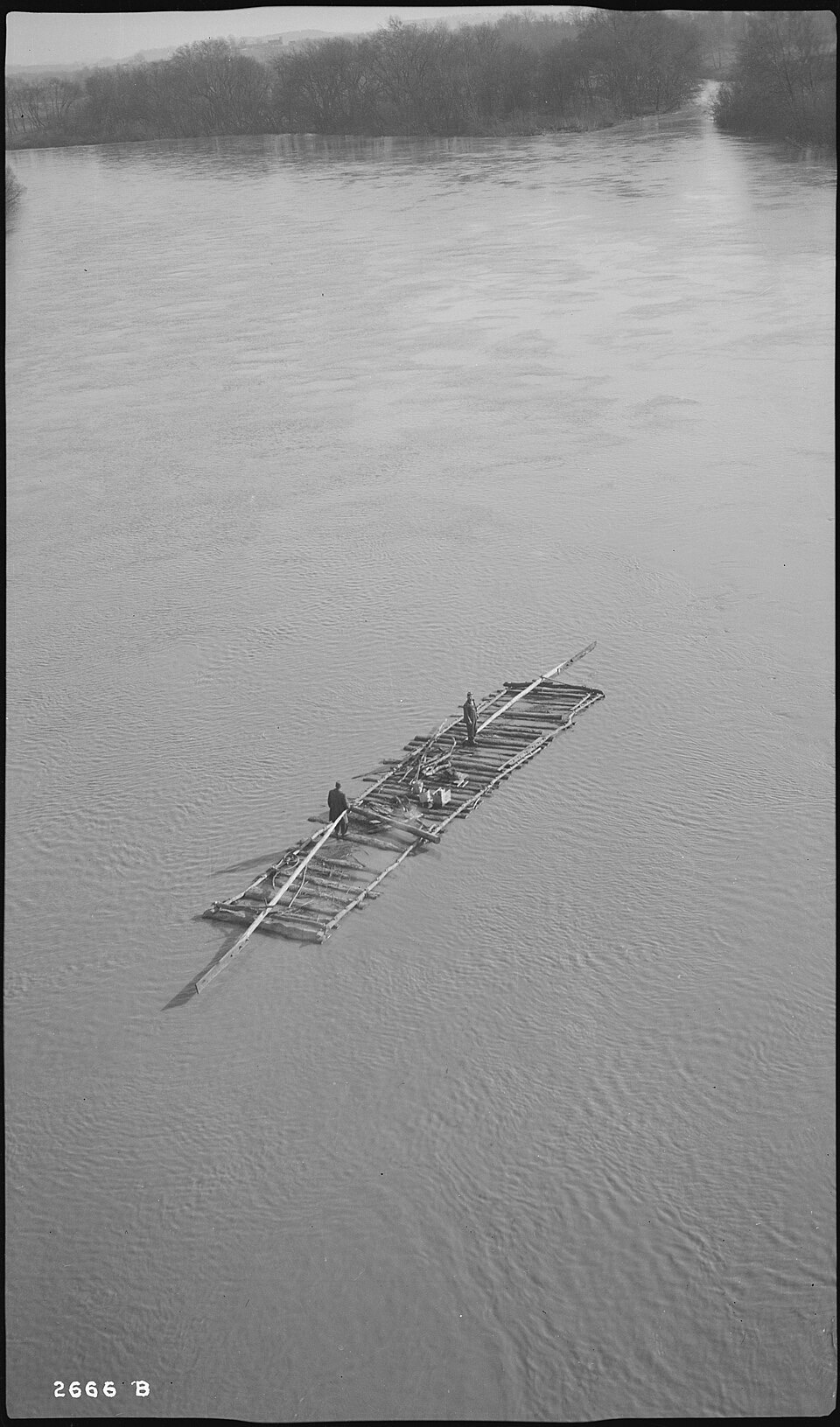
Visual AidA raft of lashed logs, working
Photograph, taken for the Tennessee Valley Authority in 1937, of two men riding a raft of lashed logs down the Holston River in Tennessee. Both principles the Knowledge Bank explains are visibly at work: the logs weigh less than the water they displace, so the raft carries two grown men and their gear, and cross-poles with tight lashings keep the logs from rolling apart — the exact failure Brian fights for days. The long poles at each end are steering sweeps, not paddles. This is a practiced crew’s raft on a working river; the drawing of Brian’s cruder one is left to the reader, because the novel never gives its shape.
Log raft on the Holston River, Tennessee, 1937; Tennessee Valley Authority photograph, U.S. National Archives (NARA 280210). Source: Wikimedia Commons, File:Log raft on Holston River - NARA - 280210.jpg, public domain.
debrisn.Ch.14
Scattered broken pieces
“The tornado left debris all across his camp.”
fuselagen.Ch.15
The main body of an aircraft
“The plane’s fuselage lay under the cold water.”
salvagev.Ch.15
To save from wreckage
“He hoped to salvage the pack from the plane.”
buoyantadj.Ch.16
Able to float
“Dead, dry logs are the most buoyant.”
lashv.Ch.16
To tie tightly with cord
“He tried to lash the logs into a raft.”
rebuildv.Ch.14
To build again after damage
“He had to rebuild the shelter the storm destroyed.”
projectn.Ch.16
A planned piece of work
“The raft became his hardest project yet.”
fixedadj.Ch.16
Firm and unchanging
“He held a fixed purpose to reach the plane.”
frustratev.Ch.16
To block and annoy
“The rolling logs frustrated him for days.”
currentn.Ch.16
Water moving in one direction
“He worried the current might push the raft off course.”
ⓘ The vocabulary words in this list are selected to help you understand and complete this workbook. Some may not appear verbatim in the original novel.
🧠Knowledge Bank question
1The Knowledge Bank explains that a dry, dead log is buoyant because ___.Ch.14
2The ‘fuselage’ is the main body of an aircraft.Ch.15
3To ‘salvage’ something is to ___.Ch.15
4Something that is ‘buoyant’ sinks quickly to the bottom.Ch.16
5Fill in each blank with the correct word.Ch.16
Word choices:lashcurrentdebristhrottle- some words will not be used
He would need to the logs together tightly.
He feared the might push the raft aside.
6To ‘rebuild’ is to build ___.Ch.14
7A ‘project’ is a planned piece of ___.Ch.16
8To ‘frustrate’ someone is to ___.Ch.16
9Fill in each blank with the correct word.Ch.15
Word choices:fuselagesalvagebuoyantlash- some words will not be used
The plane’s held the survival pack.
He hoped to what was trapped inside.
10A ‘fixed’ purpose is one that is firm and unchanging.Ch.16
Part 2
Comprehension
Show you understood what happens in Chapters 14–16.
🌊Knowledge Bank · Reading a Northern Lake
Environmental Science · Cold Water and Water SafetyBrian’s whole new plan depends on the lake, so it is worth understanding the water he means to cross. Northern boreal lakes are often deep, and even in summer the water below the thin, sun-warmed top layer stays shockingly cold. Sudden immersion in cold water triggers ‘cold-water shock’ — an involuntary gasp and a racing heart that can drown even strong swimmers in the first minute, before hypothermia is ever a factor. Wind matters too: an open lake has nothing to slow the wind, so it can whip up steep waves and push a raft off course in moments. A careful person reads these things before setting out — where the water is calm, how far the crossing really is, which way the wind is driving — because on cold, open water a small mistake becomes deadly fast. Brian cannot simply swim the heavy pack ashore, so he must respect the lake and plan a crossing that keeps him out of that killing water.
Visual AidA northern lake in section
Structure diagram of the water the Knowledge Bank warns about, drawn as a cut-away section: a thin, sun-warmed top layer over deep water that stays cold all year, with the wind running unchecked across the open surface. Nothing is to scale, real depths vary from shore to center, and the tidy boundary between layers is in truth a gradual change. The diagram makes no claim about Brian’s particular lake, which the novel never sounds. What to notice is the trap: the warmth a swimmer trusts is only skin-deep, and cold-water shock — the gasp, the racing heart — arrives in the first minute, long before hypothermia.
Summer stratification of boreal lakes, and cold-water shock, as described by the U.S. National Weather Service and Canadian water-safety authorities. Drawn for Garden Heights Academy.
🧠Knowledge Bank question
1According to the Knowledge Bank, cold-water shock can drown even strong swimmers ___.Ch.14
2What does Brian notice out in the lake after the storm?Ch.15
3Brian realizes the plane may hold a survival pack.Ch.15
4Brian believes the survival pack could hold ___.Ch.15
5Write the numbers 1–5 in the boxes to show the correct order of events. Number 1 = what happens first.Chapters 14–16
He spots the plane’s tail rising from the lake.
He realizes the plane holds a survival pack.
He rebuilds his shelter and fire.
He begins struggling to build a raft.
Brian wakes in the wreckage of the storm.
6Reaching the plane is quick and easy for Brian.Ch.16
7Brian’s plan for reaching the plane is to ___.Ch.16
8The raft is hard to build because the logs ___.Ch.16
9Brian gives up on reaching the plane by the end of Part 6.Ch.16
10By the end of Part 6, Brian has a raft and a ___.Ch.16
Part 3
Literary Elements
Understanding HOW and WHY Gary Paulsen (author) tells the story across Chapters 14–16.
⏳Knowledge Bank · The Art of Making Us Wait
Literary Craft · SuspensePaulsen knows exactly what the survival pack might mean — food, tools, maybe a way to call for help — and so does Brian, which is why Part 6 is built on suspense. Suspense is the tension a writer creates by making the reader want to know what happens next and then delaying the answer. The pack is close, just under the water, yet Paulsen refuses to let Brian reach it easily. First Brian must recover from the storm, then rebuild his wrecked camp, then wrestle for days with logs that keep rolling loose from his raft. Every one of these delays tightens the reader’s impatience, so that we lean forward, almost willing him to hurry. Skilled authors use this deliberately: the longer a payoff is postponed, the more we crave it, and the bigger the eventual moment feels. By stretching out the distance between wanting and having, Paulsen turns a simple errand — get the pack — into a chapter we cannot stop reading.
Symbol
The survival pack — standing for the lost world of civilization and the effort it will take to reach it.
Suspense
The tension of the delayed dive — the pack is near, yet Brian must rebuild, plan, and struggle first.
Motivation
The powerful want — food, tools, rescue — that drives Brian to build the raft and reach the wreck.
🧠Knowledge Bank question
1According to the Knowledge Bank, Gary Paulsen (author) turns the errand for the pack into a gripping chapter by ___.Ch.15
2Fill in each blank with the correct literary term.Ch.16
Word choices:suspensesymbolrhymeindex- some words will not be used
The tension of the delayed dive is .
The unseen survival pack is a .
3Suspense is the tension that makes a reader eager to know what happens next.Ch.16
4The powerful want that drives Brian to build the raft is his ___.Ch.16
5Paulsen slows the story with rebuilding and raft-work mainly to build ___.Ch.16
6A symbol can stand for more than one idea at the same time.Ch.15
7The survival pack ties together the old Brian and the ___ Brian.Ch.15
8Fill in each blank with the correct literary term.Ch.16
Word choices:motivationsuspensenarratorclimax- some words will not be used
Brian’s driving want is his .
The tense wait for the dive is .
9Motivation is the reason a character wants to act.Ch.16
10The clearest source of suspense in Part 6 is that the pack is ___.Ch.16
Part 4
Think Deeper
Four deeper challenges — no single-word recall. Read, weigh the evidence, and reason it out.
🧭Knowledge Bank · Turning Ruin into a Plan
Psychology · Adapting After DisasterThe morning after the tornado tests something deeper in Brian than his body. Everything he built is wrecked, and he has every reason to sink back into despair. Instead he rebuilds, and then does something new: he sets himself a bold goal — reach the plane and recover the pack. Psychologists who study people in extreme situations find that having a concrete purpose is one of the most powerful things that keeps a person going. A clear goal organizes scattered energy, pushes fear into the background, and turns endless empty days into a series of steps with a point. Until now Brian has mostly survived hour to hour, reacting to whatever the wilderness throws at him. The raft project changes that: for the first time he is planning ahead, working toward something he has chosen rather than merely enduring what happens to him. That shift — from reacting to reaching for a goal — is a quiet but real sign of how far he has grown.
Picture the morning after the storm: a boy standing in the ruins of everything he built, ribs aching, fire cold, tools flung into the brush. He could give up here. Instead he starts to rebuild, log by log, and while he works his eyes keep drifting to the lake — where something new breaks the flat water. The tail of the plane, lifted by the same wind that wrecked him, stands up now like a signpost. And a thought catches fire in his mind: there is gear in that plane, a survival pack, food and tools and maybe a voice to the outside world. Suddenly he is not just surviving from day to day; he has a mission. He drags dead logs to the shore and fights to bind them into a raft, and the raft fights back, and still he keeps on — because out there, just under the water, the old world is waiting to be reclaimed.
Original passage written for Garden Heights — not a quotation from the novel.
1Claim: “Part 6 shows that Brian’s survival now depends on planning and persistence, not luck.” — choose the two details that best prove it.Claim & Evidence
2A problem Brian must solve, or A resource that helps him? Tap each detail to sort it — tap again to switch sides. You can keep tapping to change your answer.Sort into two
◄ A problem Brian must solveA resource that helps him ►
3Match each cause to its result. For each cause, pick its result.Cause & Effect
The tornado passes over the lake→
Brian sees the raised tail→
The plane sits in deep water→
The logs keep rolling loose→
🧠Knowledge Bank question
4Fill both blanks to complete the reasoning.Build the Argument
The Knowledge Bank argues that the raft project marks real growth in Brian because , which shows that .
Part 5
Standardized Test
Reading passage · How Tornadoes Form · SAT & TOEFL-style practice
Read the passage — the highlighted words are tested — then answer. Tap an answer, then tap it again to confirm.
SATCentral Ideas — the passage's main point
SATDetail — a fact stated in the passage
SATWords in Context — a word's meaning in this passage
SATText Connections — how two parts of the text relate
TOEFLFactual Information — a fact stated in the passage
TOEFLProse Summary — the three sentences that sum it up
How a Tornado Forms
The storm that tears through Brian's camp and lifts the sunken plane is a tornado, one of the most violent events in nature. A tornado is a spinning column of air that reaches from the base of a thunderstorm down to the ground. Inside that narrow funnel, winds can whirl faster than a race car drives, fast enough to rip roofs from houses, uproot trees, and hurl broken debris through the air like toys. Tornadoes are usually small and short-lived, but within their path they are almost unbelievably powerful.
Tornadoes are born from a particular recipe of unstable air. They begin inside strong thunderstorms, where a rising current of warm, moist air pushes upward while cold, dry air sits above it. When winds at different heights blow at different speeds or directions — a condition weather scientists call wind shear — the rising air can start to roll, forming a hidden, horizontal tube of spinning air. If the storm's powerful updraft tilts that tube upright and stretches it, a rotating column can form and reach downward. The moment that spinning column touches the earth, it is officially a tornado.
What makes tornadoes so deadly is not only their power but their suddenness. They can form and strike in minutes, leaving little time to react, so learning to read the warning signs can save lives. People in tornado country watch for a heavy stillness in the air, a sky that turns an odd greenish color, a sudden roar of wind, and a low, dark wall of cloud. Brian, caught off guard, can only endure the storm. Yet the very wind that nearly kills him raises the plane he needs, a reminder that in nature destruction and opportunity often arrive together.
Original passage written for Garden Heights — not a quotation from the novel.
1What is the passage mainly about?SAT · Central Ideas
2A tornado is a spinning column of air reaching from a storm to the ___.TOEFL · Factual Information
3Winds inside a tornado can whirl faster than ___.TOEFL · Factual Information
4Tornadoes begin inside strong ___.SAT · Detail
5The condition of winds blowing differently at different heights is called ___.SAT · Detail
6In the passage, current most nearly means ___.SAT · Words in Context
7One warning sign of a tornado is a sky that turns ___.TOEFL · Factual Information
8In the passage, debris most nearly means ___.SAT · Words in Context
9Prose Summary (TOEFL).This passage explains what tornadoes are, how they form, and why they are so dangerous. This TOEFL task lists six sentences; choose the THREE that best capture the passage’s main ideas. The other three do not belong — they state minor details or ideas the passage does not present.TOEFL · Prose Summary
10How does this passage best help explain Brian’s story?SAT · Text Connections
Part 6 · Optional
Creative Writing
A bonus challenge to practice your English. Take your time and have fun with it.
About This Section
This writing task is optional and is not part of your auto-graded score. The feedback below checks only the basics — length, spelling, and grammar — not whether your ideas are right or wrong. It is meant for classroom discussion and creative practice, so feel free to use your imagination!
Writing Task — Part 6 “A Change That Cut Both Ways”
The same tornado that wrecks Brian’s camp also raises the plane he needs. Write about a hard event in your life that turned out to have a hidden good side. What happened, why did it seem bad at first, and what good came out of it? 6–10 sentences. End with what it taught you about hard times.
You can start with: “At first it felt like a disaster, but later I realized...”
0 / 40 words minimum
🗣 Teach It · Just for Fun (optional)
No right or wrong — close the screen and tell someone nearby what happened in this part. Can’t find anyone? Tell yourself out loud. The moment you teach it, you truly understand it.
Part 6 Complete!
You finished Chapters 14–16 of Hatchet.
Here are your auto-graded results:
-
points out of 100
Teach it to someone
The best last step is to teach it. In your own words, explain what happened — retell a favorite scene, teach a character’s big choice, or sum up the main idea for a parent, friend, or classmate. When you can teach it clearly, you truly own it.
Independent study guide by Garden Heights. Not affiliated with or endorsed by Gary Paulsen. Contains original analysis only; no text from the novel is reproduced. Reference text: This workbook follows Gary Paulsen’s classic text (the standard Puffin edition sold worldwide). Revised 2023 UK editions change some wording and may not match the vocabulary studied here.
SAT® is a registered trademark of College Board, which is not affiliated with, and does not endorse, these materials. TOEFL® is a registered trademark of ETS. These materials are not endorsed or approved by ETS. Garden Heights is an independent provider of test-style reading practice.