New here? Just sign up with Google — your account includes Matilda, our gift book, forever.
📚
Garden Heights Academy
Members sign in to continue.
Holes · Garden Heights Academy
Part 2
for Holes · Part 2 · Chapters 8–14 · Book Part One: “You Are Entering Camp Green Lake”
a novel by Louis Sachar
35 min5 Parts
This workbook is built on a solid pedagogical foundation, effectively integrating content and language learning based on the CLIL framework (Content and Language Integrated Learning), elevated by our unique 5th C — Connection — and an integrated Standardized Test section that weaves every SAT & TOEFL question type right into the novel, so learners build real test skills easily, naturally, and with fun.
💭 Before You Read · Just for Fun
No right or wrong answers — just think or chat about it: Have you ever given away something valuable just to fit in with a group? Did it work out? And when a person in charge suddenly gets very interested in something small, what does that make you suspect?
What Happens in Part 2
Stanley finds a gold tube, gives it away, and learns the Warden is hunting for something.
The yellow-spotted lizardsStanley learns how deadly Camp Green Lake can be when the yellow-spotted lizards are described. Water and shade are scarce, and the boys line up by seniority behind X-Ray.
A gold tubeDigging, Stanley uncovers a small gold tube marked K B. Hoping to win the older boys’ respect, he hands it to X-Ray instead of claiming it.
The Warden appearsWhen the tube is turned in, the Warden arrives, far too interested, and orders everyone to dig around that spot. Stanley earns his camp nickname, Caveman.
What We Will Learn
Literary Element
What It Means
Characterization
How a writer reveals what characters are like through their actions, words, and habits
Symbolism
When an object stands for a bigger idea — here, the gold tube
Irony
A gap between what is claimed and what is really true
Chapter Summary
Chapter
Key Events
Ch.8
The Yellow-Spotted Lizard — a frightening description: black teeth, white tongue, eleven yellow spots; a bite means death
Ch.9
A Hard Routine — Stanley toughens up; Mr. Sir, off cigarettes, chews sunflower seeds; water and shade are scarce
Ch.10
The Pecking Order — the boys line up for water by seniority, with the leader X-Ray first and Stanley and Zero last
Ch.11
The Gold Tube — Stanley digs up a small gold tube engraved with the letters ‘K B’
Ch.12
A Risky Gift — instead of turning it in, Stanley gives the tube to X-Ray to win the older boy’s favor
Ch.13
The Warden Appears — X-Ray hands the tube in; the Warden hurries out, strangely interested, and changes where they dig
Ch.14
‘Caveman’ — the boys accept Stanley with a nickname; everyone digs hard, hoping to find more for the Warden
Copyright Notice
Independent study guide by Garden Heights Academy. Not affiliated with or endorsed by Louis Sachar or the publisher. No text from the novel is reproduced. Students should read the original book.
Part 1
Vocabulary
Study 10 key words from Chapters 8–14, then answer each question.
🧠Knowledge Bank · Ghost Towns and Gila Monsters
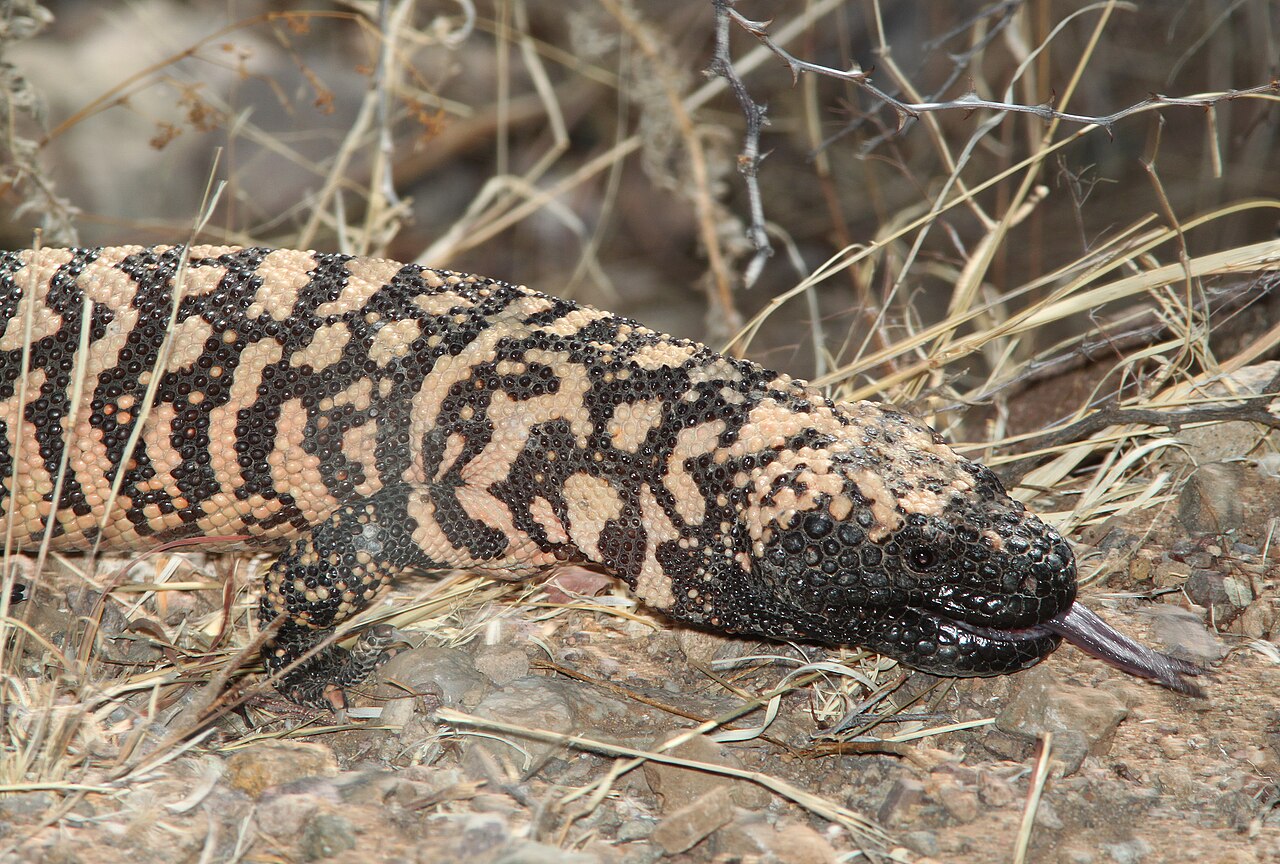
Desert Biology · Venomous LizardsTwo real things stand behind Part 2. The first is the abandoned town. Across the American Southwest, settlements really were emptied when a river shifted, a well failed, or a drought outlasted the money, and the maps still carry their names as ghost towns. The second is the camp’s most feared animal. The yellow-spotted lizard is Sachar’s invention, but venomous lizards do exist: the Gila monster of Arizona and northern Mexico delivers venom through grooved teeth in its lower jaw and holds on while the poison works. It is slow, it spends most of its life underground, and it bites almost only when handled or cornered. Both facts do the same job in the novel. Dry country punishes carelessness, and the creatures that outlast it do so by staying still, staying hidden, and spending as little energy as the heat will allow.
Visual AidA lizard that really is venomous
Photograph of the Gila monster, the venomous lizard the Knowledge Bank names. The beaded skin and the thick, low body belong to an animal that moves slowly and spends most of its life underground. This is a real species of the American Southwest; it is not the yellow-spotted lizard, which Sachar invented, and the picture claims nothing about how any lizard behaves in the novel. Notice the blunt head. The venom travels through grooved teeth in the lower jaw, so this animal bites and holds on rather than striking and letting go.
ⓘ Vocabulary words are selected to help you understand and complete this workbook. Some may not appear verbatim in the novel.
venomn.Ch.8
The poison some animals inject through a bite or sting
“The lizard’s venom could kill a grown man.”
lurkv.Ch.8
To wait hidden, ready to surprise or attack
“Lizards lurk in the cool shadows of empty holes.”
fangn.Ch.8
A long, sharp tooth used for biting
“Its black fangs flashed as it opened its mouth.”
seniorityn.Ch.10
A higher position earned by being somewhere longer
“Water was handed out in order of seniority.”
scarceadj.Ch.9
Hard to find; not enough to go around
“Shade was scarce, and water even scarcer.”
hierarchyn.Ch.10
An order of people ranked from highest to lowest
“X-Ray sat at the top of the tent’s hierarchy.”
engravev.Ch.11
To cut letters or a design into a hard surface
“The letters K B were engraved on the gold.”
summonv.Ch.13
To order someone to come
“Mr. Pendanski had to summon the Warden at once.”
grudgingadj.Ch.13
Given unwillingly, with reluctance
“She gave a grudging nod of approval.”
concealv.Ch.12
To hide something from view
“Stanley tried to conceal the tube in his pocket.”
🧠Knowledge Bank question
1According to the Knowledge Bank, how does a Gila monster deliver its venom?Ch.8
2To “lurk” means to wait hidden, ready to attack.Ch.8
3A long, sharp tooth used for biting is a —Ch.8
4Fill in each blank with the correct word.Ch.9–10
Word choices:scarceseniorityhierarchyvenom- some words will not be used
Water is at the camp.
The boys line up for it by .
5In a “hierarchy,” everyone has exactly equal rank.Ch.10
6The letters ‘K B’ were cut into the hard gold surface. They were —Ch.11
7Stanley first tries to hide the gold tube. To hide something is to —Ch.12
8To “summon” someone is to order them to come.Ch.13
9Fill in each blank with the correct word.Ch.13
Word choices:summongrudgingfangconceal- some words will not be used
Mr. Pendanski had to the Warden.
She gave only a nod.
10The order that ranks the boys from leader down to newest is the camp’s —Ch.10
Part 2
Comprehension
How well do you understand Chapters 8–14?
🧠Knowledge Bank · When Words Mean the Opposite
Language · Verbal IronyIrony, in its plainest form, is a gap between what is said and what is true, and Part 2 is built on one. Consider the name first. Green Lake holds no lake and nothing green; it is a white pan of cracked dirt. Then consider the official reason for the digging. The work is said to build character, a word that sounds like education and turns out to mean unpaid labor for a treasure hunt nobody has mentioned to the boys. This is verbal irony, and it is the favorite instrument of institutions rather than of villains. A cruel man says a cruel thing. A cruel system says a kind thing and does a cruel one, which is far harder for a child to argue against. Whenever gentle official language covers a plainly unfair arrangement, the language itself is worth reading as evidence.
Visual AidWhat is said against what is true
Table for the Knowledge Bank on verbal irony, setting the camp’s own words beside what the novel shows to be true. Three examples stand for many; the diagram leaves out the plot entirely and does not claim that pleasant language is always a lie. Notice that each phrase on the left would sound reasonable read on its own. That is the point: the gap only appears when the words are laid against the facts.
Wording drawn from the camp’s stated purpose and the events of Part 2. Drawn for Garden Heights Academy.
🧠Knowledge Bank question
1According to the Knowledge Bank, why is verbal irony the favorite instrument of institutions?Ch.8
2A bite from a yellow-spotted lizard is usually harmless.Ch.8
3Why is X-Ray always first in line for water?Ch.10
4What does Stanley dig up that turns out to be important?Ch.11
5Put these Part 2 events in the correct order. Write 1–4 (1 = first).Ch.11–13
X-Ray hands the tube in to Mr. Pendanski.
Stanley secretly gives the tube to X-Ray.
The Warden hurries out and has the boys dig around that spot.
Stanley digs up a small metal tube with initials on it.
6Stanley gives the gold tube to X-Ray to win the older boys’ respect.Ch.12
7How does the Warden react to the gold tube?Ch.13
8What nickname do the boys give Stanley?Ch.13–14
9Mr. Sir chews sunflower seeds because he is trying not to smoke.Ch.9
10The Warden’s strong interest in the gold tube is a clue that —Ch.13
Part 3
Literary Elements
Understanding HOW and WHY Sachar writes Chapters 8–14 the way he does.
🧠Knowledge Bank · A Clue With No Meaning Yet
Literary Craft · Symbol and MysteryA mystery works by controlling the order in which a reader learns things. Sachar gives Stanley a small gold tube stamped with two initials and then refuses to say what it is. That refusal is the craft. An object whose meaning is withheld collects possibilities, and every page a reader spends guessing is a page of attention the writer has earned rather than demanded. The tube does a second job as well. It changes the adults: the Warden appears within minutes, and her interest tells the reader more about this camp than any description could. When an object reveals character through the reactions it provokes, it has become a symbol as well as a clue. Notice too that Stanley gives it away. Handing the find to X-Ray is his first attempt to buy standing among the boys, and it costs him the only thing he had left to trade: leverage.
📚 Literary Devices in This Part · definitions & examples
Characterization is how a writer reveals what characters are like through their actions, words, and habits. Sachar shows the boys’ ranks and Mr. Sir’s seed-chewing this way.Symbolism is when an object stands for a bigger idea. The small gold tube is more than junk — it stands for a buried secret from long ago.Irony is a gap between what is claimed and what is really true. The camp says digging ‘builds character,’ but it is really a treasure hunt.
The questions below are mixed — not grouped by device. Decide which device each one is about.
🧠Knowledge Bank question
1According to the Knowledge Bank, what does the gold tube reveal before its meaning is known?Ch.10
2A symbol is an object that stands for something bigger than itself.Ch.11
3Fill in the blanks with the correct words.Ch.13
Word choices:ironyoppositerhymescarce- some words will not be used
A gap between claim and truth is called . The truth is the of what the camp says.
4The gold tube stands for a buried secret from the past. An object that stands for a bigger idea is a —Ch.11
5Irony is when the truth is the opposite of what is claimed or expected.Ch.2–13
6Fill in the blanks with the correct words.Ch.9–10
Word choices:characterizationactionsrhymevenom- some words will not be used
Showing what a character is like is . We learn it from their .
7The camp claims digging ‘builds character,’ but the Warden is really hunting treasure. This gap is called —Ch.13
8Characterization can be shown through a character’s actions and habits.Ch.9
9Fill in the blanks with the correct words.Ch.11
Word choices:symbolidearhymefang- some words will not be used
An object that stands for a bigger idea is a . The gold tube stands for a hidden from the past.
10The mystery of the gold tube and the Warden’s sudden reaction mainly create —Ch.11–13
Part 4
Think Deeper
Four deeper challenges — no single-word recall. Read, weigh the evidence, and reason it through.
🧠Knowledge Bank · Work Meant to Break You
US History · Convict LaborDigging a hole and then digging another one has a documented history in the United States. After the Civil War, Southern states leased convicts to private companies and worked them in mines, forests, and fields, and chain gangs remained legal well into the twentieth century. What historians stress is the purpose. Some of that labor produced roads and levees, but a great deal of it was designed mainly to exhaust and humiliate, on the theory that a broken will is an obedient one. Sachar takes the theory to its logical end. His boys produce nothing at all — a hole is the absence of something — and are told the emptiness is good for them. The novel poses a hard question about any punishment: when the work benefits the institution far more than the person performing it, whose interest is the sentence actually serving?
1Claim: “Stanley slowly toughens up and learns the camp’s harsh rules of survival.” — choose the two details that best prove it.Claim & Evidence
2Shows Stanley adapting to survive, or just a danger of the camp? Tap each item to sort it — tap again to switch sides. You can keep tapping to change your answer.Sort into two
◄ Stanley adaptingA danger of the camp ►
3Match each cause to its result. For each cause, pick its result.Cause & Effect
Stanley digs a hole every day→
The boys have a strict pecking order→
Water and shade are scarce→
Stanley finds a small gold tube→
🧠Knowledge Bank question
4Fill both blanks to complete the reasoning.Build the Argument
The Knowledge Bank argues that the digging echoes American convict labor because , which shows that .
Part 5
Standardized Test · Main Idea & Detail
Part 2 practices Main Idea and Detail reading — finding the central point and the exact facts that support it, the way the SAT and TOEFL do. Read the passage (the highlighted words are tested below), then choose the answer best supported by the text.
Read the passage — the highlighted words are tested — then answer. Tap an answer, then tap it again to confirm.
SATWords in Context — a word's meaning in this passage
SATInference — a conclusion the passage implies
TOEFLVocabulary — a tested word's meaning here
TOEFLFactual Information — a fact stated in the passage
TOEFLProse Summary — the three sentences that sum it up
TOEFLRhetorical Purpose — why the author included a detail
How Venom Attacks the Body
Many desert animals that lurk beneath rocks and sand defend themselves with venom — a mix of toxins an animal can inject through fangs or a sting. Venom is not a single substance but a complex cocktail of dozens of different proteins and enzymes working together. Unlike poison, which harms only if it is swallowed or touched, venom must be injected to work. Delivered straight into the bloodstream, it can begin to act within seconds. A single bite can be surprisingly potent, strong enough to stop prey far larger than the attacker.
Venom did not appear overnight. Over millions of years, snakes, spiders, and lizards slowly evolved chemicals that immobilize prey or deter enemies. Each species developed a distinct blend: some venoms attack the nerves, while others break down blood or muscle. Venom is costly for a body to make and therefore scarce, so animals rarely waste it. Most give a warning first — a rattle, a hiss, or a bright color — hoping to scare off a threat without a fight. Scientists now study these potent chemicals to build medicines, turning a perilous weapon into a tool that can endure as a lifesaver.
Original passage written for Garden Heights — not a quotation from the novel.
1In the passage, “lurk” most nearly means ___.SAT · Words in Context
2In the passage, the word “potent” is closest in meaning to —TOEFL · Vocabulary
3According to the passage, how is venom different from poison?TOEFL · Factual Information
4In the passage, “scarce” most nearly means ___.SAT · Words in Context
5According to the passage, why do many venomous animals give a warning first?TOEFL · Factual Information
6According to the passage, why do most venomous animals give a warning first?TOEFL · Factual Information
7Prose Summary (TOEFL).The passage explains what venom is and how animals use it. This TOEFL task lists six sentences; choose the THREE that best capture the passage’s main ideas. The other three do not belong — they state minor details or ideas the passage does not present.TOEFL · Prose Summary
8The passage most strongly suggests that scientists value venom because it can —SAT · Inference
9According to the passage, scientists study venom in order to —TOEFL · Factual Information
10The author ends by calling venom a “perilous” weapon that can endure as a lifesaver mainly to —TOEFL · Rhetorical Purpose
Part 6 · Optional
Creative Writing
A bonus challenge to practice your English.
About This Section
This writing task is optional and not part of your auto-graded score. Feedback checks length, spelling, and grammar only.
Writing Task — Part 2 “The Most Dangerous Thing at Camp”
Use vivid description to write a warning poster about the yellow-spotted lizard for new campers. What does it look like, and why should they fear it? Write at least 40 words.
You can start with: “WARNING! If you ever see a lizard with eleven yellow spots, you must…”
0 / 40 words minimum
🗣 Teach It · Just for Fun (optional)
No right or wrong — close the screen and tell someone nearby what happened in this part. Can’t find anyone? Tell yourself out loud. The moment you teach it, you truly understand it.
Part 2 Complete!
You finished Chapters 8–14 of Holes.
Here are your auto-graded results:
-
points out of 100
Teach it to someone
The best last step is to teach it. In your own words, explain what happened — retell a favorite scene, teach a character’s big choice, or sum up the main idea for a parent, friend, or classmate. When you can teach it clearly, you truly own it.
SAT® is a registered trademark of College Board, which is not affiliated with, and does not endorse, these materials. TOEFL® is a registered trademark of ETS. These materials are not endorsed or approved by ETS. Garden Heights is an independent provider of test-style reading practice.