New here? Just sign up with Google — your account includes Matilda, our gift book, forever.
📚
Garden Heights Academy
Members sign in to continue.
Holes · Garden Heights Academy
Part 3
for Holes · Part 3 · Chapters 15–21 · Book Part One: “You Are Entering Camp Green Lake”
a novel by Louis Sachar
35 min5 Parts
This workbook is built on a solid pedagogical foundation, effectively integrating content and language learning based on the CLIL framework (Content and Language Integrated Learning), elevated by our unique 5th C — Connection — and an integrated Standardized Test section that weaves every SAT & TOEFL question type right into the novel, so learners build real test skills easily, naturally, and with fun.
💭 Before You Read · Just for Fun
No right or wrong answers — just think or chat about it: Have you ever taken the blame for someone else to protect them? And have you ever taught someone a skill, or been taught one, as part of a trade? What did each of you gain from the deal?
What Happens in Part 3
Stanley takes the blame for spilled seeds, and Zero trades digging for reading lessons.
The spilled seedsMagnet steals Mr. Sir’s whole sack of sunflower seeds, and they spill into Stanley’s hole. Stanley takes the blame to protect the others.
What the Warden wantsHauled before the Warden, Stanley learns she does not care about the seeds at all — only whether he found anything valuable.
Rattlesnake nail polishWhen Mr. Sir complains, the Warden coolly scratches his face with her rattlesnake-venom nail polish, showing exactly how dangerous she is.
A trade with ZeroMeanwhile Zero offers to dig part of Stanley’s hole each day in exchange for reading lessons, and proves a quick, clever learner.
What We Will Learn
Literary Element
What It Means
Characterization
Revealing what characters are like through their actions — including the Warden’s cruelty
Conflict
A struggle a character faces — here, against the camp’s unfairness
Theme
A big idea that runs through the story — friendship and the power of reading
Chapter Summary
Chapter
Key Events
Ch.15
Getting Stronger — Stanley is fitter and faster now and no longer dreads each day quite so much
Ch.16
Sticky Fingers — Magnet steals Mr. Sir’s whole sack of sunflower seeds and passes it around
Ch.17
The Spilled Sack — the sack ends up with Stanley and spills into his hole; Stanley takes the blame to protect the others
Ch.18
Before the Warden — Mr. Sir drags Stanley to the Warden, but she only cares whether he found anything valuable
Ch.19
The Nail Polish — when Mr. Sir complains, the Warden scratches his face with her rattlesnake-venom nail polish
Ch.20
Zero’s Offer — Zero offers to dig part of Stanley’s hole each day if Stanley will teach him to read
Ch.21
Reading Lessons — Stanley teaches Zero letters and words; Zero proves a quick learner, especially at maths
Copyright Notice
Independent study guide by Garden Heights Academy. Not affiliated with or endorsed by Louis Sachar or the publisher. No text from the novel is reproduced. Students should read the original book.
Part 1
Vocabulary
Study 10 key words from Chapters 15–21, then answer each question.
🧠Knowledge Bank · Unschooled Is Not Unintelligent
Social Science · Children Out of SchoolZero cannot read, and the novel is careful about why. He has never been taught. United Nations figures put the number of children worldwide who are out of school in the hundreds of millions, and the reasons cluster: poverty, housing that keeps moving, work that cannot be skipped, and schools that quietly give up on a child who arrives behind. Literacy is not a talent that appears on its own. It is an instructed skill, and a child who is never instructed will not acquire it, however quick their mind may be. Sachar makes the point unmistakable by giving Zero the fastest arithmetic in the camp. He calculates in his head faster than boys who call him stupid, which separates two things adults constantly confuse — what a person has been taught, and what a person is able to learn.
ⓘ Vocabulary words are selected to help you understand and complete this workbook. Some may not appear verbatim in the novel.
endurev.Ch.15
To suffer something hard patiently
“Stanley learned to endure the long, hot days.”
sturdyadj.Ch.15
Strong and not easily hurt or broken
“His arms had grown sturdy from digging.”
pilferv.Ch.16
To steal small things
“Magnet could pilfer almost anything with his quick fingers.”
reluctantadj.Ch.17
Unwilling; hesitating to act
“Stanley was reluctant to get the others in trouble.”
venomousadj.Ch.19
Full of poison; also very spiteful
“Her venomous nail polish could sting like a snakebite.”
wincev.Ch.19
To flinch or make a face from pain
“Mr. Sir winced as the scratch began to burn.”
illiterateadj.Ch.20
Unable to read or write
“Zero had grown up illiterate, with no one to teach him.”
bargainn.Ch.20
A deal in which each side gives something
“They struck a fair bargain: lessons for digging.”
diligentadj.Ch.21
Hard-working and careful
“Zero was a diligent student who never gave up.”
humiliatev.Ch.18
To make someone feel deeply ashamed
“Mr. Pendanski liked to humiliate Zero in front of the others.”
🧠Knowledge Bank question
1According to the Knowledge Bank, what does Zero's fast arithmetic prove about an illiterate learner?Ch.15
2To “endure” hardship means to give up at once.Ch.15
3Magnet steals small things with his quick fingers. To steal small things is to —Ch.16
4Fill in each blank with the correct word.Ch.17–20
Word choices:reluctantsturdybargainwince- some words will not be used
Stanley was to blame the others.
Later he and Zero made a fair .
5Something “venomous” is full of poison.Ch.19
6When the venom scratch burns, Mr. Sir flinches with pain. To flinch from pain is to —Ch.19
7Zero cannot read or write. He is —Ch.20
8A “bargain” is a deal in which each side gives something.Ch.20
9Fill in each blank with the correct word.Ch.18–21
Word choices:diligenthumiliateilliteratepilfer- some words will not be used
Zero is a learner.
Mr. Pendanski tries to him.
10To suffer the camp’s hard work patiently is to —Ch.15
Part 2
Comprehension
How well do you understand Chapters 15–21?
🧠Knowledge Bank · An Idea That Keeps Returning
Language · MotifA motif is a detail a writer brings back until it begins to carry meaning. Here the returning detail is the family curse, blamed for every misfortune the Yelnatses suffer and repeated so often that it has become a household joke. The joke does two jobs at once. Inside the family it converts bad luck into a story, which is easier to live with than randomness, because a curse at least supplies a reason. For the reader it works as stitching, since each mention pulls the present-day camp back toward a village in Latvia more than a century earlier. Motifs differ from ordinary repetition in that they accumulate. The tenth mention of the curse means more than the first because nine mentions stand behind it, and a book that keeps circling one idea is usually a book whose whole plot is that idea being finally settled.
Visual AidEach time the curse comes back
Diagram for the Knowledge Bank on motif. The five rising columns stand for meaning gathering as a detail returns; they are not a measurement, and the heights do not count pages, mentions or anything else. It does not claim that every repeated word is a motif. Notice that only the position changes what the detail means: the first mention can be a joke because nothing yet stands behind it.
Pattern taken from the recurrence of the family curse across the novel. Drawn for Garden Heights Academy.
🧠Knowledge Bank question
1According to the Knowledge Bank, what does the family curse give the Yelnatses that randomness cannot?Ch.16
2Stanley takes the blame for the spilled sunflower seeds to protect the other boys.Ch.17
3When Stanley is brought before the Warden, what does she actually care about?Ch.18
4The Warden scratches Mr. Sir with nail polish made with rattlesnake venom.Ch.19
5Put these Part 3 events in the correct order. Write 1–4 (1 = first).Ch.16–20
The Warden scratches Mr. Sir with her venom nail polish.
Zero offers to dig for Stanley in return for reading lessons.
Magnet steals Mr. Sir’s sack of sunflower seeds.
The sack spills into the hole Stanley is digging and he takes the blame.
6What deal do Stanley and Zero make?Ch.20
7Zero already knows how to read very well.Ch.20
8What is Zero surprisingly good at?Ch.21
9The Warden is gentle and kind to the guards and the boys.Ch.19
10What does the Warden’s reaction to the seed theft reveal?Ch.18
Part 3
Literary Elements
Understanding HOW and WHY Sachar writes Chapters 15–21 the way he does.
🧠Knowledge Bank · Friendship as Resistance
Literary Craft · Conflict and ThemePart 3 turns the camp’s cruelty into a test of character rather than of endurance. Stanley takes the blame for the spilled sunflower seeds, and the choice costs him an hour in front of the Warden for something he did not do. Sachar is separating two kinds of conflict. There is the obvious one, a boy against a hostile place, and a quieter one in which the boys are set against each other by ranking, nicknames, and the small privileges of seniority. The camp runs on that second conflict, because a group that polices itself is cheap to control. Against it, the arrangement between Stanley and Zero — digging traded for reading lessons — is a genuine act of resistance, since two boys deciding to be useful to each other undoes precisely what the system depends on. That is where the novel locates its theme.
📚 Literary Devices in This Part · definitions & examples
Characterization is revealing character through actions. The venom nail polish reveals the Warden’s cold cruelty in a single moment.Conflict is a struggle a character faces. Stanley struggles against the camp’s unfairness and the older boys’ jealousy.Theme is a big idea that runs through a story. Stanley teaching Zero to read points to ideas about friendship and the power of learning.
The questions below are mixed — not grouped by device. Decide which device each one is about.
🧠Knowledge Bank question
1According to the Knowledge Bank, why does the camp benefit from ranking the boys against each other?Ch.19
2Conflict can be between a character and the unfair people or rules around them.Ch.17–21
3Fill in the blanks with the correct words.Ch.21
Word choices:themeidearhymefang- some words will not be used
A story’s big idea or message is its . Friendship and learning are each a big here.
4Stanley struggles against the camp’s unfairness and the boys’ jealousy. A struggle like this is called —Ch.17
5A theme is a big idea or message that runs through a story.Ch.20–21
6Fill in the blanks with the correct words.Ch.19
Word choices:characterizationcruelrhymevenom- some words will not be used
Revealing character through actions is . The Warden’s act shows exactly who she is.
7Stanley teaching Zero to read points to a big idea about friendship and learning. A story’s big idea is its —Ch.21
8A single cruel action can reveal a lot about a character.Ch.19
9Fill in the blanks with the correct words.Ch.17
Word choices:conflictstrugglerhymebargain- some words will not be used
A struggle a character faces is a . Stanley must against the camp’s unfairness.
10Stanley growing stronger, braver, and kinder over these chapters makes him a —Ch.15
Part 4
Think Deeper
Four deeper challenges — no single-word recall. Read, weigh the evidence, and reason it through.
🧠Knowledge Bank · A Schoolhouse and a Color Line
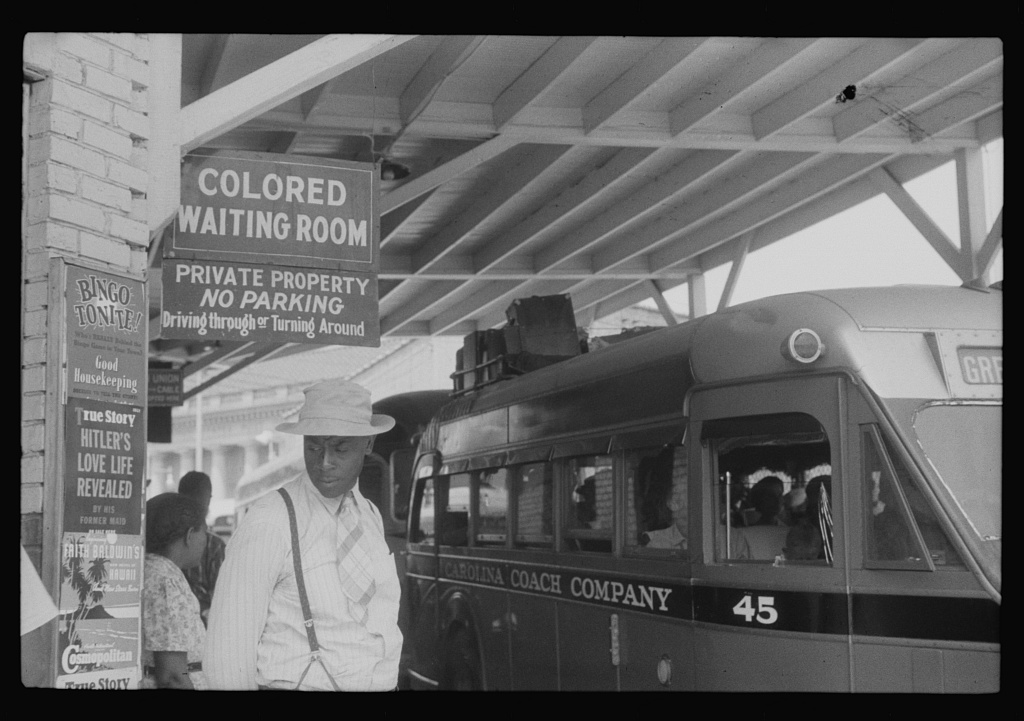
US History · Segregation in TexasThe Green Lake flashback is set inside a real legal world. From the 1890s onward, Southern and Southwestern states wrote segregation into law: separate schools, separate railcars, separate almost everything, upheld by the Supreme Court in 1896 and not overturned until 1954. Texas was among them. Laws forbidding marriage across the color line stood on the books as well, and enforcement came as often from mobs as from courts — lynching records for Texas in that period run into the hundreds, and prosecutions were rare. Sam’s death is written against that record rather than invented for shock. Notice what the town does afterward. It punishes nobody and simply carries on, and the novel lets the drought stand as the consequence the town would never impose on itself. A community that refuses to name its own crime tends to keep paying for it in ways it will not connect.
Visual AidSeparate by law
Photograph taken at a bus station in Durham, North Carolina in 1940, during the years the Knowledge Bank describes. The sign is the whole point: separate rooms, ordered by law rather than by choice. This is North Carolina, not the Texas town of the flashback, and the photograph records one station on one day — it does not stand for every place or every person in it. Notice that the sign is ordinary, weathered and permanently hung. Segregation was not an outburst; it was the everyday furniture of a state.
Bus station waiting-room sign, Durham, North Carolina, 1940; Farm Security Administration collection, US Library of Congress. Source: Wikimedia Commons, file "At the bus station in Durham, North Carolina" (1940).jpg, public domain.
1Claim: “Stanley shows real loyalty by protecting the other boys.” — choose the two details that best prove it.Claim & Evidence
2Shows Stanley’s friendship with Zero, or the Warden’s cruelty? Tap each item to sort it — tap again to switch sides. You can keep tapping to change your answer.Sort into two
◄ Friendship with ZeroThe Warden’s cruelty ►
3Match each cause to its result. For each cause, pick its result.Cause & Effect
Zero digs part of Stanley’s hole→
Magnet steals the seeds→
Stanley takes the blame→
The Warden wants results→
🧠Knowledge Bank question
4Fill both blanks to complete the reasoning.Build the Argument
The Knowledge Bank argues that Sam's death is drawn from the record rather than invented because , which shows that .
Part 5
Standardized Test · Factual, Negative Factual & Inference
Part 3 practices Factual and Negative Factual (NOT/EXCEPT) reading plus Inference — skills the SAT and TOEFL use to test careful reading. Read the passage (the highlighted words are tested below), then choose the answer best supported by the text.
Read the passage — the highlighted words are tested — then answer. Tap an answer, then tap it again to confirm.
SATWords in Context — a word's meaning in this passage
SATInference — a conclusion the passage implies
TOEFLFactual Information — a fact stated in the passage
TOEFLNegative Factual — the statement the passage does NOT support
Why Reading Is Not Instinctive
Reading is not something the human brain is born knowing. Writing itself is only a few thousand years old — far too recent for our brains to have evolved a dedicated reading center of their own. Unlike speaking, which children acquire naturally, reading must be taught, letter by letter and sound by sound. For an illiterate beginner of any age, the first steps can feel immense, but progress comes with steady, diligent practice. Scientists have found that learning to read actually reshapes the brain, building new links between the areas that handle sight and sound. This change is gradual: a learner who persists a little each day slowly turns strings of letters into words, and words into meaning — a genuinely complex skill.
Older beginners can succeed just as well as young ones. The benefits are distinct and lasting. A person who learns to read gains information, independence, and confidence. In a written world, this single skill quietly shapes a person's work, health, and daily choices for a lifetime. Studies show that adults who endure the hard early stage rarely regret it; once gained, the skill does not fade, and it opens doors that had long stayed shut.
Original passage written for Garden Heights — not a quotation from the novel.
1In the passage, “illiterate” most nearly means ___.SAT · Words in Context
2According to the passage, who can succeed at learning to read?TOEFL · Factual Information
3According to the passage, unlike speaking, reading —TOEFL · Factual Information
4In the passage, “diligent” most nearly means ___.SAT · Words in Context
5According to the passage, all of the following are true EXCEPT —TOEFL · Negative Factual
6As used in the passage, the word “benefits” most nearly means —SAT · Words in Context
7According to the passage, learning to read changes the brain by —TOEFL · Factual Information
8The passage most strongly suggests that an adult who cannot read —SAT · Inference
9The passage most strongly suggests that learning to read is worth the effort because the skill —SAT · Inference
10Why does the passage mention “doors that had long stayed shut”?SAT · Inference
Part 6 · Optional
Creative Writing
A bonus challenge to practice your English.
About This Section
This writing task is optional and not part of your auto-graded score. Feedback checks length, spelling, and grammar only.
Writing Task — Part 3 “An Unfair Place”
Stanley takes the blame to protect his friends. Write about a time a character (real or imagined) did something kind or brave even though it cost them. Why did they do it? Write at least 40 words.
You can start with: “It would have been easier to stay silent, but instead I…”
0 / 40 words minimum
🗣 Teach It · Just for Fun (optional)
No right or wrong — close the screen and tell someone nearby what happened in this part. Can’t find anyone? Tell yourself out loud. The moment you teach it, you truly understand it.
Part 3 Complete!
You finished Chapters 15–21 of Holes.
Here are your auto-graded results:
-
points out of 100
Teach it to someone
The best last step is to teach it. In your own words, explain what happened — retell a favorite scene, teach a character’s big choice, or sum up the main idea for a parent, friend, or classmate. When you can teach it clearly, you truly own it.
SAT® is a registered trademark of College Board, which is not affiliated with, and does not endorse, these materials. TOEFL® is a registered trademark of ETS. These materials are not endorsed or approved by ETS. Garden Heights is an independent provider of test-style reading practice.