New here? Just sign up with Google — your account includes Matilda, our gift book, forever.
📚
Garden Heights Academy
Members sign in to continue.
Holes · Garden Heights Academy
Part 4
for Holes · Part 4 · Chapters 22–28 · Book Part One: “You Are Entering Camp Green Lake”
a novel by Louis Sachar
35 min5 Parts
This workbook is built on a solid pedagogical foundation, effectively integrating content and language learning based on the CLIL framework (Content and Language Integrated Learning), elevated by our unique 5th C — Connection — and an integrated Standardized Test section that weaves every SAT & TOEFL question type right into the novel, so learners build real test skills easily, naturally, and with fun.
💭 Before You Read · Just for Fun
No right or wrong answers — just think or chat about it: Sometimes a story reaches far into the past to explain the present. Do you think something unfair that happened long ago can still affect people today? And have you ever seen someone kind and patient finally pushed too far?
What Happens in Part 4
A flashback explains why Green Lake dried up. Zero runs away into the desert.
Green Lake long agoA long flashback tells of Green Lake 110 years ago, when it held real water.
Katherine and SamThe beloved teacher Miss Katherine Barlow loves Sam the onion man, but the town will not accept a Black man and a white woman together. They burn the school and kill Sam.
Kissin’ Kate BarlowHeartbroken, Katherine becomes the outlaw Kissin’ Kate Barlow, robs Stanley’s great-grandfather, and buries her treasure. The rain stops falling on Green Lake forever.
Zero runsBack in the present, jealousy and Mr. Pendanski’s cruelty push Zero to snap and run away into the desert alone.
What We Will Learn
Literary Element
What It Means
Flashback
A scene that jumps back to an earlier time — here, Green Lake 110 years ago
Theme
A big idea — injustice and how cruelty harms a whole community
Conflict
A struggle — against an unjust society, and Zero against the camp
Chapter Summary
Chapter
Key Events
Ch.22
Green Lake Long Ago — a flashback: 110 years earlier, Green Lake was the largest lake in Texas, and Miss Katherine Barlow was the town’s loved teacher
Ch.23
Sam the Onion Man — Sam, a kind Black man, sells onions and can ‘fix’ anything; he and Miss Katherine fall in love
Ch.24
A Forbidden Love — the town turns violent because a Black man and a white woman cannot be together; the school is burned and Sam is killed
Ch.25
Kissin’ Kate Barlow — heartbroken, Katherine becomes a feared outlaw; the rain stops and the lake begins to dry up
Ch.26
The Buried Loot — Kate robs Stanley’s great-grandfather, the first Stanley Yelnats, and buries her treasure at Green Lake
Ch.27
Back at Camp — in the present, the reading deal angers the other boys, and Mr. Pendanski cruelly humiliates Zero
Ch.28
Zero Runs Away — pushed too far, Zero hits Mr. Pendanski with a shovel and runs off alone into the empty desert
Copyright Notice
Independent study guide by Garden Heights Academy. Not affiliated with or endorsed by Louis Sachar or the publisher. No text from the novel is reproduced. Students should read the original book.
Part 1
Vocabulary
Study 10 key words from Chapters 22–28, then answer each question.
🧠Knowledge Bank · Why Mountains Make Deserts
Earth Science · Rain ShadowDeserts are not simply places far from water. Many of them are places standing behind a mountain. Moist air blown inland is forced upward when it meets a range, and rising air cools. Cool air holds less water vapor, so the moisture condenses and falls as rain on the windward slope. The air that finally crosses the ridge has been wrung out, and it warms and dries again as it descends the far side. The dry belt this produces is a rain shadow, and it explains the deserts lying east of the Sierra Nevada and the Andes alike. The formation the characters call God’s Thumb runs on the same physics in miniature: a high point catches what little moisture the air still carries, holds it in soil and rock, and supports plants the flat basin below cannot. In a rain shadow, elevation is another word for water.
Visual AidWhy a mountain makes a desert behind it
Cross-section for the Knowledge Bank on rain shadow. The ridge is drawn as a plain section, not as a picture of any particular mountain, and the slopes are not to scale. It shows one cause of desert and does not claim to explain every dry place on Earth. Notice that the same air crosses both sides. Nothing is added on the right; what changes is that the water has already been taken out on the left.
Standard orographic rain-shadow section as described in introductory physical geography. Drawn for Garden Heights Academy.
ⓘ Vocabulary words are selected to help you understand and complete this workbook. Some may not appear verbatim in the novel.
prejudicen.Ch.24
An unfair, hostile opinion about people, often because of race
“The town’s prejudice would not allow Sam and Katherine to be together.”
outlawn.Ch.25
A criminal on the run from the law
“Katherine became the most feared outlaw in Texas.”
heartbrokenadj.Ch.25
Crushed by terrible grief
“Heartbroken, she could no longer bear to teach.”
vowv.Ch.25
To make a serious promise
“She made a silent vow of revenge.”
droughtn.Ch.25
A long period with no rain at all
“A drought began that would last more than a hundred years.”
notoriousadj.Ch.25
Famous for something bad
“Kissin’ Kate Barlow was notorious across the West.”
lootn.Ch.26
Stolen money or goods
“She buried her loot somewhere beneath the lake.”
tauntv.Ch.27
To tease cruelly in order to provoke someone
“Mr. Pendanski liked to taunt Zero about being stupid.”
fleev.Ch.28
To run away from danger
“Zero decided to flee into the open desert.”
desperateadj.Ch.28
Driven to act recklessly by great need or fear
“A desperate Zero swung the shovel and ran.”
🧠Knowledge Bank question
1According to the Knowledge Bank, what causes the dryness on the far side of a mountain range?Ch.24
2An “outlaw” is a law-abiding citizen.Ch.25
3After Sam is killed, Katherine is crushed by grief. She is —Ch.25
4Fill in each blank with the correct word.Ch.25
Word choices:droughtvowlootoutlaw- some words will not be used
After Sam’s death the rain stops and a long begins.
Kate becomes a feared .
5Someone “notorious” is famous for something bad.Ch.25
6The stolen money and goods Kate buries are her —Ch.26
7Mr. Pendanski cruelly teases Zero to provoke him. To tease cruelly is to —Ch.27
8To “flee” means to run away from danger.Ch.28
9Fill in each blank with the correct word.Ch.25–28
Word choices:vowdesperateprejudicetaunt- some words will not be used
Kate made a silent of revenge.
Years later, a Zero runs away.
10A long period with no rain at all is a —Ch.25
Part 2
Comprehension
How well do you understand Chapters 22–28?
🧠Knowledge Bank · Three Stories Side by Side
Language · Parallel StructureMost novels tell one story and let the past arrive as explanation. This one runs three: Stanley at the camp, Katherine Barlow’s Green Lake more than a century earlier, and Elya Yelnats in Latvia before that. Arranging separate narratives so that they echo one another is parallel structure, and the technique makes a real demand of a reader — hold three sets of names, and wait. Payment comes in the form of recognition. A broken promise in the oldest strand, a killing in the middle one, and a boy digging in the present are eventually revealed as one event stretched across generations rather than three coincidences. Sachar signals the links with objects instead of explanations: onions, peaches, a mountain, a surname. When a book keeps jumping in time, the jumps are rarely wandering. They are a pattern the ending will ask you to see.
🧠Knowledge Bank question
1According to the Knowledge Bank, how does Sachar signal the links between his three time periods?Ch.22
2Sam the onion man is known for saying ‘I can fix that.’Ch.23
3Why does the town turn violent against Sam and Katherine?Ch.24
4After Sam is killed, it never rains on Green Lake again.Ch.25
5Put these Part 4 events in the correct order. Write 1–4 (1 = first).Ch.22–28
Kate robs a rich traveler and buries her loot.
In the present, Zero hits Mr. Pendanski and runs away.
The town kills Sam, and Katherine becomes Kissin’ Kate Barlow.
Miss Katherine Barlow and Sam the onion man fall in love.
6What does Katherine become after Sam’s death?Ch.25
7Whom does Kate Barlow rob?Ch.26
8The reading deal makes the other D-tent boys jealous and resentful.Ch.27
9Why does Zero finally run away?Ch.28
10Zero runs away into a safe, comfortable town.Ch.28
Part 3
Literary Elements
Understanding HOW and WHY Sachar writes Chapters 22–28 the way he does.
🧠Knowledge Bank · Images That Cross a Century
Literary Craft · Flashback and SymbolThe Katherine Barlow chapters form a long flashback, and Sachar links them to the present with images rather than with narration. Onions belong to Sam and reappear on the mountain generations later. Spiced peaches are Katherine’s and survive as the jars that keep Zero alive. The thumb-shaped peak rescues one Yelnats and then another. Each of these is a symbol in the working sense: a physical thing that carries meaning forward through time because the reader has met it before. The technique solves a problem particular to this novel. Three eras told plainly would read as three books; three eras stitched together with recurring objects read as one. Notice also what Sachar refuses to do. He never pauses to tell you that the onions matter, which is why the moment they matter lands as discovery rather than as instruction.
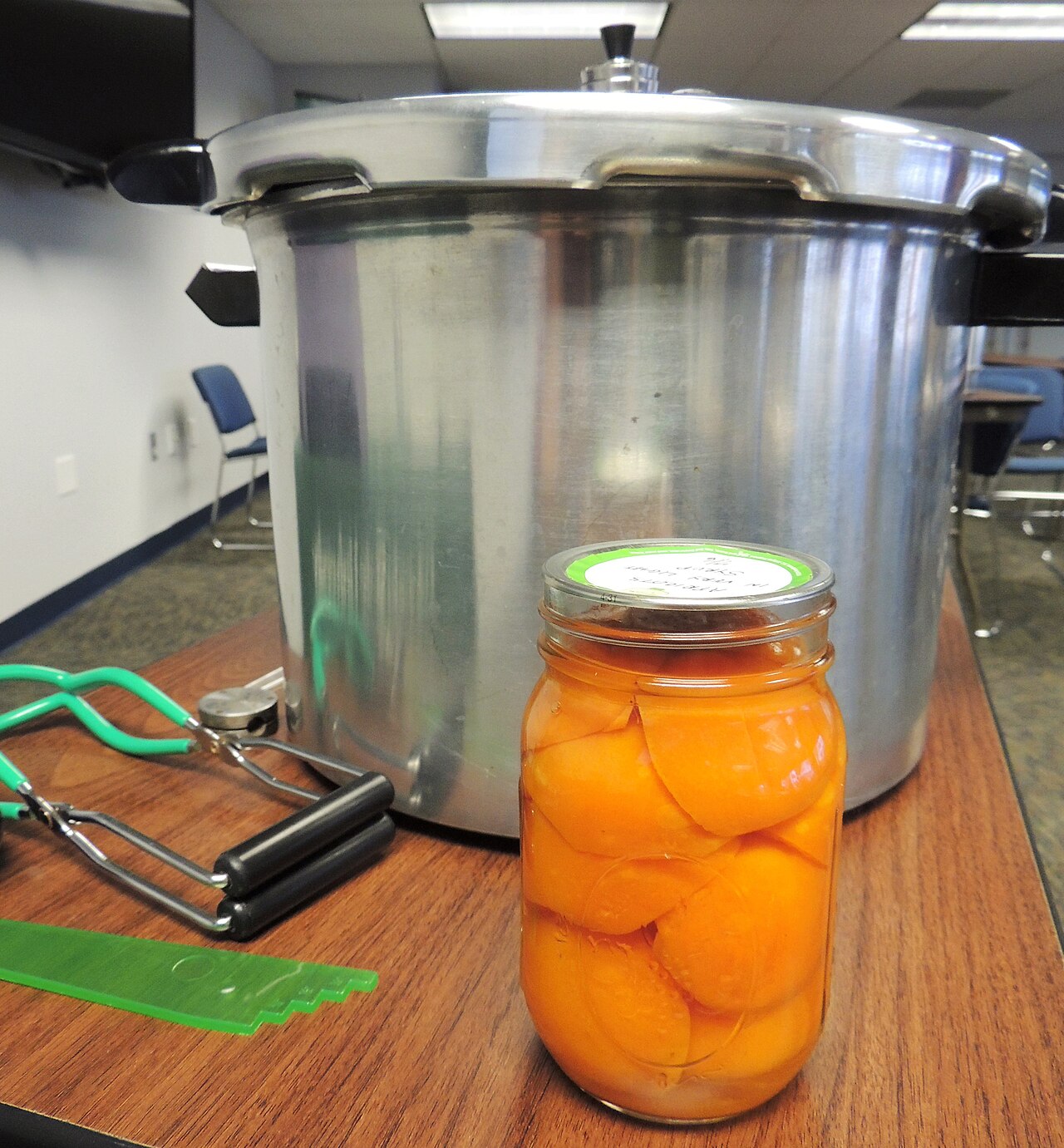
Visual AidFruit sealed to outlast the years
Photograph of home-canned peaches, the kind of object the Knowledge Bank says carries meaning across time. The jar is glass, sealed under heat, with the fruit held in syrup; behind it stands the pressure canner that did the sealing. These are modern jars in a modern kitchen, not Katherine Barlow’s, and nothing here is a hundred years old. Notice that the seal is the whole technology. It is what lets a jar of fruit outlive the person who filled it.
Home-canned peaches with a pressure canner. Source: Wikimedia Commons, file "Canned peaches.jpg", CC0.
📚 Literary Devices in This Part · definitions & examples
Flashback is a scene that jumps back to an earlier time. The Kate Barlow story is a long flashback that explains the lake’s past.Theme is a big idea. Here, the idea is that injustice and cruelty poison a whole community.Conflict is a struggle. Here it is a struggle against an unjust society, and Zero’s struggle against the camp.
The questions below are mixed — not grouped by device. Decide which device each one is about.
🧠Knowledge Bank question
1According to the Knowledge Bank, what problem does Sachar solve by repeating objects across eras?Ch.22
2One theme of Holes is that cruelty and injustice can poison an entire community.Ch.24
3Fill in the blanks with the correct words.Ch.24
Word choices:conflictsocietyrhymevow- some words will not be used
A struggle against an unfair . It is a kind of .
4Sam’s unjust death and the lake drying up point to a big idea about injustice. A story’s big idea is its —Ch.24–25
5A conflict can be a character struggling against an unfair society.Ch.24
6Fill in the blanks with the correct words.Ch.22
Word choices:flashbackpastrhymeloot- some words will not be used
A scene set in an earlier time is called a . It tells events from the .
7The town’s hatred and Zero’s mistreatment are both struggles against unfair people. Such a struggle is a —Ch.24–28
8Sachar uses a flashback to explain how Green Lake dried up and who buried the treasure.Ch.22–26
9Fill in the blanks with the correct words.Ch.24
Word choices:themeidearhymeonion- some words will not be used
A story’s big idea is its . Injustice is one big Sachar explores.
10The lake drying up and never returning works as a —Ch.25
Part 4
Think Deeper
Four deeper challenges — no single-word recall. Read, weigh the evidence, and reason it through.
🧠Knowledge Bank · The Day the Rain Stopped
US History · Racial ViolenceSachar makes a choice worth arguing about: the drought begins on the day Sam is killed. Read one way, this is folklore, the ancient belief that spilled blood curses the ground, and folktales worldwide use it. Read another way it is a moral argument. A town that watches a murder and shields the murderers has destroyed something inside itself, and the novel turns that ruin outward into a landscape nobody can live in. Historians describe a comparable pattern that needs no supernatural help at all. Communities that permitted racial violence often lost the people, trade, and skills they had driven out, then declined for reasons they preferred to blame on luck. What the Knowledge Bank leaves open is which reading Sachar intends, and whether a novel written for children gains force or loses it when a consequence arrives dressed as a curse.
1Claim: “The past injustice at Green Lake set today’s events in motion.” — choose the two details that best prove it.Claim & Evidence
2The past (110 years ago), or the present-day camp? Tap each item to sort it — tap again to switch sides. You can keep tapping to change your answer.Sort into two
◄ The pastThe present-day camp ►
3Match each cause to its result. For each cause, pick its result.Cause & Effect
The town cannot accept Sam and Katherine→
Sam is murdered→
Kate robs and buries her treasure→
The lake dries up over time→
🧠Knowledge Bank question
4Fill both blanks to complete the reasoning.Build the Argument
The Knowledge Bank offers a reading of the drought that needs no curse because , which shows that .
Part 5
Standardized Test · Inference & Author’s Purpose
Part 4 practices Inference and Author’s Purpose — reading between the lines and asking why a writer includes a detail, as the SAT and TOEFL do. Read the passage (the highlighted words are tested below), then choose the answer best supported by the text.
Read the passage — the highlighted words are tested — then answer. Tap an answer, then tap it again to confirm.
SATInference — a conclusion the passage implies
SATText Structure & Purpose — how the passage is built, and why
TOEFLVocabulary — a tested word's meaning here
TOEFLFactual Information — a fact stated in the passage
TOEFLInsert Text — where a sentence best fits
The Onion's Long History
For thousands of years, people have valued the onion as far more than food. Ancient Egyptians thought its rings were a symbol of eternal life, and soldiers were given onions to keep them strong. Workers who built the great pyramids are said to have eaten onions and garlic by the basketful. Bundles of the plant were even placed in tombs, meant to feed the dead on the long journey beyond. Folk healers used the onion as a remedy, believing its sharp juice could help the body resist illness.
Modern science shows there was some truth to these beliefs. Onions contain compounds that can fight bacteria and reduce swelling, giving the body a small but beneficial boost. They are also easy to cultivate and can wait out a long drought underground, which is why nearly every culture grows a distinct variety of its own. Onions even defend themselves. When you cut one, it releases a potent gas that stings the eyes and makes them water — a chemical trick that once helped deter hungry animals. The onion is notorious for making cooks weep, yet the same plant has for centuries helped people endure hard times and stay healthy.
Original passage written for Garden Heights — not a quotation from the novel.
1In the passage, the word “remedy” is closest in meaning to —TOEFL · Vocabulary
2According to the passage, ancient Egyptians thought an onion’s rings were a symbol of —TOEFL · Factual Information
3In the passage, “drought” most nearly means ___.TOEFL · Vocabulary
4According to the passage, what does an onion release when it is cut?TOEFL · Factual Information
5The passage most strongly suggests that old folk beliefs about onions —SAT · Inference
6In the passage, “notorious” most nearly means ___.TOEFL · Vocabulary
7Why does the author mention that cutting an onion stings the eyes?SAT · Text Structure & Purpose
8Insert Text (TOEFL). Look at the four squares [1]–[4] in the passage excerpt below. They show where the following sentence could be added: “Their reputation as a healer, in other words, was not pure superstition.”
[1] Modern science shows there was some truth to these beliefs. [2] Onions contain compounds that can fight bacteria and reduce swelling, giving the body a small but beneficial boost. [3] They are also abundant and easy to cultivate, which is why nearly every culture grows a distinct variety of its own. [4]
Where would the sentence fit best?TOEFL · Insert Text
9The passage implies that onions are grown all over the world because —SAT · Inference
10The passage is organized mainly to —SAT · Text Structure & Purpose
Part 6 · Optional
Creative Writing
A bonus challenge to practice your English.
About This Section
This writing task is optional and not part of your auto-graded score. Feedback checks length, spelling, and grammar only.
Writing Task — Part 4 “I Can Fix That”
Sam the onion man always said, ‘I can fix that.’ Write about the tragic story of Sam and Miss Katherine, and explain why the town’s prejudice was so wrong and harmful. Write at least 40 words.
You can start with: “Long ago, when Green Lake was still full of water, a kind man named Sam…”
0 / 40 words minimum
🗣 Teach It · Just for Fun (optional)
No right or wrong — close the screen and tell someone nearby what happened in this part. Can’t find anyone? Tell yourself out loud. The moment you teach it, you truly understand it.
Part 4 Complete!
You finished Chapters 22–28 of Holes.
Here are your auto-graded results:
-
points out of 100
Teach it to someone
The best last step is to teach it. In your own words, explain what happened — retell a favorite scene, teach a character’s big choice, or sum up the main idea for a parent, friend, or classmate. When you can teach it clearly, you truly own it.
SAT® is a registered trademark of College Board, which is not affiliated with, and does not endorse, these materials. TOEFL® is a registered trademark of ETS. These materials are not endorsed or approved by ETS. Garden Heights is an independent provider of test-style reading practice.