New here? Just sign up with Google — your account includes Matilda, our gift book, forever.
📚
Garden Heights Academy
Members sign in to continue.
Holes · Garden Heights Academy
Part 5
for Holes · Part 5 · Chapters 29–35 · Book Part Two: “The Last Hole”
a novel by Louis Sachar
35 min5 Parts
This workbook is built on a solid pedagogical foundation, effectively integrating content and language learning based on the CLIL framework (Content and Language Integrated Learning), elevated by our unique 5th C — Connection — and an integrated Standardized Test section that weaves every SAT & TOEFL question type right into the novel, so learners build real test skills easily, naturally, and with fun.
💭 Before You Read · Just for Fun
No right or wrong answers — just think or chat about it: Would you risk your own safety to help a friend in danger? What makes someone worth that risk? And have you ever kept pushing toward a goal even when you were exhausted, thirsty, and afraid?
What Happens in Part 5
Stanley goes into the desert after Zero, and the two head for a distant thumb-shaped rock.
A reckless choiceStanley cannot leave Zero to die in the desert, so he goes after him. He crashes the camp’s water truck and continues on foot.
Under Mary LouHe finds Zero hiding beneath an overturned boat named Mary Lou, kept alive by jars of century-old sploosh — preserved peaches.
The Big ThumbStanley spots a far-off rock shaped like a giant thumb, the very place his great-grandfather once survived. Weak and thirsty, the boys set off toward it together.
What We Will Learn
Literary Element
What It Means
Rising Action
The build-up of events that leads toward the story’s climax
Symbolism
Objects that stand for bigger ideas — the boat ‘Mary Lou’ and the sploosh
Suspense
The tense feeling that makes us want to read on
Chapter Summary
Chapter
Key Events
Ch.29
A Reckless Choice — Stanley cannot bear to leave Zero to die, so he sets out across the dry lake to find him
Ch.30
The Runaway Truck — Stanley tries to drive the camp’s water truck after Zero but crashes it into a hole
Ch.31
Into the Wasteland — on foot, Stanley searches the empty, blazing desert with almost no water
Ch.32
‘Mary Lou’ — Stanley finds Zero hiding under an overturned old boat named Mary Lou
Ch.33
Sploosh — Zero has stayed alive on jars of 100-year-old ‘sploosh’ (preserved peaches) buried long ago
Ch.34
The Big Thumb — the boys spot a far-off rock shaped like a thumb, the place Stanley’s great-grandfather once found refuge
Ch.35
The Long Walk — weak and thirsty, the two boys set off together toward the distant mountain
Copyright Notice
Independent study guide by Garden Heights Academy. Not affiliated with or endorsed by Louis Sachar or the publisher. No text from the novel is reproduced. Students should read the original book.
Part 1
Vocabulary
Study 10 key words from Chapters 29–35, then answer each question.
🧠Knowledge Bank · How Fast a Body Loses Water
Human Biology · DehydrationThe desert crossing is dangerous for measurable reasons. A body cools itself by sweating, and in extreme heat an adult can lose more than a liter (about a quart) of water in an hour. Dehydration begins when that loss is not replaced: blood volume falls, the heart works harder to move what remains, and thinking blurs well before a person feels seriously ill, which is why lost travelers make poor decisions early. At around a hundred degrees Fahrenheit (38 degrees Celsius), with no water and no shade, survival is usually counted in a day or two rather than the three days people often quote. Two things change those odds. Shade cuts the heat load sharply, and any water at all extends the clock. Both explain the geography of the second half: the boys walk toward high ground because high ground is where a basin keeps its rain.
Visual AidHow long a body lasts without water
Scale drawing for the Knowledge Bank on dehydration. The three stretches are rough bands for an adult in extreme heat with no water at all; they are not a schedule, and they do not predict what would happen to any particular person. Health, age, shade and effort all move the boundaries. Notice where the first band sits. Judgment fails inside the first day, well before a person feels seriously ill, which is why the early decisions are the dangerous ones.
Bands from standard heat-illness and desert-survival guidance for adults. Drawn for Garden Heights Academy.
ⓘ Vocabulary words are selected to help you understand and complete this workbook. Some may not appear verbatim in the novel.
recklessadj.Ch.29
Acting without thinking of the danger
“It was a reckless plan, but Stanley could not just sit still.”
loyaladj.Ch.29
Faithful and supportive to a friend
“A loyal friend, Stanley would not abandon Zero.”
abandonv.Ch.29
To leave someone or something behind
“He refused to abandon Zero in the desert.”
miragen.Ch.31
Something you think you see in the desert that is not really there
“The shimmering water ahead was only a mirage.”
staggerv.Ch.31
To walk unsteadily, as if about to fall
“Stanley began to stagger under the burning sun.”
dehydratedadj.Ch.31
Dangerously dried out from lack of water
“Without water he grew dehydrated and dizzy.”
vastadj.Ch.31
Extremely large in area
“The vast, empty lakebed stretched in every direction.”
refugen.Ch.34
A safe place that gives shelter
“The thumb-shaped rock had once been a refuge.”
preservev.Ch.33
To keep food from going bad for a long time
“The peaches had been preserved in jars for a century.”
trekn.Ch.35
A long, hard journey on foot
“The trek to the mountain would take all their strength.”
🧠Knowledge Bank question
1According to the Knowledge Bank, why does a dehydrated traveler make poor decisions so early?Ch.29
2To “abandon” someone means to stay loyally by their side.Ch.29
3In the heat, Stanley sees shimmering water that is not really there. This trick of the desert is a —Ch.31
4Fill in each blank with the correct word.Ch.31
Word choices:dehydratedstaggervastmirage- some words will not be used
Without water Stanley becomes .
He begins to across the sand.
5Something “vast” is extremely large.Ch.31
6Jars of peaches were specially treated to last 100 years. To keep food from spoiling is to —Ch.33
7Stanley’s great-grandfather once found shelter and safety on the mountain. A safe, sheltering place is a —Ch.34
8A “loyal” friend is faithful and supportive.Ch.29
9Fill in each blank with the correct word.Ch.35
Word choices:trekrefugerecklessloyal- some words will not be used
The long tested the boys.
It showed how they were to each other.
10To walk unsteadily, as if about to fall, is to —Ch.31
Part 2
Comprehension
How well do you understand Chapters 29–35?
🧠Knowledge Bank · A Shape on the Horizon
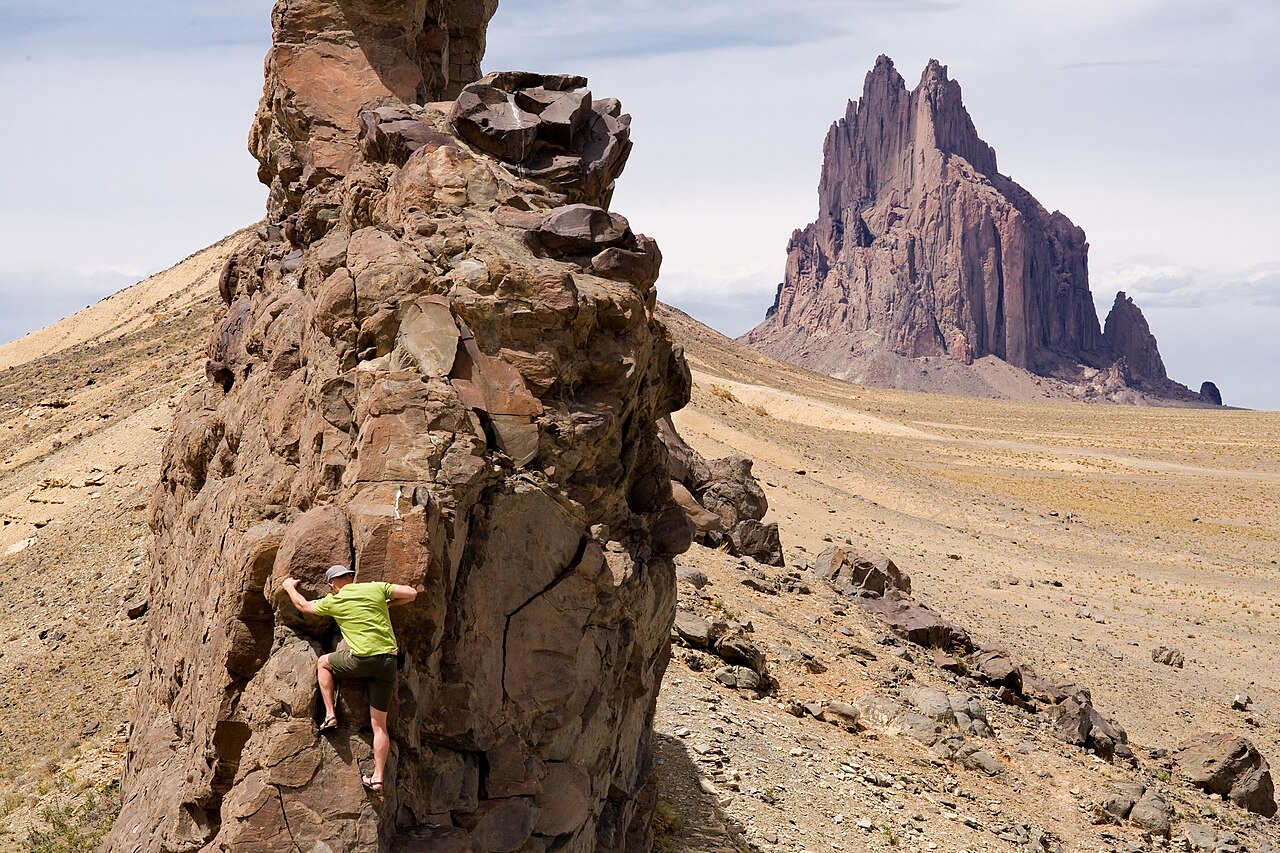
Language · SymbolA symbol is an ordinary thing a story loads with meaning until it stops being ordinary. Out on the lakebed, Stanley fixes on a distant rock shaped like a fist with the thumb raised. Geologically it is nothing remarkable — a resistant outcrop left standing while softer stone eroded away around it. To Stanley it means water, shade, survival, and something harder to name. His great-great-grandfather reached that same formation dying of thirst and came down alive, so walking toward it means walking into a story his family has already told. That is how symbols gather power: not because an author announces them, but because a character invests everything in them at the moment of greatest need. Watch for the object a hero fixes on in the worst stretch of a book. The writer has usually shaped it to hold that character’s remaining hope.
Visual AidA shape that stands above a flat basin
Photograph of Shiprock in New Mexico, a hard core of rock left standing while the softer ground eroded away around it — the kind of landform the Knowledge Bank describes. This is not God’s Thumb, which Sachar invented, and the photograph makes no claim about water or shelter at this particular peak. Notice how far it is visible across flat ground, and notice the climber in front for scale. A landform like this can be seen for a day’s walk, which is exactly what lets a character fix on one.
Shiprock, San Juan County, New Mexico, USA. Source: Wikimedia Commons, file "Shiprock - Flickr - aspidoscelis (2).jpg", CC0.
🧠Knowledge Bank question
1According to the Knowledge Bank, what turns God's Thumb from plain rock into a symbol?Ch.29
2Stanley successfully drives the water truck all the way across the desert.Ch.30
3Where does Stanley find Zero?Ch.32
4How has Zero stayed alive in the desert?Ch.33
5Put these Part 5 events in the correct order. Write 1–4 (1 = first).Ch.29–34
Stanley finds Zero under the boat ‘Mary Lou’.
The boys head toward the far-off Big Thumb.
Stanley crashes the camp’s water truck.
Stanley decides to go after Zero.
6The ‘sploosh’ Zero eats was buried at Green Lake about a hundred years ago.Ch.33
7What is the ‘Big Thumb’?Ch.34
8Stanley’s great-grandfather had once found refuge at the Big Thumb.Ch.34
9What condition are the boys in as they start toward the mountain?Ch.35
10Stanley risks his own life because he is loyal to Zero.Ch.29
Part 3
Literary Elements
Understanding HOW and WHY Sachar writes Chapters 29–35 the way he does.
🧠Knowledge Bank · Building Toward the Climax
Literary Craft · Rising ActionStanley has changed, and Part 5 proves it rather than asserting it. The boy introduced in Part 1 was passive, unlucky, and convinced that things simply happened to him. Here he takes the camp’s truck, crashes it, and walks into open desert after a boy nobody else will look for. Structurally this stretch is rising action, the sequence in which a story lifts its stakes step by step so that the climax has somewhere to arrive from. Sachar lifts them by subtraction. The water runs out, the truck is gone, the camp lies behind them, and each removal narrows the boys’ options until only the mountain is left. Notice that the danger is no longer punishment. It is dying, and that shift from an institutional threat to a physical one is the clearest sign the book has entered its final movement.
📚 Literary Devices in This Part · definitions & examples
Rising action is the build-up of events that leads toward the climax. The desert chase and journey build the tension.Symbolism is when objects stand for bigger ideas. The old boat ‘Mary Lou’ and the sploosh link the present to the buried past.Suspense is the tense feeling that makes us read on. We keep reading to learn whether the boys will survive.
The questions below are mixed — not grouped by device. Decide which device each one is about.
🧠Knowledge Bank question
1According to the Knowledge Bank, how does Sachar raise the stakes in Part 5?Ch.29–35
2An object that carries a deeper meaning is a symbol.Ch.32
3Fill in the blanks with the correct words.Ch.31
Word choices:suspensesurviverhymevast- some words will not be used
The tense feeling that keeps us reading is . We wonder whether the boys will .
4The boat ‘Mary Lou’ and the 100-year-old sploosh tie the present to the old Green Lake story. Objects that stand for bigger ideas are —Ch.32–33
5Suspense is the worried, eager feeling that keeps a reader turning pages.Ch.31
6Fill in the blanks with the correct words.Ch.29–35
Word choices:risingtensionrhymeboat- some words will not be used
The build-up toward the climax is the action. It steadily builds .
7We keep reading to learn whether the boys will survive the desert. This tense feeling is called —Ch.31
8Rising action is the build-up of events leading toward the climax.Ch.29–35
9Fill in the blanks with the correct words.Ch.32
Word choices:symbolmeaningrhymesand- some words will not be used
An object with a deeper . That object is a .
10Stanley’s choice to risk his own life to save Zero marks a —Ch.29
Part 4
Think Deeper
Four deeper challenges — no single-word recall. Read, weigh the evidence, and reason it through.
🧠Knowledge Bank · When Children Run
Social History · Reform SchoolsZero runs, Stanley follows, and both choices have a documented background. Children have always fled harsh institutions. Nineteenth- and twentieth-century reform-school records are full of escapes, and the standard response was to treat running as further proof that the child was the problem. Modern oversight asks a different question first: what was the child running from? Inspections of American youth facilities through the 1990s and 2000s repeatedly found untrained staff, unreported injuries, and punishment used where instruction had been promised. Camp Green Lake fails every one of those tests, and Sachar makes certain the reader notices that no adult ever goes out to look for Zero. The novel’s ethical claim is quiet but firm. An institution that loses a child and does not search has already announced what it believes that child is worth.
1Claim: “Stanley risks his own life because he refuses to abandon Zero.” — choose the two details that best prove it.Claim & Evidence
2Shows Stanley’s loyalty, or the dangers of the desert? Tap each item to sort it — tap again to switch sides. You can keep tapping to change your answer.Sort into two
◄ Stanley’s loyaltyDangers of the desert ►
3Match each cause to its result. For each cause, pick its result.Cause & Effect
Zero runs off into the desert→
Stanley will not abandon him→
Stanley crashes the water truck→
Stanley finds Zero at last→
🧠Knowledge Bank question
4Fill both blanks to complete the reasoning.Build the Argument
The Knowledge Bank argues that Camp Green Lake fails modern standards of oversight because , which shows that .
Part 5
Standardized Test · Author’s Purpose, Structure & Vocabulary
Part 5 practices Author’s Purpose & Text Structure together with Vocabulary — asking why a passage is built the way it is, as the SAT and TOEFL do. Read the passage (the highlighted words are tested below), then choose the answer best supported by the text.
Read the passage — the highlighted words are tested — then answer. Tap an answer, then tap it again to confirm.
SATWords in Context — a word's meaning in this passage
SATText Structure & Purpose — how the passage is built, and why
SATInference — a conclusion the passage implies
TOEFLFactual Information — a fact stated in the passage
TOEFLVocabulary — a tested word's meaning here
The Body's Need for Water
Water is essential to the human body — even more urgent than food. The body is roughly two-thirds water, and it needs a steady supply to cool itself, move blood, and carry away waste. A person can live for weeks without eating, but only a few days without drinking. In a desert's immense heat, the body loses water fast through sweat, so the danger grows more quickly. When the body is deprived of water, it works hard to conserve what remains. It sweats less and makes less urine, trying to retain every drop.
But this is only a temporary defense. As dehydration grows, a person may stagger, feel dizzy and confused, and may even see a mirage — a shimmering illusion of water that is not really there. Thirst alone is a poor guide, because the body often signals it only after the shortage has already begun. Survival experts give simple advice: travel in the cool of night, rest in the refuge of shade by day, and save energy. The goal is to endure until you can replenish your water. Even small amounts, sipped slowly, can be vital, keeping a stranded traveler alive long enough to reach help.
Original passage written for Garden Heights — not a quotation from the novel.
1In the passage, “stagger” most nearly means ___.SAT · Words in Context
2According to the passage, a person can live longer without —TOEFL · Factual Information
3In the passage, “refuge” most nearly means ___.TOEFL · Vocabulary
4According to the passage, what do survival experts advise a stranded traveler to do?TOEFL · Factual Information
5According to the passage, a mirage is —TOEFL · Factual Information
6As used in the passage, the word “endure” most nearly means —SAT · Words in Context
7Why does the author explain that the body sweats less when deprived of water?SAT · Text Structure & Purpose
8The passage most strongly suggests that sipping water slowly helps a stranded traveler because it —SAT · Inference
9According to the passage, survival experts advise stranded travelers to —TOEFL · Factual Information
10The end of the passage is organized mainly by —SAT · Text Structure & Purpose
Part 6 · Optional
Creative Writing
A bonus challenge to practice your English.
About This Section
This writing task is optional and not part of your auto-graded score. Feedback checks length, spelling, and grammar only.
Writing Task — Part 5 “Into the Desert”
Imagine you are Stanley, staggering across the blazing dry lake to find Zero. Use the setting to describe what you see, feel, and fear with almost no water left. Write at least 40 words.
You can start with: “My throat was on fire and my legs could barely carry me, but I kept walking because…”
0 / 40 words minimum
🗣 Teach It · Just for Fun (optional)
No right or wrong — close the screen and tell someone nearby what happened in this part. Can’t find anyone? Tell yourself out loud. The moment you teach it, you truly understand it.
Part 5 Complete!
You finished Chapters 29–35 of Holes.
Here are your auto-graded results:
-
points out of 100
Teach it to someone
The best last step is to teach it. In your own words, explain what happened — retell a favorite scene, teach a character’s big choice, or sum up the main idea for a parent, friend, or classmate. When you can teach it clearly, you truly own it.
SAT® is a registered trademark of College Board, which is not affiliated with, and does not endorse, these materials. TOEFL® is a registered trademark of ETS. These materials are not endorsed or approved by ETS. Garden Heights is an independent provider of test-style reading practice.