New here? Just sign up with Google — your account includes Matilda, our gift book, forever.
📚
Garden Heights Academy
Members sign in to continue.
Holes · Garden Heights Academy
Part 6
for Holes · Part 6 · Chapters 36–42 · Book Part Two: “The Last Hole”
a novel by Louis Sachar
35 min5 Parts
This workbook is built on a solid pedagogical foundation, effectively integrating content and language learning based on the CLIL framework (Content and Language Integrated Learning), elevated by our unique 5th C — Connection — and an integrated Standardized Test section that weaves every SAT & TOEFL question type right into the novel, so learners build real test skills easily, naturally, and with fun.
💭 Before You Read · Just for Fun
No right or wrong answers — just think or chat about it: Have you ever done something kind for someone without expecting anything back, and had it change things in a way you never planned? And is there a song, a saying, or a recipe your family has passed down to you?
What Happens in Part 6
Carrying Zero up the mountain, Stanley unknowingly keeps his family’s ancient promise.
Up the mountainStanley carries the weak Zero up the steep slope and, without realizing it, fulfills his family’s broken promise: a Yelnats is at last carrying a Zeroni uphill.
Water and onionsThey find water and a field of onions. Stanley sings the old family lullaby that Madame Zeroni once gave Elya.
Zero’s confessionZero admits that he was the one who stole the sneakers Stanley was blamed for.
A plan to digAs the boys grow strong again, the curse quietly lifts, and they plan to return to camp and dig where the gold tube was found.
What We Will Learn
Literary Element
What It Means
Theme
A big idea — loyalty and friendship breaking an old curse
Symbolism
Actions and objects that stand for bigger ideas — the mountain, the onions, the song
Cause and Effect
How one event makes another happen — carrying Zero and singing breaks the curse
Chapter Summary
Chapter
Key Events
Ch.36
Climbing the Thumb — Stanley carries the weak, sick Zero up the steep mountain toward the rock thumb
Ch.37
Water and Onions — near the top they find muddy water and a whole field of wild onions to eat
Ch.38
The Old Song — Stanley sings the lullaby his family has passed down, the one Madame Zeroni first gave Elya
Ch.39
Carrying a Zeroni — without knowing it, Stanley fulfills the broken promise: a Yelnats carries a Zeroni up the mountain and sings
Ch.40
Zero’s Confession — Zero admits that HE stole Clyde Livingston’s sneakers, the crime Stanley was blamed for
Ch.41
Getting Strong — living on onions and water, the boys recover their strength on the mountain
Ch.42
A Daring Plan — they decide to go back to the camp at night and dig in the hole where Stanley found the gold tube
Copyright Notice
Independent study guide by Garden Heights Academy. Not affiliated with or endorsed by Louis Sachar or the publisher. No text from the novel is reproduced. Students should read the original book.
Part 1
Vocabulary
Study 10 key words from Chapters 36–42, then answer each question.
🧠Knowledge Bank · Food That Holds Water
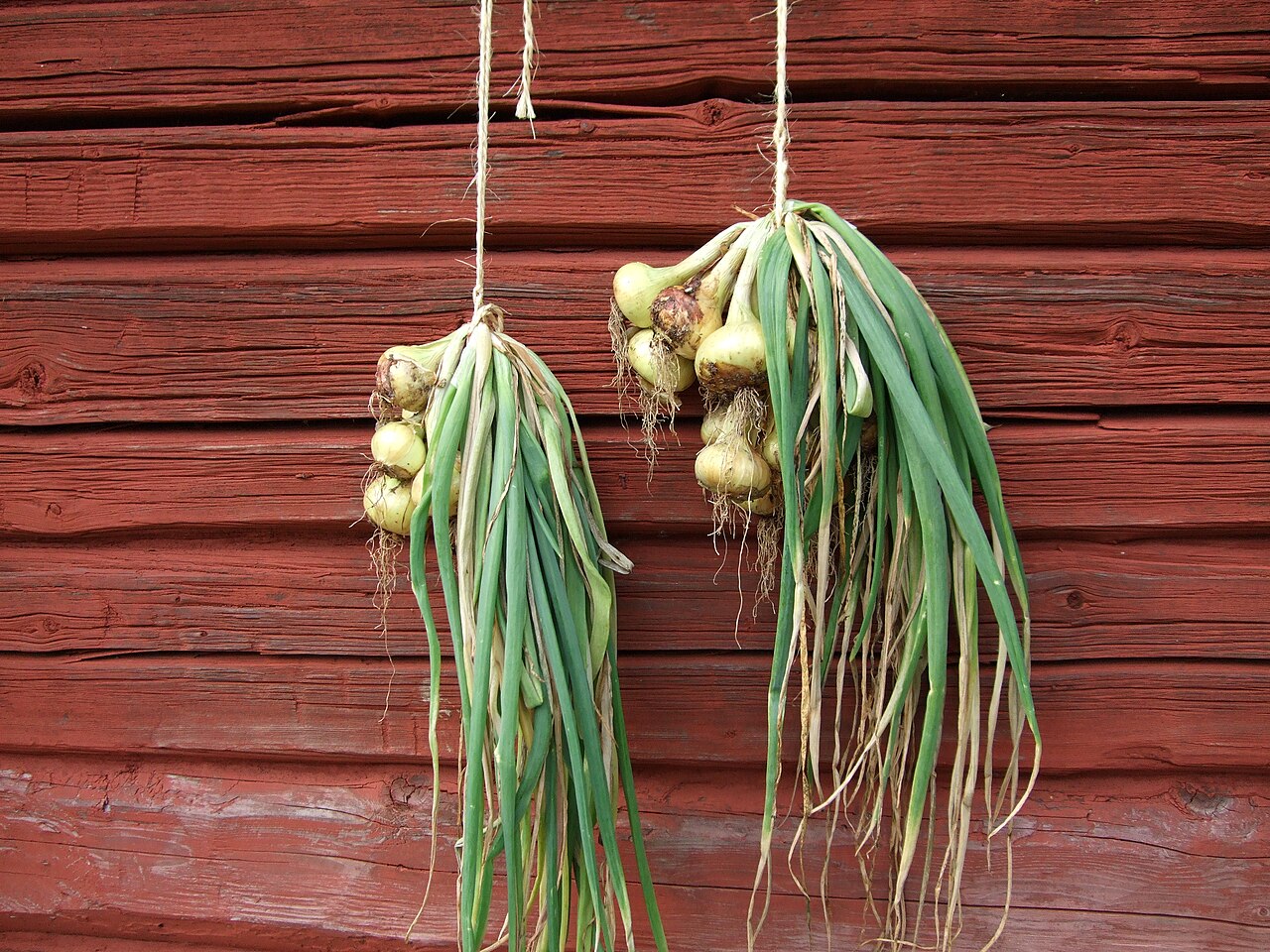
Nutrition Science · OnionsOnions keep the boys alive on the mountain, and the botany is real. An onion is a bulb, a compressed underground stem wrapped in swollen leaf bases, and its purpose is storage: sugars and water banked below ground so the plant can outlast a dry season and grow again. That is why a raw onion is roughly nine-tenths water by weight, and why it can be eaten straight from the soil with no preparation at all. Onions also carry vitamin C and sulfur compounds — the same chemistry that stings the eyes — which have measurable antibacterial effects and gave the vegetable a long career in folk medicine. Sam’s claims are exaggerated but not baseless. For two starving boys with no equipment, a field of onions supplies calories, hydration, and vitamins in one package that demands no fire, no tools, and no skill.
Visual AidThe whole plant, bulb and all
Photograph of onions hung to dry, showing the plant the Knowledge Bank describes. Each one has three parts in view at once: fine roots below, the pale swollen bulb in the middle, and the green leaves above that filled it. These are cultivated onions drying against a barn wall, not the wild ones on the mountain, and the picture says nothing about how any of them taste. Notice how much larger the bulb is than the roots feeding it. That difference is stored food and stored water.
Onions (Allium cepa) hung to dry. Source: Wikimedia Commons, file "Allium cepa drying.jpg", public domain.
ⓘ Vocabulary words are selected to help you understand and complete this workbook. Some may not appear verbatim in the novel.
ascendv.Ch.36
To climb or go up
“Slowly they began to ascend the steep mountain.”
feebleadj.Ch.36
Very weak
“Zero was too feeble to walk on his own.”
burdenn.Ch.36
A heavy load that you carry
“Zero was a heavy burden on Stanley’s back.”
wearyadj.Ch.36
Very tired
“Weary and aching, Stanley kept on climbing.”
nourishv.Ch.37
To feed and keep healthy
“The onions and water nourished the starving boys.”
revivev.Ch.41
To bring back strength or life
“Day by day their strength began to revive.”
fulfillv.Ch.39
To carry out or complete a promise
“Without knowing it, Stanley fulfilled an old promise.”
lullabyn.Ch.38
A gentle song sung to soothe someone
“He sang the family lullaby softly to Zero.”
destinyn.Ch.39
What is meant to happen to someone; fate
“It seemed like destiny that he carried a Zeroni up the mountain.”
confessv.Ch.40
To admit that you did something wrong
“At last Zero confessed the truth about the sneakers.”
🧠Knowledge Bank question
1According to the Knowledge Bank, why can onions nourish two boys with no equipment at all?Ch.36
2Someone “feeble” is very strong.Ch.36
3Stanley carries the weak Zero, a heavy load on his back. Zero is a —Ch.36
4Fill in each blank with the correct word.Ch.37–41
Word choices:nourishreviveascendweary- some words will not be used
The onions and water the boys.
Slowly they their strength.
5To “fulfill” a promise means to break it.Ch.39
6Zero admits he did the crime Stanley was blamed for. To admit doing wrong is to —Ch.40
7The gentle family song Stanley sings to soothe Zero is a —Ch.38
8“Destiny” means what is meant to happen to someone; fate.Ch.39
9Fill in each blank with the correct word.Ch.36
Word choices:wearyfeebleburdendestiny- some words will not be used
The Stanley kept climbing.
He carried his friend on his back.
10To bring the boys’ strength back to life is to —Ch.41
Part 2
Comprehension
How well do you understand Chapters 36–42?
🧠Knowledge Bank · A Promise Paid Late
Language · CallbackA callback is a detail a story establishes early and cashes in much later, and this is the largest one in the novel. In the Latvian strand, Elya Yelnats agrees to carry Madame Zeroni up a mountain and does not do it. On the mountain now, Stanley carries Zero up a slope while singing the song that came with the original bargain. Every element of the old promise is present — a Yelnats, a Zeroni, a climb, the song — and neither boy has the faintest idea. That last point is the craft. Sachar lets the reader complete the pattern alone, which converts a plot mechanism into a private discovery. Callbacks fail when an author explains them and succeed when the audience arrives first, and the reason this one lands is that its setup was buried a hundred pages back and never once underlined.
Visual AidA promise made, broken, and paid
Flow diagram for the Knowledge Bank on callback, following one promise from the oldest strand of the novel to the newest. It compresses more than a century into five steps and leaves out everything not on that thread. It does not claim the curse is real; it traces what the story does with it. Notice that the loop closes on a step neither boy understands. The reader completes the pattern first, which is the whole effect.
Sequence taken from the Elya Yelnats strand and the events of Part 6. Drawn for Garden Heights Academy.
🧠Knowledge Bank question
1According to the Knowledge Bank, why does this callback succeed?Ch.36
2Near the top of the mountain the boys find water and a field of onions.Ch.37
3What does Stanley sing to Zero?Ch.38
4By carrying a Zeroni up the mountain and singing, Stanley unknowingly fulfills Elya’s broken promise.Ch.39
5Put these Part 6 events in the correct order. Write 1–4 (1 = first).Ch.36–42
They find water and a field of onions.
Stanley carries the weak Zero up the mountain.
The boys plan to return to camp and dig for the treasure.
Zero confesses that he stole the sneakers.
6What does Zero confess?Ch.40
7Zero’s confession means Stanley really was innocent all along.Ch.40
8What do the boys live on to get their strength back?Ch.41
9The boys decide to return to the camp to dig where Stanley found the gold tube.Ch.42
10Why is it so meaningful that a Yelnats carries a Zeroni up the mountain?Ch.39
Part 3
Literary Elements
Understanding HOW and WHY Sachar writes Chapters 36–42 the way he does.
🧠Knowledge Bank · Coincidence That Is Really Cause
Literary Craft · Plot CausationCoincidence weakens most novels, and this one looks as though it were built almost entirely from it. A boy is sent to the exact desert his great-grandfather was robbed in. He befriends the descendant of the woman his ancestor wronged. He climbs the same peak. Read carelessly, that is a chain of unlikely accidents. Read as Sachar designed it, it is causation operating across generations: Elya’s failure creates a debt, the debt shapes what the family becomes, and the debt is what finally places Stanley on that slope. Critics call this tightly interlocked design a braided or puzzle-box plot. The test of one is simple. Remove any single element — the onions, the song, the surname, the promise — and later events stop working, which is the difference between a story that merely surprises you and a story that has been engineered.
📚 Literary Devices in This Part · definitions & examples
Theme is a big idea. Here, the idea is that loyalty and friendship can heal old wrongs and break a curse.Symbolism is when objects or actions stand for bigger ideas. The mountain climb and the old song stand for healing the family’s past.Cause and effect means one event makes another happen. Carrying Zero up the mountain and singing causes the curse to lift.
The questions below are mixed — not grouped by device. Decide which device each one is about.
🧠Knowledge Bank question
1According to the Knowledge Bank, what is the simple test of a braided plot?Ch.39
2An action can be a symbol when it stands for something larger.Ch.39
3Fill in the blanks with the correct words.Ch.39
Word choices:causeeffectrhymesong- some words will not be used
Fulfilling the promise is the . Breaking the curse is the .
4Carrying Zero up the mountain and singing the old song stand for healing the past. Such meaningful actions are —Ch.38–39
5The breaking of the curse is the effect of Stanley fulfilling the old promise.Ch.39
6Fill in the blanks with the correct words.Ch.39
Word choices:themeloyaltyrhymeonion- some words will not be used
A big idea in a story is its . Here that idea is .
7Carrying a Zeroni up the mountain and singing (the cause) breaks the curse (the effect). This link is called —Ch.39
8A theme of these chapters is that loyalty and kindness can undo old wrongs.Ch.39
9Fill in the blanks with the correct words.Ch.39
Word choices:symbollargerrhymewater- some words will not be used
An action that stands for something . That action is a .
10Stanley carrying Zero up the mountain deliberately echoes Elya’s promise to carry Madame Zeroni. This mirroring is called a —Ch.39
Part 4
Think Deeper
Four deeper challenges — no single-word recall. Read, weigh the evidence, and reason it through.
🧠Knowledge Bank · Digging for Someone Else
Ethics · Forced LaborBy Part 6 the reader knows what the digging is for, and that knowledge changes the ethics of every earlier chapter. The Warden is not running a corrective program that happens to be harsh. She is running a private treasure hunt staffed by children who cannot leave. International labor law has a name for the arrangement — forced labor, meaning work extracted under threat from someone who never genuinely offered it — and the definition turns on consent and benefit rather than on how tiring the work happens to be. Note who gains. The boys receive nothing, learn nothing, and are told the emptiness is for their own good. Sachar has quietly moved the story from a question about discipline to a question about theft, and the thing being stolen is not the buried suitcase. It is months of each boy’s life.
1Claim: “Stanley unknowingly lifts his family’s curse by carrying Zero up the mountain.” — choose the two details that best prove it.Claim & Evidence
2Shows the curse being fulfilled, or just how they survive on the mountain? Tap each item to sort it — tap again to switch sides. You can keep tapping to change your answer.Sort into two
◄ The curse fulfilledHow they survive ►
3Match each cause to its result. For each cause, pick its result.Cause & Effect
Zero is too weak to walk→
A Yelnats carries a Zeroni uphill→
They reach the mountaintop→
The old vow is fulfilled→
🧠Knowledge Bank question
4Fill both blanks to complete the reasoning.Build the Argument
The Knowledge Bank claims the camp meets the definition of forced labor because , which shows that .
Part 5
Standardized Test · Reference & Inference
Part 6 adds two new exam skills — Reference (what a word like it or they points back to) and Sentence Simplification (restating a sentence without changing its meaning) — along with Inference and Vocabulary. Read the passage (the highlighted words are tested below), then choose the answer best supported by the text.
Read the passage — the highlighted words are tested — then answer. Tap an answer, then tap it again to confirm.
SATWords in Context — a word's meaning in this passage
SATInference — a conclusion the passage implies
SATText Structure & Purpose — how the passage is built, and why
TOEFLFactual Information — a fact stated in the passage
TOEFLReference — what a pronoun refers to
TOEFLSentence Simplification — the shorter sentence that keeps the meaning
TOEFLVocabulary — a tested word's meaning here
TOEFLProse Summary — the three sentences that sum it up
Passing Down Stories by Memory
Long before books, people preserved their history in songs and stories. A grandparent would teach a lullaby or a tale to a child, who would later teach it to their own children. In this way, knowledge was transmitted from one generation to the next entirely by memory, and songs and stories fulfill the role that written libraries would take over much later. This method, called oral tradition, is surprisingly durable. In some cultures, trained singers could carry epics thousands of lines long in their heads, reciting them aloud without a single written page. Because a song is easy to memorize, it can endure for centuries with only small changes.
Rhythm and rhyme act like glue, helping the words stick in the mind, and communal singing meant many people helped keep each song alive. Even today, oral tradition survives. A single melody can outlast the buildings and borders of the age that first shaped it. Families pass down recipes, sayings, and lullabies that no one has ever written down, and many of those songs still tell of heroes meeting their destiny. When a parent sings a song their own grandparent once sang, they revive a distinct thread of the past — proof that some of the most important things we carry are held not on paper, but in memory.
Original passage written for Garden Heights — not a quotation from the novel.
1In the passage, “fulfill” most nearly means ___.SAT · Words in Context
2According to the passage, how are songs and sayings passed down in an oral tradition?TOEFL · Factual Information
3According to the passage, before books, people preserved their history in —TOEFL · Factual Information
4Early in the passage, the word “it” in “teach it to their own children” refers to —TOEFL · Reference
5As used in the passage, the word “endure” most nearly means —SAT · Words in Context
6Which choice best restates “Rhythm and rhyme act like glue, helping the words stick in the mind”?TOEFL · Sentence Simplification
7The passage most strongly suggests that a song survives better than —SAT · Inference
8In the passage, “destiny” most nearly means ___.TOEFL · Vocabulary
9Prose Summary (TOEFL).The passage explains how oral tradition preserves knowledge across generations. This TOEFL task lists six sentences; choose the THREE that best capture the passage’s main ideas. The other three do not belong — they state minor details or ideas the passage does not present.TOEFL · Prose Summary
10Why does the author mention families today passing down recipes and sayings?SAT · Text Structure & Purpose
Part 6 · Optional
Creative Writing
A bonus challenge to practice your English.
About This Section
This writing task is optional and not part of your auto-graded score. Feedback checks length, spelling, and grammar only.
Writing Task — Part 6 “Breaking the Curse”
Stanley carries Zero up the mountain and sings the old family song. Write about this moment and explain why it feels so powerful, even though Stanley does not know he is breaking the curse. Write at least 40 words.
You can start with: “With his last bit of strength, Stanley lifted Zero onto his back and began to climb, and as he climbed he…”
0 / 40 words minimum
🗣 Teach It · Just for Fun (optional)
No right or wrong — close the screen and tell someone nearby what happened in this part. Can’t find anyone? Tell yourself out loud. The moment you teach it, you truly understand it.
Part 6 Complete!
You finished Chapters 36–42 of Holes.
Here are your auto-graded results:
-
points out of 100
Teach it to someone
The best last step is to teach it. In your own words, explain what happened — retell a favorite scene, teach a character’s big choice, or sum up the main idea for a parent, friend, or classmate. When you can teach it clearly, you truly own it.
SAT® is a registered trademark of College Board, which is not affiliated with, and does not endorse, these materials. TOEFL® is a registered trademark of ETS. These materials are not endorsed or approved by ETS. Garden Heights is an independent provider of test-style reading practice.