New here? Just sign up with Google — your account includes Matilda, our gift book, forever.
📚
Garden Heights Academy
Members sign in to continue.
Holes · Garden Heights Academy
Part 7
for Holes · Part 7 · Chapters 43–49 · Book Part Two: “The Last Hole”
a novel by Louis Sachar
35 min5 Parts
This workbook is built on a solid pedagogical foundation, effectively integrating content and language learning based on the CLIL framework (Content and Language Integrated Learning), elevated by our unique 5th C — Connection — and an integrated Standardized Test section that weaves every SAT & TOEFL question type right into the novel, so learners build real test skills easily, naturally, and with fun.
💭 Before You Read · Just for Fun
No right or wrong answers — just think or chat about it: Have you ever had something you did earlier quietly protect or help you later, in a way you never planned? And how does it feel when the truth finally comes out and clears your name?
What Happens in Part 7
The boys dig up a suitcase, survive a pit of lizards, and Stanley is cleared.
The metal suitcaseSneaking back to camp, Stanley and Zero dig where the gold tube was found and strike a heavy metal suitcase.
A pit of lizardsBefore they can escape, the hole fills with deadly yellow-spotted lizards — which do not bite, because the boys’ blood is full of the onions the lizards hate.
Cleared at dawnAt dawn the Warden arrives, waiting for the lizards to finish them, but Stanley’s lawyer appears with proof of his innocence. The suitcase is marked Stanley Yelnats, so the treasure belongs to his family.
What We Will Learn
Literary Element
What It Means
Climax
The most exciting, highest-tension turning point of the story
Irony
A surprising reversal — the deadly lizards become the boys’ protectors
Resolution
The part where the story’s main problems are sorted out
Chapter Summary
Chapter
Key Events
Ch.43
Back to the Hole — at night the boys sneak back and dig in the hole where Stanley found the gold tube
Ch.44
The Treasure Chest — they strike a heavy metal suitcase buried deep in the ground
Ch.45
Surrounded by Lizards — before they can climb out, deadly yellow-spotted lizards swarm into the hole
Ch.46
The Onions Save Them — the lizards do not bite, because the boys’ blood is full of onions, which they hate
Ch.47
The Warden’s Trap — at dawn the Warden, Mr. Sir, and Mr. Pendanski arrive and wait for the lizards to kill the boys
Ch.48
The Lawyer Arrives — Stanley’s lawyer comes with proof that Stanley is innocent and must be released
Ch.49
A Name on the Case — the suitcase says ‘Stanley Yelnats,’ so by law the treasure belongs to Stanley, not the Warden
Copyright Notice
Independent study guide by Garden Heights Academy. Not affiliated with or endorsed by Louis Sachar or the publisher. No text from the novel is reproduced. Students should read the original book.
Part 1
Vocabulary
Study 10 key words from Chapters 43–49, then answer each question.
🧠Knowledge Bank · Why the Lizards Did Not Bite
Animal Behavior · Diet and ScentThe lizards ignore the boys, and Sachar grounds the miracle in something real. Predators and biting animals choose targets partly by smell, and an animal’s diet changes the chemistry of its skin, sweat, and breath. Sulfur compounds from onions are absorbed and then released through the lungs and skin for many hours, which is why a heavy onion meal is still detectable on a person the following day. Field researchers use the same principle in reverse when they test which odors deter mosquitoes, ticks, and rodents. Whether a real reptile would refuse an onion-scented human has never been tested and probably never will be, so the specific claim is invention. The general mechanism is not. Sachar’s rule for his own fantasy is visible here: allow one impossible thing, then support it with a chain of entirely ordinary biology.
Visual AidWhat an animal eats can change how it smells
Flow diagram for the Knowledge Bank on diet and scent. It shows the general route by which something eaten reaches the skin and the breath, and leaves out the chemistry entirely. It does not claim that a real lizard would refuse an onion-fed person; that part of the story is Sachar’s invention, and the closing line on the figure says so. Notice that the last step is measured in hours, not minutes. A single meal keeps changing the signal long after it is eaten.
Route summarized from published work on diet-derived volatile compounds in breath and skin. Drawn for Garden Heights Academy.
ⓘ Vocabulary words are selected to help you understand and complete this workbook. Some may not appear verbatim in the novel.
unearthv.Ch.44
To dig up something that was buried
“Their shovels finally unearthed a metal case.”
dreadn.Ch.45
Great fear of something about to happen
“A cold dread filled Stanley as the lizards appeared.”
swarmv.Ch.45
To gather and move in a huge crowd
“The lizards swarmed into the dark hole.”
motionlessadj.Ch.46
Completely still
“The boys stayed motionless so the lizards would leave them alone.”
immuneadj.Ch.46
Protected; not affected by something harmful
“Full of onions, the boys were almost immune to the lizards.”
verdictn.Ch.48
An official decision about guilt or innocence
“The verdict was clear: Stanley was innocent.”
evidencen.Ch.48
Facts that prove what is true
“The lawyer brought evidence of Stanley’s innocence.”
releasev.Ch.48
To set someone free
“The camp had no choice but to release Stanley.”
rightfuladj.Ch.49
Owned by law; proper and fair
“Stanley was the rightful owner of the suitcase.”
triumphn.Ch.49
A great victory
“It was a complete triumph over the cruel Warden.”
🧠Knowledge Bank question
1According to the Knowledge Bank, what makes the lizards' behavior scientifically plausible?Ch.44
2“Dread” is a feeling of great fear about something about to happen.Ch.45
3Because of the onions, the boys are protected from the lizards’ bite. They are almost —Ch.46
4Fill in each blank with the correct word.Ch.45–46
Word choices:swarmmotionlessimmunedread- some words will not be used
The lizards into the hole.
The boys stay perfectly .
5A “verdict” is an official decision about guilt or innocence.Ch.48
6Stanley’s lawyer brings facts that prove he is innocent. Such proof is called —Ch.48
7The suitcase lawfully belongs to Stanley. He is its —Ch.49
8To “release” a prisoner means to lock them up.Ch.48
9Fill in each blank with the correct word.Ch.48–49
Word choices:triumphreleaserightfuldread- some words will not be used
Stanley wins his .
It feels like a complete .
10To stay completely still, without moving at all, is to be —Ch.46
Part 2
Comprehension
How well do you understand Chapters 43–49?
🧠Knowledge Bank · The Twist You Did Not Expect
Language · Situational IronySituational irony is the gap between the outcome a story has trained you to expect and the outcome you actually get. For six parts the yellow-spotted lizard has been the camp’s ultimate threat, described in the flat voice reserved for certainties. Then two boys stand in a hole full of them for hours and are never bitten. The reversal is total, and it is fair, because the explanation was planted long before the reader needed it. That fairness is what separates irony from a cheat. An unearned twist contradicts its story; an earned one reinterprets it, and here the same detail that kept the boys alive on the mountain keeps them alive in the pit. Notice the second reversal underneath the first. The hole the Warden forced them to dig is the hole that finally protects them from her.
🧠Knowledge Bank question
1According to the Knowledge Bank, what separates an earned twist from a cheat?Ch.43
2The boys dig up a heavy metal suitcase.Ch.44
3What happens just as the boys find the treasure?Ch.45
4Why do the yellow-spotted lizards NOT bite the boys?Ch.46
5Put these Part 7 events in the correct order. Write 1–4 (1 = first).Ch.43–49
At dawn the Warden arrives, hoping the lizards will kill the boys.
The lizards crawl over the boys but never bite.
Stanley’s lawyer arrives with proof that he is innocent.
The boys dig up a metal suitcase in the old hole.
6The Warden waits by the hole, hoping the lizards will kill Stanley and Zero.Ch.47
7Who arrives to save Stanley?Ch.48
8Whose name is on the suitcase?Ch.49
9Because his name is on the suitcase, the treasure lawfully belongs to Stanley.Ch.49
10The onions the boys ate on the mountain end up saving their lives.Ch.46
Part 3
Literary Elements
Understanding HOW and WHY Sachar writes Chapters 43–49 the way he does.
🧠Knowledge Bank · Knowing More Than the Hero
Literary Craft · Dramatic IronyBecause the novel has fed the past to the reader in pieces, the reader reaches the climax holding information the characters lack. That imbalance is dramatic irony, and Sachar uses it to generate tension without withholding anything unfairly. You know why the name stamped on the suitcase matters before Stanley reads it. You know whose descendant Zero is before either boy does. You understand the onions. The characters catch up one at a time, and the pleasure of the sequence is watching knowledge you already carry arrive for someone who badly needs it. Compare this with suspense, where the reader knows less than the character and waits to be told. Dramatic irony reverses the flow, and it is the harder technique, because a writer must keep a reader gripped by an answer that reader already has.
📚 Literary Devices in This Part · definitions & examples
Climax is the most exciting, highest-tension turning point of a story. The boys trapped in a hole full of deadly lizards is that moment.Irony is a surprising reversal of what we expect. The most feared creatures in the book end up protecting the boys.Resolution is the part where the story’s main problems are sorted out. Stanley is proved innocent and freed.
The questions below are mixed — not grouped by device. Decide which device each one is about.
🧠Knowledge Bank question
1According to the Knowledge Bank, how does dramatic irony differ from suspense?Ch.45
2It is ironic that the most feared creatures in the book end up keeping the boys safe.Ch.46
3Fill in the blanks with the correct words.Ch.48–49
Word choices:resolutionsettledrhymecase- some words will not be used
When the problems are . the story reaches its .
4The deadly lizards become the boys’ protectors instead of their killers. This surprising reversal is called —Ch.46
5The resolution is where the story’s big problems are finally settled.Ch.48–49
6Fill in the blanks with the correct words.Ch.45
Word choices:climaxtensionrhymehole- some words will not be used
The most exciting turning point is the . It is the moment of greatest .
7Stanley is proved innocent and freed, and the treasure is his. The sorting-out of the story’s problems is the —Ch.48–49
8The climax is the most exciting, highest-tension moment of a story.Ch.45
9Fill in the blanks with the correct words.Ch.46
Word choices:ironyreversalrhymeonion- some words will not be used
A surprising of what we expect. This twist is called .
10The cruel Warden losing the treasure while innocent Stanley gains it is an example of —Ch.49
Part 4
Think Deeper
Four deeper challenges — no single-word recall. Read, weigh the evidence, and reason it through.
🧠Knowledge Bank · Undoing a False Verdict
Law · Clearing a NameStanley is cleared, and the speed of it is the least realistic thing in the novel. Exonerations — formal cancellations of a conviction — are slow and rare. The American registry of exonerations has recorded thousands of cases since 1989, and the average wrongly convicted person served years before release. The common causes are mistaken identification, false confession, and official misconduct. Stanley’s case involves two of the three. What frees him is not the system noticing its own error but an outside lawyer arriving with proof, which is also the pattern in most real exonerations. Sachar gives his readers the ending they want and leaves the uncomfortable part visible for anyone who looks. The boy goes free because someone with resources took an interest, and a justice system resting on that is not delivering justice so much as distributing luck.
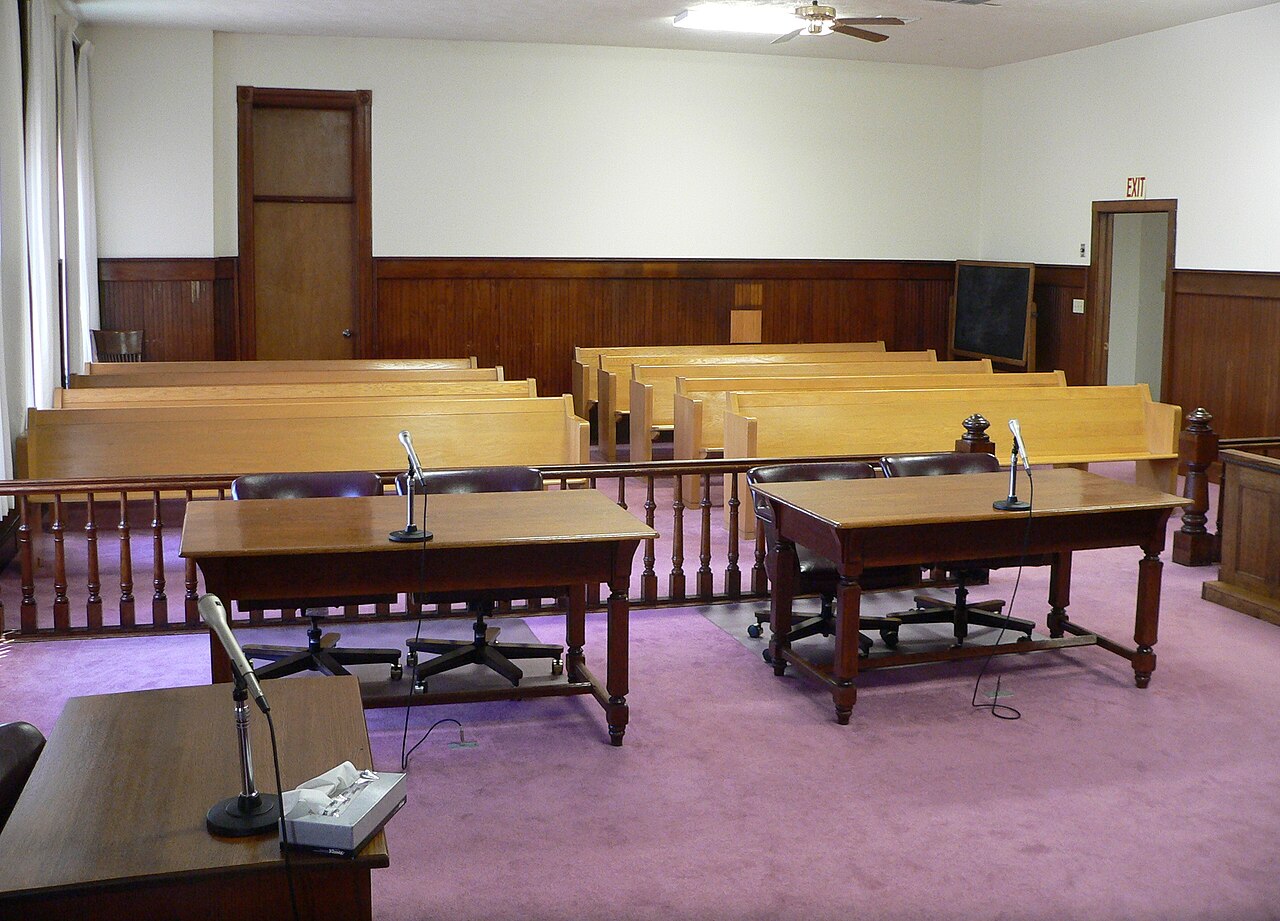
Visual AidThe room where a name is cleared
Photograph of an American county courtroom of the ordinary sort, the setting the Knowledge Bank has in mind. The two tables in front hold the two sides; the low rail divides them from the public benches behind. This is a county courthouse in Nebraska, chosen because it is unremarkable, and it is not the court that hears Stanley’s case. Notice how small and plain the room is. Almost every conviction, and almost every correction of one, happens in a room like this rather than a grand one.
Courtroom, Nuckolls County Courthouse, Nebraska, USA. Source: Wikimedia Commons, file "Nuckolls County Courthouse courtroom 4.JPG", public domain.
1Claim: “Stanley and Zero survive the lizards and hold onto the treasure.” — choose the two details that best prove it.Claim & Evidence
2The deadly danger, or why the boys are spared? Tap each item to sort it — tap again to switch sides. You can keep tapping to change your answer.Sort into two
◄ The deadly dangerWhy they are spared ►
3Match each cause to its result. For each cause, pick its result.Cause & Effect
The boys dig at the right spot→
The hole fills with lizards→
Stanley and Zero smell of onions→
They hold on until dawn→
🧠Knowledge Bank question
4Fill both blanks to complete the reasoning.Build the Argument
The Knowledge Bank calls Stanley's release the least realistic part of the novel because , which shows that .
Part 5
Standardized Test · Cohesion, Insert Text & Evidence
Part 7 is the toughest round: it adds Insert Text (placing a sentence where it fits best), Cohesion & Transitions (how ideas connect), and Command of Evidence (which detail supports a claim). Read the passage (the highlighted words are tested below), then choose the answer best supported by the text.
Read the passage — the highlighted words are tested — then answer. Tap an answer, then tap it again to confirm.
SATText Structure & Purpose — how the passage is built, and why
SATInference — a conclusion the passage implies
SATCommand of Evidence — the detail that best supports a claim
SATCentral Ideas — the passage's main point
TOEFLVocabulary — a tested word's meaning here
TOEFLFactual Information — a fact stated in the passage
TOEFLInsert Text — where a sentence best fits
Animals That Resist Venom
A bite that kills most creatures barely troubles a few remarkable animals. The opossum, for example, can survive snake venom that would fell a much larger animal. Its body makes a protein that helps it resist the poison, leaving it almost immune, and when threatened it may also fall motionless until the danger loses interest. That protein locks onto the venom's harmful toxins in the blood and neutralizes them before they can spread and shut the body down. Resistance of this kind is far more widespread across the animal kingdom than most people would ever guess. So how does such a valuable defense first arise?
[A] Over many generations, animals that could tolerate a little venom survived and had young. [B] Slowly, through this gradual process, whole species evolved stronger defenses. [C] The mongoose and the honey badger developed a distinct ability to shrug off bites that would kill other animals. [D] This resistance has real limits, however; no defense is ever perfect. Even a venom-resistant animal can be overwhelmed by a swarm of attackers or a large enough dose. Still, scientists study these tough survivors closely, because understanding how they endure venom may consequently lead to better antivenom for people.
Original passage written for Garden Heights — not a quotation from the novel.
1In the passage, “motionless” most nearly means ___.TOEFL · Vocabulary
2According to the passage, the opossum can survive —TOEFL · Factual Information
3In the passage, “swarm” most nearly means ___.TOEFL · Vocabulary
4According to the passage, which animals developed a strong ability to resist venom?TOEFL · Factual Information
5Look at the four points [A], [B], [C], [D] in the passage. Where would this sentence best fit? — “Those with the weakest defenses did not.”TOEFL · Insert Text
6Near the end of the passage, the word “however” signals a relationship of —SAT · Text Structure & Purpose
7The passage most strongly suggests that venom resistance developed because it —SAT · Inference
8Which detail best supports the idea that venom resistance has limits?SAT · Command of Evidence
9Which statement best expresses the central idea of the passage?SAT · Central Ideas
10According to the passage, scientists study venom-resistant animals in order to —TOEFL · Factual Information
Part 6 · Optional
Creative Writing
A bonus challenge to practice your English.
About This Section
This writing task is optional and not part of your auto-graded score. Feedback checks length, spelling, and grammar only.
Writing Task — Part 7 “The Hole Full of Lizards”
Imagine you are Stanley standing in the hole as the yellow-spotted lizards swarm in. Describe the terror of the moment and how it feels to slowly realize the lizards are not biting. Write at least 40 words.
You can start with: “I froze as the first lizard crawled onto my shoe, certain I was about to die, but then…”
0 / 40 words minimum
🗣 Teach It · Just for Fun (optional)
No right or wrong — close the screen and tell someone nearby what happened in this part. Can’t find anyone? Tell yourself out loud. The moment you teach it, you truly understand it.
Part 7 Complete!
You finished Chapters 43–49 of Holes.
Here are your auto-graded results:
-
points out of 100
Teach it to someone
The best last step is to teach it. In your own words, explain what happened — retell a favorite scene, teach a character’s big choice, or sum up the main idea for a parent, friend, or classmate. When you can teach it clearly, you truly own it.
SAT® is a registered trademark of College Board, which is not affiliated with, and does not endorse, these materials. TOEFL® is a registered trademark of ETS. These materials are not endorsed or approved by ETS. Garden Heights is an independent provider of test-style reading practice.