New here? Just sign up with Google — your account includes Matilda, our gift book, forever.
Hoot · Garden Heights
Part 6
for Hoot · Part 6 · Chapters 16–18
8 Parts40 min
What Happens in Part 6
With Dana arrested and the groundbreaking set for Wednesday, Roy, Beatrice, and a baby owl push him toward speaking out.
Sunday NewsGarrett turns up Sunday with news that Dana Matherson has been arrested for the trouble at the Mother Paula's lot, while Curly fishes his lost pistol out of a portable toilet tank. Roy's parents claim the day for an airboat ride through the backcountry, and the wild water sharpens something in Roy: a place like this can be erased.
Allies at MidnightAt home, a message from Officer Delinko confirms the arrest, and Roy's father tells him where an ordinary citizen may ask to see a project's paperwork — the building department at City Hall. That night Beatrice crawls out from under his bed, driven from a house gone loud, and the two agree that if they cannot stop Mullet Fingers, they will join him.
Monday's Dead EndsMonday brings Chuck Muckle's verdict down the phone line: the groundbreaking happens Wednesday, no excuses. Delinko tosses a rubber alligator at his suspect and learns he has the wrong boy. At City Hall Roy is told the project file is checked out; Curly catches him feeding crickets to owls the foreman denies exist. Past midnight a flashlight beam finds a baby owl looking back — by morning Roy has a camera, a newspaper advertisement, and something to say out loud.
What We Will Learn
Section
What you will practice
Vocabulary
Words of protest: disobedience, sabotage, vandalism, penalty, conscience…
Literary Elements
A hard deadline, three converging plots, and a watchman’s change of heart
Cross-Curricular
Civil disobedience: the conditions it must meet, and where protest ends and sabotage begins
Chapter Summary
Ch.
What happens
16
Sunday, and an Offer — Dana’s arrest becomes the neighborhood news, Curly recovers his lost pistol from a foul hiding place, and an airboat afternoon sharpens Roy’s sense of what can be wiped off a map; that night Beatrice appears from under his bed, and the two decide to join the boy they cannot talk out of it.
17
Wednesday, No Excuses — Chuck Muckle fixes the groundbreaking date; Delinko’s rubber alligator proves his suspect is the wrong boy; Roy asks a city counter for the project file and is told it is checked out, then feeds live crickets to owls Curly insists are not there at all.
18
A Beak in the Flashlight — on a midnight watch Delinko meets a baby owl and begins doubting the job he is guarding; next morning Roy borrows a camera, carries the newspaper advertisement into class, and tells everyone where he will be standing at noon.
Part 1
Vocabulary
Study 10 key words from Chapters 16–18, then answer each question.
📚Knowledge Bank · The Words of Protest
Civics · Protest VocabularyProtest has a vocabulary, and its words are not interchangeable. To protest is to object openly, so that other people can see the objection and answer it. Sabotage is something else: secretly damaging equipment or work so an operation cannot continue, a method that depends entirely on nobody knowing who acted. Vandalism is the legal term for deliberately destroying property belonging to someone else, and courts treat it as a crime whatever the motive behind it. Disobedience means only refusing to obey; the phrase civil disobedience adds conditions, chief among them that the refusal is public and that the person expects to face a penalty. Notice how these words divide along one line — whether the actor stays visible. Secret words hide a person, while public words hand an argument to strangers and invite a reply. Choosing between them is exactly the choice these chapters set in front of Roy, and the name for the pull he feels is conscience.
Visual AidFour words, one dividing line
Structure diagram sorting the Knowledge Bank’s four words along the single line it draws: whether the actor stays visible. Sabotage and vandalism sit on the hidden side; protest stands in the open; civil disobedience stands furthest into the light, because the refusal is public and the person expects the penalty. Each definition is compressed to a phrase, and the diagram passes no verdict — it does not claim a hidden act can never serve a good cause, only that it makes no argument. Notice what the visible side buys that the hidden side cannot: an objection handed to strangers, and the chance of an answer.
Distinctions among protest, sabotage, vandalism, and civil disobedience as drawn in standard civics references. Drawn for Garden Heights Academy.
disobediencen.Ch.16
Refusal to obey a rule, law, or order
“Open disobedience is not the same thing as secret damage.”
protestn.Ch.18
A public act that shows strong objection
“His protest would happen in daylight, in front of witnesses.”
sabotagen.Ch.17
Secret damage meant to stop an operation
“Sabotage done after dark hides the person who did it.”
vandalismn.Ch.17
Deliberate destruction of property
“Slashed seats count as vandalism, not as an argument.”
consciencen.Ch.16
An inner sense of right and wrong
“His conscience would not let him keep looking away.”
penaltyn.Ch.18
The punishment that follows breaking a rule
“A protester who accepts the penalty still respects the law.”
advocatev.Ch.18
To speak publicly in support of a cause
“He stood up in class to advocate for the small owls.”
interrogationn.Ch.17
Formal questioning of a suspect
“The interrogation produced plenty of shouting and no answers.”
vigiln.Ch.18
A long watch kept through the night
“Coffee and a flashlight carried him through the vigil.”
groundbreakingn.Ch.17–18
A ceremony that begins construction
“The groundbreaking was set for Wednesday at noon.”
ⓘ The vocabulary words in this list are selected to help you understand and complete this workbook. Some may not appear verbatim in the original novel.
🧠Knowledge Bank question
1According to the Knowledge Bank, the one line that divides words like protest from words like sabotage is ___.Ch.16–18
2‘Sabotage’ means openly asking a city office to change a decision.Ch.16–18
3A public act that shows strong objection is a ___.Ch.16–18
4A ‘penalty’ is the punishment that follows breaking a rule.Ch.16–18
5Fill in each blank with the correct word.Ch.16–18
Word choices:sabotageconsciencevigilpenalty- some words will not be used
Secret damage that stops a machine is .
Her would not let her stay quiet.
6To speak publicly in support of a cause is to ___.Ch.16–18
7Someone who keeps a ‘vigil’ sleeps soundly all night long.Ch.16–18
8A long watch kept through the night is a ___.Ch.16–18
9Fill in the blanks with the correct words.Ch.16–18
Word choices:interrogationgroundbreakingadvocatevandalism- some words will not be used
A long produced no useful confession.
Smashed seats are plain .
10In this part, the word groundbreaking names ___.Ch.16–18
Part 2
Comprehension
Show you understood what happens in Chapters 16–18.
📋Knowledge Bank · How Lawful Protest Works
Civics · Rules of AssemblyIn the United States, peaceful public protest is protected speech, but the protection is not unlimited. Gathering on a sidewalk, in a park, or on a public plaza is generally lawful, and cities may ask the organizers of a large march to give advance notice so that traffic and safety can be managed. Stepping onto private land, blocking a roadway, or refusing an officer’s lawful order pushes the same protest outside that protection. Before protesting, citizens are expected to work through ordinary channels: reading public documents, speaking at a council meeting, writing to a newspaper, or signing a petition. Those steps matter twice over. Sometimes they solve the problem with no confrontation at all, and when they fail they become the record proving that quieter methods were tried. A protest that follows exhausted channels reads as a last resort rather than a stunt. Standing where you are permitted to stand, saying plainly what you want, and staying peaceful is what makes such an act durable rather than merely loud — and the working name for that discipline is restraint.
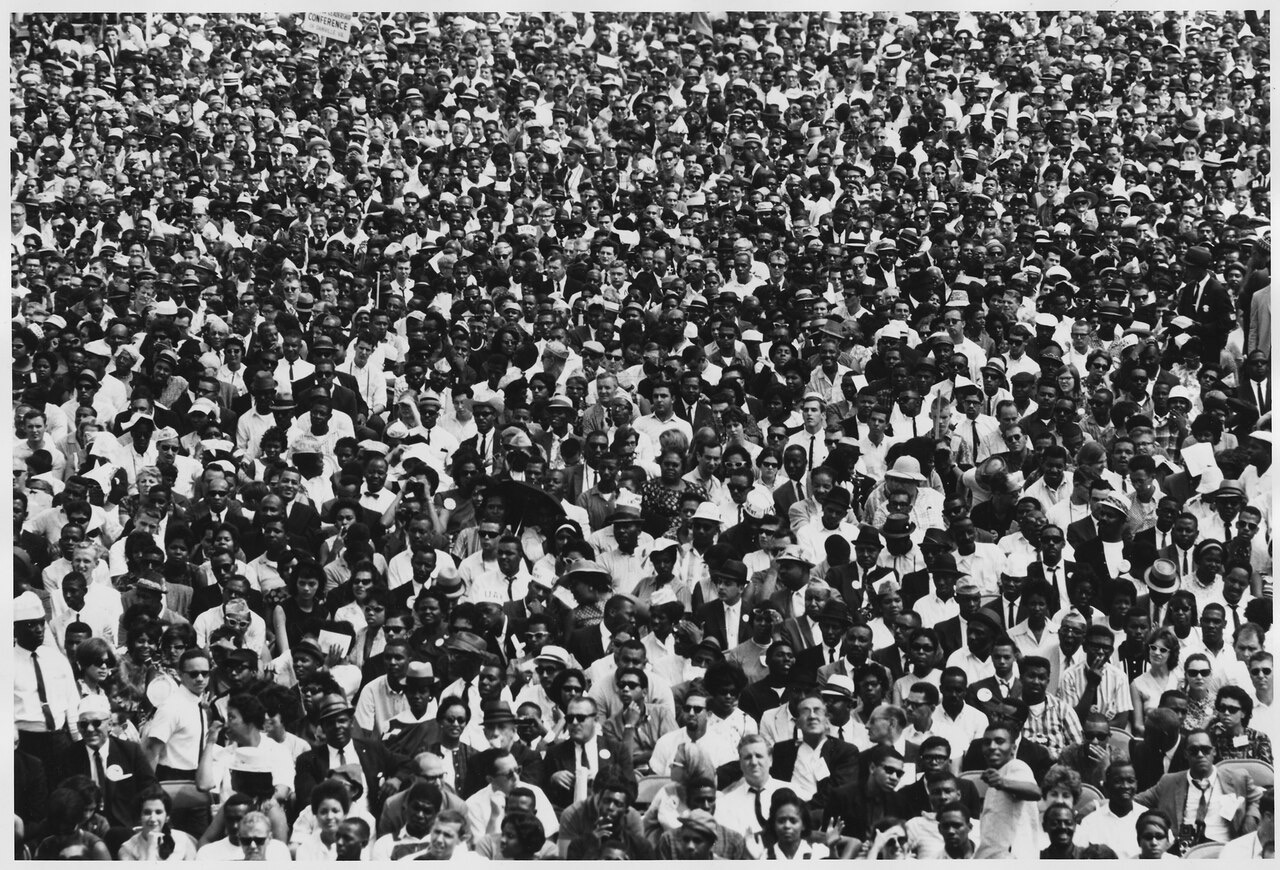
Visual AidLawful assembly at full scale
Photograph of part of the crowd at the March on Washington for Jobs and Freedom, August 28, 1963, taken for the U.S. Information Agency. Roughly a quarter of a million people assembled on public ground that day, after organizers did what the Knowledge Bank describes: gave notice, planned routes, and worked with the city so a vast march stayed peaceful and protected. One frame cannot hold the speeches, the years of quieter channels tried first, or the marchers outside its edges, and the picture does not claim that every protest enjoys this protection — stepping onto private land or blocking a road forfeits it. Notice how orderly a crowd this size can be; that discipline is what kept the argument, not the disruption, in front of the country.
Crowd at the Civil Rights March on Washington, D.C., August 28, 1963; photograph by Rowland Scherman for the U.S. Information Agency, National Archives (NARA 542042). Source: Wikimedia Commons, File:Civil Rights March on Washington, D.C. (A crowd of marchers.) - NARA - 542042.tif, public domain.
🧠Knowledge Bank question
1The Knowledge Bank explains that trying ordinary channels first matters twice because such steps ___.Ch.16
2How do Roy and his parents spend Sunday afternoon?Ch.16
3Beatrice has been hiding under Roy’s bed because her own house has turned chaotic.Ch.16
4What does Chuck Muckle decide after hearing about the slashed seats?Ch.17
5Write the numbers 1–5 in the boxes to show the correct order of events in Chapters 16–18. Number 1 = what happens first.Ch.16–18
Roy rides an airboat with his parents.
A flashlight beam finds a baby owl in a burrow.
Garrett brings word that Dana has been arrested.
Beatrice turns up hiding under Roy’s bed.
A city counter cannot produce the project file.
6Officer Delinko stays certain that Dana is behind all of the trouble at the lot.Ch.17
7What does Delinko toss at Dana inside the detention center?Ch.17
8What happens when Roy asks a city counter for the project file?Ch.17
9Curly agrees with Roy that owls are living on the lot.Ch.17
10How does Roy end his turn in current events class?Ch.18
Part 3
Literary Elements
Understanding HOW and WHY Carl Hiaasen (author) tells the story across Chapters 16–18.
🧠Knowledge Bank · Three Plots, One Deadline
Literary Craft · Converging PlotsHiaasen runs three story lines at once — a boy, a foreman, and a patrolman — and in these chapters he binds them together with a single date. The moment Wednesday is announced, every following scene inherits a deadline, and readers start measuring pages against a clock nobody in the book can move. That is structure rather than incident: nothing has happened yet, but everything now has a due hour. Hiaasen also uses these chapters to move the reader’s sympathy. A patrolman who has spent the whole novel chasing a trespasser kneels at a burrow, meets a hungry chick, and turns into someone who might change sides. Comedy works the same seam from the other direction; a lost pistol recovered from a portable toilet keeps the company men ridiculous instead of terrifying, so the owls stay the serious thing on the page. When separate plots begin pointing at one lot and one hour, the technique has a name — convergence.
Ticking clock
Wednesday’s groundbreaking hands every later scene a due date nobody can move.
Converging plots
Boy, foreman, and patrolman — three separate lines begin aiming at one lot and one hour.
Sympathy shift
The watchman kneels at a burrow, meets a hungry chick, and stops being only an obstacle.
🧠Knowledge Bank question
1According to the Knowledge Bank, announcing the Wednesday date matters because it ___.Ch.16–18
2Fill in the blank with the correct literary term.Ch.16–18
Word choices:deadlineconvergingrhymesequel- some words will not be used
Wednesday works as a hard .
Three story lines are .
3Delinko’s reaction to the baby owl is an example of ___.Ch.16–18
4Hiaasen keeps three separate story lines running through these chapters.Ch.16–18
5The pistol pulled out of a portable toilet keeps the company men ___.Ch.16–18
6Hiaasen puts Roy’s trip to the records counter BEFORE his public announcement in order to show ___.Ch.16–18
7Roy’s announcement to his class leaves Part 6 on a promise rather than a result.Ch.16–18
8Fill in the blanks with the correct literary terms.Ch.16–18
Word choices:sympathysatirestanzasuspense- some words will not be used
The baby owl scene begins a shift.
A fixed date builds .
9Hiaasen’s comic villains and his serious cause together create ___.Ch.16–18
10These chapters settle the fight over the lot completely.Ch.16–18
Part 4
Think Deeper
Four deeper challenges — no single-word recall. Read, weigh the evidence, and reason it out.
💡Knowledge Bank · When Breaking a Law Is Defensible
Ethics · Justified DisobediencePhilosophers who defend civil disobedience are not defending lawbreaking in general; they set conditions strict enough to exclude most of it. The act must target one specific injustice rather than express a general mood. It must be public, because a hidden act makes no argument and asks nobody to reconsider anything. It must avoid violence, since injury replaces persuasion with force. Ordinary legal remedies should be tried, and seen to fail, before anything is broken. Finally the protester should accept arrest and punishment, which signals loyalty to law as a system even while one particular law is refused — a costly kind of sincerity. Hold these chapters against that list and the two boys come apart. Cut seats and midnight damage fail nearly every condition: secret, destructive, answerable to no one. A boy who asks for the record, is refused, and then announces the hour and place where he will stand fails none of them. The difference is not how much each one cares. It is method.
Think back over these chapters. A pistol comes up out of a tank nobody wants to reach into. An airboat throws spray across water that has never been paved. Under a bed, in the dark, a girl with nowhere else to sleep tells a boy they may as well stop trying to stop the running boy. A phone call sets a date and refuses to discuss it. A counter clerk cannot produce a file that ought to be there. And long past midnight a flashlight beam falls on a small feathered head that opens its beak and waits, trustingly, to be fed.
Original passage written for Garden Heights — not a quotation from the novel.
1Claim: “Across these chapters Roy moves from helping in secret toward open, public protest.” — choose the two details that best prove it.Claim & Evidence
2Sabotage (secret damage), or Protest (open and lawful)? Tap each detail to sort it — tap again to switch sides. You can keep tapping to change your answer.Sort into two
◄ Sabotage (secret damage)Protest (open and lawful) ►
3Match each cause to its result. For each cause, pick its result.Cause & Effect
Seats are slashed after the arrest→
Dana panics at a rubber alligator→
The project file cannot be produced→
A flashlight finds a baby owl in a burrow→
🧠Knowledge Bank question
4Fill both blanks to complete the reasoning.Build the Argument
The Knowledge Bank argues that midnight damage fails the philosophers' test because , which shows that .
Part 5
Standardized Test
Reading passage · The Conditions of Civil Disobedience · Words in Context & Central Ideas · SAT & TOEFL-style practice
Read the passage — the highlighted words are tested — then answer. Tap an answer, then tap it again to confirm.
SATCentral Ideas — the passage's main point
SATWords in Context — a word's meaning in this passage
SATInference — a conclusion the passage implies
TOEFLFactual Information — a fact stated in the passage
TOEFLVocabulary — a tested word's meaning here
TOEFLProse Summary — the three sentences that sum it up
The Rules of Civil Disobedience
Civil disobedience is the deliberate, public refusal to obey a law that the protester's conscience condemns as unjust. Thinkers as different as Henry David Thoreau, Mohandas Gandhi, and Martin Luther King Jr. described it as an argument made with the whole body rather than with words alone, and each man was an advocate who pleaded one cause openly before the public. Most theorists insist that the act be deliberate rather than careless, and that it be aimed at one specific grievance, because a protester is claiming that a particular rule deserves to be broken on purpose.
The remaining conditions are demanding. The protest should be open, so the public can see who acted and why; it should stay non-violent, so the argument does not turn into an injury; and lawful channels — hearings, records requests, letters, elections — should be tried before anything is broken. The protester is also expected to accept the legal penalty rather than escape it, since submitting to arrest shows respect for law as a whole even while one statute is refused. King wrote his most famous letter from a jail cell for exactly that reason.
These conditions are what separate protest from vandalism. Clandestine damage — a slashed seat, a wrecked machine, a fire set after dark — conceals the actor, destroys property, and offers no claim that anyone can answer. Courts and historians therefore classify sabotage as a crime rather than a form of speech, however sincere the motive behind it. Someone who stands in daylight, names the grievance, and waits for the consequences is doing something different in kind, not merely in degree.
Original passage written for Garden Heights — not a quotation from the novel.
1What is the main idea of the passage?SAT · Central Ideas
2According to the passage, a justified act of disobedience is aimed at ___.TOEFL · Factual Information
3In the passage, conscience most nearly means ___.SAT · Words in Context
4In the passage, a grievance is ___.TOEFL · Vocabulary
5Why are protesters expected to accept the legal penalty?TOEFL · Factual Information
6In the passage, an advocate is ___.SAT · Words in Context
7The passage suggests sabotage is not treated as speech because ___.SAT · Inference
8Prose Summary (TOEFL).The passage explains what separates civil disobedience from ordinary lawbreaking. This TOEFL task lists six sentences; choose the THREE that best capture the passage’s main ideas. The other three do not belong — they state minor details or ideas the passage does not present.TOEFL · Prose Summary
9Which of these does the passage name as a lawful channel?TOEFL · Factual Information
10Which Part 6 action best fits the passage’s definition of civil disobedience?SAT · Inference
Part 6 · Optional
Creative Writing
A bonus challenge to practice your English. Take your time and have fun with it.
About This Section
This writing task is optional and is not part of your auto-graded score. The feedback below checks only the basics — length, spelling, and grammar — not whether your ideas are right or wrong. It is meant for classroom discussion and creative practice, so feel free to use your imagination!
Writing Task — Part 6 “Standing Up in Public”
Roy could have gone on helping in secret. Instead he told a whole classroom exactly where he would be standing, and when. Write about a time you had to say something out loud that would have been far easier to keep quiet — or a time you stayed quiet and later wished you had not. What did speaking (or not speaking) cost you? 6–10 sentences. End with what you would do if that same moment came around again.
You can start with: “The easy thing would have been to say nothing at all, and I almost did...”
0 / 40 words minimum
🗣 Teach It · Just for Fun (optional)
No right or wrong — close the screen and tell someone nearby what happened in this part. Can’t find anyone? Tell yourself out loud. The moment you teach it, you truly understand it.
Part 6 Complete!
You finished Chapters 16–18 of Hoot.
Here are your auto-graded results:
-
points out of 100
Teach it to someone
The best last step is to teach it. In your own words, explain what happened — retell a favorite scene, teach a character’s big choice, or sum up the main idea for a parent, friend, or classmate. When you can teach it clearly, you truly own it.
Independent study guide by Garden Heights. Not affiliated with or endorsed by Carl Hiaasen. Contains original analysis only; no text from the novel is reproduced. Reference text: This workbook follows Carl Hiaasen’s classic text (the standard Puffin edition sold worldwide). Revised 2023 UK editions change some wording and may not match the vocabulary studied here.
SAT® is a registered trademark of College Board, which is not affiliated with, and does not endorse, these materials. TOEFL® is a registered trademark of ETS. These materials are not endorsed or approved by ETS. Garden Heights is an independent provider of test-style reading practice.