
Part 1
On a small island far out in the Pacific, a twelve-year-old girl named Karana lives with her people in the village of Ghalas-at. Her father, Chowig, is their chief, and Karana guards a secret name of her own, Won-a-pa-lei, ‘the Girl with the Long Black Hair.’ One day a red ship appears, carrying Aleut hunters led by the Russian Captain Orlov, who has come to take the thick fur of the sea otter that swim among the island’s kelp. Chowig, wary of the strangers, strikes a bargain: the Aleuts may hunt if they share the catch fairly with the tribe. All season the hunters kill otter after otter, but when it is time to load the ship and pay, Orlov offers far less than was promised. A furious quarrel at Coral Cove turns into a battle, and though the tribe drives the Aleuts off, Chowig and most of the village men are killed. The red ship raises its sails and leaves Ghalas-at grieving, its people suddenly few and unprotected. In one visit, the outsiders have taken both the otter and the heart of the tribe.
| Section | What you will practice |
|---|---|
| Vocabulary | Island words: otter, kelp, harpoon, bargain, betray… |
| Literary Elements | Setting, first-person voice, foreshadowing, and the story’s central conflict |
| Cross-Curricular | The sea otter and the kelp forest — why the hunters came so far |
| Ch. | What happens |
|---|---|
| Chapters 1–2 | The Island and the Red Ship — Karana’s people live at Ghalas-at; a red ship of Aleut hunters arrives, and Chowig bargains to let them hunt sea otter for a fair share of the catch. |
| Chapters 3–4 | The Battle at Coral Cove — the Aleuts try to leave without paying fairly; a battle erupts at Coral Cove, Chowig and many men are killed, and the ship sails away. |
Four words, and together they explain why a ship comes. An otter is a sea mammal hunted for its thick fur, and the hunters cross an entire ocean for the ones that swim near the kelp. Kelp is long brown seaweed growing in the sea, and the otters float among its ropes. A harpoon is a spear tied to a long rope for hunting sea animals, and it is what the Aleuts strike with. A bargain is an agreement about a trade or price, and Chowig makes one to share the catch. Notice the order those four fall in. Three of them describe an ecosystem and a tool; the fourth is a promise between men, and it is the only one of the four that anybody in this book breaks.
ⓘ The vocabulary words in this list are selected to help you understand and complete this workbook. Some may not appear verbatim in the original novel.
In Chapters 1–4, plot comprehension depends on locating the trigger, tracing mounting pressure, and recognizing the decisive turn. On a small island far out in the Pacific, a twelve-year-old girl named Karana lives with her people in the village of Ghalas-at. Her father, Chowig, is their chief, and Karana guards a secret name of her own, Won-a-pa-lei, ‘the Girl with the Long Black Hair.’ One day a red ship appears, carrying Aleut hunters led by the Russian Captain Orlov, who has come to take the thick fur of the sea otter that swim among the island’s kelp. Chowig, wary of the strangers, strikes a bargain: the Aleuts may hunt if they share the catch fairly with the tribe. Seen as cause and effect, “The Coming of the Aleuts” becomes the opening catalyst.
- The hunters try to leave without paying a fair share.
- Chowig and many of the village men are killed.
- A battle breaks out at Coral Cove.
- Captain Orlov bargains to hunt otter and share the catch.
- The Aleut ship anchors at Coral Cove.
In Chapters 1–4, Scott O’Dell coordinates setting, foreshadowing, and conflict to establish the novel’s opening design. O’Dell places his whole story on a single small island far out in the Pacific, and the setting is not just a backdrop — it shapes everything. The island gives the tribe its food, its shelter, and its dangers; later it will give Karana her lonely home. It is based on a real place, San Nicolas, the most far-flung of California’s Channel Islands, where a Native people lived for thousands of years. Notice how the sea surrounds every scene: it brings the red ship, it carries the fighting, and it will one day carry the tribe away. In a survival story, the setting becomes almost a character itself — a world of wind, water, and stone that tests and teaches the person who must live in it. That authorial design makes “The Island of the Blue Dolphins” a lesson in deliberate atmosphere.
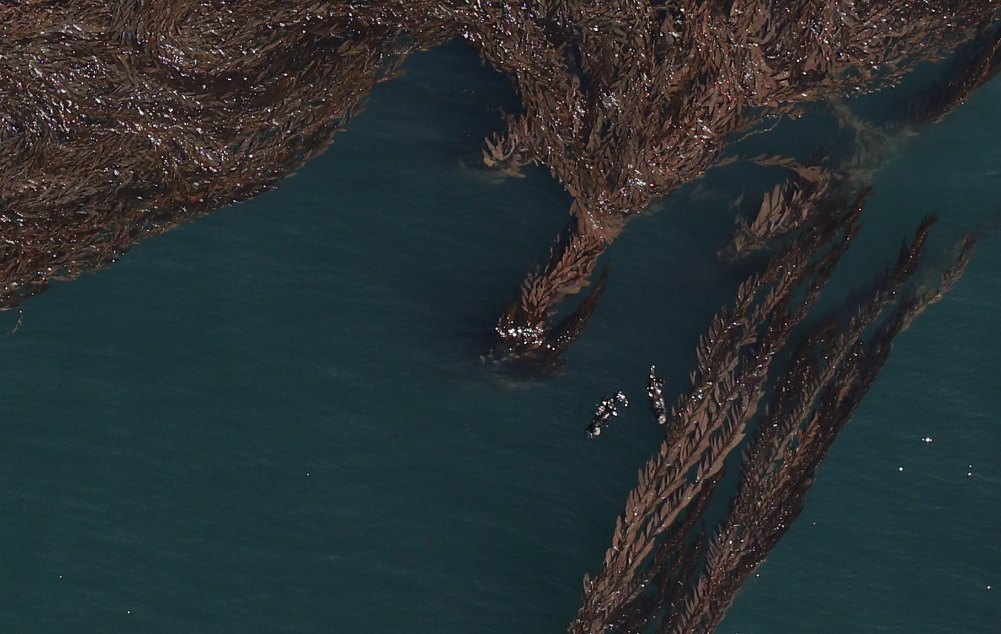
The animal that draws the Aleuts across the ocean is the sea otter, and understanding it reveals the whole living world around Karana’s island. Off the California coast grow underwater forests of giant kelp — a fast-growing seaweed that rises from the rocky bottom in tall swaying ribbons, sheltering fish, crabs, and countless other creatures. The sea otter lives among this kelp, and unlike seals or whales it has almost no fat to keep warm; instead it depends on its fur, the thickest of any animal on Earth. That dense, warm pelt is exactly what made the otter so valuable, and so hunted, in the 1800s. Put the biology and the plot together and Part 1 stops being a prologue. The otter needs the kelp, the kelp needs the otter, and the island needs both — so when a ship arrives to strip out one animal, it is not only taking fur. It is pulling a thread out of a forest.
Think back over the opening. A girl watches a red ship slide out of the ocean toward her island, and her father, the chief, hides his true name and studies the strangers with careful eyes. A bargain is struck: hunt the otter, and share what you take. All season the harpoons rise and fall among the kelp, and the pile of pelts grows. But when the ship is ready to leave, the promised share shrinks to almost nothing, and words turn to blows on the sand at Coral Cove. When it is over, the ship sails, the otter are gone, and so are the men who once kept the village safe — and a girl stands on the shore of a world that has just grown far more dangerous.
Around the Island of the Blue Dolphins grows one of the richest habitats in the sea: the kelp forest. Giant kelp is not a true plant but a kind of algae, and in cool, clear water it can grow taller than a house, rising from the rocky bottom toward the light in long, swaying brown ribbons. Among these ribbons lives the sea otter, the very animal the Aleut hunters came so far to take. It has almost no fat to keep it warm. Instead it depends on its fur, the thickest of any animal on Earth, and it was that dense pelt that made the creature so valuable, and so hunted, in Karana’s time.
This animal does more than live in the kelp forest; it protects it. Otters love to eat sea urchins, small spiny creatures that graze on kelp. Where otters are plentiful they keep the urchins in check and the forest thrives, a home the otters share with fish, crabs, and countless other creatures. But where otters are hunted until few remain, the urchins multiply and can chew a whole forest down to bare rock. Scientists call the otter a keystone species, one whose presence holds an entire community together. When the Aleuts took so many, they were pulling at a thread that held the living web of the island’s waters.
This writing task is optional and is not part of your auto-graded score. The feedback below checks only the basics — length, spelling, and grammar — not whether your ideas are right or wrong. It is meant for classroom discussion and creative practice, so feel free to use your imagination!
Writing Task — Part 1 “A Home by the Sea”
Karana’s island shapes everything about her life — how she eats, works, and sees the world. Write about a place that has shaped who you are: a home, a neighborhood, a country, or somewhere you love. Where is it, what is it like, and how has it changed you? 6–10 sentences. End with what this place means to you.
No right or wrong — close the screen and tell someone nearby what happened in this part. Can’t find anyone? Tell yourself out loud. The moment you teach it, you truly understand it.


Part 1 Complete!
You finished Chapters 1–4 of Island of the Blue Dolphins.
Here are your auto-graded results:
The best last step is to teach it. In your own words, explain what happened — retell a favorite scene, teach a character’s big choice, or sum up the main idea for a parent, friend, or classmate. When you can teach it clearly, you truly own it.
Independent study guide by Garden Heights. Not affiliated with or endorsed by Scott O'Dell. Contains original analysis only; no text from the novel is reproduced. Reference text: This workbook follows Scott O'Dell’s classic text (the standard Puffin edition sold worldwide). Revised 2023 UK editions change some wording and may not match the vocabulary studied here.