New here? Just sign up with Google — your account includes Matilda, our gift book, forever.
Island of the Blue Dolphins · Garden Heights
Part 2
for Island of the Blue Dolphins · Part 2 · Chapters 5–8
8 Parts40 min
What Happens in Part 2
With so many men dead, the grieving village must choose a new path. In council the people elect Kimki to lead them, and after a hard, hungry season he makes a bold decision: he will paddle a canoe alone across the open sea to the east, hoping to find a country where the tribe can live in safety. Time passes with no word, and Ghalas-at waits, uncertain and afraid. At last a ship of white men appears — sent, it seems, to carry the remaining people away to that far land. The tribe gathers its baskets and belongings and boards, and the ship begins to pull away from the island. Then Karana sees, with horror, that her little brother Ramo has been left behind on the shore, running after them. She cannot bear it. As her sister Ulape sails on with the others, Karana leaps from the moving ship into the cold, heaving sea and swims back to the island to stay with Ramo. In one desperate moment she trades a place in the wider world for loyalty to her brother — and the two children are left utterly alone on the Island of the Blue Dolphins.
The story’s turning point, internal conflict, and rising suspense
Cross-Curricular
Leaving a homeland — the real Nicoleño people
Chapter Summary
Ch.
What happens
Chapters 5–6
Kimki Sails East — the tribe elects Kimki, who then paddles off alone across the sea to seek a safe new land while the village waits.
Chapters 7–8
The Leap — a ship comes to take the people away; as it sails, Ramo is left behind, and Karana leaps into the sea to stay with him while Ulape sails on.
Part 1
Vocabulary
Study 10 key words from Chapters 5–8, then answer each question.
🧠Knowledge Bank · Words of Departure
Lexical Semantics · Words of Departure
Four words about a whole people deciding what to do next. A council is a meeting where leaders decide together, and the tribe holds one to choose a new leader after Chowig’s death. To elect is to choose someone by agreement or vote, and the people elect Kimki. A canoe is a narrow boat moved with paddles, and Kimki sets out alone in one. A voyage is a long journey over water, and his is east, and dangerous. Notice that all four words describe an orderly society doing an orderly thing. O’Dell puts them here deliberately, just before the ship comes: this is a functioning people with laws and leaders and a plan of its own, and the reader needs to have seen all of that before watching it end.
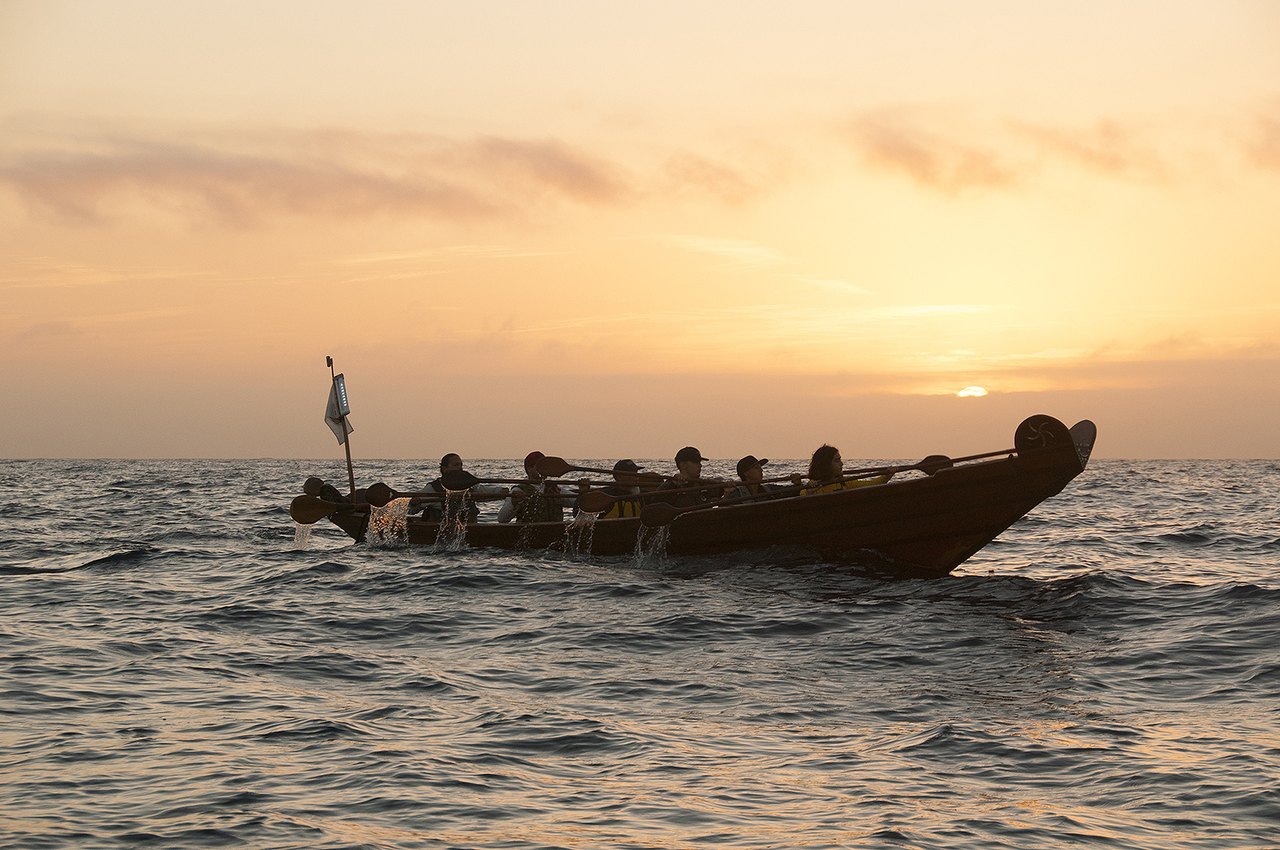
Visual AidA plank canoe on open water
Photograph of a Chumash tomol, a traditional plank canoe, crossing to the Channel Islands at sunrise. The Knowledge Bank explains that a canoe is a narrow boat moved with paddles, that a voyage is a long journey over water, and that Kimki sets out alone in one to cross the open sea eastward. Count the paddlers here. Now imagine the same crossing with one person in the boat, which is what the story asks of Kimki and later of Karana.
Chumash tomol crossing to the Channel Islands at sunrise; Channel Islands National Marine Sanctuary. Source: Wikimedia Commons, public domain.
counciln.Ch.5
A meeting where leaders decide together
“The tribe held a council to choose a new leader.”
electv.Ch.5
To choose someone by agreement or vote
“The people elected Kimki to lead them.”
canoen.Ch.6
A narrow boat moved with paddles
“Kimki set out alone in a canoe.”
voyagen.Ch.6
A long journey over water
“He began a dangerous voyage to the east.”
desertv.Ch.8
To leave someone behind and alone
“Karana would not desert her brother.”
harborn.Ch.7
A safe place for ships near the shore
“The white men’s ship waited near the shore.”
fleev.Ch.7
To run away from danger
“The people had to flee their island home.”
leapv.Ch.8
To jump with great force
“Karana chose to leap into the cold sea.”
currentn.Ch.8
Water moving strongly in one direction
“The current tugged at her as she swam back.”
loyaladj.Ch.8
Faithful and true to someone
“Karana stayed loyal to Ramo.”
ⓘ The vocabulary words in this list are selected to help you understand and complete this workbook. Some may not appear verbatim in the original novel.
🧠Knowledge Bank question
1According to the Knowledge Bank, to elect someone is to ___.Ch.5
2A ‘voyage’ is a long journey over water.Ch.6
3To ‘flee’ is to ___.Ch.7
4To ‘desert’ someone is to stay faithfully beside them.Ch.8
5Fill in each blank with the correct word.Ch.6
Word choices:councilvoyagecanoesneer- some words will not be used
The tribe met in to choose a leader.
Kimki set out on a long to the east.
6A ‘canoe’ is a narrow boat moved with ___.Ch.6
7To be ‘loyal’ is to be faithful and true to someone.Ch.8
8A ‘current’ is water moving strongly in one ___.Ch.8
9Fill in each blank with the correct word.Ch.8
Word choices:leapdesertfleeloyal- some words will not be used
Karana would not her little brother.
So she made a great into the sea.
10To ‘leap’ is to ___ with great force.Ch.8
Part 2
Comprehension
Show you understood what happens in Chapters 5–8.
🧠Knowledge Bank · The People Sail Away
Narrative Causality · The People Sail Away
The events of Chapters 5–8 become clearer when readers separate a character’s motive from the obstacle encountered and the response that follows. With so many men dead, the grieving village must choose a new path. In council the people elect Kimki to lead them, and after a hard, hungry season he makes a bold decision: he will paddle a canoe alone across the open sea to the east, hoping to find a country where the tribe can live in safety. Time passes with no word, and Ghalas-at waits, uncertain and afraid. At last a ship of white men appears — sent, it seems, to carry the remaining people away to that far land. The tribe gathers its baskets and belongings and boards, and the ship begins to pull away from the island. Following motive through response reveals why “The People Sail Away” forms a consequential sequence.
🧠Knowledge Bank question
1The Knowledge Bank says these events grow clearer when a reader separates motive from ___.Ch.5
2Kimki leaves the island alone in order to ___.Ch.6
3Kimki sets out across the sea by himself in a canoe.Ch.6
4A ship finally comes to the island to ___.Ch.7
5Write the numbers 1–5 in the boxes to show the correct order of events. Number 1 = what happens first.Chapters 5–8
A ship arrives to carry the people away.
As the ship sails, Ramo is left behind on shore.
Karana leaps into the sea to stay with Ramo.
Kimki paddles east alone to find a safe land.
The tribe elects Kimki as its new leader.
6Karana’s sister Ulape stays behind on the island with her.Ch.8
7Karana jumps from the ship when she sees that Ramo is ___.Ch.8
8Karana’s leap shows that she values ___ over her own safety.Ch.8
9By the end of Part 2, Karana and Ramo are alone on the island.Ch.8
10As she swims back, Karana must fight against the cold ___.Ch.8
Part 3
Literary Elements
Understanding HOW and WHY Scott O'Dell tells the story across Chapters 5–8.
🧠Knowledge Bank · The Moment Everything Turns
Narrative Technique · The Moment Everything Turns
The craft of Part 2 works through point, conflict, and suspense, each shaping how readers judge the new conflict. Karana’s leap from the ship is the great turning point of the whole novel — the single choice that sets everything after it in motion. Up to this moment, Karana is one of many, a girl among her people, carried along by what the tribe decides. When she jumps into the sea to stay with Ramo, she steps out of the group and into her own story: from here on, she will not be a member of a tribe but a girl alone. Notice how O’Dell makes the choice split-second and physical — a body flung into cold water — rather than a long, careful decision. That authorial design makes “The Moment Everything Turns” a lesson in deliberate suspense.
Visual AidThe moment she stops being one of many
Diagram for the Knowledge Bank on the turning point. Card 1 is Karana before the leap, card 2 is Karana after it, and card 3 names why the moment cannot be undone. The Knowledge Bank calls this the great turning point of the whole novel. Notice the arrow points only forward, because the ship does not come back.
The novel's turning point, as described in the Knowledge Bank. Drawn for Garden Heights Academy.
Turning point
Karana’s leap from the ship — the choice that strands her and sets the whole survival story in motion.
Internal conflict
Karana’s struggle between safety aboard the ship and love for Ramo left behind.
Suspense
The long, silent wait for word from Kimki — O’Dell keeps the reader tense about the tribe’s fate.
🧠Knowledge Bank question
1According to the Knowledge Bank, Karana’s leap from the ship is ___.Ch.8
2Fill in each blank with the correct literary term.Ch.8
Word choices:turning pointinternal conflictnarratorrhyme- some words will not be used
Karana’s leap from the ship is the story’s .
Her struggle between safety and love is an .
3A turning point is a moment that changes a story’s direction.Ch.8
4The battle inside Karana — safety versus love for Ramo — is ___.Ch.8
5The long, silent wait for news of Kimki mainly builds ___.Ch.6
6Suspense is the tense, uncertain feeling of not knowing what will happen.Ch.6
7O’Dell makes the leap sudden and physical to show it was ___.Ch.8
8Fill in each blank with the correct literary term.Ch.6
Word choices:suspenseturning pointmotifrhyme- some words will not be used
The silent wait for Kimki fills the reader with .
Karana’s leap is the novel’s great .
9Karana’s inner struggle needs a villain to create its drama.Ch.8
10The leap tells us, before the survival story begins, that Karana is ___.Ch.8
Part 4
Think Deeper
Four deeper challenges — no single-word recall. Read, weigh the evidence, and reason it out.
🧠Knowledge Bank · Leaving a Homeland
The Nicoleño People · Leaving a Homeland
The scene of a whole people boarding a ship to leave their island is not only powerful fiction — something very like it truly happened. The Native people of Karana’s island are remembered today as the Nicoleño, named for San Nicolas Island. Remote San Nicolas lies far off the California coast; there they had lived for thousands of years. They were skilled boat-builders and fishers, deeply at home in a world of ocean and stone. In the early 1800s that long life came apart: after years of conflict with outside hunters, and after their numbers fell terribly low, the last survivors were carried away by ship to the California mainland around 1835. O’Dell changes very little of that. He gives the island a girl and a name and a story, but the ship, the date, and the emptying are history — which is why the book’s most invented-sounding scene is the one closest to the record.
Think back over these chapters. A wounded village gathers to choose who will lead it now, and a brave man paddles off alone into the sunrise, swallowed by the sea, while everyone waits for a word that does not come. Then sails appear, and the people carry their baskets aboard a ship that promises safety far away. The island slips backward across the water — until a girl sees a small figure racing along the shore, her little brother, left behind. There is no time to think. She flings herself off the deck into the cold waves and swims back toward the emptying island, choosing a brother and a hard, lonely life over the safe world sailing on without her.
Original passage written for Garden Heights — not a quotation from the novel.
1Claim: “Part 2 shows that Karana’s love for Ramo matters more to her than her own safety.” — choose the two details that best prove it.Claim & Evidence
2Staying safe on the ship, or Going back for Ramo? Tap each detail to sort it — tap again to switch sides. You can keep tapping to change your answer.Sort into two
◄ Staying safe on the shipGoing back for Ramo ►
3Match each cause to its result. For each cause, pick its result.Cause & Effect
The men are killed at Coral Cove→
Kimki sails east alone→
A ship comes for the people→
Ramo is left on the shore→
🧠Knowledge Bank question
4Fill both blanks to complete the reasoning.Build the Argument
The Knowledge Bank says the Nicoleño were skilled boat-builders and fishers who were , and that their long life there ended .
Part 5
Standardized Test
Reading passage · Leaving a Homeland: The Nicoleño People · SAT & TOEFL-style practice
Read the passage — the highlighted words are tested — then answer. Tap an answer, then tap it again to confirm.
SATCentral Ideas — the passage's main point
SATDetail — a fact stated in the passage
SATWords in Context — a word's meaning in this passage
TOEFLFactual Information — a fact stated in the passage
TOEFLVocabulary — a tested word's meaning here
TOEFLProse Summary — the three sentences that sum it up
The Nicoleño of San Nicolas Island
The people of Karana’s island were real. Today they are remembered as the Nicoleño, named for San Nicolas Island, the most far-flung of the Channel Islands off the coast of California. For thousands of years they lived there, fishing the rich waters, hunting sea mammals, and trading with other island and mainland peoples. They were skilled boat-builders who were deeply at home in a world of ocean, wind, and stone. Their long life on the island was not a story of a few years but of countless generations.
In the early 1800s that long life was shattered, for Aleut hunters, brought from the far north to take sea otter, came into conflict with the islanders, and many Nicoleño men were killed. Their numbers fell so low that, around 1835, a ship made the voyage to the mainland carrying the last survivors away, and the island was left to desert itself of people. Yet the removal did not go smoothly, and at least one person was left behind: a woman who would live alone there for many years, and whose true story inspired this book. To leave a homeland is to lose more than a place. It is to lose the graves, the familiar paths, and the shared stories a people has gathered.
Original passage written for Garden Heights — not a quotation from the novel.
1What is the passage mainly about?SAT · Central Ideas
2The people of Karana’s island are remembered as the ___.TOEFL · Factual Information
3San Nicolas is one of California’s ___ Islands.SAT · Detail
4For how long had the people lived on the island?TOEFL · Factual Information
5The people were especially skilled as ___.SAT · Detail
6Around 1835 the last survivors were ___.TOEFL · Factual Information
7In the passage, a voyage is ___.SAT · Words in Context
8In the passage, an island left to desert itself of people is one that is ___.TOEFL · Vocabulary
9Prose Summary (TOEFL).The passage explains who the Nicoleño were and how they lost their island homeland. This TOEFL task lists six sentences; choose the THREE that best capture the passage’s main ideas. The other three do not belong — they state minor details or ideas the passage does not present.TOEFL · Prose Summary
10The passage says leaving a homeland means losing the graves, paths, and ___.SAT · Detail
Part 6 · Optional
Creative Writing
A bonus challenge to practice your English. Take your time and have fun with it.
About This Section
This writing task is optional and is not part of your auto-graded score. The feedback below checks only the basics — length, spelling, and grammar — not whether your ideas are right or wrong. It is meant for classroom discussion and creative practice, so feel free to use your imagination!
Writing Task — Part 2 “A Hard Choice”
Karana leaps from the ship to stay with Ramo, giving up safety for love. Write about a time you made a hard choice to help or stay with someone you cared about. What did you give up, and why did you do it? 6–10 sentences. End with how you felt about your choice afterward.
You can start with: “When I had to choose, I decided...”
0 / 40 words minimum
🗣 Teach It · Just for Fun (optional)
No right or wrong — close the screen and tell someone nearby what happened in this part. Can’t find anyone? Tell yourself out loud. The moment you teach it, you truly understand it.
Part 2 Complete!
You finished Chapters 5–8 of Island of the Blue Dolphins.
Here are your auto-graded results:
-
points out of 100
Teach it to someone
The best last step is to teach it. In your own words, explain what happened — retell a favorite scene, teach a character’s big choice, or sum up the main idea for a parent, friend, or classmate. When you can teach it clearly, you truly own it.
Independent study guide by Garden Heights. Not affiliated with or endorsed by Scott O'Dell. Contains original analysis only; no text from the novel is reproduced. Reference text: This workbook follows Scott O'Dell’s classic text (the standard Puffin edition sold worldwide). Revised 2023 UK editions change some wording and may not match the vocabulary studied here.
SAT® is a registered trademark of College Board, which is not affiliated with, and does not endorse, these materials. TOEFL® is a registered trademark of ETS. These materials are not endorsed or approved by ETS. Garden Heights is an independent provider of test-style reading practice.