New here? Just sign up with Google — your account includes Matilda, our gift book, forever.
Island of the Blue Dolphins · Garden Heights
Part 6
for Island of the Blue Dolphins · Part 6 · Chapters 20–23
8 Parts40 min
What Happens in Part 6
With Rontu at her side, Karana’s life on the island grows fuller and, for a while, content. She explores, gathers abalone and roots, catches and raises young birds who become tame pets, and sews herself a beautiful skirt from the glossy black feathers of cormorants. She feels, for the first time since her people left, something close to happiness. But one danger has long haunted her: in a deep cave in the sea lives a giant octopus, which she calls the devilfish, a creature so large and strong that she both fears and admires it. Over a long winter she carefully carves a special spear point strong enough to pierce it. When the season is right, she and Rontu set out to hunt the devilfish, and the battle is long, dangerous, and exhausting — the great creature wrapping its arms about her line as she struggles, Rontu helping at her side — before at last she wins. Then, in the spring, the danger she thought was gone returns: the red ship of the Aleut hunters sails back to the island. Karana knows what these men once did to her people, and she hides herself away, watching and waiting to see what they will do.
Suspense, the devilfish battle as climax, and the feather-skirt symbol
Cross-Curricular
The giant Pacific octopus
Chapter Summary
Ch.
What happens
Chapters 20–21
A Fuller Life — with Rontu, Karana raises tame birds, sews a cormorant-feather skirt, feels content, and carves a special spear point to hunt the devilfish.
Chapters 22–23
The Devilfish and the Ship — Karana and Rontu win a long, dangerous battle with the giant octopus; then in spring the Aleut ship returns and she hides.
Part 1
Vocabulary
Study 10 key words from Chapters 20–23, then answer each question.
🧠Knowledge Bank · Words of a Fuller Life
Lexical Semantics · Words of a Fuller Life
Four words, and the first one is the surprise. Content means happy and at peace with what one has, and for a time Karana is exactly that, which is not something any reader expects from a book about a girl alone. A cormorant is a dark seabird that dives for fish, and she gathers its feathers for a skirt she has no one to wear it for. Devilfish is Karana’s own name for the giant octopus, and she both fears and admires it. A barb is a sharp point that catches and holds, and she carves one onto a new spear. Notice what she spends this part doing. She makes a skirt, names a creature, and builds a better weapon — and only one of those three has anything to do with staying alive.
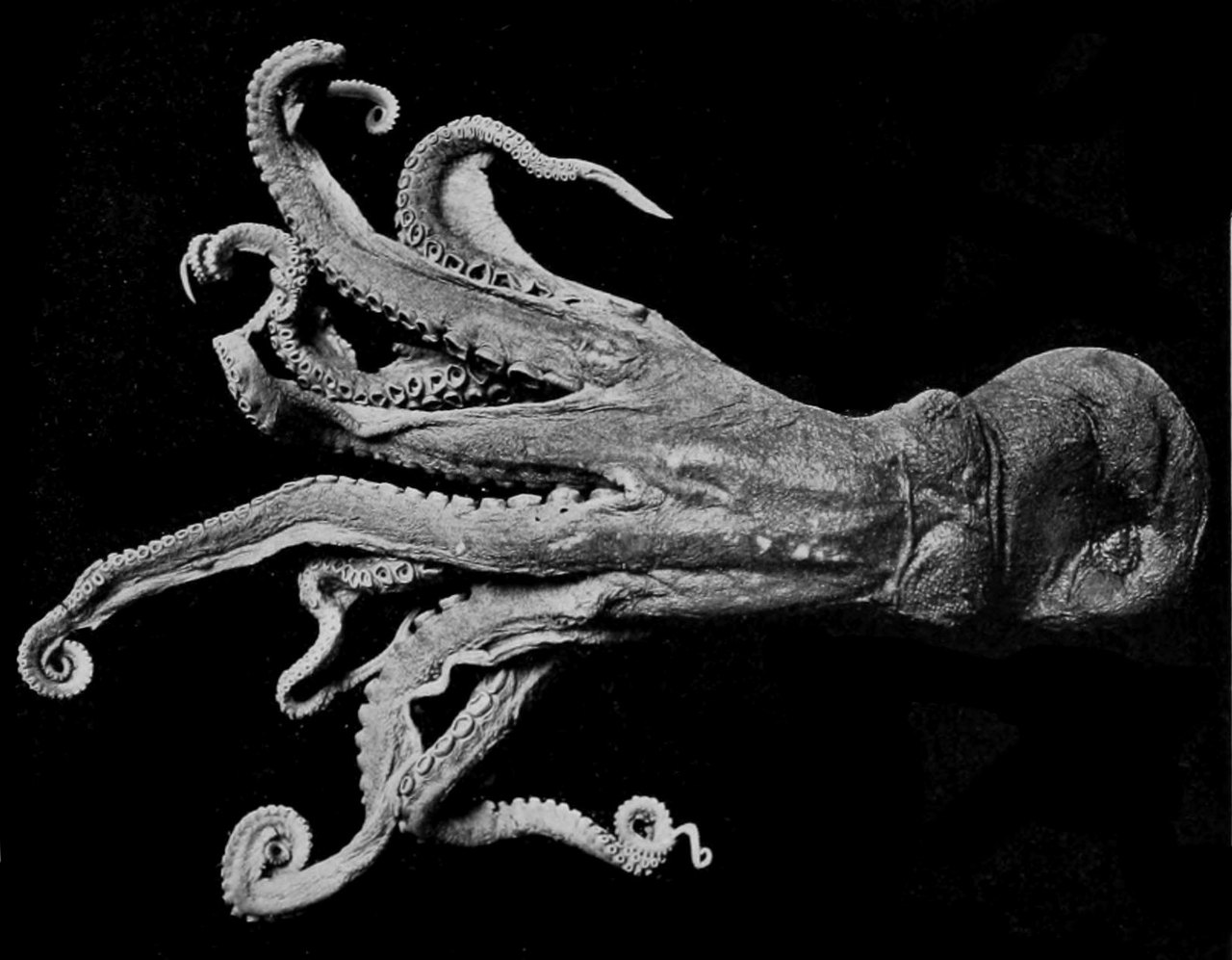
Visual AidThe creature she called the devilfish
A scientific illustration of the giant Pacific octopus, the largest octopus in the world and a real inhabitant of the cold water off the California coast. The Knowledge Bank explains that a big one can spread its arms wider than a room, that each arm carries hundreds of suckers that grip and taste at once, and that it is among the most intelligent animals in the sea. Follow one arm from the body to its tip, and count the suckers the drawing shows.
Giant Pacific octopus, scientific illustration. Source: Wikimedia Commons, public domain.
contentadj.Ch.20
Happy and at peace with what one has
“For a time Karana felt content.”
cormorantn.Ch.20
A dark seabird that dives for fish
“She gathered cormorant feathers for a skirt.”
devilfishn.Ch.21
Karana’s name for the giant octopus
“She feared and admired the great devilfish.”
barbn.Ch.21
A sharp point that catches and holds
“She carved a barb onto her new spear.”
tentaclen.Ch.22
A long, bending arm of a sea creature
“The devilfish gripped with each tentacle.”
strugglen.Ch.22
A hard, drawn-out fight or effort
“The struggle with the devilfish was long.”
alertadj.Ch.23
Watchful and ready for danger
“She stayed alert when the ship returned.”
concealv.Ch.23
To hide from sight
“Karana had to conceal herself in a cave.”
patiencen.Ch.21
Calm effort without giving up
“Making the spear point took great patience.”
triumphn.Ch.22
A great victory or success
“Landing the devilfish was a hard triumph.”
ⓘ The vocabulary words in this list are selected to help you understand and complete this workbook. Some may not appear verbatim in the original novel.
🧠Knowledge Bank question
1According to the Knowledge Bank, a cormorant is ___.Ch.23
2To be ‘content’ is to be happy and at peace with what you have.Ch.20
3A ‘tentacle’ is a long, bending ___ of a sea creature.Ch.22
4To ‘conceal’ something is to show it plainly.Ch.23
5Fill in each blank with the correct word.Ch.20
Word choices:cormorantdevilfishcontentsneer- some words will not be used
Karana sewed a skirt from feathers.
She feared the great in its cave.
6A ‘barb’ is a sharp point that catches and ___.Ch.21
7To be ‘alert’ is to be watchful and ready for danger.Ch.23
8A ‘triumph’ is a great ___.Ch.22
9Fill in each blank with the correct word.Ch.22
Word choices:strugglepatiencetriumphbarb- some words will not be used
The with the devilfish was long and hard.
Carving the spear point took great .
10‘Patience’ is calm effort without ___.Ch.21
Part 2
Comprehension
Show you understood what happens in Chapters 20–23.
🧠Knowledge Bank · Contentment and a Great Fight
Narrative Causality · Contentment and a Great Fight
Careful sequence reading reveals the textual evidence, the structural pivot, and the resulting consequence in Chapters 20–23. With Rontu at her side, Karana’s life on the island grows fuller and, for a while, content. She explores, gathers abalone and roots, catches and raises young birds who become tame pets, and sews herself a beautiful skirt from the glossy black feathers of cormorants. She feels, for the first time since her people left, something close to happiness. But one danger has long haunted her: in a deep cave in the sea lives a giant octopus, which she calls the devilfish, a creature so large and strong that she both fears and admires it. Over a long winter she carefully carves a special spear point strong enough to pierce it. Reading evidence around the pivot turns “Contentment and a Great Fight” into meaningful convergence.
Visual AidHow a writer builds to a fight
Diagram for the Knowledge Bank on suspense. The four numbered cards are the order the Knowledge Bank describes, and the gray card names where the tension actually lives. The battle is only the last box. Notice how much room the three slow steps take, which is the Knowledge Bank’s point about how a climax is prepared.
How suspense is built, as described in the Knowledge Bank. Drawn for Garden Heights Academy.
🧠Knowledge Bank question
1The Knowledge Bank says that with Rontu at her side, Karana’s life for a while grows ___.Ch.20
2Karana sews herself a beautiful skirt made of ___.Ch.20
3For a time in Part 6, Karana feels content and even happy.Ch.20
4The ‘devilfish’ Karana fears is really a giant ___.Ch.21
5Write the numbers 1–5 in the boxes to show the correct order of events. Number 1 = what happens first.Chapters 20–23
She and Rontu set out to hunt the devilfish.
In spring, the Aleut ship returns and she hides.
Karana lives contentedly with Rontu and tame birds.
After a long battle, she defeats the giant octopus.
She carves a special spear point over the winter.
6Karana spends a whole winter making a spear point for the devilfish.Ch.21
7During the devilfish battle, Karana is helped by ___.Ch.22
8The battle with the devilfish is best described as ___.Ch.22
9When the Aleut ship returns, Karana runs down to greet the hunters.Ch.23
10Karana hides from the returning Aleuts because they once ___.Ch.23
Part 3
Literary Elements
Understanding HOW and WHY Scott O'Dell tells the story across Chapters 20–23.
🧠Knowledge Bank · The Long Devilfish Battle
Narrative Technique · The Long Devilfish Battle
The pressure of Chapters 20–23 is crafted through suspense, climax, and symbolism working in combination. The fight with the giant devilfish is the great action climax of this stretch of the book — the peak of danger toward which the chapters build. O’Dell prepares it carefully: first the long fear of the creature, then a whole winter spent carving the one spear point that might pierce it, then the choice of the right day. By the time the battle comes, the reader is as tense as Karana. Notice how the author draws the fight out, making it long and uncertain, with the great arms coiling around her line and Rontu battling at her side — this is how a writer builds suspense to a breaking point. That authorial design makes “The Long Devilfish Battle” a lesson in deliberate perspective.
Suspense
O’Dell stretches the long devilfish battle to keep the reader tense over whether Karana will survive.
Climax
The fierce fight with the giant devilfish — a peak of danger and courage in Karana’s island life.
Symbolism
The cormorant-feather skirt — a sign of the beauty and contentment Karana makes for herself alone.
🧠Knowledge Bank question
1According to the Knowledge Bank, O’Dell prepares the devilfish battle with a whole winter spent ___.Ch.22
2Fill in each blank with the correct literary term.Ch.22
Word choices:suspenseclimaxnarratorrhyme- some words will not be used
Drawing out the devilfish fight builds .
The peak of that dangerous battle is the .
3Suspense is the tense feeling of not knowing what will happen.Ch.22
4The devilfish battle is the ___ of this part — its peak of action.Ch.22
5The cormorant-feather skirt mainly stands for Karana’s ___.Ch.20
6A climax is the peak of tension or action in a story.Ch.22
7O’Dell sets the peaceful skirt-making beside the dangerous hunt to show Karana’s ___.Ch.20
8Fill in each blank with the correct literary term.Ch.20
Word choices:symbolismclimaxmotifrhyme- some words will not be used
The beautiful feather skirt is a use of .
The devilfish battle is the part’s .
9The feather skirt shows that Karana wants beauty, not only survival.Ch.20
10The return of the Aleut ship in spring mainly renews the story’s ___.Ch.23
Part 4
Think Deeper
Four deeper challenges — no single-word recall. Read, weigh the evidence, and reason it out.
🧠Knowledge Bank · The Giant Pacific Octopus
Channel Islands Ecology · The Giant Pacific Octopus
The creature Karana calls the devilfish is real: the giant Pacific octopus, the largest octopus in the world, which lives in the cold waters off the California coast. A big one can stretch its arms wider than a room and weigh as much as a grown person, and each of its eight arms is lined with hundreds of powerful suckers that grip and taste at the same time. Despite its fearsome look, the octopus is not a monster but one of the most intelligent animals in the sea — able to solve puzzles, remember, use tools, and change the color and texture of its skin to vanish against rock or sand in an instant. Karana’s name for it is the interesting part. She calls it a devilfish and hunts it for two years, and O’Dell lets both things stand: she is afraid of it, she wants to kill it, and she describes it with more attention than she gives any human being in the book.
Think back over these chapters. A girl who once had nothing now has a home, a dog who loves her, birds that eat from her hand, and a shining skirt she sewed from black feathers just because it is beautiful. She is, for a while, content. But out in a deep sea-cave waits the thing she fears most, a giant octopus so huge she calls it the devilfish, and all winter she shapes a single spear point strong enough to face it. When the day comes, she and Rontu fight the great creature through a long and desperate struggle, and she wins. Then spring brings back the red sails of the Aleuts, the men who took her people, and the girl who can defeat a devilfish slips quietly into hiding, watching, waiting to see what these old enemies will do.
Original passage written for Garden Heights — not a quotation from the novel.
1Claim: “Part 6 shows that Karana’s island life is now full — holding both real contentment and real danger.” — choose the two details that best prove it.Claim & Evidence
2Beauty and contentment, or Danger and struggle? Tap each detail to sort it — tap again to switch sides. You can keep tapping to change your answer.Sort into two
◄ Beauty and contentmentDanger and struggle ►
3Match each cause to its result. For each cause, pick its result.Cause & Effect
Karana feels safe with Rontu→
She fears the giant devilfish→
She and Rontu hunt the octopus→
The Aleut ship returns in spring→
🧠Knowledge Bank question
4Fill both blanks to complete the reasoning.Build the Argument
The Knowledge Bank says that despite its fearsome look the octopus is , but instead one of the sea’s .
Part 5
Standardized Test
Reading passage · The Giant Pacific Octopus · SAT & TOEFL-style practice
Read the passage — the highlighted words are tested — then answer. Tap an answer, then tap it again to confirm.
SATCentral Ideas — the passage's main point
SATDetail — a fact stated in the passage
SATWords in Context — a word's meaning in this passage
SATInference — a conclusion the passage implies
TOEFLFactual Information — a fact stated in the passage
TOEFLVocabulary — a tested word's meaning here
TOEFLProse Summary — the three sentences that sum it up
The Giant Pacific Octopus
The creature Karana calls the devilfish is real: the giant Pacific octopus, the largest octopus in the world, which lives in the cold waters off the California coast. A big one can spread its arms wider than a room and weigh as much as a grown person. Each tentacle is lined with hundreds of powerful suckers that can grip and taste at the same time, and it has eight of them. For all its fearsome look it is not a mindless monster. In fact the octopus is among the most intelligent animals in the sea, able to solve puzzles, remember, and even use simple tools.
It defends itself in clever ways. It hides in a rocky den, and when threatened it can squirt a cloud of dark ink to confuse an attacker and cover its escape. Its greatest trick is to conceal itself completely: in an instant it changes the color and even the texture of its skin to match rock or sand, seeming to vanish before your eyes. It hunts crabs, clams, and fish with its strong arms. When Karana spends an entire winter carving a spear point strong enough to face such an animal, she shows real respect for its power. Her long battle with it is not cruelty but survival.
Original passage written for Garden Heights — not a quotation from the novel.
1What is the passage mainly about?SAT · Central Ideas
2The giant Pacific octopus is the ___ octopus in the world.TOEFL · Factual Information
3How many arms does the octopus have?SAT · Detail
4The suckers on its arms can grip and ___ at the same time.TOEFL · Factual Information
5The passage says the octopus is very ___.SAT · Detail
6When threatened, the octopus can squirt a cloud of dark ___.TOEFL · Factual Information
7In the passage, a tentacle is ___.SAT · Words in Context
8In the passage, to conceal itself is to ___.TOEFL · Vocabulary
9Prose Summary (TOEFL).The passage explains what the giant Pacific octopus is and how it defends itself. This TOEFL task lists six sentences; choose the THREE that best capture the passage’s main ideas. The other three do not belong — they state minor details or ideas the passage does not present.TOEFL · Prose Summary
10The passage says Karana’s long battle with the devilfish is ___.SAT · Inference
Part 6 · Optional
Creative Writing
A bonus challenge to practice your English. Take your time and have fun with it.
About This Section
This writing task is optional and is not part of your auto-graded score. The feedback below checks only the basics — length, spelling, and grammar — not whether your ideas are right or wrong. It is meant for classroom discussion and creative practice, so feel free to use your imagination!
Writing Task — Part 6 “Facing a Fear”
Karana gathers her courage over a long winter to face the giant devilfish. Write about a time you prepared for and faced something that frightened you. What was the challenge, how did you get ready, and what happened? 6–10 sentences. End with how you felt afterward.
You can start with: “I spent a long time getting ready to face it...”
0 / 40 words minimum
🗣 Teach It · Just for Fun (optional)
No right or wrong — close the screen and tell someone nearby what happened in this part. Can’t find anyone? Tell yourself out loud. The moment you teach it, you truly understand it.
Part 6 Complete!
You finished Chapters 20–23 of Island of the Blue Dolphins.
Here are your auto-graded results:
-
points out of 100
Teach it to someone
The best last step is to teach it. In your own words, explain what happened — retell a favorite scene, teach a character’s big choice, or sum up the main idea for a parent, friend, or classmate. When you can teach it clearly, you truly own it.
Independent study guide by Garden Heights. Not affiliated with or endorsed by Scott O'Dell. Contains original analysis only; no text from the novel is reproduced. Reference text: This workbook follows Scott O'Dell’s classic text (the standard Puffin edition sold worldwide). Revised 2023 UK editions change some wording and may not match the vocabulary studied here.
SAT® is a registered trademark of College Board, which is not affiliated with, and does not endorse, these materials. TOEFL® is a registered trademark of ETS. These materials are not endorsed or approved by ETS. Garden Heights is an independent provider of test-style reading practice.