New here? Just sign up with Google — your account includes Matilda, our gift book, forever.
Maniac Magee · Garden Heights
Part 2
for Maniac Magee · Part 2 · Chapters 6–12
8 Parts40 min
What Happens in Part 2
Now the legend truly takes off. Maniac performs one astonishing feat after another and the whole town starts talking. He races down the streets faster than anyone can believe; he snatches a football out of the air and returns it for a touchdown; he steps into the batter’s box against Giant John McNab, the huge, terrifying pitcher who strikes everyone out, and calmly hammers his fastballs — even smacking a hit off a frog that McNab hurls in fury. Most famous of all, he sits down and patiently unties Cobble’s Knot, a monstrous, tangled knot at the corner store that no one has ever undone, winning himself free pizza and permanent legend status. But as Maniac runs everywhere, he crosses a line he does not even know exists. Two Mills, it turns out, is a town split in two: white families live in the West End, Black families live in the East End, and the two sides do not mix. Maniac, an outsider who sees people but not colors, wanders straight into the East End, where he meets Mars Bar Thompson, a tough, proud boy who tries to scare him off. Instead of backing down, Maniac calmly takes a bite of the candy bar Mars Bar is holding — an act so fearless and so blind to the color line that it stuns everyone watching. The legend is spreading, and it is about to run right into the town’s deepest divide.
The feats as legend fuel, an introduced conflict, and a boy blind to the line
Cross-Curricular
The color line: how American neighborhoods became segregated
Chapter Summary
Ch.
What happens
Chapters 6–9
The Feats — Maniac’s legend grows: he outruns everyone, hits Giant John McNab’s pitches, and unties the impossible Cobble’s Knot, winning fame and free pizza.
Chapters 10–12
The Color Line — Two Mills is split into a white West End and a Black East End; the outsider Maniac wanders east and calmly bites Mars Bar’s candy, blind to the divide.
Part 1
Vocabulary
Study 10 key words from Chapters 6–12, then answer each question.
🧠Knowledge Bank · Words of Feats and Fences
Lexical Semantics · Words of Feats and Fences
Two of these words are about doing and two are about dividing. A feat is a remarkable act of skill or daring, which is what Maniac keeps performing — the knot, the frog ball, the running. To segregate is to keep groups apart, often by race, and Two Mills has done exactly that without ever passing a law. A boundary is a line that divides one area from another; here it is Hector Street, and nothing marks it but everybody knowing. Prejudice is an unfair opinion formed before knowing, and it is the reason the boundary holds. Put them together and the chapter’s joke becomes clear. Maniac’s feats are all about crossing things — knots, ropes, streets. Nobody in Two Mills applauds the last kind, because the one crossing the town cannot forgive is the one he does without trying.
featn.Ch.6
A remarkable act of skill or daring
“Untying the knot was an amazing feat.”
segregatev.Ch.10
To keep groups apart, often by race
“The town was segregated into two ends.”
boundaryn.Ch.10
A line that divides one area from another
“Hector Street was the unspoken boundary.”
prejudicen.Ch.11
An unfair opinion formed before knowing
“The town was full of racial prejudice.”
fearlessadj.Ch.12
Showing no fear
“Maniac was fearless with Mars Bar.”
outsidern.Ch.10
A person who does not belong to a group
“As an outsider, Maniac ignored the rules.”
intimidatev.Ch.12
To frighten into obedience
“Mars Bar tried to intimidate the new kid.”
dividev.Ch.10
To split into separate parts
“One street divided the whole town.”
astonishingadj.Ch.6
Amazing; very surprising
“His feats were simply astonishing.”
ignorev.Ch.12
To pay no attention to
“Maniac seemed to ignore the color line.”
ⓘ The vocabulary words in this list are selected to help you understand and complete this workbook. Some may not appear verbatim in the original novel.
🧠Knowledge Bank question
1According to the Knowledge Bank, what marks the boundary between the two sides of Two Mills?Ch.6
2To ‘segregate’ is to keep groups apart, often by race.Ch.10
3A line that divides one area from another is a ___.Ch.10
4‘Prejudice’ is a fair opinion based on full knowledge.Ch.11
5Fill in each blank with the correct word.Ch.12
Word choices:fearlessintimidatefeatsneer- some words will not be used
Mars Bar tried to the new boy.
But Maniac was calm and .
6An ‘outsider’ is a person who ___ a group.Ch.10
7To ‘divide’ is to split into separate parts.Ch.10
8Something ‘astonishing’ is very ___.Ch.6
9Fill in each blank with the correct word.Ch.10
Word choices:segregateboundaryprejudicefeat- some words will not be used
An unspoken split the two ends.
Old habits of kept the sides apart.
10To ‘ignore’ something is to ___ it.Ch.12
Part 2
Comprehension
Show you understood what happens in Chapters 6–12.
🧠Knowledge Bank · Feats and a Divide
Narrative Causality · Feats and a Divide
The events of Chapters 6–12 become clearer when readers separate a character’s motive from the obstacle encountered and the response that follows. Now the legend truly takes off. Maniac performs one astonishing feat after another and the whole town starts talking. He races down the streets faster than anyone can believe; he snatches a football out of the air and returns it for a touchdown; he steps into the batter’s box against Giant John McNab, the huge, terrifying pitcher who strikes everyone out, and calmly hammers his fastballs — even smacking a hit off a frog that McNab hurls in fury. Most famous of all, he sits down and patiently unties Cobble’s Knot, a monstrous, tangled knot at the corner store that no one has ever undone, winning himself free pizza and permanent legend status. Following motive through response reveals why “Feats and a Divide” forms a consequential sequence.
🧠Knowledge Bank question
1The Knowledge Bank explains that Maniac’s feats matter to the plot because they ___.Ch.6
2Giant John McNab is famous as a pitcher who ___.Ch.7
3No one has ever managed to untie Cobble’s Knot before Maniac.Ch.9
4Two Mills is divided into a white West End and a ___.Ch.10
5Write the numbers 1–5 in the boxes to show the correct order of events. Number 1 = what happens first.Chapters 6–12
He wanders into the East End, crossing the color line.
He unties the impossible Cobble’s Knot.
Maniac returns a football for a touchdown.
He calmly bites Mars Bar’s candy, blind to the divide.
He hits Giant John McNab’s fastballs.
6Maniac clearly understands the town’s color line.Ch.10
7When Maniac enters the East End, ___ tries to scare him off.Ch.12
8Maniac stuns everyone by ___.Ch.12
9Maniac reacts to Mars Bar with fear and hostility.Ch.12
10By the end of Part 2, Maniac’s legend is running straight into the town’s ___.Ch.12
Part 3
Literary Elements
Understanding HOW and WHY Jerry Spinelli tells the story across Chapters 6–12.
🧠Knowledge Bank · Feats as Legend Fuel
Narrative Technique · Feats as Legend Fuel
The craft of Part 2 works through symbol, conflict, and foreshadowing, each shaping how readers judge the new conflict. Watch how Spinelli uses Maniac’s feats. Each amazing act — the football, the hits off McNab, Cobble’s Knot — is a log thrown on the fire of the legend, and Spinelli tells them in the tall-tale voice set up in Part 1, half believing, half winking. But notice these feats do more than entertain. Untangling an impossible knot, hitting the un-hittable pitcher: they quietly establish Maniac as someone who does what everyone else says cannot be done. That is not just athletic talent; it is a preview of the book’s real challenge, the ‘impossible knot’ of racial division. Spinelli is training the reader to believe that this boy can untangle things others have given up on. That authorial design makes “Feats as Legend Fuel” a lesson in deliberate suspense.
Visual AidEach feat feeds the fire
Diagram for the Knowledge Bank on how the feats work. Cards 1 to 3 are three of Maniac's famous acts, dashed arrows carry each of them into card 4, the legend growing again, and card 5 is the quieter thing every feat also does. The Knowledge Bank calls each act a log thrown on the fire. Notice that the arrows only run one way. Nothing in the town ever shrinks the legend back down; it only ever grows.
How each feat feeds the legend, as described in the Knowledge Bank. Drawn for Garden Heights Academy.
Symbol
Cobble’s Knot — the impossible tangle Maniac undoes, standing for the town’s racial division.
Conflict
The color line — the segregation that becomes the book’s central problem.
Foreshadowing
That Maniac unties what others can’t hints he may loosen the town’s deeper knot.
🧠Knowledge Bank question
1According to the Knowledge Bank, each of Maniac’s feats works in the story as ___.Ch.9
2Fill in each blank with the correct literary term.Ch.10
Word choices:symbolconflictsettingrhyme- some words will not be used
Cobble’s Knot works as a of the town’s division.
The color line is the book’s central .
3Conflict is the central problem or struggle in a story.Ch.10
4That Maniac unties the ‘impossible’ knot is ___ of his effect on the town.Ch.9
5The candy-bar bite mainly shows the book’s ___ that divisions are not natural.Ch.12
6A symbol is an object that also stands for a larger idea.Ch.9
7Spinelli tells the feats in a ___ voice, half believing, half winking.Ch.6
8Fill in each blank with the correct literary term.Ch.9
Word choices:foreshadowingsymbolnarratormotif- some words will not be used
Untying the impossible knot is of Maniac’s effect on the town.
The knot itself is a of division.
9The color line is only a minor detail with no effect on the plot.Ch.10
10The clearest sign the real story is about race is that Maniac ___.Ch.12
Part 4
Think Deeper
Four deeper challenges — no single-word recall. Read, weigh the evidence, and reason it out.
🧠Knowledge Bank · The Color Line
Segregated Neighborhoods · The Color Line
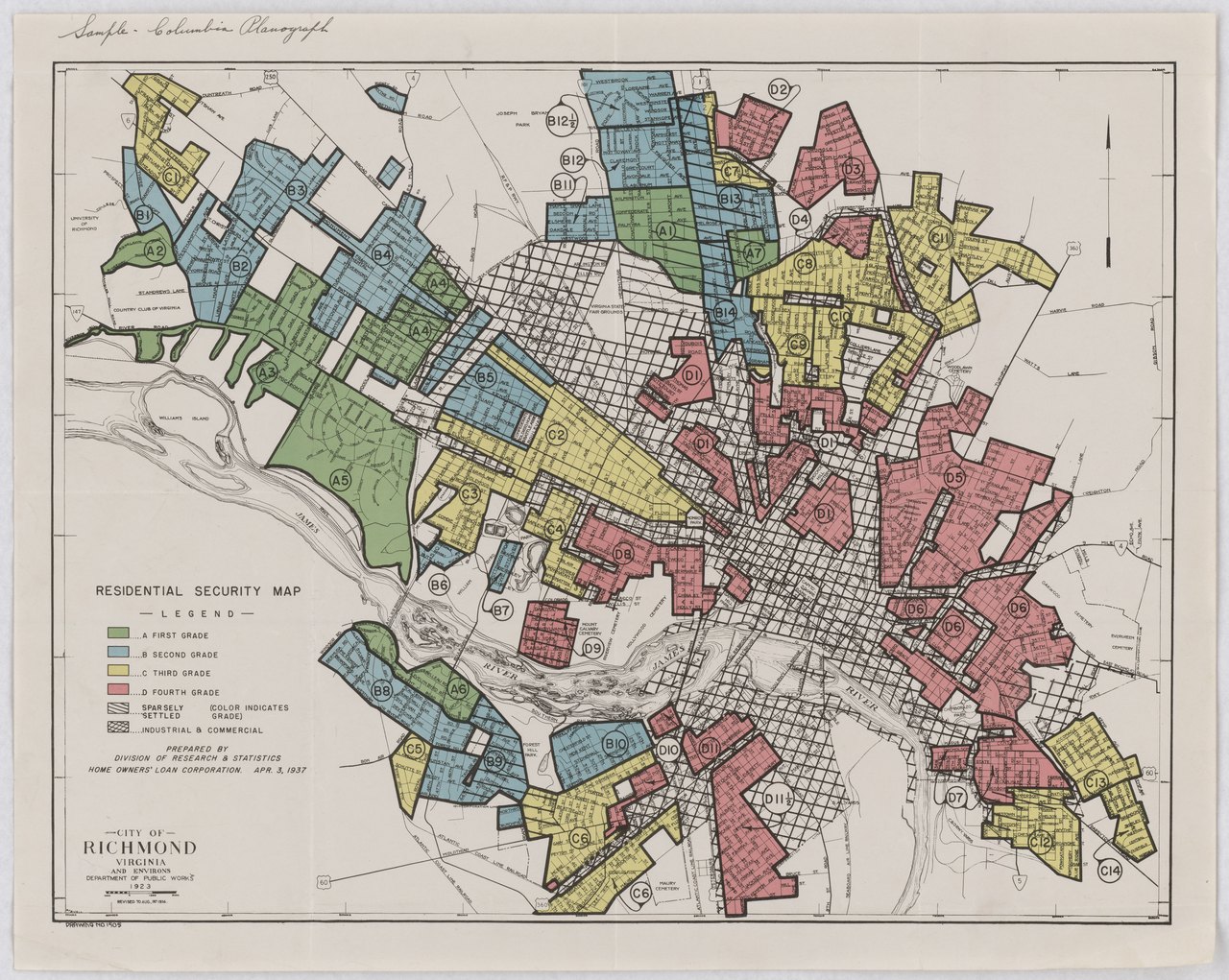
The invisible border Maniac crosses is the heart of the book, and it reflects a hard American reality. Two Mills is divided by race: white families in the West End, Black families in the East End, with an unspoken line between. This kind of split — whole neighborhoods separated by race — was not an accident or a law of nature; it was created. For much of the twentieth century, banks, real-estate agents, and government policies deliberately kept Black families out of white neighborhoods, through practices such as redlining (refusing loans in Black areas), restrictive rules written into house deeds, and threats when families tried to cross the line. That history is why the book’s central image is a street rather than a fence. Nobody built a wall down Hector Street. It works because everyone on both sides agrees it is there — which is also the only reason it could ever stop working.
Visual AidThe map that drew the line
A Residential Security Map of Richmond, Virginia, drawn in the 1930s. Find the legend at the lower left: neighborhoods were graded first, second, third and fourth, and the fourth grade was printed in red. The Knowledge Bank explains that banks and government agencies used maps like this one to refuse loans in Black neighborhoods, a practice later called redlining. This is what it means to say the color line was created rather than inherited. Somebody sat down with colored pencils and drew it.
Residential Security Map, City of Richmond, Virginia and Environs; U.S. National Archives. Source: Wikimedia Commons, public domain.
Think back over these chapters. A boy runs faster than the town can believe, plucks a football from the air, and stands in against a pitcher so scary that grown kids shake — and calmly hits him, even hits the frog he throws. He sits in the street and, finger by patient finger, undoes a knot no one has ever conquered, and the legend catches fire. Then his running carries him across a street that everyone but him knows is a wall: white on one side, Black on the other. A tough kid steps up to frighten the outsider off, and the outsider, seeing only another boy with a candy bar, leans in and takes a friendly bite — and a whole crowd goes silent, because he has just walked through a line they thought was solid.
Original passage written for Garden Heights — not a quotation from the novel.
1Claim: “Part 2 uses Maniac’s feats to prepare us to believe he can loosen the town’s racial knot.” — choose the two details that best prove it.Claim & Evidence
2Maniac’s athletic feats, or The town’s human ‘knot’? Tap each detail to sort it — tap again to switch sides. You can keep tapping to change your answer.Sort into two
◄ Maniac’s athletic featsThe town’s human ‘knot’ ►
3Match each cause to its result. For each cause, pick its result.Cause & Effect
Maniac hits Giant John McNab→
He unties Cobble’s Knot→
He wanders into the East End→
He bites Mars Bar’s candy→
🧠Knowledge Bank question
4Fill both blanks to complete the reasoning.Build the Argument
The Knowledge Bank argues that the split between the West End and the East End was , which shows that .
Part 5
Standardized Test
Reading passage · The Color Line: Segregated Neighborhoods · SAT & TOEFL-style practice
Read the passage — the highlighted words are tested — then answer. Tap an answer, then tap it again to confirm.
SATCentral Ideas — the passage's main point
SATWords in Context — a word's meaning in this passage
SATDetail — a fact stated in the passage
SATText Connections — how two parts of the text relate
TOEFLFactual Information — a fact stated in the passage
TOEFLVocabulary — a tested word's meaning here
TOEFLProse Summary — the three sentences that sum it up
Redlining and the Color Line
The invisible wall Maniac crosses in Two Mills — white families on one side, Black families on the other — is drawn from a real and painful part of American history. For much of the twentieth century, many towns and cities were sharply divided by race, with Black and white residents living in separate neighborhoods that rarely mixed. It is tempting to imagine this just happened on its own, but it did not. Powerful people worked to segregate one street from the next, on purpose, in ways most residents never saw.
Several tools built the color line. In a practice later called redlining, banks and government agencies drew maps that marked Black neighborhoods in red and refused to lend money there, making it nearly impossible for families to buy homes or improve them. Many house deeds carried rules forbidding the owner from ever selling to a Black family. And when Black families did try to move into white areas, they often faced threats or violence. Even after such practices were finally made illegal in the mid-twentieth century, the neighborhoods they had shaped did not magically un-divide, and the boundary held for decades, which is why so many American towns — like the fictional Two Mills — stayed split long after the laws changed. Spinelli never delivers a history lesson; he simply drops a boy who does not see color into a town built entirely around it.
Original passage written for Garden Heights — not a quotation from the novel.
1What does the passage mainly explain?SAT · Central Ideas
2For much of the twentieth century, many towns were divided by ___.TOEFL · Factual Information
3The passage says the separation ___.TOEFL · Factual Information
4In the passage, segregate most nearly means ___.SAT · Words in Context
5Many house deeds carried rules forbidding sale to a ___ family.TOEFL · Factual Information
6Black families who tried to move into white areas often faced ___.TOEFL · Factual Information
7After the practices were made illegal, the divided neighborhoods ___.SAT · Detail
8In the passage, boundary most nearly means ___.TOEFL · Vocabulary
9Prose Summary (TOEFL).The passage explains how and why American neighborhoods became segregated by race. This TOEFL task lists six sentences; choose the THREE that best capture the passage’s main ideas. The other three do not belong — they state minor details or ideas the passage does not present.TOEFL · Prose Summary
10Which part of the book does this passage BEST help explain?SAT · Text Connections
Part 6 · Optional
Creative Writing
A bonus challenge to practice your English. Take your time and have fun with it.
About This Section
This writing task is optional and is not part of your auto-graded score. The feedback below checks only the basics — length, spelling, and grammar — not whether your ideas are right or wrong. It is meant for classroom discussion and creative practice, so feel free to use your imagination!
Writing Task — Part 2 “A Line You Didn’t See”
Maniac crosses a line everyone else treats as real, simply because he never learned it was there. Write about an unspoken ‘line’ or divide you have noticed — between groups at school, in a town, or anywhere — and what it would mean to cross it. What is the line, why does it exist, and should it? 6–10 sentences. End with your view on the divide.
You can start with: “Nobody ever announced the rule, but everyone seemed to know it...”
0 / 40 words minimum
🗣 Teach It · Just for Fun (optional)
No right or wrong — close the screen and tell someone nearby what happened in this part. Can’t find anyone? Tell yourself out loud. The moment you teach it, you truly understand it.
Part 2 Complete!
You finished Chapters 6–12 of Maniac Magee.
Here are your auto-graded results:
-
points out of 100
Teach it to someone
The best last step is to teach it. In your own words, explain what happened — retell a favorite scene, teach a character’s big choice, or sum up the main idea for a parent, friend, or classmate. When you can teach it clearly, you truly own it.
Independent study guide by Garden Heights. Not affiliated with or endorsed by Jerry Spinelli. Contains original analysis only; no text from the novel is reproduced. Reference text: This workbook follows Jerry Spinelli’s classic text (the standard Puffin edition sold worldwide). Revised 2023 UK editions change some wording and may not match the vocabulary studied here.
SAT® is a registered trademark of College Board, which is not affiliated with, and does not endorse, these materials. TOEFL® is a registered trademark of ETS. These materials are not endorsed or approved by ETS. Garden Heights is an independent provider of test-style reading practice.