New here? Just sign up with Google — your account includes Matilda, our gift book, forever.
Maniac Magee · Garden Heights
Part 3
for Maniac Magee · Part 3 · Chapters 13–20
8 Parts40 min
What Happens in Part 3
Amanda Beale’s family opens its door, and for the first time in his life Maniac has a home. The Beales — Amanda, her mother and father, and her little brother and sister — take the homeless boy in, and he moves into their house in the East End at 728 Sycamore Street. To Maniac, who has spent years without one, the greatest treasure is not the food or the bed but the ADDRESS itself: a real place that is his, a family that laughs and argues and talks. He is blissfully, almost painfully happy; he does chores, plays with the little ones, and lovingly repairs Amanda’s favorite book after the baby chews it. But the world outside the Beales’ front door has not changed. A white boy living with a Black family unsettles people on both sides of the color line, and one morning an ugly slur — telling the ‘fishbelly’ to go home — is scrawled across the Beales’ house. Maniac slowly, sickeningly understands: his presence is bringing anger and danger down on the very people he loves most. He cannot bear to be the reason the Beales are threatened. So, the way he has answered pain his whole life, Maniac runs — slipping away in the night, giving up the only home he has ever known in order to protect it.
What We Will Learn
Section
What you will practice
Vocabulary
Home words: address, belong, slur, vandalize, sacrifice…
Literary Elements
The longed-for home, the intruding hatred, and a selfless choice
Cross-Curricular
Prejudice is learned, not born
Chapter Summary
Ch.
What happens
Chapters 13–16
An Address at Last — the Beale family takes Maniac in at 728 Sycamore; the homeless boy’s greatest joy is finally having a home, a family, and an address of his own.
Chapters 17–20
Fishbelly Go Home — a racist slur is scrawled on the Beales’ house; realizing his presence endangers the family he loves, Maniac slips away to protect them.
Part 1
Vocabulary
Study 10 key words from Chapters 13–20, then answer each question.
🧠Knowledge Bank · Words of Home and Hate
Lexical Semantics · Words of Home and Hate
These four words tell the whole arc of Part 3 in order. An address is the location where someone lives, and for a boy who has been sleeping in a band shell it means far more than a street number. To belong is to have a rightful, welcome place, which is what the Beales give him — not shelter, but a place at the table. A slur is an insulting word aimed at a group, and it turns up painted across the front of that house. To vandalize is to damage property on purpose, which is what somebody does to the only home Maniac has. Read the four as a sequence and you have the cruelty of this section exactly: he is given an address, and the address is what makes him a target.
addressn.Ch.13
The location where someone lives
“An address of his own meant everything to Maniac.”
belongv.Ch.14
To have a rightful, welcome place
“At the Beales’, Maniac finally belonged.”
slurn.Ch.18
An insulting word aimed at a group
“A racist slur was painted on the house.”
vandalizev.Ch.18
To damage property on purpose
“Someone vandalized the Beales’ home.”
sacrificen.Ch.20
Giving up something for another’s good
“Leaving was a sacrifice to protect the family.”
bigotn.Ch.18
A person full of prejudice
“A bigot had scrawled the hateful words.”
cherishv.Ch.14
To hold dear and care for
“Maniac cherished his new home.”
endangerv.Ch.19
To put at risk of harm
“His presence seemed to endanger the Beales.”
repairv.Ch.15
To fix something broken
“He lovingly repaired Amanda’s chewed book.”
threatenv.Ch.18
To warn of harm to come
“The graffiti seemed to threaten the family.”
ⓘ The vocabulary words in this list are selected to help you understand and complete this workbook. Some may not appear verbatim in the original novel.
🧠Knowledge Bank question
1According to the Knowledge Bank, why does an address mean more to Maniac than a street number?Ch.13
2To ‘belong’ is to have a rightful, welcome place.Ch.14
3An insulting word aimed at a whole group is a ___.Ch.18
4To ‘vandalize’ is to carefully repair property.Ch.18
5Fill in each blank with the correct word.Ch.20
Word choices:sacrificeaddressslursneer- some words will not be used
Having an of his own meant everything to Maniac.
Leaving the Beales was a to keep them safe.
6A ‘bigot’ is a person full of ___.Ch.18
7To ‘cherish’ something is to hold it dear.Ch.14
8To ‘endanger’ someone is to put them at risk of ___.Ch.19
9Fill in each blank with the correct word.Ch.18
Word choices:vandalizethreatenrepairbelong- some words will not be used
Someone chose to the Beales’ home.
The hateful words seemed to the family.
10To ‘repair’ something is to ___ it.Ch.15
Part 2
Comprehension
Show you understood what happens in Chapters 13–20.
🧠Knowledge Bank · A Home, Then a Sacrifice
Narrative Causality · A Home, Then a Sacrifice
This portion of Maniac Magee links setting to conflict, then measures the human change produced by that collision. Amanda Beale’s family opens its door, and for the first time in his life Maniac has a home. The Beales — Amanda, her mother and father, and her little brother and sister — take the homeless boy in, and he moves into their house in the East End at 728 Sycamore Street. To Maniac, who has spent years without one, the greatest treasure is not the food or the bed but the ADDRESS itself: a real place that is his, a family that laughs and argues and talks. He is blissfully, almost painfully happy; he does chores, plays with the little ones, and lovingly repairs Amanda’s favorite book after the baby chews it. This event pattern makes “A Home, Then a Sacrifice” the section’s central reversal.
🧠Knowledge Bank question
1The Knowledge Bank explains that the Beales give Maniac something greater than food or a bed, namely ___.Ch.13
2For Maniac, the single greatest treasure of the Beales’ house is ___.Ch.13
3Maniac is unhappy living with the Beales.Ch.14
4One morning, the Beales’ house is ___.Ch.18
5Write the numbers 1–5 in the boxes to show the correct order of events. Number 1 = what happens first.Chapters 13–20
A racist slur is painted on the Beales’ house.
He repairs Amanda’s chewed book and does chores.
The Beales take homeless Maniac into their home.
To protect them, Maniac slips away in the night.
Maniac rejoices at finally having an address.
6Everyone in town is happy to see a white boy living with a Black family.Ch.18
7The slur on the house makes Maniac realize his presence ___ the Beales.Ch.19
8Maniac leaves the Beales mainly to ___.Ch.20
9Maniac leaves because the Beales reject him.Ch.20
10Maniac’s choice to leave is best described as a ___.Ch.20
Part 3
Literary Elements
Understanding HOW and WHY Jerry Spinelli tells the story across Chapters 13–20.
🧠Knowledge Bank · The Meaning of an Address
Narrative Technique · The Meaning of an Address
Across Chapters 13–20, symbol interacts with irony and sacrifice to complicate the apparent meaning of events. Notice what thrills Maniac most about the Beales’ house: not the meals, but the ADDRESS — 728 Sycamore Street. Spinelli makes the address a powerful symbol. To most people a house number is nothing; to a boy who has been homeless and orphaned, it means belonging, permanence, proof that he EXISTS somewhere and matters to someone. All Maniac’s legendary feats cannot give him what a simple address can. Watch how the book measures Maniac’s whole journey by this one longing: he does not want fame or victory; he wants a place, a family, an address. When you understand what the address means to him, you understand why leaving the Beales — and, at the end, coming back — matters more than any home run. That authorial design makes “The Meaning of an Address” a lesson in deliberate contrast.
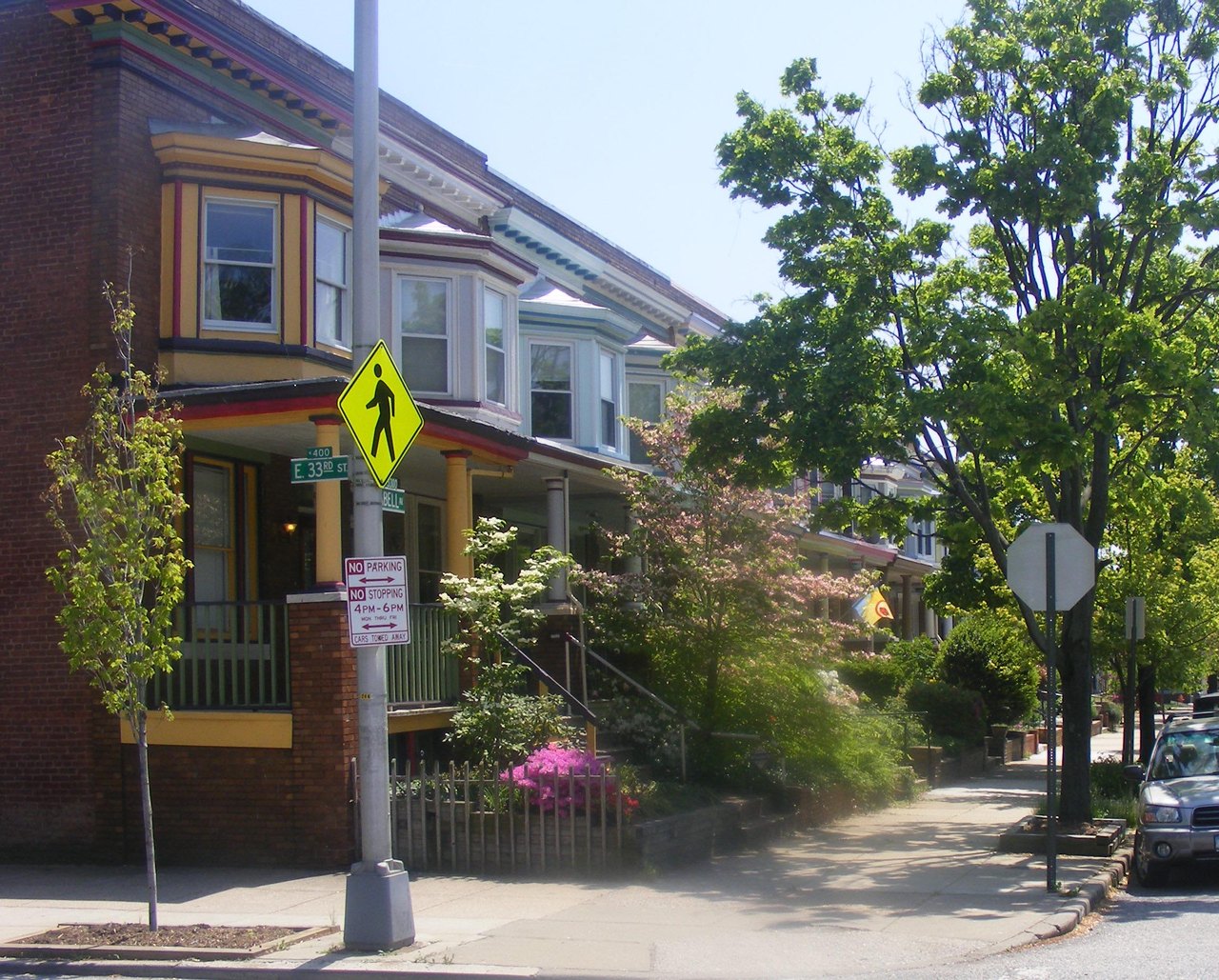
Visual AidA door, a step, a number
A row of joined houses on one street, each with its own porch, its own steps and its own front door. The Knowledge Bank explains that Spinelli turns a house number into a symbol: to most people 728 Sycamore Street is nothing, but to a boy who has been orphaned and homeless it means belonging, permanence, and proof that he exists somewhere. Look along the row and count the doors. Every one of them is an address that somebody can be reached at, and that is precisely what Maniac has never had.
Row houses in the Charles Village-Abell Historic District, Baltimore. Source: Wikimedia Commons, public domain.
Symbol
The address, 728 Sycamore — standing for belonging and proof that Maniac matters.
Irony
Maniac finds his dream home, only to be forced out of it by hatred aimed at the family.
Sacrifice
Leaving the Beales — giving up his own happiness to protect the people he loves.
🧠Knowledge Bank question
1According to the Knowledge Bank, Spinelli turns the house number into a symbol of ___.Ch.13
2Fill in each blank with the correct literary term.Ch.13
Word choices:symbolsacrificesettingrhyme- some words will not be used
The address 728 Sycamore works as a of belonging.
Leaving the Beales to protect them is a .
3A symbol is an object that also stands for a larger idea.Ch.13
4It is ironic that Maniac finds his dream home and then ___.Ch.20
5Maniac leaving to protect the Beales is an act of ___.Ch.20
6Irony is when the outcome is the opposite of what is hoped or expected.Ch.20
7The address matters more than Maniac’s feats because it gives him ___.Ch.13
8Fill in each blank with the correct literary term.Ch.20
Word choices:ironysymbolnarratormotif- some words will not be used
Finding a home only to be driven from it by hate is .
The address that stands for belonging is a .
9Maniac’s sacrifice shows how racism can wound even the innocent.Ch.20
10The deepest reason leaving hurts Maniac is that he is giving up ___.Ch.20
Part 4
Think Deeper
Four deeper challenges — no single-word recall. Read, weigh the evidence, and reason it out.
🧠Knowledge Bank · Prejudice Is Learned
Where Hate Comes From · Prejudice Is Learned
The ugly graffiti on the Beales’ house forces a question the whole book is asking: where does racial hatred come from? The answer, which Maniac embodies, is that prejudice is not something people are born with — it is taught. Young children do not naturally sort others by race or hate across a color line; researchers who study children find that babies and toddlers happily play with anyone. Prejudice is learned later, absorbed from the words, fears, and examples of the adults and communities around them, until it feels normal and even invisible to the people who hold it. That is exactly why Maniac, an outsider raised without those lessons, simply does not see the line others treat as sacred. If prejudice were natural, he would have arrived with it. He did not, because nobody was there to teach him — which means the line is not a fact about the world but a lesson somebody gave.
Visual AidWhere the hatred comes from
Diagram for the Knowledge Bank on learned prejudice. The four numbered steps run downward: nobody is born with it, it is absorbed from the adults nearby, it stops being visible, and therefore it can be unlearned. The Knowledge Bank rests all of this on what researchers find in very young children, who play with anyone. Notice that step 3 is the dangerous one. Once a habit stops being visible, the people who hold it can no longer see anything strange about it.
How prejudice is learned and unlearned, as described in the Knowledge Bank. Drawn for Garden Heights Academy.
Think back over these chapters. A homeless boy is folded into a warm, loud, loving family, and what makes him happiest is the least glamorous thing imaginable: a house number, an address, a place he can finally call his. He fixes a chewed book, minds the little ones, belongs. And then, one morning, ugly words appear across the front of the house — hate aimed not really at him but at the family for daring to love him — and the boy understands that his happiness is a danger to the people who gave it to him. So he does the hardest thing: he gives up the home he has wanted his whole life, and walks away in the dark, to keep it safe.
Original passage written for Garden Heights — not a quotation from the novel.
1Claim: “Part 3 shows that Maniac values belonging — an address and a family — above any of his famous feats.” — choose the two details that best prove it.Claim & Evidence
2What the legend gives Maniac, or What the Beales give Maniac? Tap each detail to sort it — tap again to switch sides. You can keep tapping to change your answer.Sort into two
◄ What the legend gives ManiacWhat the Beales give Maniac ►
3Match each cause to its result. For each cause, pick its result.Cause & Effect
The Beales take Maniac in→
Maniac repairs Amanda’s book→
A slur is painted on the house→
Maniac slips away in the night→
🧠Knowledge Bank question
4Fill both blanks to complete the reasoning.Build the Argument
The Knowledge Bank argues that racial hatred is not something people are born with because , which shows that .
Part 5
Standardized Test
Reading passage · Prejudice Is Learned, Not Born · SAT & TOEFL-style practice
Read the passage — the highlighted words are tested — then answer. Tap an answer, then tap it again to confirm.
SATCentral Ideas — the passage's main point
SATDetail — a fact stated in the passage
SATInference — a conclusion the passage implies
SATWords in Context — a word's meaning in this passage
SATText Connections — how two parts of the text relate
TOEFLFactual Information — a fact stated in the passage
TOEFLVocabulary — a tested word's meaning here
Why Prejudice Has to Be Taught
The hateful words painted on the Beales’ house raise a question the whole novel circles: where does racial prejudice come from? A painted slur is meant to wound a whole group at once, and Maniac cannot understand it, because he simply does not have that hatred. He walks across a color line everyone else treats as sacred, and treats Black and white families exactly the same, for one reason: no one ever taught him not to. This matches what scientists who study children find. People are not born prejudiced. Babies and very young children happily play with anyone, paying no attention to differences of skin color that adults treat as enormous.
Prejudice, in other words, is learned: it is absorbed a little at a time from the words, the fears, the jokes, and the examples of the grown-ups around a child, until the divisions come to feel like the way things are — so ordinary that they become invisible. That is why the bigots of Two Mills cannot see how strange their hatred is, while Maniac, raised outside those lessons, cannot see the line at all. And there is real hope in this fact. Because prejudice is learned, it can also be unlearned, and children who grow up beside people different from themselves, and who belong to a mixed circle of friends, are far less likely to absorb it. The color line is not a law of nature. It is a human habit, and habits can be changed.
Original passage written for Garden Heights — not a quotation from the novel.
1What is the main idea of the passage?SAT · Central Ideas
2Maniac crosses the color line easily because ___.TOEFL · Factual Information
3Scientists find that people are ___ prejudiced.TOEFL · Factual Information
4Very young children tend to ___ with anyone.SAT · Detail
5Prejudice is absorbed from the words and examples of the ___ around a child.TOEFL · Factual Information
6To those who hold it, learned prejudice comes to feel ___.SAT · Inference
7In the passage, slur most nearly means ___.SAT · Words in Context
8Children less likely to absorb prejudice are those who ___ people different from them.TOEFL · Factual Information
9In the passage, belong most nearly means ___.TOEFL · Vocabulary
10Which part of the book does this passage BEST help explain?SAT · Text Connections
Part 6 · Optional
Creative Writing
A bonus challenge to practice your English. Take your time and have fun with it.
About This Section
This writing task is optional and is not part of your auto-graded score. The feedback below checks only the basics — length, spelling, and grammar — not whether your ideas are right or wrong. It is meant for classroom discussion and creative practice, so feel free to use your imagination!
Writing Task — Part 3 “Where It Comes From”
The book suggests that no one is born prejudiced — it is learned. Write about something you learned to think or feel from the people around you — good or bad — that you later questioned. What did you absorb, when did you start to think for yourself about it, and what do you believe now? 6–10 sentences. End with why it matters to question what we are taught.
You can start with: “For a long time I just believed what I’d always heard, until...”
0 / 40 words minimum
🗣 Teach It · Just for Fun (optional)
No right or wrong — close the screen and tell someone nearby what happened in this part. Can’t find anyone? Tell yourself out loud. The moment you teach it, you truly understand it.
Part 3 Complete!
You finished Chapters 13–20 of Maniac Magee.
Here are your auto-graded results:
-
points out of 100
Teach it to someone
The best last step is to teach it. In your own words, explain what happened — retell a favorite scene, teach a character’s big choice, or sum up the main idea for a parent, friend, or classmate. When you can teach it clearly, you truly own it.
Independent study guide by Garden Heights. Not affiliated with or endorsed by Jerry Spinelli. Contains original analysis only; no text from the novel is reproduced. Reference text: This workbook follows Jerry Spinelli’s classic text (the standard Puffin edition sold worldwide). Revised 2023 UK editions change some wording and may not match the vocabulary studied here.
SAT® is a registered trademark of College Board, which is not affiliated with, and does not endorse, these materials. TOEFL® is a registered trademark of ETS. These materials are not endorsed or approved by ETS. Garden Heights is an independent provider of test-style reading practice.