New here? Just sign up with Google — your account includes Matilda, our gift book, forever.
Maniac Magee · Garden Heights
Part 6
for Maniac Magee · Part 6 · Chapters 34–38
8 Parts40 min
What Happens in Part 6
The band shell fills with the happiest time of Maniac’s life. He and Grayson celebrate Christmas together like a real family — small gifts, a tree, warmth against the winter, the old man reading by lamplight. For once, both of them have someone to belong to, and the reader feels the deep, hard-won joy of it. And then, five days after Christmas, it is taken away: Grayson dies in his sleep. The blow is crushing, and made worse by cruelty — almost no one comes to the funeral of a poor old groundskeeper, and Maniac, grieving harder than he ever has, watches his second family lowered into the ground nearly alone. Something in him breaks. Convinced now that he is a curse, that everyone he loves is taken from him, Maniac does the only thing he knows how to do with unbearable pain: he runs. But this time the running is different — it is not toward a new home but away from all of them, out into the freezing dark, half-hoping the cold will simply end his grief. The boy who has spent the whole book searching for a family has just lost one for the second time, and he no longer believes he deserves to find another. It is the lowest, darkest point of his journey.
What We Will Learn
Section
What you will practice
Vocabulary
Loss words: grief, mourn, funeral, despair, numb…
Literary Elements
The peak of joy before the fall, the lowest point, and a false belief
Cross-Curricular
Grief: living with the loss of someone we love
Chapter Summary
Ch.
What happens
Chapters 34–36
A Real Christmas — Maniac and Grayson share the happiest days of his life, celebrating Christmas as a family in the warm band shell.
Chapters 37–38
Grayson Is Gone — five days after Christmas, Grayson dies; almost no one comes to the funeral; devastated and sure he is a curse, Maniac runs into the winter night.
Part 1
Vocabulary
Study 10 key words from Chapters 34–38, then answer each question.
🧠Knowledge Bank · Words of Deep Loss
Lexical Semantics · Words of Deep Loss
Four words, and the book uses them in the order a person actually goes through them. Grief is deep sorrow, especially at a death, and it swallows Maniac whole. To mourn is to feel and show sorrow for a death — and the cruelty of this part is that showing it requires somebody to show it to, which he does not have. A funeral is a ceremony for a person who has died, and almost nobody comes to Grayson’s. Despair is a total loss of hope, and it is what drives him back out into the night. Notice how small the funeral word is here. Three people and a boy, in a town that had a whole legend about that boy. Spinelli gives an old man an entire part of the novel and then gives him a nearly empty room.
griefn.Ch.37
Deep sorrow, especially at a death
“Grief swallowed Maniac whole.”
mournv.Ch.38
To feel and show sorrow for a death
“He had no one to mourn beside him.”
funeraln.Ch.38
A ceremony for a person who has died
“Almost no one came to the funeral.”
despairn.Ch.38
A total loss of hope
“Despair drove him into the night.”
numbadj.Ch.38
Unable to feel
“The loss left him numb.”
treasurev.Ch.34
To value greatly
“Maniac would treasure that Christmas forever.”
blamev.Ch.38
To hold responsible for something bad
“He wrongly began to blame himself.”
frigidadj.Ch.38
Extremely cold
“He ran out into the frigid dark.”
cherishedadj.Ch.34
Held dear
“It was a cherished, warm time.”
hopelessadj.Ch.38
Without hope
“For a while he felt hopeless.”
ⓘ The vocabulary words in this list are selected to help you understand and complete this workbook. Some may not appear verbatim in the original novel.
🧠Knowledge Bank question
1According to the Knowledge Bank, what makes mourning especially cruel for Maniac in this part?Ch.37
2To ‘mourn’ is to feel and show sorrow for a death.Ch.38
3A ceremony for a person who has died is a ___.Ch.38
4‘Despair’ is a bright feeling of hope.Ch.38
5Fill in each blank with the correct word.Ch.38
Word choices:numbdespairfuneralsneer- some words will not be used
The loss left Maniac and cold inside.
finally drove him into the night.
6To ‘treasure’ something is to ___ it greatly.Ch.34
7To ‘blame’ is to hold someone responsible for something bad.Ch.38
8‘Frigid’ means extremely ___.Ch.38
9Fill in each blank with the correct word.Ch.34
Word choices:cherishedhopelessgriefmourn- some words will not be used
It was a warm, Christmas.
Afterward Maniac felt utterly .
10Someone ‘numb’ is unable to ___.Ch.38
Part 2
Comprehension
Show you understood what happens in Chapters 34–38.
🧠Knowledge Bank · Joy, Then Grief
Narrative Causality · Joy, Then Grief
Careful sequence reading reveals the textual evidence, the structural pivot, and the resulting consequence in Chapters 34–38. The band shell fills with the happiest time of Maniac’s life. He and Grayson celebrate Christmas together like a real family — small gifts, a tree, warmth against the winter, the old man reading by lamplight. For once, both of them have someone to belong to, and the reader feels the deep, hard-won joy of it. And then, five days after Christmas, it is taken away: Grayson dies in his sleep. The blow is crushing, and made worse by cruelty — almost no one comes to the funeral of a poor old groundskeeper, and Maniac, grieving harder than he ever has, watches his second family lowered into the ground nearly alone. Reading evidence around the pivot turns “Joy, Then Grief” into meaningful convergence.
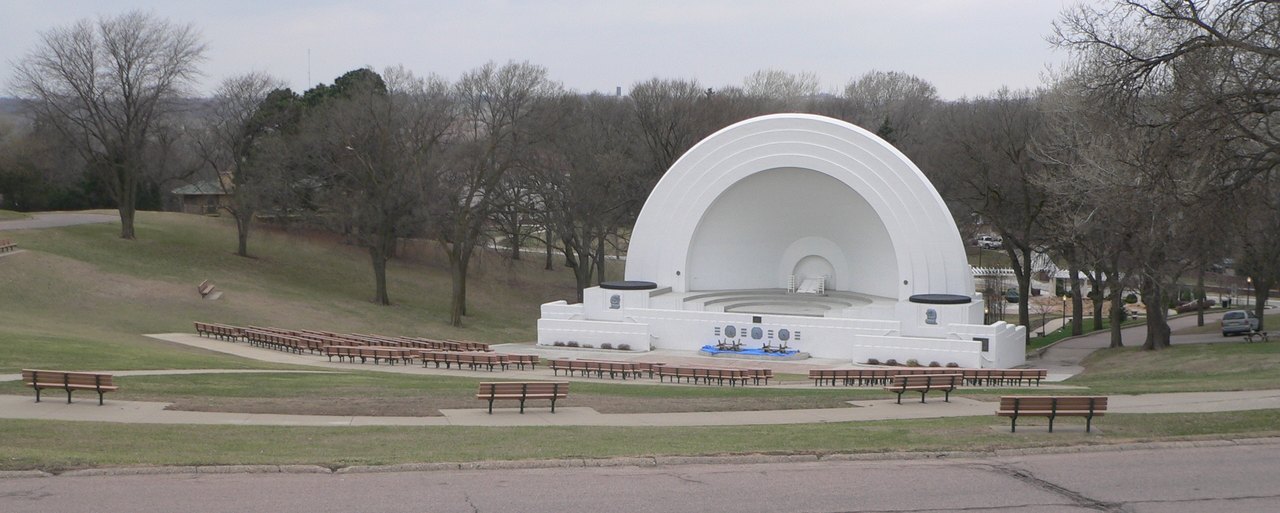
Visual AidThe place both scenes happen
A park band shell with its benches empty. The Knowledge Bank explains that the happiest scene in the book and the saddest one happen in the same place: this is where Maniac and Grayson keep Christmas like a family, and it is where Maniac is left alone five days later. Look at the rows of benches facing a stage with nobody on it. A band shell is built for a crowd, which is what makes it the right setting for both a small warm celebration and the emptiness that follows.
Music pavilion at Grandview Park, Sioux City, Iowa. Source: Wikimedia Commons, CC0.
🧠Knowledge Bank question
1The Knowledge Bank explains that the Christmas scene matters to the plot because it ___.Ch.34
2Five days after Christmas, Grayson ___.Ch.37
3A large, loving crowd comes to Grayson’s funeral.Ch.38
4After the funeral, Maniac comes to believe that he is ___.Ch.38
5Write the numbers 1–5 in the boxes to show the correct order of events. Number 1 = what happens first.Chapters 34–38
Almost no one comes to the lonely funeral.
Maniac decides he is a curse to those he loves.
He runs off into the frigid winter night.
Maniac and Grayson celebrate a warm Christmas.
Five days later, Grayson dies in his sleep.
6Maniac caused Grayson’s death.Ch.38
7This time, Maniac’s running is different because it is ___.Ch.38
8Spinelli places the joyful Christmas right before the death to make the loss ___.Ch.37
9Losing Grayson is Maniac’s first loss of a family.Ch.38
10Part 6 is best described as Maniac’s ___.Ch.38
Part 3
Literary Elements
Understanding HOW and WHY Jerry Spinelli tells the story across Chapters 34–38.
🧠Knowledge Bank · Joy Before the Fall
Narrative Technique · Joy Before the Fall
The pressure of Chapters 34–38 is crafted through juxtaposition, point, and belief working in combination. Notice where Spinelli places the happiest scene in the whole book: right before the saddest. The warm family Christmas is not there by accident; it is set directly beside Grayson’s death on purpose, so that the loss lands with maximum force. This is a classic structural move — the peak of joy just before the fall — and it works because we are not told Grayson matters, we are made to FEEL it, sharing the happiness first. The higher Spinelli lifts us, the harder the drop. Reading well means noticing this design: the Christmas warmth is doing a job, quietly loading the death with all the weight of everything Maniac is about to lose. That authorial design makes “Joy Before the Fall” a lesson in deliberate perspective.
Visual AidWhere the happiest scene sits
Diagram for the Knowledge Bank on structure. The four numbered points trace the line the Knowledge Bank describes: a hard winter, the warm Christmas at the top, five days later, and then alone again at the bottom. Card 5 states why the order matters. Notice how short the distance is between point 2 and point 4. Spinelli lifts the reader as high as he can and then drops the floor almost immediately, which is what makes the loss land.
Why the happiest scene comes just before the saddest, as described in the Knowledge Bank. Drawn for Garden Heights Academy.
Juxtaposition
The warm Christmas placed right beside Grayson’s death — joy sharpening grief.
Low point
Grayson’s death and Maniac’s despair — the darkest moment of his journey.
False belief
Maniac’s idea that he is a ‘curse’ — grief lying to him, to be undone later.
🧠Knowledge Bank question
1According to the Knowledge Bank, why is the happiest scene placed just before the saddest?Ch.37
2Fill in each blank with the correct literary term.Ch.38
Word choices:juxtapositionlow pointsettingrhyme- some words will not be used
Joy set right beside grief is .
Grayson’s death is the story’s .
3A low point is the darkest, most hopeless moment for the hero.Ch.38
4Maniac’s idea that he is a ‘curse’ is a ___ the book will later undo.Ch.38
5Spinelli lifts us with joy first so the loss ___.Ch.37
6Juxtaposition places two contrasting things side by side.Ch.37
7The book plants Maniac’s false belief on purpose so the ending can ___ it.Ch.38
8Fill in each blank with the correct literary term.Ch.38
Word choices:false beliefjuxtapositionnarratormotif- some words will not be used
Maniac’s idea that he is a curse is a .
Joy set beside grief is .
9Maniac’s self-blame is the truth about the losses.Ch.38
10The cruelest effect of Maniac’s grief is that it makes him ___.Ch.38
Part 4
Think Deeper
Four deeper challenges — no single-word recall. Read, weigh the evidence, and reason it out.
🧠Knowledge Bank · Living With Loss
Grief · Living With Loss
Grayson’s death plunges Maniac into grief, and Spinelli treats it with unusual honesty for a children’s book. Grief is the deep sorrow we feel when we lose someone we love, and it is one of the most universal human experiences — and one of the hardest. It does not follow neat rules; it can bring not only sadness but numbness, anger, guilt, and even a strange sense of unfairness, exactly as it does for Maniac, who twists his pain into the belief that he himself is somehow to blame. That reaction is common and worth understanding: grieving people, especially children, often invent reasons the loss is their fault, because feeling guilty can seem easier than feeling helpless. That is precisely the trade Maniac makes. He decides Grayson died because he taught him to read, which is not true and never could be — but it hands a grieving boy something a death does not otherwise offer, which is a cause.
Think back over these chapters. For a handful of glowing days, a band shell in a cold park holds everything a lonely boy and a lonely old man ever wanted: a tree, small gifts, warmth, each other. It is the happiest Maniac has ever been. And then, five mornings after Christmas, the old man does not wake up. Almost no one comes to stand at the grave, and the boy who has now lost two families in one year decides, in the wrong and terrible logic of grief, that he must be the reason — that he poisons everyone he loves. So he runs, not toward anything this time but away from all of it, out into the freezing night, hoping the cold will take the ache away.
Original passage written for Garden Heights — not a quotation from the novel.
1Claim: “Part 6 shows grief lying to Maniac, convincing him of a false belief that he is to blame.” — choose the two details that best prove it.Claim & Evidence
2What grief tells Maniac, or What is actually true? Tap each detail to sort it — tap again to switch sides. You can keep tapping to change your answer.Sort into two
◄ What grief tells ManiacWhat is actually true ►
3Match each cause to its result. For each cause, pick its result.Cause & Effect
Maniac and Grayson share Christmas→
Grayson dies suddenly→
Almost no one comes to the funeral→
Maniac decides he is a curse→
🧠Knowledge Bank question
4Fill both blanks to complete the reasoning.Build the Argument
The Knowledge Bank argues that Maniac blames himself for Grayson’s death because , which shows that .
Part 5
Standardized Test
Reading passage · Living With Loss: Understanding Grief · SAT & TOEFL-style practice
Read the passage — the highlighted words are tested — then answer. Tap an answer, then tap it again to confirm.
SATCentral Ideas — the passage's main point
SATDetail — a fact stated in the passage
TOEFLFactual Information — a fact stated in the passage
TOEFLNegative Factual — the statement the passage does NOT support
TOEFLVocabulary — a tested word's meaning here
TOEFLProse Summary — the three sentences that sum it up
Grief Without Tidy Rules
When Grayson dies, Maniac is plunged into grief, which Spinelli writes with rare honesty. Grief is the deep sorrow we feel at the loss of someone we love, and it is among the most universal of human experiences — and the hardest. The most important thing to understand about grief is that it does not follow tidy rules. It is not only sadness. It can also bring numbness, anger, confusion, guilt, and a sense that the world is unfair. A grieving person may feel several at once, or swing between them, and none of it means they are grieving wrongly.
Grief can play a trick on children, and Maniac falls for it: rather than feel the helplessness of a loss no one could control, a grieving child will sometimes decide, as Maniac does, that they are somehow to blame. Feeling guilty can seem easier than feeling powerless, but it is a lie, and it can drive a person into despair and away from others just when they need them most. What helps is not getting over it quickly, for there is no such thing. What helps is time, and other people: being allowed to mourn without being rushed, and being reminded, gently and repeatedly, that one is loved and not alone. Spinelli does not shrink Maniac’s sorrow; he lets it be as large as real grief is.
Original passage written for Garden Heights — not a quotation from the novel.
1What does the passage mainly explain?SAT · Central Ideas
2Grief is the deep sorrow felt at the loss of ___.TOEFL · Factual Information
3The passage says grief does not follow ___.TOEFL · Factual Information
4Besides sadness, grief can bring ___.SAT · Detail
5A trick grief plays on children is making them ___.TOEFL · Factual Information
6Blaming themselves can drive grieving people to ___.TOEFL · Factual Information
7The passage says there is no such thing as ___ grief quickly.TOEFL · Negative Factual
8What truly helps with grief is time and ___.SAT · Central Ideas
9In the passage, despair most nearly means ___.TOEFL · Vocabulary
10Prose Summary (TOEFL).The passage explains grief and what helps a grieving person. This TOEFL task lists six sentences; choose the THREE that best capture the passage’s main ideas. The other three do not belong — they state minor details or ideas the passage does not present.TOEFL · Prose Summary
Part 6 · Optional
Creative Writing
A bonus challenge to practice your English. Take your time and have fun with it.
About This Section
This writing task is optional and is not part of your auto-graded score. The feedback below checks only the basics — length, spelling, and grammar — not whether your ideas are right or wrong. It is meant for classroom discussion and creative practice, so feel free to use your imagination!
Writing Task — Part 6 “Carrying a Loss”
Maniac’s grief is real and heavy, and the book refuses to rush it. Write about a loss you or someone you know has faced — of a person, a pet, a home, or something dear — and how it felt. What helped, even a little? 6–10 sentences. Be as honest as you want to be. End with what you would tell someone else who is grieving.
You can start with: “Losing it was harder than I expected, and what helped most was...”
0 / 40 words minimum
🗣 Teach It · Just for Fun (optional)
No right or wrong — close the screen and tell someone nearby what happened in this part. Can’t find anyone? Tell yourself out loud. The moment you teach it, you truly understand it.
Part 6 Complete!
You finished Chapters 34–38 of Maniac Magee.
Here are your auto-graded results:
-
points out of 100
Teach it to someone
The best last step is to teach it. In your own words, explain what happened — retell a favorite scene, teach a character’s big choice, or sum up the main idea for a parent, friend, or classmate. When you can teach it clearly, you truly own it.
Independent study guide by Garden Heights. Not affiliated with or endorsed by Jerry Spinelli. Contains original analysis only; no text from the novel is reproduced. Reference text: This workbook follows Jerry Spinelli’s classic text (the standard Puffin edition sold worldwide). Revised 2023 UK editions change some wording and may not match the vocabulary studied here.
SAT® is a registered trademark of College Board, which is not affiliated with, and does not endorse, these materials. TOEFL® is a registered trademark of ETS. These materials are not endorsed or approved by ETS. Garden Heights is an independent provider of test-style reading practice.