New here? Just sign up with Google — your account includes Matilda, our gift book, forever.
Maniac Magee · Garden Heights
Part 7
for Maniac Magee · Part 7 · Chapters 39–42
8 Parts40 min
What Happens in Part 7
Half-frozen and starving, back at the buffalo pen and no longer caring whether he lives, Maniac is found by two young runaways — Russell and Piper McNab, the little brothers of Giant John McNab. Caring for someone weaker pulls Maniac back from the edge: to get the boys safely home, he strikes deals, tells stories, and dares them into good behavior, and soon he is living with the rowdy, neglectful McNab family in the West End. What he finds there horrifies him. The McNabs are loudly, proudly racist, and they are building a ‘pillbox’ — a fortified bunker — right inside their run-down house, stockpiling supplies because they are convinced that the Black East End is about to attack, and they mean to be ready for a ‘war.’ The little boys are growing up soaking in this hatred and chaos, skipping school, running wild. Maniac, who does not carry the town’s prejudice, tries in his own way to reach Russell and Piper — bribing them to attend school with the promise of pizza, telling them stories, offering the steady attention no one else gives them. He cannot undo the McNabs’ bigotry, but he plants small seeds of something better in the boys. And he begins to understand that the town’s color line is not just sad — it is dangerous, built on a fear that could explode.
Rescue that revives the hero, a disturbing setting, and hate seen up close
Cross-Curricular
How hate is taught — and how it can be unlearned
Chapter Summary
Ch.
What happens
Chapters 39–40
Pulled Back — near death and hopeless, Maniac finds the runaway McNab brothers; caring for them revives him, and he goes to live with the wild McNab family.
Chapters 41–42
The Pillbox — the racist McNabs build a bunker for a ‘war’ with the East End; Maniac, horrified, tries to reach the boys with stories, school, and steady care.
Part 1
Vocabulary
Study 10 key words from Chapters 39–42, then answer each question.
🧠Knowledge Bank · Words of Fear and Hate
Lexical Semantics · Words of Fear and Hate
Four words, and all four describe a single household. Racist means prejudiced against a race of people, and the McNabs are loudly, openly that. A bunker is a fortified shelter for defense, and they are building one inside a house, against an enemy that does not exist. To neglect is to fail to care for, which is what the parents do to Russell and Piper while pouring concrete for an imaginary war. To bribe is to offer a reward to get someone to act, and it is what Maniac is reduced to in order to get two boys to attend school. Put them together and the sequence is plain. The bunker is what the adults built instead of raising their sons, and the bribes are what a twelve-year-old uses to fill the gap.
Visual AidA shelter against an imagined war
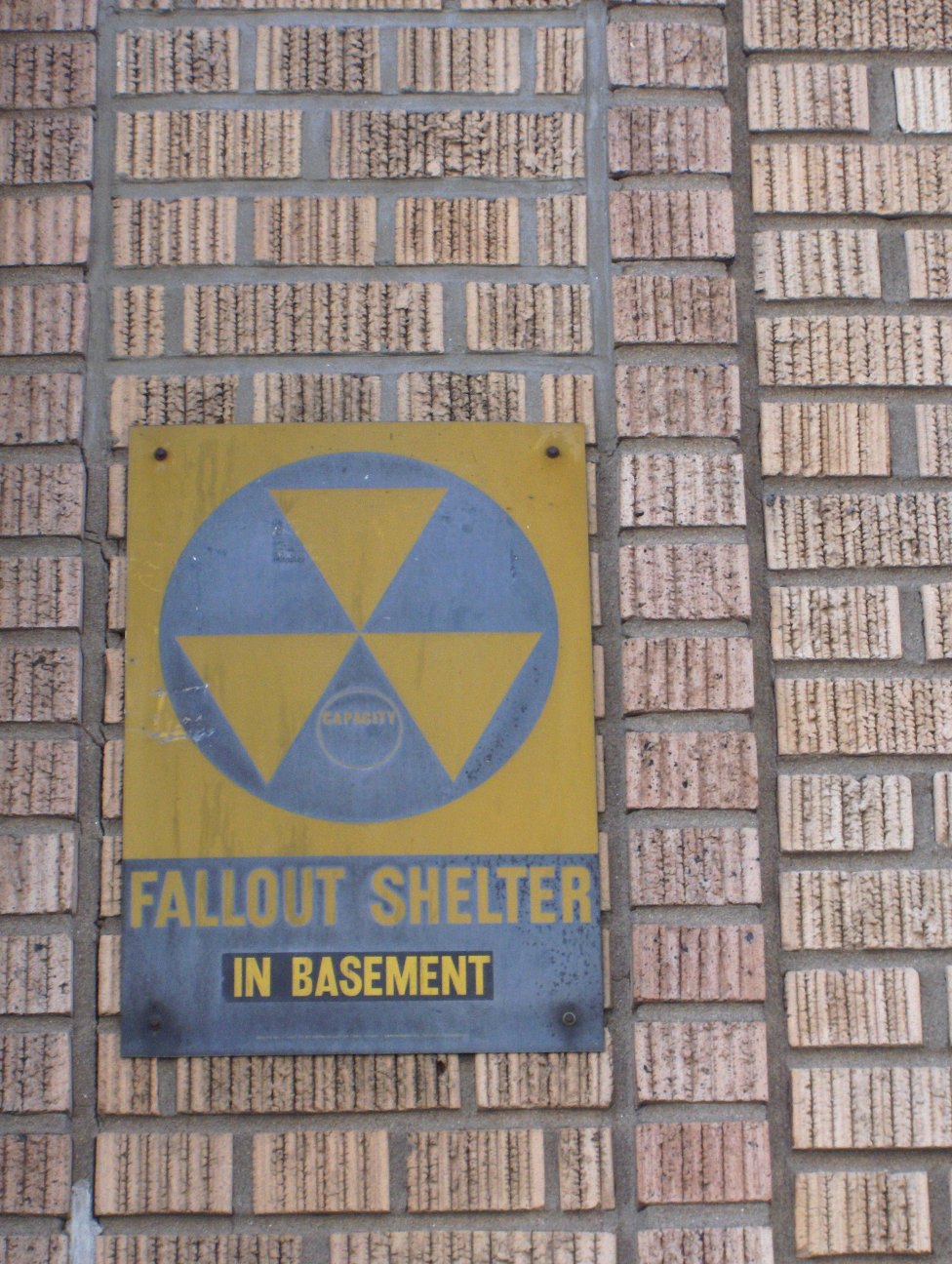
A fallout shelter sign of the kind bolted to American buildings during the Cold War, pointing to a reinforced room in the basement. The Knowledge Bank explains that a bunker is a fortified shelter for defense, and that the McNabs are building one inside a house against an enemy that does not exist. Read the sign and notice what it assumes: that a real, named danger is coming. The McNabs have taken that structure and pointed it at their own neighbors.
Fallout shelter sign on a building basement, United States. Source: Wikimedia Commons, public domain.
racistadj.Ch.41
Prejudiced against a race of people
“The McNabs were loudly racist.”
bunkern.Ch.41
A fortified shelter for defense
“They built a bunker inside the house.”
neglectv.Ch.40
To fail to care for
“The parents neglected the boys.”
bribev.Ch.42
To offer a reward to get someone to act
“Maniac would bribe them to attend school.”
tolerancen.Ch.42
Accepting people different from oneself
“He hoped to teach a little tolerance.”
revivev.Ch.39
To bring back to life or strength
“Caring for the boys revived Maniac.”
stockpilev.Ch.41
To store up a large supply
“They stockpiled goods for a ‘war.’”
ignorancen.Ch.41
A lack of knowledge
“The hatred grew from fear and ignorance.”
chaosn.Ch.40
Complete disorder
“The McNab house was pure chaos.”
seedn.Ch.42
A small beginning that may grow
“He planted a seed of something better.”
ⓘ The vocabulary words in this list are selected to help you understand and complete this workbook. Some may not appear verbatim in the original novel.
🧠Knowledge Bank question
1According to the Knowledge Bank, what are the McNab parents doing while they pour concrete for the bunker?Ch.41
2A ‘bunker’ is a fortified shelter for defense.Ch.41
3To ‘neglect’ children is to ___ them.Ch.40
4To ‘bribe’ someone is to offer a reward to get them to act.Ch.42
5Fill in each blank with the correct word.Ch.41
Word choices:bunkertoleranceracistsneer- some words will not be used
The family built a for a coming ‘war.’
Maniac hoped to teach a little .
6To ‘revive’ someone is to bring them back to ___.Ch.39
7To ‘stockpile’ is to store up a large supply.Ch.41
8‘Ignorance’ is a lack of ___.Ch.41
9Fill in each blank with the correct word.Ch.40
Word choices:chaosneglectseedrevive- some words will not be used
The McNab house was pure .
Maniac planted a of something better.
10‘Tolerance’ is accepting people ___ oneself.Ch.42
Part 2
Comprehension
Show you understood what happens in Chapters 39–42.
🧠Knowledge Bank · Pulled Back, Into Hate’s House
Narrative Causality · Pulled Back, Into Hate’s House
The narrative’s growing tension gives way to a crucial revelation and redirects the story’s direction. Half-frozen and starving, back at the buffalo pen and no longer caring whether he lives, Maniac is found by two young runaways — Russell and Piper McNab, the little brothers of Giant John McNab. Caring for someone weaker pulls Maniac back from the edge: to get the boys safely home, he strikes deals, tells stories, and dares them into good behavior, and soon he is living with the rowdy, neglectful McNab family in the West End. What he finds there horrifies him. The McNabs are loudly, proudly racist, and they are building a ‘pillbox’ — a fortified bunker — right inside their run-down house, stockpiling supplies because they are convinced that the Black East End is about to attack, and they mean to be ready for a ‘war.’ The accumulated tension makes “Pulled Back, Into Hate’s House” a genuine story threshold.
🧠Knowledge Bank question
1The Knowledge Bank explains that Maniac is pulled back from the edge by ___.Ch.39
2Maniac ends up living with the ___ family.Ch.40
3The McNabs are a warm, welcoming, open-minded family.Ch.41
4Inside their house, the McNabs are building a ___.Ch.41
5Write the numbers 1–5 in the boxes to show the correct order of events. Number 1 = what happens first.Chapters 39–42
He is horrified by their bunker built for a ‘race war.’
Near death, Maniac is found by the runaway McNab boys.
He bribes and tells stories to reach Russell and Piper.
Caring for them pulls him back from despair.
He goes to live with the wild McNab family.
6Maniac shares the McNabs’ hatred of the East End.Ch.41
7Maniac tries to reach the McNab boys by ___.Ch.42
8The McNab boys are growing up soaking in ___.Ch.41
9Maniac fully cures the McNabs of their prejudice.Ch.42
10Maniac comes to see that the color line is not just sad but ___.Ch.41
Part 3
Literary Elements
Understanding HOW and WHY Jerry Spinelli tells the story across Chapters 39–42.
🧠Knowledge Bank · Saved by Saving Others
Narrative Technique · Saved by Saving Others
As the story nears its end, setting, contrast, and theme turn earlier details into consequences. Notice what pulls Maniac back from wanting to die: not comfort for himself, but two children who need him. The moment there is someone weaker to protect, Maniac’s despair loses its grip, and he chooses to live in order to help. This is a deep truth about the character — and about people. Having a reason beyond yourself, someone who needs you, can be the strongest anchor against hopelessness. Spinelli quietly answers Maniac’s ‘curse’ belief here, too: the boy who thinks he destroys everyone he loves immediately begins to HELP the moment he is needed. His instinct is not to harm but to save. That authorial design makes “Saved by Saving Others” a lesson in deliberate structure.
Visual AidWhat pulls him back
Diagram for the Knowledge Bank on what saves Maniac. The four numbered steps run downward: not caring whether he lives, two younger boys who need him, a reason outside himself, and the choice to live in order to help. Notice that step 2 does not make anything easier for him. It makes things harder, and that is exactly why it works. The Knowledge Bank says a person who needs you is the strongest anchor against hopelessness.
What pulls Maniac back from despair, as described in the Knowledge Bank. Drawn for Garden Heights Academy.
Setting
The McNab house and its bunker — a setting that reveals how hate is taught and how far fear can go.
Contrast
Maniac, who never learned to hate, set against a family teaching hatred hardest of all.
Theme
Hate is learned — and so is its cure; the boys can absorb bigotry or something better.
🧠Knowledge Bank question
1According to the Knowledge Bank, what does Maniac’s rescue of the McNab boys quietly answer?Ch.41
2Fill in each blank with the correct literary term.Ch.41
Word choices:settingcontrastrhymefootnote- some words will not be used
The McNab bunker is a that reveals the town’s hate.
Maniac beside the hateful family is a sharp .
3Contrast places two very different things together to highlight both.Ch.41
4Maniac inside the racist McNab home is a striking ___.Ch.41
5The pillbox develops the theme that hate is ___.Ch.41
6A setting can reveal ideas, not just tell where events happen.Ch.41
7Spinelli makes the McNabs afraid and poor, not cartoon villains, to show hate feeds on ___.Ch.41
8Fill in each blank with the correct literary term.Ch.42
Word choices:themesettingnarratormotif- some words will not be used
That hate is learned, and so is its cure, is a .
The bunker is a that reveals danger.
9The book presents the McNabs as pure, simple villains.Ch.41
10Maniac planting ‘seeds’ in the boys mainly shows that hate’s ___ can also be taught.Ch.42
Part 4
Think Deeper
Four deeper challenges — no single-word recall. Read, weigh the evidence, and reason it out.
🧠Knowledge Bank · How Hate Is Taught
Learning — and Unlearning — Prejudice · How Hate Is Taught
The McNab household shows the opposite of Maniac: a place where hatred is actively taught. Russell and Piper are not born hating the East End; they are learning it, day by day, from a father and a home soaked in fear and bigotry, complete with a bunker built for an imaginary ‘race war.’ This is how prejudice passes down — not usually through formal lessons, but through the fears, jokes, and warnings children absorb from the adults they trust, until hatred feels like common sense. The McNabs’ fear is worth understanding too: prejudice often grows from fear of a group one does not actually know, and the less contact people have across a line, the easier it is to imagine the other side as a threat. Which is why Maniac’s plan is not an argument. He does not try to talk the McNabs out of anything; he tries to get Mars Bar into their house — because the one thing that reliably dissolves this kind of fear is contact.
Visual AidHow the fear grows, and what shrinks it
Diagram for the Knowledge Bank on how prejudice is passed on. The four teal cards are the chain the Knowledge Bank runs: no contact, then an imagined neighbor, then a threat, then concrete in the basement. The single gold arrow underneath is the only one pointing the other way, and it is not an argument — it is a person arriving. Notice that nothing on the chain requires anybody to be cruel. It only requires that they never meet.
How prejudice grows without contact and what reverses it, as described in the Knowledge Bank. Drawn for Garden Heights Academy.
Think back over these chapters. A boy who has stopped caring whether he lives is found in the cold by two small runaways — and the moment someone needs him, he chooses to live. He follows them home into chaos: a house where the grown-ups have taught the children to fear and hate the far side of town, where a bunker is rising in the living room, stocked for a ‘war’ against neighbors no one there has ever met. Maniac cannot argue the hatred away. So he does the only thing he knows: he tells the boys stories, bribes them into a classroom with pizza, and simply shows them, day after day, a person who does not hate — planting, in soil full of weeds, a few small seeds of something better.
Original passage written for Garden Heights — not a quotation from the novel.
1Claim: “Part 7 shows that hatred is taught — the McNab boys are learning it — and that it can also be unlearned.” — choose the two details that best prove it.Claim & Evidence
2How the McNabs teach hate, or How Maniac teaches its cure? Tap each detail to sort it — tap again to switch sides. You can keep tapping to change your answer.Sort into two
◄ How the McNabs teach hateHow Maniac teaches its cure ►
3Match each cause to its result. For each cause, pick its result.Cause & Effect
Two runaways need Maniac→
He enters the McNab home→
The bunker rises inside→
Maniac tells the boys stories→
🧠Knowledge Bank question
4Fill both blanks to complete the reasoning.Build the Argument
The Knowledge Bank argues that the strongest medicine against prejudice is contact because , which shows that .
Part 5
Standardized Test
Reading passage · How Hate Is Taught — and Unlearned · SAT & TOEFL-style practice
Read the passage — the highlighted words are tested — then answer. Tap an answer, then tap it again to confirm.
SATCentral Ideas — the passage's main point
SATDetail — a fact stated in the passage
SATInference — a conclusion the passage implies
SATWords in Context — a word's meaning in this passage
SATText Connections — how two parts of the text relate
TOEFLFactual Information — a fact stated in the passage
How a Family Teaches Hatred
The McNab household in Two Mills is a place where hatred is actively taught. Russell and Piper McNab were not born hating the East End. They are learning it, a little every day, from a home filled with fear and prejudice — complete with a bunker for an imagined race war. This is how prejudice usually passes from one generation to the next, and it is rarely a formal lesson. Instead it seeps in through the fears, the jokes, and the example of trusted adults around a child, until hatred comes to feel like common sense.
The McNabs’ fear is worth understanding, because it points to the cure: prejudice often grows from plain ignorance of a group a person does not actually know. The less contact people have across a dividing line, the easier it is to imagine the other side as a faceless threat — which is why the McNabs arm themselves against neighbors they have never really met. But this same fact carries real hope: if hatred is learned, it can be unlearned, and the strongest medicine against prejudice is contact — knowing, working with, and befriending people across the line. Children who grow up alongside people different from themselves are less likely to absorb fear of them. The novel’s deepest hope is that hate, being a habit and not a fact of nature, can be undone.
Original passage written for Garden Heights — not a quotation from the novel.
1What does the passage mainly explain?SAT · Central Ideas
2Russell and Piper were ___ hating the East End.TOEFL · Factual Information
3Prejudice usually passes down through ___.TOEFL · Factual Information
4The McNabs build a bunker because they fear a ___.SAT · Detail
5Prejudice often grows from fear of a group one does not ___.TOEFL · Factual Information
6In the passage, if hatred is learned, it can also be ___.SAT · Inference
7The strongest medicine against prejudice, the passage says, is ___.SAT · Central Ideas
8Children who grow up alongside different people are ___ to absorb fear of them.TOEFL · Factual Information
9In the passage, ignorance most nearly means ___.SAT · Words in Context
10Which part of the book does this passage BEST help explain?SAT · Text Connections
Part 6 · Optional
Creative Writing
A bonus challenge to practice your English. Take your time and have fun with it.
About This Section
This writing task is optional and is not part of your auto-graded score. The feedback below checks only the basics — length, spelling, and grammar — not whether your ideas are right or wrong. It is meant for classroom discussion and creative practice, so feel free to use your imagination!
Writing Task — Part 7 “Planting a Seed”
Maniac can’t undo the McNabs’ hatred, but he plants small seeds of something better in the boys through stories and attention. Write about a small, quiet thing someone did that made a difference over time — a ‘seed’ that grew — or a seed you could plant for someone. What was it, and why do small actions matter? 6–10 sentences. End with the seed you would choose to plant.
You can start with: “It seemed like such a small thing at the time, but...”
0 / 40 words minimum
🗣 Teach It · Just for Fun (optional)
No right or wrong — tell someone nearby what happened in this part. Can’t find anyone? Tell yourself out loud. The moment you teach it, you truly understand it.
Part 7 Complete!
You finished Chapters 39–42 of Maniac Magee.
Here are your auto-graded results:
-
points out of 100
Teach it to someone
The best last step is to teach it. In your own words, explain what happened — retell a favorite scene, teach a character’s big choice, or sum up the main idea for a parent, friend, or classmate. When you can teach it clearly, you truly own it.
Independent study guide by Garden Heights. Not affiliated with or endorsed by Jerry Spinelli. Contains original analysis only; no text from the novel is reproduced. Reference text: This workbook follows Jerry Spinelli’s classic text (the standard Puffin edition sold worldwide). Revised 2023 UK editions change some wording and may not match the vocabulary studied here.
SAT® is a registered trademark of College Board, which is not affiliated with, and does not endorse, these materials. TOEFL® is a registered trademark of ETS. These materials are not endorsed or approved by ETS. Garden Heights is an independent provider of test-style reading practice.