New here? Just sign up with Google — your account includes Matilda, our gift book, forever.
📚
Garden Heights Academy
Members sign in to continue.
Matilda · Garden Heights Academy
Part 5
for Matilda · Part 5 · Chapters 14–15
a novel by Roald Dahl (author)
40 min6 Parts
This workbook is built on a solid pedagogical foundation, effectively integrating content and language learning based on the CLIL framework (Content and Language Integrated Learning), elevated by our unique 5th C — Connection — and an integrated Standardized Test section that weaves every SAT & TOEFL question type right into the novel, so learners build real test skills easily, naturally, and with fun.
💭 Before You Read · Just for Fun
No right or wrong answers — just think or chat about it: Who is the one person you would trust with your biggest secret — and what makes them trustworthy? Has anyone ever proven you wrong about something you were SURE was impossible? And how many times would something strange have to succeed before you believed it?
What Happens in Part 5
Matilda tests her new mind-power with Miss Honey, and it works twice.
The secretMatilda cannot stop thinking about Chapter 13. She knows something extraordinary happened — she moved the glass with only her eyes and her mind — but she barely dares to believe it herself.
Telling Miss HoneyIn Chapter 14, she confides in Miss Honey, the one adult who truly listens. Miss Honey is astonished but takes her seriously. They stay after school to test the power: Matilda concentrates with everything she has, and the chalk moves. The First Miracle is confirmed.
The Second MiracleIn Chapter 15, they return to the classroom to test the power a second time. Once again, Matilda succeeds. The Second Miracle deepens the mystery — and draws Miss Honey and Matilda closer together than ever before.
What We Will Study
Chapter
Title & Key Events
Ch.14
The First Miracle — Matilda tells Miss Honey about her strange power; they practice together after school; Matilda successfully moves the chalk with her mind for the first time deliberately
Ch.15
The Second Miracle — Matilda and Miss Honey return to the classroom for a second test; Matilda’s power works again, and its reality becomes undeniable
Copyright Notice
This is an independent study guide created by Garden Heights Academy. It contains original analysis questions and does not reproduce any text from the novel. Matilda is a work by Roald Dahl (author). Not affiliated with or endorsed by Roald Dahl or the Roald Dahl Story Company. Students should read the original book. Reference text: This workbook follows Roald Dahl’s classic text (the standard Puffin edition sold worldwide). Revised 2023 UK editions change some wording and may not match the vocabulary studied here.
Part 1
Vocabulary
Study 10 key words from Chapters 14–15, then answer each question.
🧠Knowledge Bank · How Practice Rewires the Brain
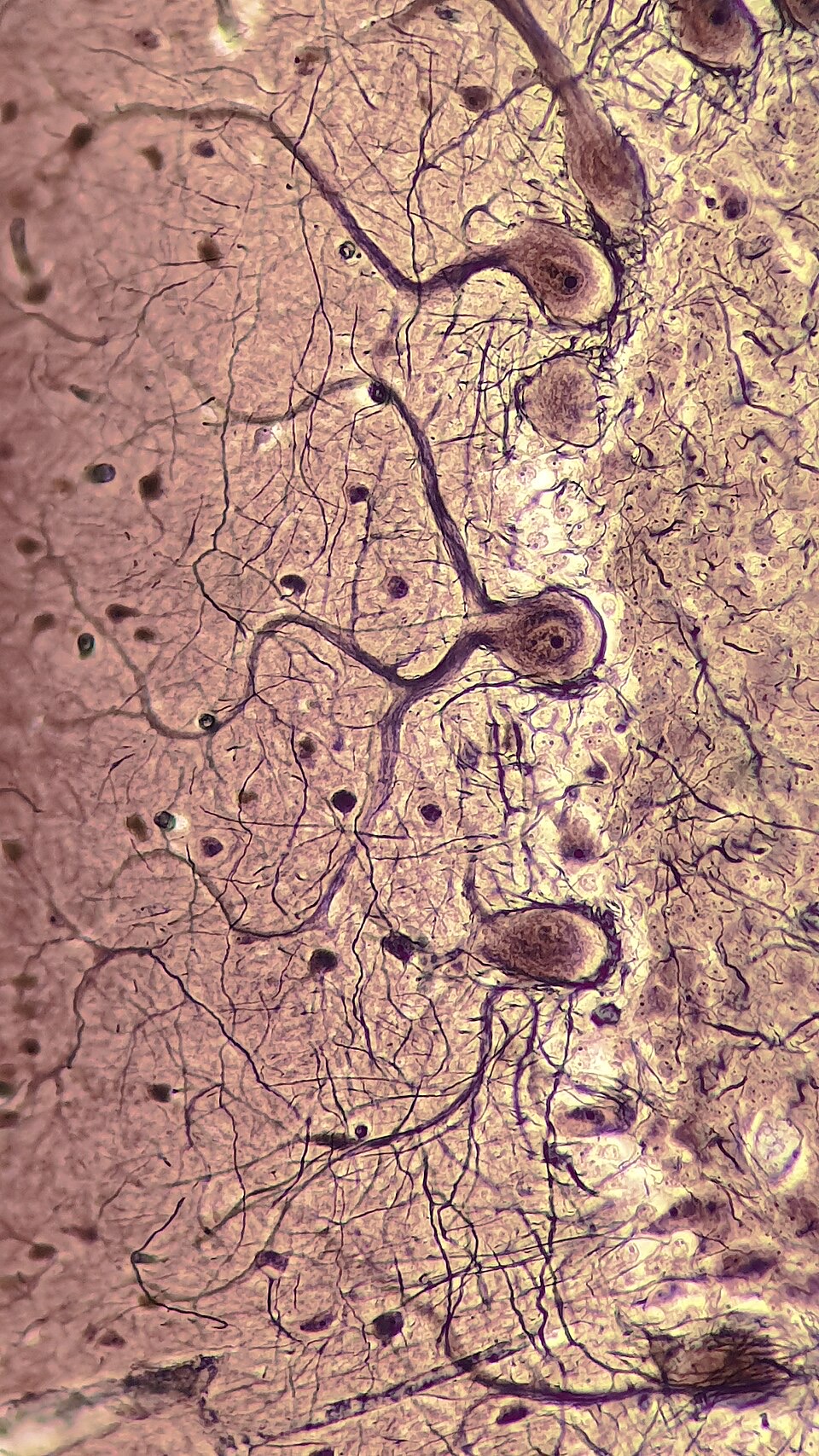
Neuroscience · NeuroplasticityAfter her first success, Matilda practices tipping and lifting until the skill grows steady, and that mirrors a real truth about the brain. Scientists call it neuroplasticity: the brain physically reshapes itself when you repeat an action. Each time you practice, the neurons that fire together strengthen their connections, and the busiest pathways gain a fatty coating called myelin that lets signals race faster. This is why a piano piece that felt impossible on Monday can flow by Friday — the wiring itself has changed. Matilda’s mind-power is invented, but the lesson beneath it is honest: talent alone is never enough without practice. A gifted child who never trains her gift stays a beginner, while steady effort turns clumsy first tries into smooth mastery. Dahl (author) shows Matilda working at her strange ability like a musician at scales, because even a genius must build her powers through patient, repeated effort.
Visual AidReal neurons under a microscope
Photograph through a microscope of neurons — the branching nerve cells the Knowledge Bank says ‘fire together and wire together’. These are Purkinje cells from a dog’s cerebellum — the part of the brain that coordinates movement — stained so their branches show. The connections that strengthen with practice are far too small to see even here, and this is nobody’s brain in the story.
Purkinje cells, dog cerebellum, optical microscope; photograph by Lennart Rikk, 2021. Source: Wikimedia Commons, File:Neurons (Purkinje cells).jpg, CC0.
ⓘ The vocabulary words in this list are selected to help you understand and complete this workbook. Some may not appear verbatim in the original novel.
telekinesisn.Ch.14
The supposed ability to move or affect objects using only the power of the mind, without physical contact
“What Matilda had done in the classroom — moving the glass with her eyes alone — was a form of telekinesis.”
incredulousadj.Ch.14
Unable or unwilling to believe something; showing great surprise at something that seems impossible
“Miss Honey sat perfectly still, incredulous, as Matilda described exactly what she had done with the glass.”
confidev.Ch.14
To trust someone with a private or personal secret; to share something that one would not tell just anyone
“Matilda had decided to confide in Miss Honey — she was the only adult Matilda trusted completely.”
phenomenonn.Ch.14
A remarkable event or fact, especially one that is difficult to understand or explain
“For Miss Honey, what Matilda described was not a lie — it was a genuine and extraordinary phenomenon.”
exhilaratedadj.Ch.14
Filled with a strong sense of excitement, happiness, and energy, especially after an achievement
“After the chalk moved across the board, Matilda felt exhilarated — dizzy with the sheer thrill of what she had done.”
tentativeadj.Ch.14
Done carefully and without full confidence; hesitant, as if not sure whether to proceed
“Matilda’s first attempt was tentative — she was not yet sure she could repeat what had happened in the classroom.”
rigidadj.Ch.15
Stiff and unable to move; completely fixed, often because of intense concentration or tension
“Matilda sat rigid in her chair, every muscle locked, all her attention poured into a single point on the board.”
quiverv.Ch.15
To tremble or shake slightly, especially with excitement, nervousness, or intense effort
“Miss Honey’s hands began to quiver as she watched the chalk rise slowly from the ledge.”
undeniableadj.Ch.15
So clear and obvious that it cannot be denied, doubted, or argued against
“By the second miracle, the evidence was undeniable — Matilda could move objects with the power of her mind.”
extraordinaryadj.Ch.14
Very unusual, remarkable, or beyond what is normal; far outside the range of ordinary experience
“Matilda was not just intelligent — she was extraordinary in a way that Miss Honey had never encountered before.”
🧠Knowledge Bank question
1According to the Knowledge Bank, Matilda’s telekinesis is invented, yet it mirrors a real truth about the brain. What is that truth?Ch.14
2True or False: “Incredulous” means feeling absolutely certain and confident that something is true.Ch.14
3Matilda chose to share her secret only with Miss Honey, not with anyone else. Which word means to share a personal secret with someone you trust?Ch.14
4True or False: A “phenomenon” is something completely ordinary and easily explained, something we see every day without surprise.Ch.14
5Fill in each blank with the correct word.Ch.14
Word choices:tentativeexhilaratedconfidetelekinesisrigid— some words will not be used
Matilda’s first attempt was — she approached the chalk carefully, not yet sure she could repeat what she had done before.
When the chalk finally moved, she felt completely : excited, breathless, and amazed by her own power.
6True or False: If someone is “rigid” with concentration, they are moving around freely and restlessly, unable to sit still.Ch.15
7Miss Honey’s hands trembled slightly as she watched the chalk rise from the ledge. Which word means to shake or tremble slightly with excitement or tension?Ch.15
8True or False: If something is “undeniable,” you can easily argue that it is false or not real.Ch.15
9Fill in the blanks with the correct words.Ch.14–15
Word choices:phenomenonundeniableextraordinaryincredulousquiver— some words will not be used
Miss Honey was as she listened — she had never encountered anything like what Matilda described.
By the time of the Second Miracle, the proof was : this was not imagination or coincidence, but something very real.
10Matilda was not just clever — she was remarkable in a way no ordinary word could capture. Which word means far beyond what is normal or usual?Ch.14
Part 2
Comprehension
How well do you understand Chapters 14–15?
🧠Knowledge Bank · Tracking a Story’s Big Idea
Reading Skill · ThemeA theme is a big idea a story keeps returning to, larger than any single event. In these chapters two themes deepen: that kindness matters, and that the world is often unfair to the good. When Matilda visits Miss Honey’s tiny, almost bare cottage, she learns that her gentle teacher is desperately poor, and we feel the wrongness of a kind woman living so hard a life. Skilled readers track a theme by noticing when it surfaces again and again through different scenes. Here, Matilda’s growing power and Miss Honey’s quiet suffering both circle the same question: who deserves good fortune, and who actually receives it? Do not just follow what happens; ask what it all keeps meaning. When separate events point toward one shared idea, you have found the beating heart of the whole book.
Visual AidWhere the two themes surface
Pattern diagram. The Knowledge Bank names two themes and four moments; a dot shows which moments touch which theme. It is a way of seeing the pattern, not a list of everything in the chapters, and the scenes are given in the Knowledge Bank’s words rather than in story order.
Scenes and themes as named in the Knowledge Bank for these chapters. Drawn for Garden Heights Academy.
🧠Knowledge Bank question
1According to the Knowledge Bank, which two themes deepen in these chapters?Ch.14
2True or False: When Matilda tells Miss Honey about moving the glass, Miss Honey laughs and tells Matilda she must have imagined it.Ch.14
3Where do Matilda and Miss Honey go to test Matilda’s power in Chapter 14?Ch.14
4True or False: In the First Miracle, Matilda successfully moves the piece of chalk with her mind in the empty classroom.Ch.14
5Write the numbers 1–4 in the boxes to show the correct order of events. Number 1 = what happens first.Ch.14–15
Miss Honey listens carefully to Matilda’s account and believes her.
Matilda performs the Second Miracle, confirming her power a second time.
Matilda and Miss Honey test the power together in the classroom; Matilda successfully moves the chalk.
Matilda decides to confide in Miss Honey about what happened with the glass.
6True or False: In Chapter 15, when Matilda and Miss Honey test the power a second time, Matilda fails and they conclude the first time was just an accident.Ch.15
7Why is it significant that Matilda chooses to tell Miss Honey about her power, rather than her parents?Ch.14
8What does the fact that Miss Honey believes Matilda immediately tell us about Miss Honey’s character?Ch.14
9True or False: Matilda is able to tip the glass over using only the power of her eyes and mind.Ch.14
10How does Miss Honey react when Matilda shows her that she can move the glass?Ch.14
Part 3
Literary Elements
Understanding HOW and WHY Dahl (author) creates certain effects across Chapters 14–15.
🧠Knowledge Bank · Foil, Motif & Characterization
Literary Craft · Foil & MotifDahl (author) sharpens his people using clever tools. A foil is a character who, by contrast, makes another stand out: gentle, patient Miss Honey is the perfect foil for the loud, brutal Trunchbull, and each makes the other clearer. A motif is a detail that keeps returning to carry meaning; watch how bareness and emptiness follow Miss Honey — her plain cottage, her single mug — quietly telling of stolen years. And characterization is the whole art of building a person from words, which Dahl (author) does through homes, habits, and small kindnesses rather than long descriptions. Notice how much you learn about Miss Honey simply from how little she owns and how much she still gives. When two characters mirror opposite qualities, or a small image keeps recurring, slow down, because Dahl (author) is teaching you who these people truly are without a single line of blunt explanation.
📚 Literary Devices in This Part · definitions & examples
Foil is a character who contrasts with another to make their qualities clearer. Miss Honey believes Matilda and listens to her carefully; Matilda’s parents dismiss and ignore her. Set side by side, each makes the other’s nature stand out.Motif is a repeated element — an image, symbol, or idea — that appears throughout a story and carries meaning. The tipping glass that Matilda moves with her mind returns again and again, becoming a motif for her growing, hidden power.Characterization is how a writer reveals what a character is like. Dahl (author) never simply states “Miss Honey was a kind person.” Instead he shows her kindness — her gentle voice, her patience, the careful way she treats Matilda.
The questions below are mixed — not grouped by device. Decide which device each one is about.
🧠Knowledge Bank question
1According to the Knowledge Bank, what motif follows Miss Honey through these chapters, and what does it quietly tell?Ch.15
2True or False: A motif is a repeated element — image, symbol, or idea — that appears throughout a story.Ch.14–15
3Fill in the blanks with the correct words.Ch.15
Word choices:characterizationkindnessrhymemotiffoil- some words will not be used
Revealing what a character is like is called . Dahl (author) shows Miss Honey’s through her gentle actions rather than stating it.
4The glass that Matilda moves with her mind appears again and again across these chapters. A repeated image or idea like this is called a —Ch.14–15
5True or False: Dahl (author) reveals Miss Honey’s kindness mainly by stating it directly rather than showing it through her actions.Ch.15
6Fill in the blanks with the correct words.Ch.15
Word choices:foilbelievesrhymemotif- some words will not be used
A character who highlights another by being their opposite is a . Unlike Matilda’s parents, Miss Honey in her and listens.
7How does Dahl (author) mainly show readers that Miss Honey is kind?Ch.15
8True or False: A foil is a character who contrasts with another character to make their qualities clearer.Ch.15
9Fill in the blanks with the correct words.Ch.14–15
Word choices:motifglassrhymefoil- some words will not be used
A repeated image or idea that carries meaning is called a . The tipping returns again and again as a sign of Matilda’s power.
10The glass, then the chalk — small objects keep returning at the center of huge moments. What does a MOTIF give the story that a single scene cannot?Ch.14–15
Part 4
Think Deeper
Four deeper challenges — no single-word recall. Read, weigh the evidence, and reason it through.
🧠Knowledge Bank · The Gift of Being Truly Seen
Ethics · RecognitionOne of the tenderest ideas in Matilda blooms in these chapters: the joy of being trulyseen. For years Matilda was invisible to her family, and Miss Honey was overlooked and robbed by her own aunt. Now teacher and pupil recognize each other — one a brilliant child, the other a kind adult — and something in each begins to heal. Dahl (author) suggests that being understood for who you really are is one of the deepest human needs, as vital as food or shelter. Notice how gently Miss Honey listens, and how safe Matilda feels in that small cottage compared with her own loud home. To be seen is not to be flattered; it is to be known and valued honestly. As you read, ask what changes in a lonely person the moment somebody finally looks closely and truly understands.
1Claim: “Matilda’s power appears when she burns with a sense of injustice.” — choose the two details that best prove it.Claim & Evidence
2Which miracle is it? Tap each item to sort it — tap again to switch sides. You can keep tapping to change your answer.Sort into two
◄ First Miracle (in class)Second Miracle (at the cottage) ►
3Match each cause to its result. For each cause, pick its result.Cause & Effect
Trunchbull blames Matilda for the newt→
Matilda fixes her eyes on the glass→
Miss Honey doubts what she saw→
Matilda concentrates calmly at the cottage→
🧠Knowledge Bank question
4Fill both blanks to complete the reasoning.Build the Argument
The Knowledge Bank argues that Matilda and Miss Honey both begin to heal in these chapters because , which shows that .
Part 5
Standardized Test · Author’s Purpose & Passage Structure
Part 5 studies how nonfiction is BUILT — Text Structure & Purpose (what job each paragraph and sentence does) — together with Vocabulary in Context and Factual Detail, in the styles the SAT and TOEFL use. Read the passage (the highlighted words are tested below), then choose the answer best supported by the text.
Read the passage — the highlighted words are tested — then answer. Tap an answer, then tap it again to confirm.
SATWords in Context — a word's meaning in this passage
SATInference — a conclusion the passage implies
SATText Structure & Purpose — how the passage is built, and why
SATCentral Ideas — the passage's main point
TOEFLFactual Information — a fact stated in the passage
TOEFLVocabulary — a tested word's meaning here
TOEFLInference — what the passage implies
Testing an Extraordinary Claim
What should we do when someone reports an extraordinary phenomenon — an event that seems impossible: a memory that never forgets, a bird that can count, stones falling from the sky? Science’s answer is neither instant belief nor instant mockery. The good scientist stays skeptical in the true sense: not sneering, but unwilling to accept OR reject a claim until it has been fairly tested. The fair response to “that’s impossible” is not an argument. It is an experiment.
A fair test has rules: the event must be watched by a reliable witness under precise, agreed conditions, so tricks and accidents can be ruled out. And one success is never enough — a single result may be luck, so the test must be repeated: only when the same result returns, time after time, does it harden into reliable evidence. To verify a claim is exactly this — to check it again, under watchful eyes, until doubt has nowhere left to stand. History shows why the method matters: reports of stones falling from the sky were mocked by the finest scientists of the 1700s — until careful investigation of a meteorite shower proved the villagers right. The theory of drifting continents was dismissed for half a century before the evidence became undeniable — too strong to reject — and the skeptics themselves were overturned. A tested conclusion can convince even those who laughed, which is precisely why testing, not laughing, is the scientist’s first duty.
Original passage written for Garden Heights — not a quotation from the novel.
1As used in the passage, the word “skeptical” most nearly means —SAT · Words in Context
2The passage most strongly suggests that the best way to answer doubters is to —SAT · Inference
3According to the passage, why is a single successful test never enough?TOEFL · Factual Information
4In the passage, phenomenon most nearly means ___.SAT · Words in Context
5According to the passage, what happened to reports of stones falling from the sky?TOEFL · Factual Information
6In the passage, undeniable most nearly means ___.TOEFL · Vocabulary
7Which choice best describes how the passage is organized?SAT · Text Structure & Purpose
8Why does the author include the example of drifting continents?SAT · Text Structure & Purpose
9The passage most strongly suggests that a teacher who hears an impossible-sounding claim from a student should —TOEFL · Inference
10Which statement best expresses the central idea of the passage?SAT · Central Ideas
Part 6 · Optional
Creative Writing
A bonus challenge to practice your English. Take your time and have fun with it.
About This Section
This writing task is optional and is not part of your auto-graded score. The feedback below checks only the basics — length, spelling, and grammar — not whether your ideas are right or wrong. It is meant for classroom discussion and creative practice.
Writing Task — Part 4 “The First Miracle”
Imagine you are Miss Honey, sitting in the empty classroom, watching Matilda stare at the chalk on the board. Describe what you see, what you feel, and what you think in that moment when the chalk begins to move. Write at least 40 words.
You can start with: “The classroom was completely quiet. Then — slowly — the chalk began to move…”
0 / 40 words minimum
🗣 Teach It · Just for Fun (optional)
No right or wrong — close the screen and tell someone nearby what happened in this part. Can’t find anyone? Tell yourself out loud. The moment you teach it, you truly understand it.
Part 5 Complete!
You finished Chapters 14–15 of Matilda.
Here are your auto-graded results:
-
points out of 100
Teach it to someone
The best last step is to teach it. In your own words, explain what happened — retell a favorite scene, teach a character’s big choice, or sum up the main idea for a parent, friend, or classmate. When you can teach it clearly, you truly own it.
SAT® is a registered trademark of College Board, which is not affiliated with, and does not endorse, these materials. TOEFL® is a registered trademark of ETS. These materials are not endorsed or approved by ETS. Garden Heights is an independent provider of test-style reading practice.