New here? Just sign up with Google — your account includes Matilda, our gift book, forever.
From the Mixed-Up Files of Mrs. Basil E. Frankweiler · Garden Heights
Part 3
for From the Mixed-Up Files of Mrs. Basil E. Frankweiler · Part 3 · Chapter 4
8 Parts40 min
What Happens in Part 3
Morning in the museum brings rules for living there: dress before the guards arrive, stash belongings out of sight, then blend into the day’s crowds — easiest of all by drifting along with visiting school groups. Claudia, ever the planner, announces a curriculum: they will learn one gallery per day. But the museum has other plans. A roped-off line of more than a thousand people leads to a small marble sculpture of an angel — and one look is enough to make Claudia forget her schedule. The newspapers explain the fuss: the Angel may be an early work of Michelangelo himself, and the museum bought it at auction for a scandalous $225 — the bargain of the century — from the private collection of a rich widow named Mrs. Basil E. Frankweiler. Claudia has found something better than a hideout: a mystery.
What We Will Learn
Section
What you will practice
Vocabulary
Words of art and fame: exhibit, sculpture, marble, auction, masterpiece, genius…
Literary Elements
Allusion, irony, and rising action
Cross-Curricular
Who Michelangelo was, and how an auction can sell a masterpiece for $225
Chapter Summary
Ch.
What happens
4a
House Rules — dress early, hide the belongings, and blend into the crowds with the school groups.
4b
The Line — over a thousand visitors queue for one small marble angel.
4c
The Headlines — the Angel may be Michelangelo’s; the museum paid just $225 at auction.
4d
The Seller — the statue came from the collection of one Mrs. Basil E. Frankweiler — and Claudia is hooked.
Part 1
Vocabulary
Study 10 key words from Chapter 4, then answer each question.
🎨Knowledge Bank · Why Sculptors Choose Marble
Art Materials · Carrara MarbleMarble begins as limestone. Deep underground, heat and pressure reorganize its calcite into interlocking crystals, creating a metamorphic rock that can hold fine carved detail. Pale marble can scatter a little light beneath its surface, which helps carved skin appear softly luminous. Renaissance sculptors valued stone from the quarries near Carrara in Tuscany, and Michelangelo personally examined blocks before major projects. A hidden crack or stain could ruin months of work, so choosing the material was part of the artist’s skill. Sculptors then removed stone with pointed chisels, toothed tools, rasps, and abrasives; unlike clay, every cut was difficult to reverse. When the Angel draws a crowd in Chapter 4, its material helps explain why viewers connect delicacy with mastery. Marble is geology transformed through human craft. Finishing matters too: abrasives smooth chisel marks, while different polishing choices control how strongly a surface reflects light. Technique lets one stone display many kinds of texture.
Visual AidStone that holds a detail
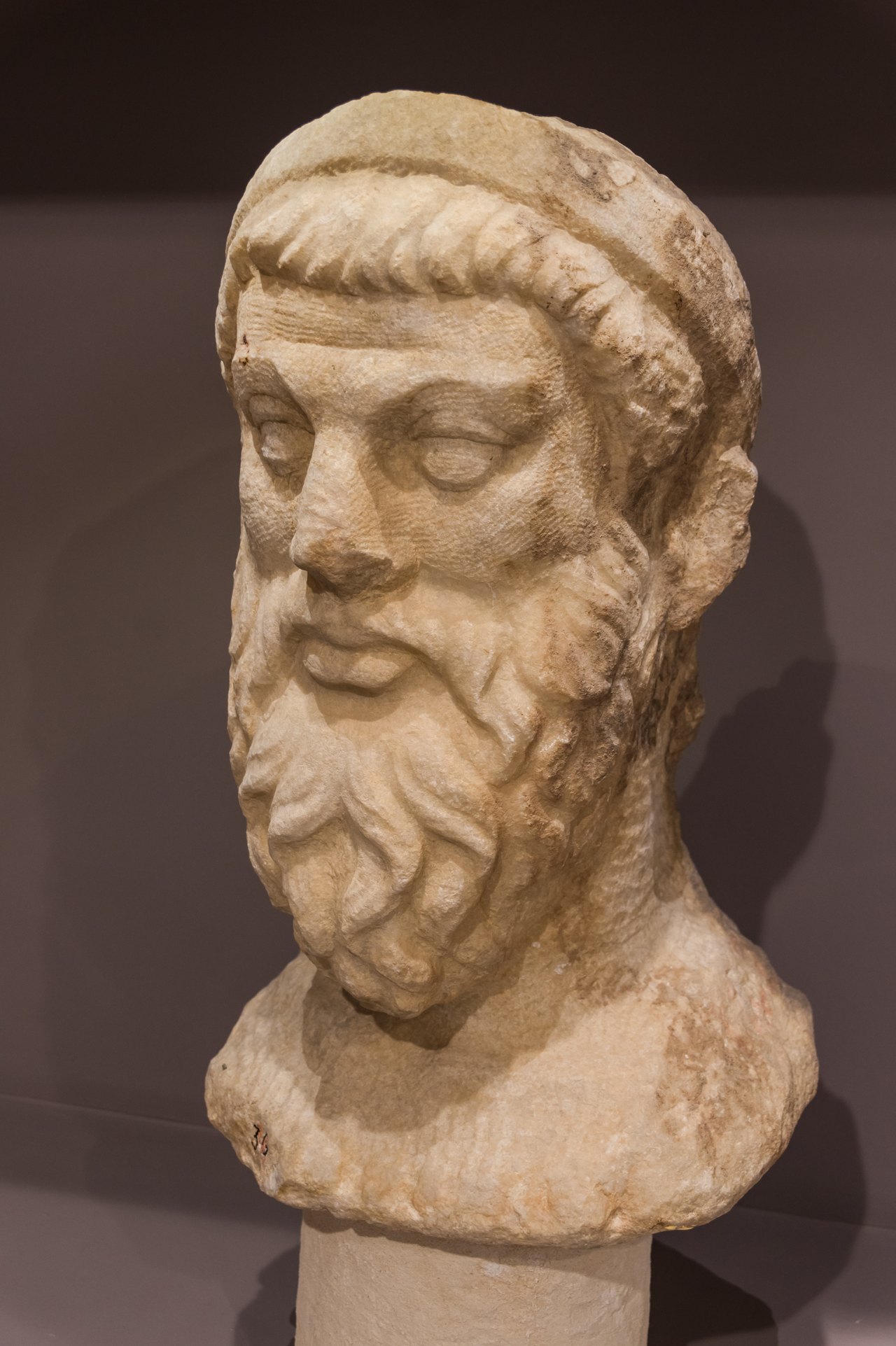
A marble head from the archaeological museum at Heraklion, left unfinished. The Knowledge Bank explains that marble begins as limestone and that heat and pressure deep underground reorganize its calcite into interlocking crystals — a metamorphic rock fine enough to hold carved detail. Compare the deep curls of the beard with the rougher patches around them. Both are the same block. The difference is only how far the pointed chisels, toothed tools and abrasives had got, and unlike clay, none of those cuts could be taken back.
Unfinished marble head, Archaeological Museum of Heraklion; photograph by Jebulon. Source: Wikimedia Commons, CC0.
exhibitn.Ch.4
A public display in a museum
“The new exhibit drew enormous crowds.”
sculpturen.Ch.4
Art shaped from stone, metal, or wood
“The sculpture stood barely two feet (61 cm) tall.”
marblen.Ch.4
A hard, fine stone prized by sculptors
“The angel was carved from pale marble.”
auctionn.Ch.4
A sale where the highest bidder wins
“The museum bought it at auction.”
bargainn.Ch.4
Something bought for far less than its worth
“At $225, it might be the bargain of the century.”
masterpiecen.Ch.4
An artist’s greatest work
“Was the little angel a lost masterpiece?”
geniusn.Ch.4
Extraordinary talent, or a person who has it
“Michelangelo’s genius shaped the Renaissance.”
admirev.Ch.4
To look at with wonder and approval
“Claudia stood and admired the Angel.”
blendv.Ch.4
To mix in without being noticed
“They blend into the school groups.”
headlinen.Ch.4
The large title of a newspaper story
“The Angel was in every headline.”
ⓘ The vocabulary words in this list are selected to help you understand and complete this workbook. Some may not appear verbatim in the original novel.
🧠Knowledge Bank question
1According to the Knowledge Bank, marble carving is subtractive, meaning each cut ___.Ch.4
2A ‘masterpiece’ is an artist’s weakest, most forgettable work.Ch.4
3Art shaped from stone, metal, or wood is called ___.Ch.4
4To ‘blend’ into a crowd means to stand out from it loudly.Ch.4
5Fill in each blank with the correct word.Ch.4
Word choices:marbleheadlineadmiregenius- some words will not be used
The angel was carved from pale .
The story made every in New York.
6Something bought for far less than its true worth is a ___.Ch.4
7To ‘admire’ something is to look at it with wonder.Ch.4
8A public display in a museum is an ___.Ch.4
9Fill in the blanks with the correct words.Ch.4
Word choices:blendmasterpieceauctionsculpture- some words will not be used
School groups made it easy to in.
A lost would be the find of the century.
10Extraordinary creative talent is called ___.Ch.4
Part 2
Comprehension
Show you understood what happens in Chapter 4.
📰Knowledge Bank · Seeing, Reporting, and Knowing
Research Skills · Sources and CorroborationHistorical questions begin by separating what was directly observed from what was reported by another source. In Chapter 4, the children can see the exhibition, the crowd, and the marble object. A newspaper adds claims about price, seller, and possible maker. Neither kind of information should be ignored, but each answers a different question. Researchers call an original object or record a primary source, but a newspaper can be primary or secondary depending on the question: its reporting may mix firsthand evidence with later explanation. A strong conclusion checks whether independent sources agree, a process called corroboration. Newspaper writers may simplify uncertainty for a headline, while museum labels may change as research improves. Careful readers therefore ask, “How does this source know?” Sorting sight, report, and inference keeps an exciting possibility from being mistaken for established fact. Museum labels often signal uncertainty with phrases such as ‘attributed to’ or ‘possibly by.’ Recognizing those signals is part of responsible source literacy.
🧠Knowledge Bank question
1The Knowledge Bank says that when records are missing, similarity raises ___.Ch.4
2What is Claudia’s learning plan for their stay?Ch.4
3The Angel exhibit draws a line of more than a thousand visitors.Ch.4
4What does the small marble statue show?Ch.4
5Write the numbers 1–5 in the boxes to show the correct order of events in Chapter 4. Number 1 = what happens first.Ch.4
The newspapers reveal the price and the seller’s name.
The children dress early and hide their belongings.
The two see the little marble Angel for themselves.
They find the enormous line for the new exhibit.
Claudia announces her gallery-a-day learning plan.
6The newspapers say the museum paid millions of dollars for the Angel.Ch.4
7Which great artist might have made the Angel, according to the papers?Ch.4
8Who sold the Angel to the museum?Ch.4
9Seeing the Angel makes Claudia forget her tidy gallery schedule.Ch.4
10What does the Angel give Claudia that her runaway was missing?Ch.4
Part 3
Literary Elements
Understanding HOW and WHY E.L. Konigsburg tells the story across Chapter 4.
🧠Knowledge Bank · When Real History Enters Fiction
Literary Craft · Allusion and IronyAn allusion is a reference to a real person, event, place, or work that brings outside knowledge into a story. Naming Michelangelo connects the fictional Angel to the Italian Renaissance, when artists studied anatomy, classical sculpture, mathematics, and the expressive possibilities of marble. Readers who know his fame immediately understand why a low auction price and uncertain authorship would cause excitement. Konigsburg then creates irony: trained experts debate the object while two children, officially missing, observe the debate from inside the museum. The allusion makes the mystery feel rooted in real art history; the irony lets readers see more than the public in the scene. Together they move the plot from hiding to investigation. Real history gives the invented mystery weight, texture, and credibility. An allusion rewards background knowledge without requiring a long history lesson inside the plot. It lets one famous name bring centuries of achievement and debate into the scene as resonance.
Allusion
A reference to something real — Michelangelo, the Renaissance, the Met — that anchors fiction in the actual world.
Irony
A gap between what is expected and what is — experts are stumped while two runaway children quietly join the hunt.
Rising Action
The events that build toward the climax — the Angel turns a hideout story into a quest that keeps climbing.
🧠Knowledge Bank question
1According to the Knowledge Bank, real history entering fiction makes the Angel ___.Ch.4
2Fill in the blank with the correct literary term.Ch.4
Word choices:rising actionallusionresolutiondialogue- some words will not be used
The events that build toward the climax are the .
A reference to something real, like the Renaissance, is an .
3The irony of Chapter 4 is that ___.Ch.4
4Rising action means the story’s events are winding down toward the ending.Ch.4
5Konigsburg makes the Angel small and modest rather than huge and golden to suggest that ___.Ch.4
6The $225 price tag works on the reader because it creates ___.Ch.4
7An allusion anchors a made-up story to the real world.Ch.4
8Fill in the blank with the correct literary term.Ch.4
Word choices:ironyallusionimagerytheme- some words will not be used
A gap between what is expected and what actually happens is called .
9Claudia abandoning her gallery-a-day plan the moment she sees the Angel shows that ___.Ch.4
10Ending the chapter on the seller’s name — Mrs. Basil E. Frankweiler — is effective because ___.Ch.4
Part 4
Think Deeper
Four deeper challenges — no single-word recall. Read, weigh the evidence, and reason it out.
💡Knowledge Bank · How Museums Attribute an Artwork
Art History · Evidence and AttributionAn attribution names the artist believed to have created a work, but it is a scholarly conclusion rather than a magical label. Curators compare style, anatomy, tool marks, materials, workshop practice, and dated documents. They also study provenance, the chain of ownership from the object’s creation to the present. One clue may support a theory without proving it. A mark, for example, might identify a workshop, owner, stone supplier, or later repair instead of the artist’s own hand. Experts publish reasons, invite other specialists to challenge them, and sometimes revise catalog records when stronger evidence appears. Chapter 4 presents a thrilling claim about the Angel, yet a careful investigator keeps claim and certainty separate. Responsible art history makes room for evidence, debate, and uncertainty. Conservators may add X-rays, chemical analysis, or microscopic images to the historical record. Confidence grows when several independent methods converge on the same conclusion.
Visual AidHow a name gets attached to a statue
Diagram for the Knowledge Bank on attribution. The four numbered steps run downward: one clue, then several kinds of clue, then a reason published where other specialists can attack it, then a catalog entry that stronger evidence can rewrite. The Knowledge Bank stresses that an attribution is a scholarly conclusion, not a magic label. Notice that step 4 stays open. A museum that can never revise an entry is not being careful; it has stopped doing the work.
The steps behind an attribution, as described in the Knowledge Bank. Drawn for Garden Heights Academy.
Think back over the day. Two stowaways join the morning crowds as easily as putting on coats. A line a thousand deep bends around a statue smaller than a fire hydrant. The papers shout three facts — maybe-Michelangelo, $225, sold by a Mrs. Basil E. Frankweiler — and a girl who came to the museum to feel important realizes that answering one question could make her exactly that.
Original passage written for Garden Heights — not a quotation from the novel.
1Claim: “By the end of Chapter 4, Claudia’s runaway has turned into a quest.” — choose the two details that best prove it.Claim & Evidence
2Reported in the newspapers, or Seen with their own eyes? Tap each detail to sort it — tap again to switch sides. You can keep tapping to change your answer.Sort into two
◄ Reported in the newspapersSeen with their own eyes ►
3Match each cause to its result. For each cause, pick its result.Cause & Effect
A possible Michelangelo appears in New York→
Nobody could prove who carved the Angel→
The papers name the statue’s seller→
Claudia sees the Angel for herself→
🧠Knowledge Bank question
4Fill both blanks to complete the reasoning.Build the Argument
The Knowledge Bank says a museum attributing an artwork prefers , because visual resemblance alone .
Part 5
Standardized Test
Attribution Without a Signature · Factual Information & Inference · SAT & TOEFL-style practice
Read the passage — the highlighted words are tested — then answer. Tap an answer, then tap it again to confirm.
SATWords in Context — a word's meaning in this passage
SATInference — a conclusion the passage implies
SATAuthor’s Purpose — what the author wants to achieve
SATText Structure — how the passage is built, and why
TOEFLFactual Information — a fact stated in the passage
Michelangelo and the Question of Attribution
Michelangelo Buonarroti was born in Italy in 1475, during a period of renewed interest in classical learning and art. He trained in the Florence workshop of the painter Domenico Ghirlandaio, yet he became celebrated above all as a sculptor who carved figures from marble. Carving that stone is subtractive: each cut removes material, so a mistaken blow cannot simply be painted over. From 1501 to 1504 he transformed a large block already begun and abandoned by two other sculptors into the masterpiece David, completing it before he turned thirty. From 1508 to 1512 he also painted the Sistine Chapel ceiling while standing on a raised scaffold and reaching overhead, not lying flat on his back as a popular myth claims.
Artists of that period commonly worked on commission, an agreement in which a patron ordered and paid for a particular work. Churches, civic governments, rulers, and wealthy families supplied projects, while workshops could divide preparation and other labor among assistants. Today, contracts, letters, payment records, and preparatory drawings can link an object to an artist more firmly than visual resemblance alone. When those records are missing, experts compare style, tool marks, materials, and ownership history, but similarity raises a possibility rather than proving a maker. A missing paper trail explains why a careful museum must investigate before presenting certainty.
Original passage written for Garden Heights — not a quotation from the novel.
1In the passage, marble is ___.SAT · Words in Context
2Why does the passage emphasize Michelangelo as a sculptor despite his training in painting?SAT · Inference
3How did Michelangelo work on the Sistine Chapel ceiling, according to the passage?TOEFL · Factual Information
4What is remarkable about the block that became the David?TOEFL · Factual Information
5In the passage, a masterpiece is ___.SAT · Words in Context
6Which groups commonly acted as patrons for Renaissance commissions?TOEFL · Factual Information
7Which evidence can link an old object firmly to a particular artist?TOEFL · Factual Information
8What can be inferred when an object resembles an artist’s known work but has no records?SAT · Inference
9How does the passage connect to Chapter 4?SAT · Author’s Purpose
10The passage is organized by ___.SAT · Text Structure
Part 6 · Optional
Creative Writing
A bonus challenge to practice your English. Take your time and have fun with it.
About This Section
This writing task is optional and is not part of your auto-graded score. The feedback below checks only the basics — length, spelling, and grammar — not whether your ideas are right or wrong. It is meant for classroom discussion and creative practice, so feel free to use your imagination!
Writing Task — Part 3 “The Line I Would Wait In”
A thousand people wait in line to see one small statue. What piece of art, invention, or treasure would make YOU wait in line for hours? Describe the moment you finally reach it: what you see, what you feel, and whether it was worth the wait. Write at least 40 words.
You can start with: “After three hours, there were only ten people ahead of me…”
0 / 40 words minimum
🗣 Teach It · Just for Fun (optional)
No right or wrong — close the screen and tell someone nearby what happened in this part. Can’t find anyone? Tell yourself out loud. The moment you teach it, you truly understand it.
Part 3 Complete!
You finished Chapter 4 of From the Mixed-Up Files of Mrs. Basil E. Frankweiler.
Here are your auto-graded results:
-
points out of 100
Teach it to someone
The best last step is to teach it. In your own words, explain what happened — retell a favorite scene, teach a character’s big choice, or sum up the main idea for a parent, friend, or classmate. When you can teach it clearly, you truly own it.
Independent study guide by Garden Heights. Not affiliated with or endorsed by E.L. Konigsburg. Contains original analysis only; no text from the novel is reproduced. Reference text: This workbook follows E.L. Konigsburg’s classic text (the standard Puffin edition sold worldwide). Revised 2023 UK editions change some wording and may not match the vocabulary studied here.
SAT® is a registered trademark of College Board, which is not affiliated with, and does not endorse, these materials. TOEFL® is a registered trademark of ETS. These materials are not endorsed or approved by ETS. Garden Heights is an independent provider of test-style reading practice.