New here? Just sign up with Google — your account includes Matilda, our gift book, forever.
Mr. Popper’s Penguins · Garden Heights
Part 5
for Mr. Popper’s Penguins · Part 5 · Chapters 11–13
8 Parts40 min
What Happens in Part 5
Winter blows into Stillwater, the windows stand open for penguin comfort, and Greta delivers a surprise science has no explanation for: egg after egg after egg — ten in all, though ordinary penguins lay only one or two. Soon the house holds twelve penguins: Captain Cook, Greta, and ten chicks with explorers’ names — Nelson, Columbus, Louisa, Jenny, Scott, Magellan, Adelina, Isabella, Ferdinand, and Victoria. To house the colony, an engineer installs a freezing plant in the basement, complete with an ice floe and a diving pool. But twelve penguins eat mountains of fresh fish, the freezing plant devours money, and the Poppers slide toward ruin — until the family lands on a gleaming idea: if the penguins cost a fortune, let the penguins earn one. With Mrs. Popper at the piano playing marches and dances, the twelve birds begin to rehearse: drilling in rows, sparring matches, and a grand tobogganing finale up ladders and down boards. In the parlor of a broke house painter, Popper’s Performing Penguins are born.
What We Will Learn
Section
What you will practice
Vocabulary
Words of hatching and hard times: hatch, brood, engineer, install, rehearse…
Literary Elements
Exaggeration for comedy, naming as characterization, and the turning-point decision
Cross-Curricular
How penguin chicks really hatch, and how families invented income in the 1930s
Chapter Summary
Ch.
What happens
11
The Eggs — winter comes and Greta lays an impossible ten eggs; the icebox era is over.
12
Twelve Penguins — the chicks hatch and get explorers’ names; a freezing plant with a pool fills the basement.
13
The Big Idea — fish bills and machinery push the family toward ruin, so the penguins start rehearsing an act to Mrs. Popper’s piano.
Part 1
Vocabulary
Study 10 key words from Chapters 11–13, then answer each question.
🧠Knowledge Bank · From Egg to Hungry Chick
Content · Penguin Life CyclePenguins begin life inside an egg, and the parents take turns keeping it warm, often balancing it on their feet away from the cold ground. Once a fuzzy chick hatches, it is astonishingly hungry, and both parents work hard to bring back food. This is where penguin biology meets the Poppers’ empty pockets. Because ten little penguins hatch in the story, ten small appetites must be fed with fish every single day, and the family’s money vanishes fast. In nature the ocean supplies that endless food, but in a town house someone must buy it. The joyful arrival of chicks and the sudden strain on the family purse are really the same fact seen twice: new life always brings a growing, unstoppable appetite.
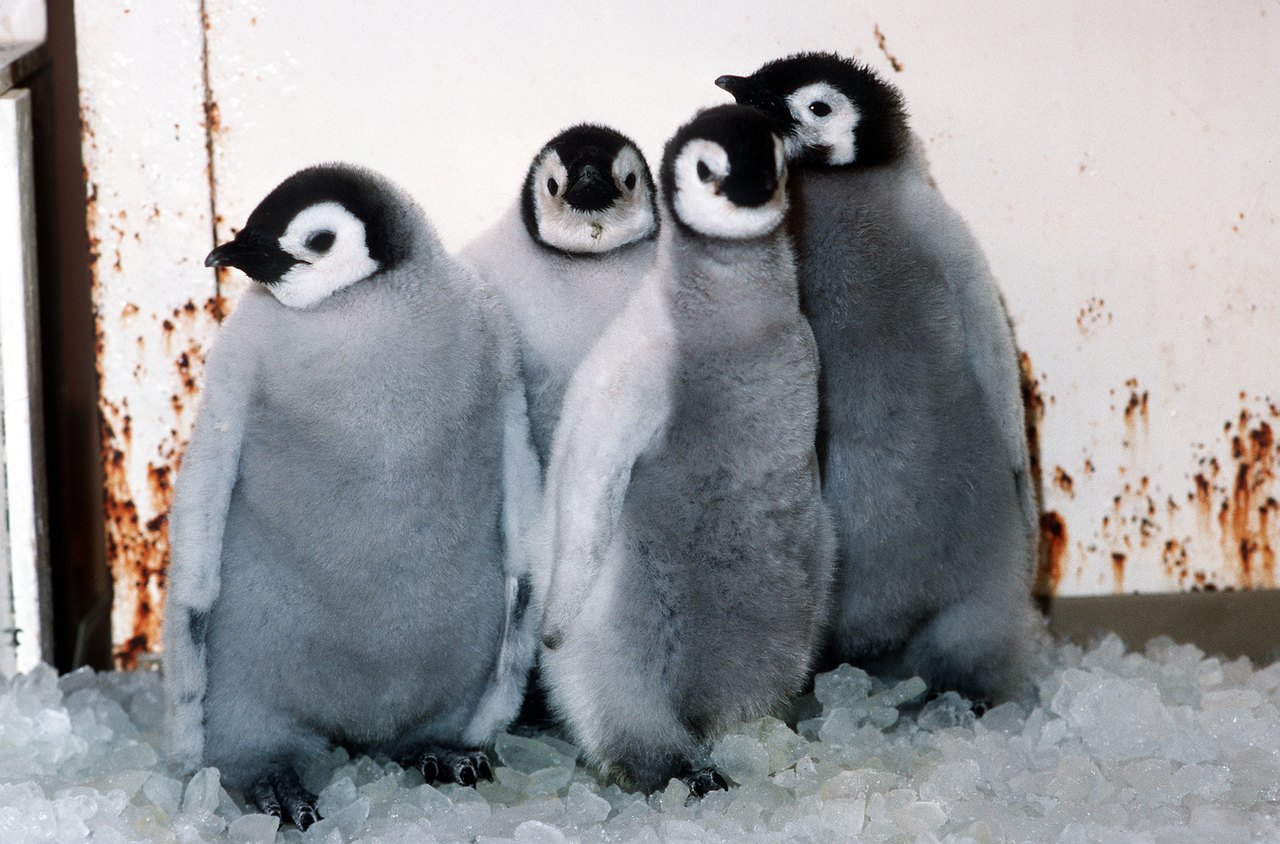
Visual AidChicks in their gray down
Photograph of four emperor penguin chicks huddled together in 1988 at SeaWorld in San Diego, where they had been flown from McMurdo Station in Antarctica for a National Science Foundation study. The Knowledge Bank explains that a fuzzy chick hatches astonishingly hungry and that both parents work hard to bring back food. These chicks wear the soft gray down of the passage above — warm on land, useless in water. They came by airplane, not out of an icebox, and no family had to buy their fish. Notice how they press together for warmth even indoors on ice.
Emperor penguin chicks at SeaWorld, San Diego, 16 November 1988; U.S. Department of Defense photograph DF-ST-90-04598 by Jose Lopez, Jr. Source: Wikimedia Commons, public domain.
hatchv.Ch.12
To break out of an egg
“One by one the ten eggs began to hatch.”
broodn.Ch.12
A family of young birds hatched together
“The brood of ten chicks filled the basement with noise.”
incubatev.Ch.11
To keep eggs warm until they hatch
“The penguins took turns incubating the precious eggs.”
engineern.Ch.12
A person trained to design and build machines
“An engineer came to install the freezing plant.”
installv.Ch.12
To put equipment in place so it can be used
“It cost a fortune to install the basement machinery.”
ruinn.Ch.13
Complete loss of money; total collapse
“The fish bills were driving the family toward ruin.”
rehearsev.Ch.13
To practice a performance before showing it
“The penguins began to rehearse to piano music.”
sparv.Ch.13
To fight playfully, as boxers do in practice
“Two penguins would spar with their flippers like little boxers.”
applaudv.Ch.13
To clap in approval
“The children would applaud every successful trick.”
fortunen.Ch.13
A large amount of money
“Perhaps twelve trained penguins could earn a fortune.”
ⓘ The vocabulary words in this list are selected to help you understand and complete this workbook. Some may not appear verbatim in the original novel.
🧠Knowledge Bank question
1According to the Knowledge Bank, the chicks' arrival and the family's money worry are the same fact because ___.Ch.12
2To ‘incubate’ eggs is to keep them warm until they hatch.Ch.11
3A family of young birds hatched together is a ___.Ch.12
4To ‘rehearse’ means to perform in front of a paying audience.Ch.13
5Fill in each blank with the correct word.Ch.12–13
Word choices:installsparengineerfortune- some words will not be used
An arrived to build the basement freezing plant.
Two young penguins loved to like tiny boxers.
6Complete loss of money is called ___.Ch.13
7To ‘applaud’ is to clap in approval.Ch.13
8To put equipment in place so it can be used is to ___ it.Ch.12
9Fill in the blanks with the correct words.Ch.11–13
Word choices:hatchrehearseincubatebrood- some words will not be used
Each evening the twelve birds would their act.
At last the first egg began to .
10A large amount of money is a ___.Ch.13
Part 2
Comprehension
Show you understood what happens in Chapters 11–13.
🧠Knowledge Bank · Same and Different
Reading Skill · Compare & ContrastA useful reading skill is to compare two things, noticing how they are alike, and to contrast them, noticing how they differ. Part 5 invites this again and again. Captain Cook and Greta are both penguins, yet they behave in their own ways; the tidy early house and the crowded, chilly one it becomes are the same home turned upside down. You might also compare the family’s joy at the new chicks with their worry over the growing bills. Because you set two ideas side by side, each one becomes clearer and more interesting. As you read, ask how these are alike, and how they are different. Sorting sameness from difference sharpens your thinking and helps you hold a whole story in one clear view.
Visual AidTwo penguins, one house
Venn diagram for the Knowledge Bank on comparing and contrasting. Each circle holds what belongs to one penguin only — who sent it, when it came, which parent it is; the overlap holds what both share. It does not say which bird is more important. Notice that the overlap is the part that matters most: both drooped alone and both revived together, which is exactly what the earlier chapters taught about what a penguin needs.
Facts about the two penguins as given in the Knowledge Banks of Parts 1, 4 and 5. Drawn for Garden Heights Academy.
🧠Knowledge Bank question
1The Knowledge Bank says to contrast two things is to notice how they ___.Ch.11
2What is installed in the basement for the growing penguin family?Ch.12
3The ten chicks are named after famous explorers and queens.Ch.12
4Why do the Poppers slide toward ruin?Ch.13
5Write the numbers 1–5 in the boxes to show the correct order of events in Chapters 11–13. Number 1 = what happens first.Ch.11–13
The chicks hatch and receive explorers’ names.
Greta begins laying her impossible ten eggs.
The penguins begin rehearsing an act to piano music.
The bills pile up and ruin comes closer.
The freezing plant is installed in the basement.
6Ordinary penguins usually lay about ten eggs, so Greta’s ten are unremarkable.Ch.11
7Who provides the music for the penguins’ rehearsals?Ch.13
8Which of these is part of the penguins’ act?Ch.13
9The performing act is Mr. Popper’s way of turning the penguins’ cost into income.Ch.13
10How many penguins live with the Poppers by the end of these chapters?Ch.12
Part 3
Literary Elements
Understanding HOW and WHY Richard & Florence Atwater tells the story across Chapters 11–13.
🧠Knowledge Bank · What a Name Can Tell You
Literary Craft · NamingAuthors rarely choose names by accident; a good name can quietly reveal character. When the ten baby penguins are named after famous explorers and adventurers, the choice is playful but meaningful. Because Mr. Popper adores tales of the frozen poles, he passes that love straight into the names he gives, and the little flock becomes a living tribute to the dreams filling his head. The names also make each penguin feel like a real personality rather than one bird lost in a crowd. As you read, notice how a name can hint at what a character loves, hopes for, or comes from. Here the joyful, grand explorer names tell you almost as much about Mr. Popper himself as they do about the penguins.
Comic exaggeration
Stretching facts past truth for laughter — ten eggs from a bird whose species lays two, and the book admits it with a grin.
Naming as characterization
Names that reveal the namer — Nelson, Magellan, Victoria: ten chicks carrying one house painter’s polar dream.
Turning point
The decision that changes the story’s direction — from paying for penguins to performing with them.
🧠Knowledge Bank question
1According to the Knowledge Bank, the explorer names tell readers about ___.Ch.11
2Fill in the blank with the correct literary term.Ch.13
Word choices:turning pointflashbackcliffhangermoral- some words will not be used
The decision to train the penguins is the story’s .
3The chicks’ names — Columbus, Magellan, Scott, Victoria — tell readers most about ___.Ch.12
4A turning point is a moment that changes the direction of the whole story.Ch.13
5The freezing plant — a private Antarctica in a Stillwater basement — continues the book’s central comic method of ___.Ch.12
6Setting the money crisis (ruin) right beside the big idea (the act) gives Chapter 13 the shape of ___.Ch.13
7The book hides the fact that ten eggs is scientifically impossible.Ch.11
8Fill in the blank with the correct literary term.Ch.11
Word choices:exaggerationunderstatementsymbolismirony- some words will not be used
Stretching facts past truth for laughs is comic .
9Mrs. Popper — the budget-watcher of Part 1 — now plays piano for penguin rehearsals. This change shows ___.Ch.13
10These chapters swing from joy (chicks) to fear (ruin) to hope (the act). This emotional shape keeps the middle of the book ___.Ch.11–13
Part 4
Think Deeper
Four deeper challenges — no single-word recall. Read, weigh the evidence, and reason it out.
🧠Knowledge Bank · Facing Hard Times Together
Social-Emotional · Family TeamworkPart 5 brings a real worry that many families know: there is not enough money. The Poppers must feed a growing flock while their savings shrink, and how they respond is the quiet heart of these chapters. Instead of blaming one another, they pull together, share the work, and search for a clever plan. Because each person gives something — patience, effort, an idea — the family stays warm even as the budget grows cold. This is a gentle lesson about hardship: trouble either splits people apart or draws them closer, and love often decides which. Mrs. Popper’s steadiness especially holds the household up. When difficulties come to your own home, the Poppers show that the surest way through is to face them shoulder to shoulder, together.
Think back over the chapters. Snow drifts through open windows while ten impossible eggs warm under patient parents. A basement fills with machinery, ice, and a diving pool. At the kitchen table, bills rise like a tide — and then, one evening, a piano strikes up a military march, and twelve penguins fall into line, drilling and sparring and tobogganing, while a ruined house painter watches his ruin learn to dance.
Original passage written for Garden Heights — not a quotation from the novel.
1Claim: “By Chapter 13, the penguins have changed from a beloved burden into the family’s great hope.” — choose the two details that best prove it.Claim & Evidence
2What the penguins COST the family, or What the penguins GIVE the family? Tap each detail to sort it — tap again to switch sides. You can keep tapping to change your answer.Sort into two
◄ What the penguins COST the familyWhat the penguins GIVE the family ►
3Match each cause to its result. For each cause, pick its result.Cause & Effect
Greta lays ten eggs instead of two→
An icebox cannot hold a whole colony→
Fish and machinery drain the family’s money→
Mrs. Popper strikes up marches on the piano→
🧠Knowledge Bank question
4Fill both blanks to complete the reasoning.Build the Argument
The Knowledge Bank says the Poppers face the money trouble by , which shows that .
Part 5
Standardized Test
Reading passage · Raising a Penguin Chick · SAT & TOEFL-style practice
Read the passage — the highlighted words are tested — then answer. Tap an answer, then tap it again to confirm.
SATText Structure & Purpose — how the passage is built, and why
SATWords in Context — a word's meaning in this passage
SATDetail — a fact stated in the passage
TOEFLFactual Information — a fact stated in the passage
TOEFLVocabulary — a tested word's meaning here
TOEFLRhetorical Purpose — why the author included a detail
Patient Parenting in a Penguin Egg
A penguin chick begins life inside one of the best-guarded eggs in nature. Most penguin species lay only one or two eggs a season, and the parents share duty with military precision: one parent balances the egg on its feet, tucked beneath a warm fold of belly skin, to incubate it — sitting patiently over the egg — while the other travels to the sea to hunt. In some species the father takes the long first shift, fasting for weeks while the mother feeds and returns. When the chick finally hatches, it emerges wearing a coat of fluffy gray down — wonderfully warm, but useless in water. For weeks the parents take turns delivering meals of half-digested fish, and the chick grows at astonishing speed. Only when its sleek, waterproof adult feathers replace the baby down can the young penguin finally venture into the sea to hunt for itself. From balanced egg to first swim, penguin parenting is a masterpiece of patience — which is one more reason a bird laying ten eggs in a Stillwater icebox belongs to comedy, not to science.
Original passage written for Garden Heights — not a quotation from the novel.
1What is the main purpose of the passage?SAT · Text Structure & Purpose
2How many eggs do most penguin species lay each season?TOEFL · Factual Information
3In the passage, incubating an egg means ___.SAT · Words in Context
4Where does a penguin parent keep the egg while incubating?SAT · Detail
5In the passage, the chick’s gray down is ___.TOEFL · Vocabulary
6Why can’t a young chick enter the sea right after hatching?TOEFL · Factual Information
7What do the parents feed the growing chick?SAT · Detail
8In the passage, when the chick hatches, it ___.SAT · Words in Context
9The father’s long first shift in some species involves ___.TOEFL · Factual Information
10The passage ends by calling Greta’s ten eggs ‘comedy, not science.’ The author’s purpose in that line is to ___.TOEFL · Rhetorical Purpose
Part 6 · Optional
Creative Writing
A bonus challenge to practice your English. Take your time and have fun with it.
About This Section
This writing task is optional and is not part of your auto-graded score. The feedback below checks only the basics — length, spelling, and grammar — not whether your ideas are right or wrong. It is meant for classroom discussion and creative practice, so feel free to use your imagination!
Writing Task — Part 5 “Naming the Brood”
Mr. Popper named his ten chicks after explorers and queens. Imagine YOU are given ten remarkable pets at once. What theme would you choose for their names — scientists? planets? characters from books? Name at least five of them, and explain what your naming theme says about the things YOU dream about, the way Mr. Popper’s names revealed his polar dreams. Write 6–10 sentences.
You can start with: “If ten arrived at my door tomorrow, I would name the first one...”
0 / 40 words minimum
🗣 Teach It · Just for Fun (optional)
No right or wrong — close the screen and tell someone nearby what happened in this part. Can’t find anyone? Tell yourself out loud. The moment you teach it, you truly understand it.
Part 5 Complete!
You finished Chapters 11–13 of Mr. Popper’s Penguins.
Here are your auto-graded results:
-
points out of 100
Teach it to someone
The best last step is to teach it. In your own words, explain what happened — retell a favorite scene, teach a character’s big choice, or sum up the main idea for a parent, friend, or classmate. When you can teach it clearly, you truly own it.
Independent study guide by Garden Heights. Not affiliated with or endorsed by Richard & Florence Atwater. Contains original analysis only; no text from the novel is reproduced. Reference text: This workbook follows Richard & Florence Atwater’s classic text (the standard Puffin edition sold worldwide). Revised 2023 UK editions change some wording and may not match the vocabulary studied here.
SAT® is a registered trademark of College Board, which is not affiliated with, and does not endorse, these materials. TOEFL® is a registered trademark of ETS. These materials are not endorsed or approved by ETS. Garden Heights is an independent provider of test-style reading practice.