New here? Just sign up with Google — your account includes Matilda, our gift book, forever.
My Father's Dragon · Garden Heights Academy
Part 3
for My Father's Dragon · Part 3 · Chapter 5
a novel by Ruth Stiles Gannett
25 min5 Parts
This workbook is built on a solid pedagogical foundation, effectively integrating content and language learning based on the CLIL framework (Content and Language Integrated Learning), elevated by our unique 5th C — Connection — and an integrated Standardized Test section that weaves every SAT & TOEFL question type right into the novel, so learners build real test skills easily, naturally, and with fun.
What Happens in Part 3
Hungry tigers plan to eat Elmer, so he gives them chewing gum instead.
A pack of tigersDeep in the jungle, Elmer runs straight into a pack of hungry tigers, who happily announce that they are going to eat him.
The chewing gum trickThinking fast, Elmer offers them his chewing gum. He says it is a special treat that lasts and lasts, if you never swallow it.
Chewing and chewingThe greedy tigers each grab a piece and chew. They are so busy chewing that they forget all about Elmer.
Slipping pastWhile the tigers chomp away, quick-thinking Elmer quietly slips past them and hurries on toward the river.
What We Will Learn
Focus
What It Means
Problem-Solving
Elmer’s first clever escape
Science (Tigers)
Real facts about these big cats
Character
Elmer’s quick thinking under pressure
Chapter Summary
Chapter
Key Events
Ch.5
Hungry tigers want to eat Elmer; he gives them chewing gum, and while they chew, distracted, he slips safely past
💭 Before You Read · Warm-Up (not scored)
There are no wrong answers here — just think, guess, and talk:
Facing a pack of hungry tigers, Elmer doesn’t run or fight — he hands them chewing gum. Why can distracting a stronger enemy work better than facing it head-on?
The tigers are beaten by their own greed. Can you think of a time when wanting too much of something got a person (or an animal) into trouble?
Predict: Elmer has more odd supplies in his pack. What kind of animal problem might a lollipop or a ribbon solve?
Copyright Notice
This is an independent study guide created by Garden Heights Academy to support reading comprehension and literary analysis. It contains original analysis questions and does not reproduce any text from the novel. My Father's Dragon is a work by Ruth Stiles Gannett. This guide is not affiliated with, authorized by, or endorsed by the author or any associated rights holders. Students should read the original book, available from libraries and booksellers.
Part 1
Vocabulary
Study 10 key words from Chapter 5, then answer each question.
🐅Knowledge Bank · All About Tigers
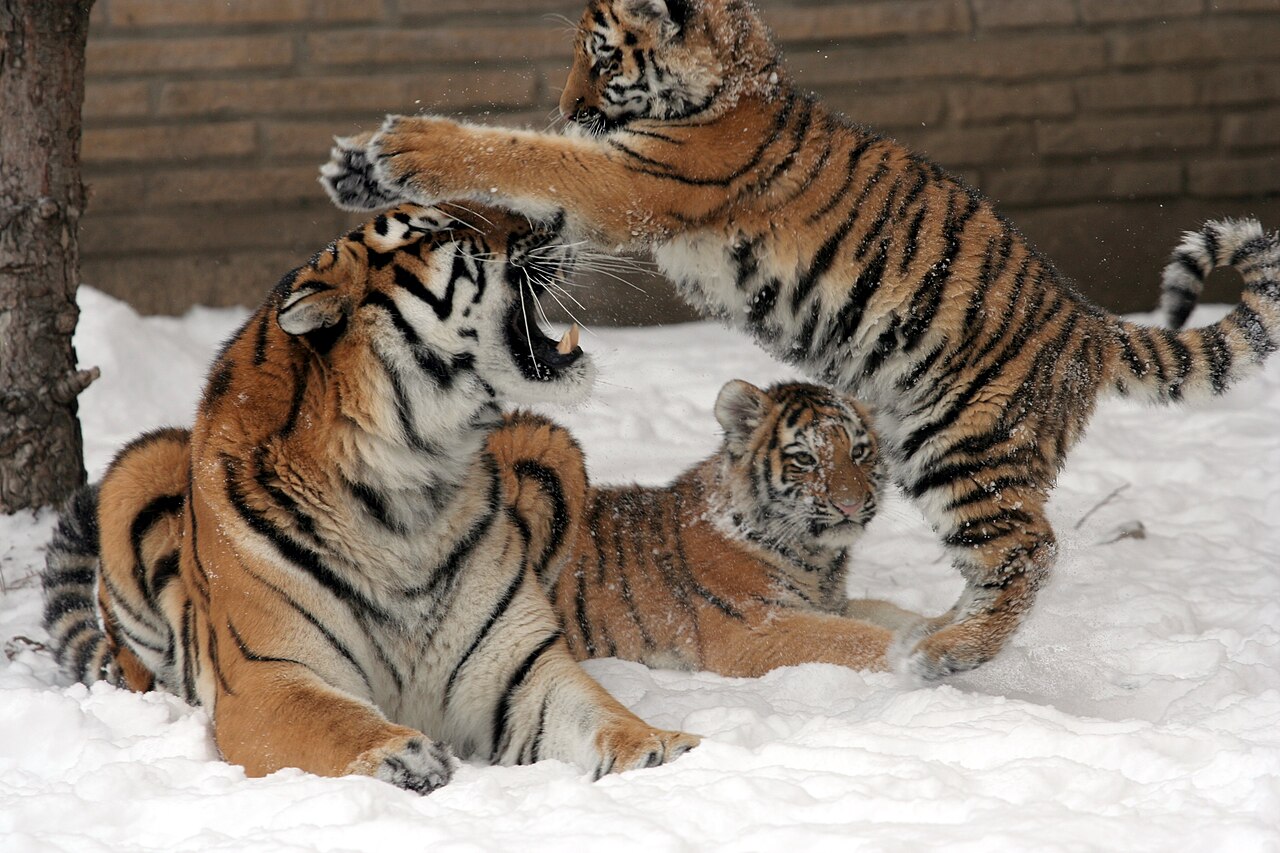
Biology · TigersThe tiger is the largest cat on Earth, heavier than a lion and strong enough to drag prey bigger than itself. Wild tigers live only in Asia, spread from the steaming forests of India to the freezing woods of eastern Russia. Every tiger wears its own pattern of black stripes, and no two are ever alike, much as no two people share a fingerprint. Those stripes are a disguise: they break up the animal’s outline among tall grass and shifting shadow so it can creep close before rushing. A tiger hunts alone and waits with great patience. So few remain today that the species is now endangered.
Visual AidStripes in the snow
Photograph of Amur tigers, the kind that live in the freezing woods the Knowledge Bank mentions. Every stripe pattern here is different, just as the Knowledge Bank says. These are zoo tigers playing in snow, and they are a mother with her cubs — grown tigers hunt alone, so this is not a hunting group. Look at how the dark bars break the shape of each animal into pieces. Against tall grass or shifting shadow, that is what makes a tiger hard to see at all.
ⓘ The vocabulary words in this list are selected to help you understand and complete this workbook. Some may not appear verbatim in the original novel.
🧠Knowledge Bank question
1According to the Knowledge Bank, what job do a tiger's stripes do?Ch.5
2True or False: To “distract” means to pull someone’s attention away.Ch.5
3Wanting far too much means being ___.Ch.5
4True or False: To “pounce” means to lie down and sleep.Ch.5
5Fill in each blank with the correct word.Ch.5
Word choices:ferociousgreedydistractescape- some words will not be used
The tigers were , so Elmer used gum to them.
6True or False: To “announce” means to say something openly.Ch.5
7To get away from danger is to ___.Ch.5
8True or False: “Enormous” means very small.Ch.5
9Fill in the blanks with the correct words.Ch.5
Word choices:cleverquietlynervouspounce- some words will not be used
Elmer’s trick worked, and he slipped away .
10To jump suddenly to attack is to ___.Ch.5
Part 2
Comprehension
How well do you understand Chapter 5?
🍫Knowledge Bank · Where Chewing Gum Comes From
Food Science · Chewing GumThe odd treat in this chapter has a real history. For centuries, people in Mexico and Central America chewed chicle, a milky sap collected by cutting the bark of the sapodilla tree. In the eighteen hundreds, makers boiled that sap, sweetened it, and rolled it flat into the sticks we would recognize today. Most modern gum uses a man-made base instead of tree sap, but the idea never changed: something soft you chew for a long while and never swallow. That is precisely what makes it handy on a journey. A single stick hides in a pocket, yet it holds a hungry mouth far longer than any snack.
🧠Knowledge Bank question
1According to the Knowledge Bank, why is chewing gum handy on a journey?Ch.5
2What does Elmer give the tigers?Ch.5
3What does Elmer tell the tigers about the gum?Ch.5
4True or False: The tigers get so busy chewing that they forget about Elmer.Ch.5
5Write the numbers 1–5 in the boxes to show the correct order across Part 3. Number 1 = what happens first.Ch.5
The tigers announce they are going to eat him.
Elmer offers them chewing gum that ‘lasts forever.’
The greedy tigers chew and chew, distracted.
Elmer runs into a pack of hungry tigers.
Elmer quietly slips past and hurries on.
6True or False: Elmer fights the tigers with his fists.Ch.5
7Why does the gum trick work?Ch.5
8What does Elmer do while the tigers chew?Ch.5
9True or False: Elmer stays calm and thinks quickly in danger.Ch.5
10Fill in the blanks to complete the sentence.Ch.5
Word choices:gumtigerschewriver- some words will not be used
Elmer gave the chewing and slipped away while they chewed.
Part 3
Literary Elements
Understanding HOW and WHY Ruth Stiles Gannett creates certain feelings across Chapter 5.
😂Knowledge Bank · Humor Born of Surprise
Literary Craft · Humor and SurpriseThis adventure is thrilling, and it is also very funny, and nearly all of its humor grows from surprise. The writer sets up something fearsome, then answers it with something small and silly, and that sudden switch is what makes a reader laugh aloud. Comedy writers say the gap between what we expect and what we get is the whole engine of a joke. Gannett keeps the danger honest — these animals really could eat a boy — while every escape stays playful. That balance thrills young readers without frightening them. Watch how often a frightening page finishes on something perfectly ridiculous.
📚 Literary Devices in This Part · definitions & examples
The tigers are a problem; the chewing gum is the clever solution.Elmer’s key trait is cleverness — he thinks his way out of danger.The story uses a pattern: each animal is outwitted by one clever item.
The questions below are mixed — not grouped by device. Decide which device each one is about.
🧠Knowledge Bank question
1According to the Knowledge Bank, where does most of this book's humor come from?Ch.5
2A solution is how a character solves the problem they face.Ch.5
3Fill in each blank with the correct word.Ch.5
Word choices:problemsolutiontraitpattern- some words will not be used
The fierce tigers are the
The clever gum trick is Elmer’s .
4Elmer’s main character trait, shown again here, is his —Ch.5
5A character trait changes completely on every single page.Ch.5
6Fill in each blank with the correct word.Ch.5
Word choices:patterntraitsolutionmood- some words will not be used
Each animal beaten by one clever item is a repeating
Elmer’s key .
7Beating each animal with one clever item over and over is a story —Ch.5
8How does Elmer solve the tiger problem?Ch.5
9Fill in each blank with the correct word.Ch.5
Word choices:solutionproblemtraitplot- some words will not be used
The tigers are a deadly
Elmer’s quick wits give him a clever .
10The repeating problem-and-solution pattern mainly shows that —Ch.5
Part 4
Think Deeper
Four deeper challenges — no single-word recall. Read, weigh the evidence, and reason it through.
💡Knowledge Bank · Solving a Problem Sideways
Thinking · Lateral ThinkingWhen a problem is too big to beat head-on, clever people hunt for a side door. Thinkers call this lateral thinking: rather than asking how to win the fight, you ask what else about the situation could change. A locked gate might be walked around. A hungry animal might simply be fed. Inventors work this way too — sticky notes exist because someone asked what a weak, failed glue might be perfect for. Elmer never tries to be stronger than a tiger, since he never could be. He changes the question instead, and his best answers always arrive sideways.
Visual AidTwo ways to meet a problem
Diagram for the Knowledge Bank on lateral thinking, comparing pushing straight at a problem with going around it. The wall is a plain shape standing for any obstacle, and the drawing leaves out the problem itself. It does not claim the sideways route always exists or is always easy. Notice that the second path is longer. Going around usually takes more steps than pushing, which is exactly why people try pushing first.
Comparison drawn from the lateral-thinking examples the Knowledge Bank gives. Drawn for Garden Heights Academy.
1Claim: “Elmer escapes the tigers by outsmarting them, not fighting.” — choose the two details that best prove it.Claim & Evidence
2Shows Elmer using cleverness, or just a detail of the danger? Tap each item to sort it — tap again to switch sides. You can keep tapping to change your answer.Sort into two
◄ Elmer’s clevernessJust a detail ►
3Match each cause to its result. For each cause, pick its result.Cause & Effect
Hungry tigers surround Elmer→
Elmer thinks fast→
The tigers are busy chewing→
His trick works→
🧠Knowledge Bank question
4Fill both blanks to complete the reasoning.Build the Argument
The Knowledge Bank says Elmer solves his problems sideways because , which shows that .
Part 5
Standardized Test
Factual Details & EXCEPT Questions — SAT & TOEFL-style practice
Read the passage — the highlighted words are tested — then answer. Tap an answer, then tap it again to confirm.
SATWords in Context — a word's meaning in this passage
SATInference — a conclusion the passage implies
SATCentral Ideas — the passage's main point
TOEFLNegative Fact (EXCEPT) — the statement the passage does NOT support
TOEFLFactual Information — a fact stated in the passage
TOEFLRhetorical Purpose — why the author included a detail
The Small Hero Folktale Pattern
In stories from all around the world, the smallest character is often the one who wins. A tiny hero cannot beat a giant by strength, so instead the hero must be cunning, using tricks and quick thinking to escape. These tales share a clear pattern. First, a weak character meets a powerful, ferocious enemy — a giant, a wolf, a tiger. Next, the small hero spots the enemy's hidden flaw, often its greed, its vanity, or its stupidity. Then, instead of fighting, the hero sets a clever trap or finds a way to distract the enemy, turning its own weakness against it. Finally, the little one escapes while the powerful one is left fooled. People have loved this pattern for thousands of years, from ancient Greece to West Africa, because it carries a hopeful message: you do not have to be the biggest or strongest to win. A sharp mind, these stories promise, can be the most powerful weapon of all.
Original passage written for Garden Heights — not a quotation from the novel.
1In the passage, “ferocious” most nearly means ___.SAT · Words in Context
2In the passage, “distract” most nearly means ___.SAT · Words in Context
3The passage lists these steps of the pattern EXCEPT —TOEFL · Negative Fact (EXCEPT)
4A “flaw” is —SAT · Words in Context
5According to the passage, what kinds of flaws does the enemy often have?TOEFL · Factual Information
6The passage most strongly suggests that the little hero usually wins by —SAT · Inference
7Why have people loved this pattern for thousands of years?SAT · Inference
8According to the passage, people have loved this story pattern for —TOEFL · Factual Information
9Which sentence best states the main idea of the passage?SAT · Central Ideas
10The author ends “a sharp mind… can be the most powerful weapon of all” mainly to —TOEFL · Rhetorical Purpose
Part 6 · Optional
Creative Writing
A bonus challenge to practice your English. Take your time and have fun with it.
About This Section
This writing task is optional and is not part of your auto-graded score. The feedback below checks only the basics — length, spelling, and grammar — not whether your ideas are right or wrong. It is meant for classroom discussion and creative practice, so feel free to use your imagination!
Writing Task — Part 3 “Outsmarting Trouble”
Elmer escapes the hungry tigers with a clever trick instead of fighting. Write about a clever way to solve a problem without fighting. Describe the problem and your smart solution. Write at least 40 words.
You can start with: “Instead of fighting, the clever thing to do was…”
0 / 40 words minimum
🗣 Teach It · Just for Fun (optional)
No right or wrong — close the screen and tell someone nearby what happened in this part. Can’t find anyone? Tell yourself out loud. The moment you teach it, you truly understand it.
Part 3 Complete!
You finished Chapter 5 of My Father's Dragon.
Here are your auto-graded results:
-
points out of 100
Teach it to someone
The best last step is to teach it. In your own words, explain what happened — retell a favorite scene, teach a character’s big choice, or sum up the main idea for a parent, friend, or classmate. When you can teach it clearly, you truly own it.
Independent study guide by Garden Heights Academy. Not affiliated with or endorsed by the author or any rights holders. Contains original analysis only; no text from the novel is reproduced.
SAT® is a registered trademark of College Board, which is not affiliated with, and does not endorse, these materials. TOEFL® is a registered trademark of ETS. These materials are not endorsed or approved by ETS. Garden Heights is an independent provider of test-style reading practice.