New here? Just sign up with Google — your account includes Matilda, our gift book, forever.
My Father's Dragon · Garden Heights Academy
Part 5
for My Father's Dragon · Part 5 · Chapters 7
a novel by Ruth Stiles Gannett
25 min5 Parts
This workbook is built on a solid pedagogical foundation, effectively integrating content and language learning based on the CLIL framework (Content and Language Integrated Learning), elevated by our unique 5th C — Connection — and an integrated Standardized Test section that weaves every SAT & TOEFL question type right into the novel, so learners build real test skills easily, naturally, and with fun.
What Happens in Part 5
Elmer’s next obstacle is a proud young lion with a wild, tangled, messy mane — and he is in a terrible temper because his mother has scolded him for looking so untidy. Once again, Elmer is ready. He pulls out his comb, his hairbrush, and seven hair ribbons of different colors, and he shows the lion how to comb, brush, and tie his mane into neat little braids. The vain lion becomes completely caught up in fixing his hair and admiring how fine he looks, giving clever Elmer the perfect chance to slip quietly away once more.
What We Will Learn
Focus
What It Means
Problem-Solving
Using the right tools for the right animal
Science (Lions)
Real facts about lions and their manes
Character
How Elmer reads each animal’s weakness
Chapter Summary
Chapter
Key Events
Ch.7
A lion is upset about his messy mane; Elmer gives him a comb, brush, and ribbons, and the vain lion lets him pass
💭 Before You Read · Warm-Up (not scored)
There are no wrong answers here — just think, guess, and talk:
A fierce lion is undone not by a weapon but by his own vanity — his love of looking good. Why can caring too much about appearance become a weakness?
The lion is grumpy because his mother scolded him. How does that small, everyday detail make a wild lion feel more like someone you know?
Predict: Elmer has faced tigers, a rhino, and now a lion. What pattern do you notice — and what might come next?
Copyright Notice
This is an independent study guide created by Garden Heights Academy to support reading comprehension and literary analysis. It contains original analysis questions and does not reproduce any text from the novel. My Father's Dragon is a work by Ruth Stiles Gannett. This guide is not affiliated with, authorized by, or endorsed by the author or any associated rights holders. Students should read the original book, available from libraries and booksellers.
Part 1
Vocabulary
Study 10 key words from Chapters 7, then answer each question.
🦁Knowledge Bank · All About Lions
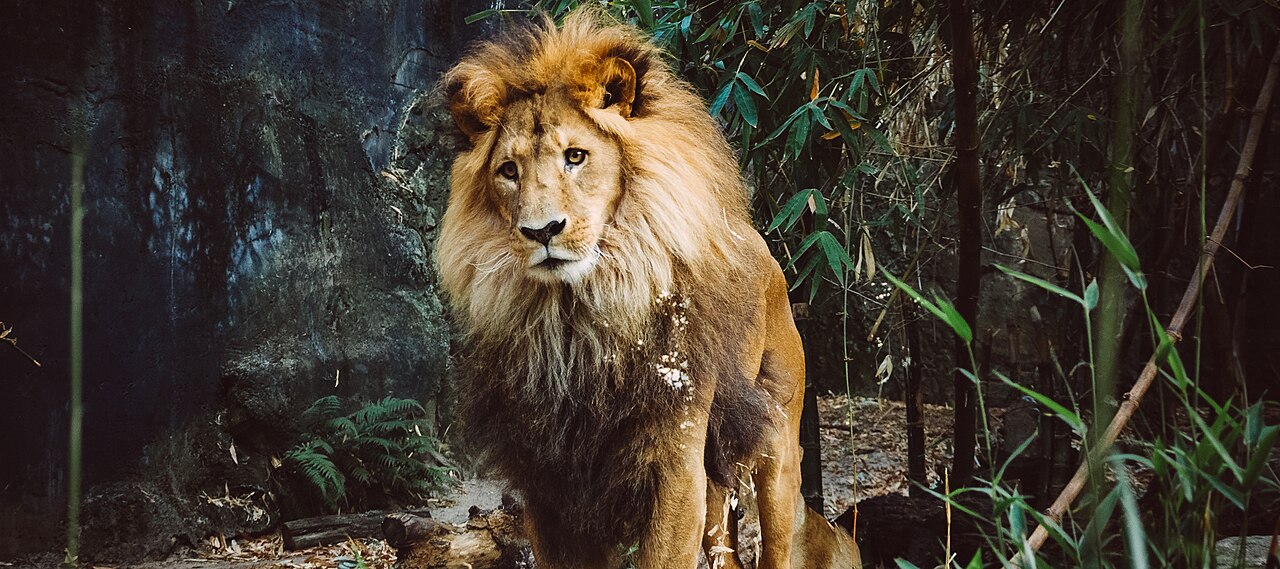
Biology · LionsThe lion is the only big cat that lives in a family group, called a pride, where related females hunt together and raise their cubs side by side. Most wild lions roam the grasslands of Africa, resting through the heat of the day and turning active at dusk. A grown male wears a heavy collar of hair around his head, his mane, and a full dark mane tells rival males that he is healthy and hard to beat. Because other lions read that signal, a lion truly does have reason to mind his appearance. A knotted, dusty mane leaves a proud animal looking shabby.
manen.Ch.7
The long hair around a lion’s head
“The lion’s mane was wild and tangled.”
tangledadj.Ch.7
Twisted into a messy knot
“His mane was badly tangled.”
vainadj.Ch.7
Too proud of how you look
“The vain lion loved his own looks.”
braidv.Ch.7
To weave strands together
“Elmer showed him how to braid his mane.”
tempern.Ch.7
A mood, often an angry one
“The lion was in a bad temper.”
scoldv.Ch.7
To tell off angrily
“His mother had scolded him.”
untidyadj.Ch.7
Messy and not neat
“His mane looked untidy.”
admirev.Ch.7
To look at with pleasure and pride
“The lion stopped to admire himself.”
groomv.Ch.7
To clean and tidy fur or hair
“Animals like to groom themselves.”
distractedadj.Ch.7
Not paying attention
“The distracted lion forgot about Elmer.”
ⓘ The vocabulary words in this list are selected to help you understand and complete this workbook. Some may not appear verbatim in the original novel.
1The long hair around a lion’s head is its ___.Ch.7
2True or False: Something “tangled” is smooth and neat.Ch.7
3Being too proud of how you look means being ___.Ch.7
4True or False: To “braid” means to weave strands together.Ch.7
5Fill in each blank with the correct word.Ch.7
Word choices:manetangledvainbraid- some words will not be used
The lion’s was badly .
6True or False: To “scold” someone means to praise them.Ch.7
7To clean and tidy fur or hair is to ___.Ch.7
8True or False: To “admire” means to look at with pleasure and pride.Ch.7
9Fill in the blanks with the correct words.Ch.7
Word choices:temperuntidydistractedgroom- some words will not be used
In a bad about his mane, the lion soon forgot Elmer.
10Not paying attention means being ___.Ch.7
Part 2
Comprehension
How well do you understand Chapters 7?
👑Knowledge Bank · The King of Beasts
Culture · Lions as SymbolsFor thousands of years people have crowned the lion king of the beasts, a title that comes from human imagination rather than from nature. Stone lions guard temple gates in China and palace steps across Europe. Ancient Egypt carved the Great Sphinx with a lion’s body and a human face. Painters set lions on shields and flags because the animal was meant to stand for courage and rule. Nothing in biology says a lion governs anybody, yet the symbol is so old that it feels true. Knowing this makes the chapter funnier: a beast the whole world treats as royalty is caught fretting over his own hair.
1Why is the young lion in a bad temper?Ch.7
2What does Elmer give the lion?Ch.7
3What does Elmer show the lion how to do?Ch.7
4True or False: The lion becomes busy fixing and admiring his mane.Ch.7
5Write the numbers 1–5 in the boxes to show the correct order across Part 5. Number 1 = what happens first.Ch.7
Elmer learns the lion is upset about his messy mane.
While the lion is busy, Elmer slips quietly away.
Elmer meets a proud lion in a terrible temper.
The vain lion happily braids and admires his mane.
Elmer gives him a comb, brush, and seven ribbons.
6True or False: How many hair ribbons does Elmer use — seven.Ch.7
7Why does the trick work on the lion?Ch.7
8What does Elmer do while the lion grooms?Ch.7
9True or False: Elmer matches the right supplies to each animal’s problem.Ch.7
10Fill in the blanks to complete the sentence.Ch.7
Word choices:maneribbonstailgum- some words will not be used
Elmer used a comb and seven to fix the lion’s .
Part 3
Literary Elements
Understanding HOW and WHY Ruth Stiles Gannett creates certain feelings across Chapters 7.
🔄Knowledge Bank · The Repeating Pattern
Literary Craft · Repetition and EpisodesHave you noticed that each animal chapter is built the same way? That is deliberate. When a story reuses one shape again and again we call it repetition, and a book made of such matching chapters is called an episodic story. Each episode nearly stands alone: a fresh beast appears, a fresh worry is revealed, a fresh object settles it. The rhythm comforts younger readers, who always know roughly what is coming, while the new animal keeps every chapter a surprise. Folk songs and old tales are put together the same way. Sameness and variety together give this book its steady, pleasing beat.
📚 Literary Devices in This Part · definitions & examples
The story’s pattern repeats: one clever item distracts each animal.The lion’s vanity (pride in his looks) is the weakness Elmer uses.Humor: a fierce lion fussing over ribbons and braids is a funny image.
The questions below are mixed — not grouped by device. Decide which device each one is about.
1Each animal outwitted by one clever item is the story’s repeating —Ch.7
2A pattern is something that repeats in a predictable way through the story.Ch.7
3Fill in each blank with the correct word.Ch.7
Word choices:patternvanityhumorsetting- some words will not be used
One clever item beats each animal — a repeating
The lion’s pride in his own looks is his .
4The lion’s pride in his own looks — the weakness Elmer uses — is his —Ch.7
5Vanity means being humble and never caring how you look.Ch.7
6Fill in each blank with the correct word.Ch.7
Word choices:humorpatternvanitymood- some words will not be used
A fierce lion fussing over ribbons is a funny image, an example of
His endless pride in his mane is pure .
7A fierce lion fussing over braids and ribbons is meant to be —Ch.7
8How does the author use the lion’s vanity?Ch.7
9Fill in each blank with the correct word.Ch.7
Word choices:vanitypatternhumorplot- some words will not be used
The comic sight of a groomed lion adds
Elmer wins by using the lion’s .
10The humor of the fussing lion mainly makes the danger feel —Ch.7
Part 4
Think Deeper
Four deeper challenges — no single-word recall. Read, weigh the evidence, and reason it through.
🦊Knowledge Bank · Why Flattery Works
Fables · Flattery and VanityA creature far too pleased with its own looks is called vain, and vanity has been a favorite target of storytellers for centuries. In one of Aesop’s best-known fables, a fox praises a crow’s lovely singing voice until the crow opens its beak to prove it — and drops the cheese it was carrying. Praise works this way because a delighted listener stops thinking and starts enjoying. The lesson costs nothing and is worth keeping: be careful of compliments that arrive precisely when somebody wants something from you. Elmer tells the lion no lies, yet he plainly understands the quiet power of flattery.
1Claim: “Elmer calms the angry lion by tidying its messy mane.” — choose the two details that best prove it.Claim & Evidence
2Shows Elmer’s clever plan, or just a detail of the scene? Tap each item to send it left or right.Sort into two
◄ Elmer’s clever planJust a detail ►
3Match each cause to its result. For each cause, pick its result.Cause & Effect
The lion is scolded for being untidy→
Elmer offers comb, brush, and ribbons→
The lion is busy grooming→
Elmer’s plan works→
4Fill both blanks to complete the reasoning.Build the Argument
Elmer handles the lion by , which shows that .
Part 5
Standardized Test
Author’s Purpose & Passage Structure — SAT & TOEFL-style practice
🎯 You already have the skills from the sections above — this is just a fun way to meet real SAT & TOEFL-style questions. Read the passage (the highlighted words are tested below), then answer the questions below. Tap an answer to select it, then tap it again to confirm — you can change your choice until you confirm.
A male lion’s mane is one of the most famous sights in nature, but for a long time people did not understand what it was for. Scientists began by asking a simple question: why do only male lions grow one? To find out, they carefully observed wild lions for years and even set up experiments with life-sized lion models wearing different manes. What they discovered was surprising. A mane is a kind of signal. Its size and color tell other lions how healthy and strong a male is, the way a flag tells you which team is which. A big, dark mane says ‘I am powerful,’ which can make rival males back down without a fight and can attract mates. But a heavy mane has a cost too: it makes the lion hotter under the blazing sun. So each lion’s mane is a balance between looking impressive and staying cool. The next time a story lion frets over his mane, remember — in the real world, that hair is doing a serious job.
Original passage written for Garden Heights — not a quotation from the novel.
1What question did scientists begin with?TOEFL · Factual Information
2In the passage, what a mane is “for” means its —SAT · Words in Context
3How did scientists study the question?TOEFL · Factual Information
4To “observe” lions is to —SAT · Words in Context
5Why does the author explain the question before the answer?TOEFL · Passage Structure
6A mane works as a “signal” because it —SAT · Words in Context
7The passage most strongly suggests a big, dark mane can help a lion by —SAT · Inference
8What is the “cost” of a big mane?TOEFL · Factual Information
9Each lion’s mane is described as a “balance” between —SAT · Central Ideas
10The author ends with “that hair is doing a serious job” mainly to —TOEFL · Rhetorical Purpose
Part 6 · Optional
Creative Writing
A bonus challenge to practice your English. Take your time and have fun with it.
About This Section
This writing task is optional and is not part of your auto-graded score. The feedback below checks only the basics — length, spelling, and grammar — not whether your ideas are right or wrong. It is meant for classroom discussion and creative practice, so feel free to use your imagination!
Writing Task — Part 5 “The Perfect Tool”
Elmer always seems to have just the right item for each animal. Write about a time the right tool or idea helped you solve a tricky problem. What was it, and how did it help? Write at least 40 words.
You can start with: “I had exactly the right thing to solve it, which was…”
0 / 40 words minimum
🗣 Teach It · Just for Fun (optional)
No right or wrong — close the screen and tell someone nearby what happened in this part. Can’t find anyone? Tell yourself out loud. The moment you teach it, you truly understand it.

Part 5 Complete!
You finished Chapters 7 of My Father's Dragon.
Here are your auto-graded results:
-
points out of 100
Your Writing
Your writing was checked automatically for length, spelling, grammar, and whether you included the key parts of the scene. Scroll back to Part 5 anytime to read your feedback and improve your work.
Independent study guide by Garden Heights Academy. Not affiliated with or endorsed by the author or any rights holders. Contains original analysis only; no text from the novel is reproduced.