New here? Just sign up with Google — your account includes Matilda, our gift book, forever.
My Father's Dragon · Garden Heights Academy
Part 6
for My Father's Dragon · Part 6 · Chapter 8
a novel by Ruth Stiles Gannett
25 min5 Parts
This workbook is built on a solid pedagogical foundation, effectively integrating content and language learning based on the CLIL framework (Content and Language Integrated Learning), elevated by our unique 5th C — Connection — and an integrated Standardized Test section that weaves every SAT & TOEFL question type right into the novel, so learners build real test skills easily, naturally, and with fun.
What Happens in Part 6
A gorilla itches with fleas, so Elmer gives the monkeys magnifying glasses.
A gorilla with fleasElmer’s next danger is a bossy gorilla who is itchy and miserable with fleas.
Six little monkeysThe gorilla orders six little monkeys to pick the fleas off him, but the monkeys cannot see the tiny pests well enough to catch them.
Six magnifying glassesQuick as ever, Elmer hands out his six magnifying glasses, one for each monkey, so they can see the fleas clearly.
The flea-hunt stopsThe monkeys become so fascinated with their new glasses that the whole flea-hunt halts. Elmer uses one perfect supply to escape and press on toward the river.
What We Will Learn
Focus
What It Means
Problem-Solving
One item for six helpers
Science (Gorillas & Lenses)
Great apes and how magnifying glasses work
Character
Elmer’s cool head in a tight spot
Chapter Summary
Chapter
Key Events
Ch.8
A gorilla with fleas has monkeys picking them off; Elmer gives the monkeys magnifying glasses, and in the busy chaos he escapes
💭 Before You Read · Warm-Up (not scored)
There are no wrong answers here — just think, guess, and talk:
Elmer doesn’t face the huge gorilla at all — he distracts the little monkeys who work for it. Why can changing what the helpers are doing be smarter than facing the boss?
The curious monkeys get so fascinated by the magnifying glasses that they forget their job. Has a fascinating new thing ever made you forget what you were supposed to do?
Predict: Elmer is close to the dragon now, but a river of snapping crocodiles lies ahead. What clever item might cross a river of crocodiles?
Copyright Notice
This is an independent study guide created by Garden Heights Academy to support reading comprehension and literary analysis. It contains original analysis questions and does not reproduce any text from the novel. My Father's Dragon is a work by Ruth Stiles Gannett. This guide is not affiliated with, authorized by, or endorsed by the author or any associated rights holders. Students should read the original book, available from libraries and booksellers.
Part 1
Vocabulary
Study 10 key words from Chapter 8, then answer each question.
🦍Knowledge Bank · All About Gorillas
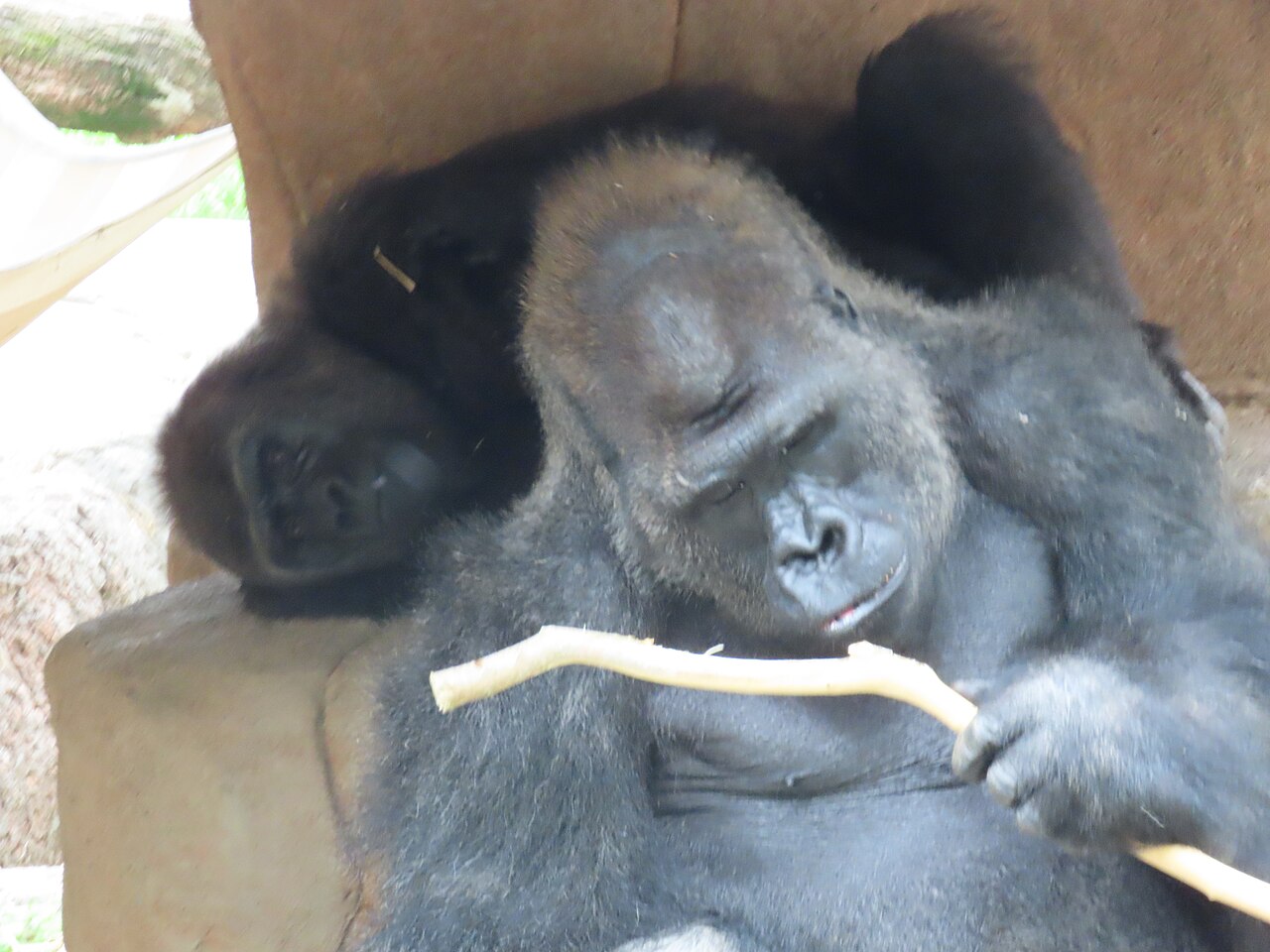
Biology · GorillasThe gorilla is the biggest of the great apes and one of our nearest animal relatives. Wild gorillas live in the mountain and lowland forests of central Africa, where each family group is led by an older male whose back hair has turned pale — a silverback. For all their size and their loud chest-beating displays, gorillas are quiet plant-eaters that spend most of the day chewing leaves and stems. They also spend long stretches grooming, combing through one another’s fur with careful fingers to pick out dirt and insects. Grooming keeps an ape clean, and it does something else besides: it keeps the whole family friendly.
Visual AidA silverback resting
Photograph of a gorilla group of the sort the Knowledge Bank describes. The pale hair across the older male's back is what gives a silverback his name, and the stripped stick in his hand is food, since gorillas are plant-eaters. These are zoo gorillas resting, not a wild family in the forests of central Africa. Look at how still and how close together they are. A gorilla spends most of its day quietly, and staying near the others is the ordinary state of things.
Western lowland gorillas, Audubon Zoo, New Orleans, USA. Source: Wikimedia Commons, file "Audubon Zoo, New Orleans April 2024 - Gorillas.jpg", public domain.
bossyadj.Ch.8
Always telling others what to do
“The bossy gorilla ordered the monkeys.”
flean.Ch.8
A tiny jumping insect that bites
“The gorilla was covered in fleas.”
magnifyv.Ch.8
To make something look bigger
“A lens can magnify tiny things.”
lensn.Ch.8
Curved glass that bends light
“A magnifying glass has a lens.”
fascinatedadj.Ch.8
Very interested and amazed
“The monkeys were fascinated by the lenses.”
pestn.Ch.8
A small creature that causes trouble
“Fleas are tiny pests.”
chaosn.Ch.8
Total confusion and disorder
“The flea-hunt turned to happy chaos.”
itchyadj.Ch.8
Wanting to scratch
“The gorilla felt itchy all over.”
commandv.Ch.8
To order someone to do something
“The gorilla would command the monkeys.”
curiousadj.Ch.8
Eager to learn or see
“The curious monkeys loved the glasses.”
ⓘ The vocabulary words in this list are selected to help you understand and complete this workbook. Some may not appear verbatim in the original novel.
🧠Knowledge Bank question
1According to the Knowledge Bank, what does grooming do besides keeping an ape clean?Ch.8
2True or False: To “magnify” something is to make it look bigger.Ch.8
3A tiny jumping insect that bites is a ___.Ch.8
4True or False: A “lens” is curved glass that bends light.Ch.8
5Fill in each blank with the correct word.Ch.8
Word choices:magnifylensfleabossy- some words will not be used
A can a tiny so the monkeys can see it.
6True or False: Someone “fascinated” is bored and uninterested.Ch.8
7A small creature that causes trouble is a ___.Ch.8
8True or False: “Chaos” means calm and order.Ch.8
9Fill in the blanks with the correct words.Ch.8
Word choices:itchycuriouscommandchaos- some words will not be used
The gorilla had fleas, and the monkeys loved the new glasses.
10To order someone to do something is to ___ them.Ch.8
Part 2
Comprehension
How well do you understand Chapter 8?
🔍Knowledge Bank · How a Magnifying Glass Works
Physics · Lenses and LightA magnifying glass looks like a toy, yet it is a genuine scientific instrument. Its glass is a lens, fatter in the middle than at the rim, and that curve bends every ray of light traveling through it. The bent rays enter your eye spread further apart, so a flea or a grain of sand appears many times larger than it really is. The same curved shape sits inside spectacles, cameras, and microscopes. Hold the glass at the wrong distance and the letters blur or flip upside down. Four hundred years ago, lenses like this uncovered a living world far too small for the naked eye.
Visual AidWhy a magnifying glass makes things look big
Diagram for the Knowledge Bank on lenses. The oval stands for a lens seen edge-on, thicker in the middle than at the rim, and the drawing leaves out the frame and handle. It shows three rays because three are easy to follow, not because a lens bends only three. It does not claim the object itself grows. Notice that the rays leave the lens further apart than they arrived. That spreading is the whole trick.
Standard ray diagram for a converging lens as given in introductory optics. Drawn for Garden Heights Academy.
🧠Knowledge Bank question
1According to the Knowledge Bank, why does a lens make a flea look bigger?Ch.8
2Who is trying to pick the fleas off the gorilla?Ch.8
3What does Elmer give the monkeys?Ch.8
4True or False: The magnifying glasses help the monkeys see the tiny fleas.Ch.8
5Write the numbers 1–5 in the boxes to show the correct order across Part 6. Number 1 = what happens first.Ch.8
In the happy chaos, Elmer escapes and hurries on.
The gorilla orders six monkeys to pick off his fleas.
The monkeys become fascinated with the magnifying glasses.
Elmer meets a bossy gorilla covered in fleas.
Elmer gives each monkey a magnifying glass.
6True or False: There are six monkeys and six magnifying glasses.Ch.8
7Why does the trick work?Ch.8
8What does Elmer do during the chaos?Ch.8
9True or False: Elmer once again uses just one kind of supply to get past an animal.Ch.8
10Fill in the blanks to complete the sentence.Ch.8
Word choices:monkeysfleasgorillalion- some words will not be used
The used magnifying glasses to look for the .
Part 3
Literary Elements
Understanding HOW and WHY Ruth Stiles Gannett creates certain feelings across Chapter 8.
🔎Knowledge Bank · Real Facts Inside a Fantasy
Literary Craft · Telling DetailsNotice how carefully this author hands each animal traits that are actually true: a rhino’s tender horn, a lion’s grand mane, an ape’s endless picking through fur. Writers call these telling details, small accurate touches that make an invented world feel solid. Because the beasts behave as real beasts might, every solution feels earned rather than lucky, and a reader can guess along instead of merely watching. If the animals acted at random, no answer would satisfy anybody. Borrow the rule for your own writing: invent the big thing freely, then anchor it with facts you know are true.
📚 Literary Devices in This Part · definitions & examples
Resourcefulness: Elmer makes the most of one clever item to solve a big problem.Cause and effect: the lenses fascinate the monkeys (cause), so the hunt stops (effect).Humor: monkeys ignoring the fleas to play with magnifying glasses is a funny twist.
The questions below are mixed — not grouped by device. Decide which device each one is about.
🧠Knowledge Bank question
1According to the Knowledge Bank, why do the true animal facts matter so much?Ch.8
2Being resourceful means cleverly using what you have to solve problems.Ch.8
3Fill in each blank with the correct word.Ch.8
Word choices:resourcefulnesscauseeffectsetting- some words will not be used
Elmer’s clever use of the lenses shows his
The lenses fascinate the monkeys — that is the .
4The lenses fascinate the monkeys, so the flea-hunt stops. This link is —Ch.8
5Cause and effect means one event has nothing to do with the next.Ch.8
6Fill in each blank with the correct word.Ch.8
Word choices:humorcauseeffectmood- some words will not be used
Monkeys ignoring fleas to play with lenses is a funny twist, an example of
Their fascination is the .
7Monkeys ignoring the fleas to play with magnifying glasses is mainly —Ch.8
8The effect of Elmer giving out the lenses is that —Ch.8
9Fill in each blank with the correct word.Ch.8
Word choices:causeeffectresourcefulnessplot- some words will not be used
The monkeys’ wonder at the lenses is the
The stopped flea-hunt is the .
10Elmer solving a big problem with one small item best shows he is —Ch.8
Part 4
Think Deeper
Four deeper challenges — no single-word recall. Read, weigh the evidence, and reason it through.
🤝Knowledge Bank · Trading a Favor
Thinking · Making a DealElmer gets past danger by offering the other side something it genuinely wants. Grown-ups call that a trade, and it is how most disagreements finish without anyone throwing a punch. The strongest deals leave both sides better off than before; people who study bargaining call that a win-win. Finding one takes listening first, because you cannot trade until you know what the other party is short of. Two children quarreling over a single orange may discover that one wants only the juice and the other only the peel. Solve their problem, and your own road opens through a simple bargain.
1Claim: “Elmer helps the flea-bitten gorilla in order to get safely by.” — choose the two details that best prove it.Claim & Evidence
2Shows Elmer’s clever help, or just a detail of the scene? Tap each item to sort it — tap again to switch sides. You can keep tapping to change your answer.Sort into two
◄ Elmer’s clever helpJust a detail ►
3Match each cause to its result. For each cause, pick its result.Cause & Effect
The gorilla is miserable with fleas→
The monkeys can’t see the tiny fleas→
Now the fleas are easy to spot→
No one is watching Elmer→
🧠Knowledge Bank question
4Fill both blanks to complete the reasoning.Build the Argument
The Knowledge Bank says the strongest deals need listening first because , which shows that .
Part 5
Standardized Test
Reference & Sentence Simplification — SAT & TOEFL-style practice
Read the passage — the highlighted words are tested — then answer. Tap an answer, then tap it again to confirm.
SATWords in Context — a word's meaning in this passage
SATInference — a conclusion the passage implies
TOEFLFactual Information — a fact stated in the passage
TOEFLReference — what a pronoun refers to
TOEFLSentence Simplification — the shorter sentence that keeps the meaning
TOEFLProse Summary — the three sentences that sum it up
The Invention of the Microscope
A magnifying glass looks simple, but it once changed the world. It is really just a curved piece of glass called a lens, thicker in the middle than at the edges. When light passes through it, the glass bends the rays so that a small object appears much larger than it truly is. Long ago, curious people used single lenses to read tiny print and to study insects. Then, about four hundred years ago, someone placed two lenses in a tube and built the first microscope. Suddenly a whole hidden world came into view: a drop of pond water was found to be swarming with tiny creatures no eye had ever detected before. This discovery amazed and even frightened people, who were fascinated to learn that living things existed all around them, far too small to see. From that little curved lens grew the science that would one day let doctors find the germs that cause disease. A simple piece of glass, it turned out, could reveal secrets the naked eye would never catch.
Original passage written for Garden Heights — not a quotation from the novel.
1A magnifying glass is really a “lens,” which is —SAT · Words in Context
2When light passes through the lens, a small object appears —TOEFL · Factual Information
3In the passage, “curious” most nearly means ___.SAT · Words in Context
4What did someone build by placing two lenses in a tube?TOEFL · Factual Information
5In the passage, “fascinated” most nearly means ___.SAT · Words in Context
6In “it showed that living things existed all around them,” the word “it” refers to —TOEFL · Reference
7Which sentence best keeps the essential meaning of: “This discovery amazed and even frightened people, because it showed that living things existed all around them, far too small to see”?TOEFL · Sentence Simplification
8What did the science that grew from the lens one day let doctors do?TOEFL · Factual Information
9The passage most strongly suggests the microscope frightened people because it revealed —SAT · Inference
10Prose Summary (TOEFL).The microscope revealed a hidden world of tiny life and changed science forever. This TOEFL task lists six sentences; choose the THREE that best capture the passage’s main ideas. The other three do not belong — they state minor details or ideas the passage does not present.TOEFL · Prose Summary
Part 6 · Optional
Creative Writing
A bonus challenge to practice your English. Take your time and have fun with it.
About This Section
This writing task is optional and is not part of your auto-graded score. The feedback below checks only the basics — length, spelling, and grammar — not whether your ideas are right or wrong. It is meant for classroom discussion and creative practice, so feel free to use your imagination!
Writing Task — Part 6 “A Clever Idea”
Elmer solves the gorilla problem with a surprising, clever idea. Write about the cleverest idea you have ever had (or could imagine). What was the problem, and how did your idea solve it? Write at least 40 words.
You can start with: “My cleverest idea was when…”
0 / 40 words minimum
🗣 Teach It · Just for Fun (optional)
No right or wrong — close the screen and tell someone nearby what happened in this part. Can’t find anyone? Tell yourself out loud. The moment you teach it, you truly understand it.
Part 6 Complete!
You finished Chapter 8 of My Father's Dragon.
Here are your auto-graded results:
-
points out of 100
Teach it to someone
The best last step is to teach it. In your own words, explain what happened — retell a favorite scene, teach a character’s big choice, or sum up the main idea for a parent, friend, or classmate. When you can teach it clearly, you truly own it.
Independent study guide by Garden Heights Academy. Not affiliated with or endorsed by the author or any rights holders. Contains original analysis only; no text from the novel is reproduced.
SAT® is a registered trademark of College Board, which is not affiliated with, and does not endorse, these materials. TOEFL® is a registered trademark of ETS. These materials are not endorsed or approved by ETS. Garden Heights is an independent provider of test-style reading practice.