New here? Just sign up with Google — your account includes Matilda, our gift book, forever.
My Father's Dragon · Garden Heights Academy
Part 7
for My Father's Dragon · Part 7 · Chapter 9
a novel by Ruth Stiles Gannett
25 min5 Parts
This workbook is built on a solid pedagogical foundation, effectively integrating content and language learning based on the CLIL framework (Content and Language Integrated Learning), elevated by our unique 5th C — Connection — and an integrated Standardized Test section that weaves every SAT & TOEFL question type right into the novel, so learners build real test skills easily, naturally, and with fun.
What Happens in Part 7
Elmer turns a row of hungry crocodiles into a bridge made of lollipops.
Crocodiles in the riverAt last Elmer reaches the wide river he must cross to reach the dragon. A long row of hungry, snapping crocodiles guards it.
Pink lollipopsElmer has saved the perfect supply for this moment: pink lollipops. He offers the crocodiles one each and tells them more is waiting.
A living bridgeHe coaxes them into a straight row across the river and sticks a lollipop on each tail. The crocodiles become a living bridge.
Skipping acrossWhile the greedy crocodiles lick their treats, brave Elmer skips across their backs like stepping stones, reaching the far side just as his lollipops run out.
What We Will Learn
Focus
What It Means
Problem-Solving
The cleverest escape of all: a living bridge
Science (Crocodiles)
Real facts about these ancient reptiles
Suspense
A race against the last lollipop
Chapter Summary
Chapter
Key Events
Ch.9
Elmer lures the crocodiles into a line with lollipops and crosses the river on their backs like a bridge
💭 Before You Read · Warm-Up (not scored)
There are no wrong answers here — just think, guess, and talk:
The crocodiles are the danger — and Elmer turns them into his bridge. When has a problem itself turned out to be part of the solution?
Elmer saved his best supply, the lollipops, for the hardest moment. Why is it wise to hold something in reserve for when you need it most?
Predict: on the far bank waits the baby dragon Elmer came to rescue. After all these fierce beasts, what do you think the dragon will be like?
Copyright Notice
This is an independent study guide created by Garden Heights Academy to support reading comprehension and literary analysis. It contains original analysis questions and does not reproduce any text from the novel. My Father's Dragon is a work by Ruth Stiles Gannett. This guide is not affiliated with, authorized by, or endorsed by the author or any associated rights holders. Students should read the original book, available from libraries and booksellers.
Part 1
Vocabulary
Study 10 key words from Chapter 9, then answer each question.
🐊Knowledge Bank · All About Crocodiles
Biology · CrocodilesCrocodiles are reptiles, close cousins of animals that shared the world with the dinosaurs, and their body plan has barely altered since. Being cold-blooded, a crocodile cannot heat itself from the inside; it basks in sunshine to warm up and slides into water to cool down. That is why it can lie without moving for hours and needs far less food than a mammal of the same weight. Only its eyes and nostrils break the surface, so a waiting crocodile is easily mistaken for a floating log. When it finally strikes, few animals alive can match the crushing power of those jaws.
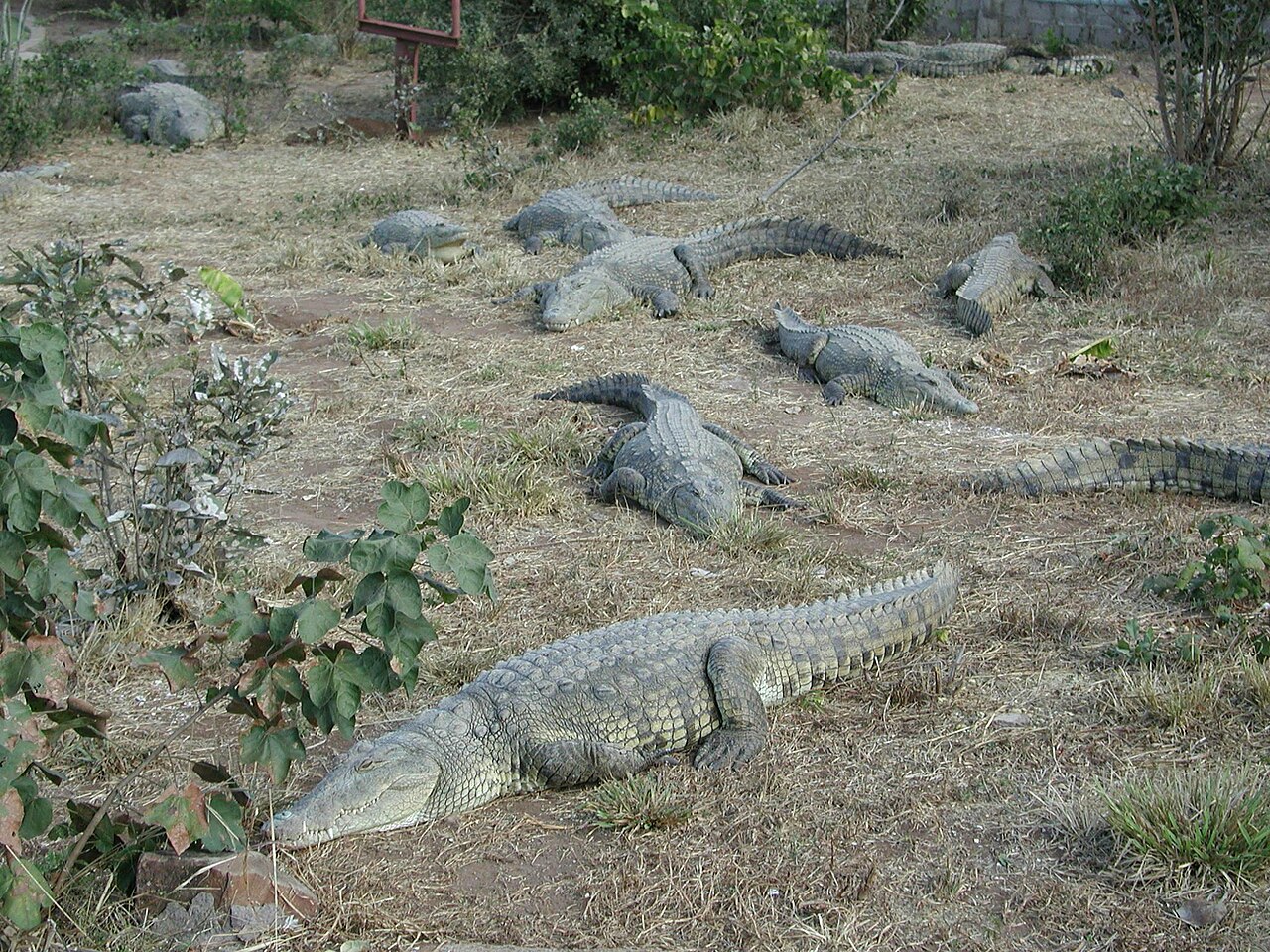
Visual AidLying still in the sun
Photograph of Nile crocodiles doing exactly what the Knowledge Bank describes: basking. Every animal here is holding still in the sun, warming a body that cannot heat itself from the inside. These are crocodiles in a managed enclosure, gathered far more closely than most wild ones would be. Look at how many are lying in a line. That is a picture worth keeping in mind two chapters later, when a row of crocodiles becomes something a boy can walk across.
Nile crocodiles (Crocodylus niloticus) basking. Source: Wikimedia Commons, file "Nilkrokodile.jpg", public domain.
crocodilen.Ch.9
A large river reptile with strong jaws
“Crocodiles guarded the river.”
lurev.Ch.9
To tempt someone with a treat
“Elmer used lollipops to lure them.”
bridgen.Ch.9
A structure for crossing over water
“The crocodiles formed a living bridge.”
reptilen.Ch.9
A cold-blooded animal like a crocodile
“A crocodile is a reptile.”
rown.Ch.9
A line of things side by side
“The crocodiles lined up in a row.”
snapv.Ch.9
To bite suddenly with a sharp sound
“The crocodiles would snap their jaws.”
coaxv.Ch.9
To gently persuade someone
“Elmer coaxed them into a line.”
greedyadj.Ch.9
Wanting far too much
“The greedy crocodiles wanted more candy.”
nimblyadv.Ch.9
Quickly and lightly on your feet
“Elmer skipped across nimbly.”
currentn.Ch.9
Water moving in one direction
“The river current rushed below.”
ⓘ The vocabulary words in this list are selected to help you understand and complete this workbook. Some may not appear verbatim in the original novel.
🧠Knowledge Bank question
1According to the Knowledge Bank, why can a crocodile lie still for hours?Ch.9
2True or False: To “lure” someone means to gently tempt them.Ch.9
3A structure for crossing over water is a ___.Ch.9
4True or False: A crocodile is a warm-blooded bird.Ch.9
5Fill in each blank with the correct word.Ch.9
Word choices:crocodilelurebridgerow- some words will not be used
Elmer used lollipops to the crocodiles into a and make a living .
6True or False: To “snap” is to bite suddenly with a sharp sound.Ch.9
7To gently persuade someone is to ___ them.Ch.9
8True or False: To move “nimbly” is to move quickly and lightly.Ch.9
9Fill in the blanks with the correct words.Ch.9
Word choices:greedyreptilecurrentnimbly- some words will not be used
The crocodiles wanted more candy, and Elmer crossed .
10A line of things side by side is a ___.Ch.9
Part 2
Comprehension
How well do you understand Chapter 9?
🛣Knowledge Bank · What Makes a Bridge
Engineering · BridgesA bridge is any structure that carries you over water or a gap your feet cannot cross. The simplest of all is a line of flat stepping stones set across a shallow stream. Next comes the beam: one long plank resting on a support at either end. Builders must think about weight, since every step presses down and the supports have to push back just as hard. Armies once laid floating pontoon bridges from boats chained side by side and marched over the top. Space your supports closely enough and almost anything can become a path.
Visual AidThree ways to cross a gap
Diagram for the Knowledge Bank on bridges, showing three of the simplest kinds side by side. Each is drawn as a plain section, and the drawing leaves out arches, cables and every modern design. It does not claim these three are the only sorts of bridge. Notice what all three share: something to walk on, and supports underneath spaced close enough that the span never has to carry too much at once.
Bridge types described in introductory structural engineering. Drawn for Garden Heights Academy.
🧠Knowledge Bank question
1According to the Knowledge Bank, what must a bridge builder think about most?Ch.9
2What does Elmer use to lure the crocodiles?Ch.9
3How does Elmer get the crocodiles to help him?Ch.9
4True or False: Elmer crosses the river by stepping across the crocodiles’ backs.Ch.9
5Write the numbers 1–5 in the boxes to show the correct order across Part 7. Number 1 = what happens first.Ch.9
He coaxes the crocodiles into a straight row, a lollipop on each tail.
Elmer skips across their backs like a living bridge.
He reaches the far side just as the lollipops run out.
Elmer reaches the river guarded by hungry crocodiles.
He offers the crocodiles lollipops, promising more.
6True or False: Elmer puts a lollipop on the tail of each crocodile.Ch.9
7Why is the crossing so tense?Ch.9
8What kind of bridge does Elmer make?Ch.9
9True or False: Elmer uses the very animals meant to stop him to help him cross.Ch.9
10Fill in the blanks to complete the sentence.Ch.9
Word choices:lollipopscrocodilesrivergum- some words will not be used
Elmer used to line up the as a bridge.
Part 3
Literary Elements
Understanding HOW and WHY Ruth Stiles Gannett creates certain feelings across Chapter 9.
⛰Knowledge Bank · Climbing to the Climax
Literary Craft · Rising ActionStories are shaped rather like a hill. The long climb of dangers and narrow escapes is called the rising action, and the single most exciting point at the summit is the climax. Everything earlier has been quietly preparing that moment, which is why it feels so much larger than the meetings that came before it. Authors control the climb by making each obstacle a shade harder than the last, so a reader’s worry keeps building. Past the summit the tension eases and the story hurries downhill toward its close. Feel that shape and you can sense, page by page, when a book is about to turn.
📚 Literary Devices in This Part · definitions & examples
Suspense: will Elmer cross before the lollipops — and the crocodiles’ patience — run out?Resourcefulness: Elmer turns the very danger (crocodiles) into his bridge.This daring crossing is the high point of Elmer’s clever escapes.
The questions below are mixed — not grouped by device. Decide which device each one is about.
🧠Knowledge Bank question
1According to the Knowledge Bank, how does an author control the climb to the climax?Ch.9
2Suspense is the tense feeling of not knowing what will happen next.Ch.9
3Fill in each blank with the correct word.Ch.9
Word choices:suspenseresourcefulnessclimaxsetting- some words will not be used
The tension over the risky crossing is
Turning the crocodiles into a bridge shows Elmer’s .
4Elmer turns the dangerous crocodiles themselves into his bridge. This clever move shows his —Ch.9
5Resourcefulness means giving up when a problem looks too hard.Ch.9
6Fill in each blank with the correct word.Ch.9
Word choices:climaxsuspenseresourcefulnessmood- some words will not be used
This daring crossing is the high point, or
The fear over its outcome is .
7The daring river crossing is the high point of Elmer’s escapes — the story’s —Ch.9
8How does Elmer turn danger into help here?Ch.9
9Fill in each blank with the correct word.Ch.9
Word choices:resourcefulnesssuspenseclimaxplot- some words will not be used
Making a bridge from the very danger shows real
This peak escape is the story’s .
10Why is this crossing the story’s most exciting moment?Ch.9
Part 4
Think Deeper
Four deeper challenges — no single-word recall. Read, weigh the evidence, and reason it through.
🔄Knowledge Bank · Turning an Obstacle Into a Tool
Thinking · ReframingA river full of teeth looks like a wall. Described another way, it is a line of solid backs already pointing where you want to go. Changing the words you use for a problem is called reframing, and it is among the most useful habits a thinker can build. Nurses reframe a frightening needle as one quick pinch; engineers reframed the waste heat pouring out of factories into warmth for the houses next door. The trick is asking what an obstacle is made of rather than only what it prevents. Surprisingly often, the thing blocking your way is also the raw material of the answer.
1Claim: “Elmer turns the dangerous crocodiles into a bridge across the river.” — choose the two details that best prove it.Claim & Evidence
2Shows Elmer’s clever plan, or just a detail of the scene? Tap each item to sort it — tap again to switch sides. You can keep tapping to change your answer.Sort into two
◄ Elmer’s clever planJust a detail ►
3Match each cause to its result. For each cause, pick its result.Cause & Effect
Crocodiles guard the wide river→
The crocodiles want more lollipops→
Their backs form a bridge→
His clever plan works→
🧠Knowledge Bank question
4Fill both blanks to complete the reasoning.Build the Argument
The Knowledge Bank says a river of crocodiles can become a bridge because , which shows that .
Part 5
Standardized Test
Cohesion & TOEFL Insert Text — SAT & TOEFL-style practice
Read the passage — the highlighted words are tested — then answer. Tap an answer, then tap it again to confirm.
SATWords in Context — a word's meaning in this passage
SATInference — a conclusion the passage implies
SATCentral Ideas — the passage's main point
TOEFLFactual Information — a fact stated in the passage
TOEFLInsert Text — where a sentence best fits
Army Ants Building Living Bridges
Deep in the rainforest, a row of army ants comes to the edge of a gap too wide to cross. <b>[1]</b> They do not stop, and they do not turn back. Instead, a few ants grip one another with their legs and jaws, and more pile on, until their linked bodies form a living bridge across the empty space. <b>[2]</b> The rest of the colony then marches nimbly over the top of their own team-mates, who hold still and take the weight without complaint. When everyone is safely across, the bridge simply comes apart, and the ants that made it hurry to rejoin the march. Scientists find this astonishing because no ant is in charge; each one follows simple rules, yet together they solve a problem none could solve alone. The bridge even adjusts its size to save ants when the gap is small. It is one of nature's clearest lessons: many weak parts, working together, can accomplish something remarkably strong.
Original passage written for Garden Heights — not a quotation from the novel.
1What problem do the army ants face?TOEFL · Factual Information
2A living “bridge” here is made of —SAT · Words in Context
3Where would this sentence best fit in the passage? “Their tiny bodies bend but do not break, forming a road no engineer designed.”TOEFL · Insert Text
4In the passage, “row” most nearly means ___.SAT · Words in Context
5What happens to the bridge once everyone is across?TOEFL · Factual Information
6In the passage, “nimbly” most nearly means ___.SAT · Words in Context
7Why do scientists find the ant bridge astonishing?SAT · Inference
8The passage most strongly suggests the ant bridge is amazing because —SAT · Inference
9According to the passage, what do the ants do after everyone crosses?TOEFL · Factual Information
10Which sentence best states the main idea of the passage?SAT · Central Ideas
Part 6 · Optional
Creative Writing
A bonus challenge to practice your English. Take your time and have fun with it.
About This Section
This writing task is optional and is not part of your auto-graded score. The feedback below checks only the basics — length, spelling, and grammar — not whether your ideas are right or wrong. It is meant for classroom discussion and creative practice, so feel free to use your imagination!
Writing Task — Part 7 “A Problem Becomes the Answer”
Elmer turns the dangerous crocodiles into a bridge. Write about a time a problem turned out to be useful, or imagine how a tricky obstacle could become helpful. Write at least 40 words.
You can start with: “What seemed like a big problem actually became helpful when…”
0 / 40 words minimum
🗣 Teach It · Just for Fun (optional)
No right or wrong — close the screen and tell someone nearby what happened in this part. Can’t find anyone? Tell yourself out loud. The moment you teach it, you truly understand it.
Part 7 Complete!
You finished Chapter 9 of My Father's Dragon.
Here are your auto-graded results:
-
points out of 100
Teach it to someone
The best last step is to teach it. In your own words, explain what happened — retell a favorite scene, teach a character’s big choice, or sum up the main idea for a parent, friend, or classmate. When you can teach it clearly, you truly own it.
Independent study guide by Garden Heights Academy. Not affiliated with or endorsed by the author or any rights holders. Contains original analysis only; no text from the novel is reproduced.
SAT® is a registered trademark of College Board, which is not affiliated with, and does not endorse, these materials. TOEFL® is a registered trademark of ETS. These materials are not endorsed or approved by ETS. Garden Heights is an independent provider of test-style reading practice.